Lo que le dice y lo que no le dice la autorización ENDO-205 sobre las expectativas previas a la IND del péptido CMC

La acción de la FDA de ENDO-205 fue una autorización del IND, no es una aprobación, y no dice nada sobre el paquete CMC detrás de esto. La marcha de EndoCyclic 2026 Anuncio de autorización del IND describe un péptido dirigido no hormonal, el primero en su clase, para la endometriosis, salió con Irvine, California, Marzo 23, 2026, con una fase 1 estudio previsto en mujeres premenopáusicas sanas en edad reproductiva. El mismo comunicado afirma que el trabajo preclínico mostró la eliminación de las lesiones de endometriosis y la inflamación asociada sin señales de seguridad en estudios de toxicología GLP.. No contiene CMC, fabricación, CDMO, o detalle de síntesis de cualquier tipo.
Esa brecha es el punto. Un IND aprobado le indica que un paquete era lo suficientemente revisable para continuar; no te dice lo que había en él, y no es una plantilla que puedas copiar. Un análisis independiente del mecanismo de ENDO-205. describe una permeabilidad celular, Péptido sensible al pH que combina la inhibición de la vía Wnt/β-catenina con administración sensible al pH, Inerte al pH del tejido sano y activo en el microambiente de la lesión acidificada.. Ese detalle proviene únicamente de la fuente secundaria., no del patrocinador, y la selectividad se ha demostrado solo en modelos preclínicos.

⚠️ Advertencia: El espejo bioespacial, el listado de PR Newswire, un artículo de archivo farmacéutico, y un compartir en LinkedIn todos parafrasean un lanzamiento de EndoCyclic. Cuentan como una fuente., no cuatro. Ninguna fuente cubre el desarrollo de ENDO-205 después de marzo 2026 fue encontrado, por lo que este artículo trata el evento como una fecha histórica fija.
El resto de esta guía analiza los cinco pilares que determinan si se cumplen los requisitos CMC de la presentación IND de un péptido.: confirmación de secuencia, perfil de impurezas, calificación del método analítico, reproducibilidad del proceso, y documentación.
Por qué CMC es la razón más común por la que los IND tempranos se estancan
Química, La fabricación y los controles son la base más común para una suspensión clínica en una IND temprana.. Una revisión piloto retrospectiva del año fiscal 2013 La cohorte CDER encontró que de 1,410 IND iniciales recibidos ese año, 125, o 8.9%, fueron puestos en espera dentro del primer 30 días, y las razones por CMC se citaron con más frecuencia que las razones clínicas o toxicológicas. (el estudio piloto de la FDA sobre retenciones clínicas de IND, publicado 2016). Léalo como una base histórica en lugar de una tasa actual.: es una revisión de un año de una sola cohorte, y los patrones de retención han cambiado desde.
El mismo hallazgo es lo que hace que el trabajo del péptido CMC pre-IND sea manejable. La FDA afirma que la cantidad de información necesaria “variará según la fase de la investigación, la formulación propuesta, y duración de la investigación” (Requisitos de información IND CMC de la FDA, contenido actual a partir de 22 Junio 2026). Fase 1 Los requisitos de CMC para la presentación de péptidos IND son, por lo tanto, un conjunto de alcance, no es el paquete comercial completo.
Los cinco pilares de la preparación previa al IND del péptido CMC
El paquete pre-IND del péptido CMC se reduce a cinco pilares, y la pregunta útil no es si cada uno importa sino cuándo hay que terminarlo.. Los requisitos de información de IND CMC de la FDA enumeran cinco elementos de sustancias farmacológicas que un patrocinador debe eventualmente suministrar: estructura y evidencia de identidad, the manufacturer’s name and address, the general method of preparation with reagents, solvents and catalysts, acceptable limits plus the analytical methods that enforce identity, fortaleza, quality and purity, and stability support for storage and for the toxicological and clinical studies (FDA, Aplicaciones IND: Información CMC, contenido actual a partir de 2026-06-22).
Those five elements map onto the pillars below. What changes between Phase 1 and later phases is depth, not the list itself, so the practical split is what you lock before the meeting versus what you defer with a written rationale.
|
Pastillas |
Lock before pre-IND |
Can be deferred with documented rationale |
|---|---|---|
|
Sequence confirmation |
Orthogonal confirmation of the intended sequence on the clinical lot |
Extended sequence variant mapping beyond the clinical lot, with a rationale citing lot coverage |
|
Perfil de impurezas |
Identification and quantitation of peptide-related impurities against the applicable thresholds |
Full toxicological qualification of every specified impurity, with a rationale citing the qualification threshold and exposure |
|
Métodos analíticos |
Qualified methods with defined acceptance criteria for identity, fortaleza, quality and purity |
Formal validation protocols, with a rationale citing the phase-appropriateness of qualification at this stage |
|
Process reproducibility |
Lot-to-lot comparability data across the lots used in toxicology and clinical supply |
Servicios Formal process validation and continued process verification, with a rationale citing the number of lots manufactured to date |
|
Documentación |
The CMC narrative and the written pre-IND question set |
The full Module 3 dossier, with a rationale citing the pre-IND stage |
The deferral column is the part sponsors under-document. Each deferred item needs the rationale recorded in the briefing package itself, not held in internal notes, because the reviewer’s question at the meeting is usually why a given piece of data is absent rather than whether it exists.
Pastillas 1: Confirmación de secuencia antes de la reunión previa al IND
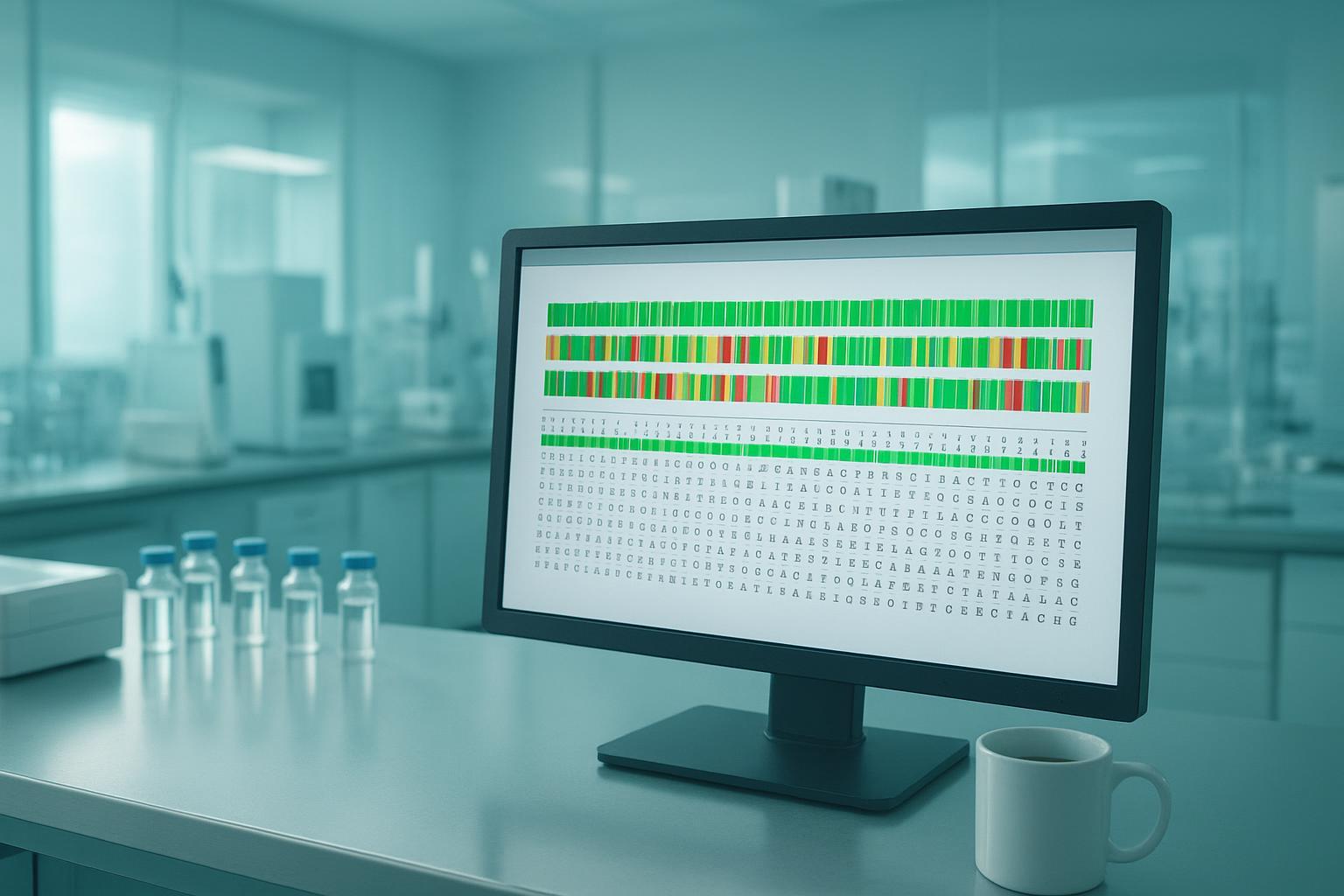
By the end of this pillar you should hold a confirmed primary sequence tied to a specific lot, not a certificate of analysis alone. FDA’s IND CMC information requirements call for a description of the drug substance’s physical, químico, or biological characteristics plus evidence supporting its structure and identity (FDA, recuperado 2026-06-22). Note what that page does not do: it never names “amino acid sequence” or “peptide map,” so build your peptide sequence confirmation on the peptide-specific guidance instead. FDA’s acceptance criteria for synthetic peptides treat primary sequence as one of several sameness dimensions alongside physicochemical properties, secondary structure, oligomer and aggregation states, and biological activity (RAPOS).
The workflow that satisfies this: intact mass by high-resolution mass spectrometry, then enzymatic or chemical fragmentation with LC-MS/MS to establish sequence coverage across the full chain. Where coverage gaps remain, confirm those regions orthogonally. Lock the reference standard against the confirmed mass profile so every later lot is compared to a characterized anchor rather than to a vendor’s summary.
⚠️ Advertencia: A sequence confirmed only by a vendor CoA, with no traceable raw method output behind Comercio it, es el modo de falla. If you cannot produce the coverage map, you have not confirmed the sequence.
Pastillas 2: Perfiles de impurezas y umbrales que realmente se aplican a los péptidos
Peptides are explicitly excluded from ICH Q3A. The Federal Register notice reproducing the guidance lists the drug substance types it does not cover, and peptide sits in that list alongside biological products, oligonucleotides, and radiopharmaceuticals (ICH Q3A’s scope exclusion for peptides, 2003-02-11). The practical consequence is that the Q3A reporting, identificación, and qualification table is a reference framework for a peptide program, not a binding requirement, and peptide impurity control is risk-based.
FDA’s own rationale for peptide-specific criteria explains why. As quoted by RAPS from the final guidance, differences in impurities, particularly peptide-related impurities, may affect the safety or effectiveness of a peptide drug product compared with the reference listed drug (FDA’s acceptance criteria for synthetic peptides). That reasoning drives the numbers a sponsor should plan around: a specified peptide-related impurity at no more than 0.5% of the drug substance, and each new specified peptide-related impurity specified with justification for why it would affect safety or effectiveness versus the reference listed drug, with each impurity present at equal or lower levels in the generic (FDA’s acceptance criteria for synthetic peptides).
The ICH Q3A thresholds themselves are dose-band dependent, and the framework is best treated qualitatively here: the reporting and identification levels that apply to a small molecule shift with maximum daily dose, so the same percentage does not carry the same meaning across programs (the ICH Q3A reporting and identification thresholds, Q3A(R2), 2006). The failure mode is specific and common: quoting a 0.10% identification threshold as if it bound a peptide program, then defending that number at the pre-IND meeting when the reviewer asks why the control strategy was built on a guideline that excludes the molecule.
Pastillas 3: Métodos analíticos: calificación ahora, Validación posterior

At Phase 1, you need qualified methods with documented suitability, not fully validated ones. The distinction is explicit in FDA’s Phase 1 CMC flexibilities: the agency expects acceptable limits and analytical methods to ensure identity, fortaleza, quality and purity, with a brief description of the test methods used, as set out in FDA’s IND CMC information requirements. Full validation under ICH Q2(R2) can follow.
A peptide program typically needs RP-HPLC or UHPLC purity, LC-MS/MS and HRMS for identity and impurity structure, CE, análisis de aminoácidos, counterion and TFA content, disolventes residuales, contenido de agua, and endotoxin by LAL. Anchor validation expectations to ICH Q2(R2); anchor endotoxin methods to USP <71> y USP <85>.
⚠️ Advertencia: A purity method with no forced-degradation or specificity data behind it is the failure mode. Qualification without documented suitability is not qualification.
Pastillas 4: Reproducibilidad del proceso y narrativa de comparabilidad entre lotes
Reproducibility is demonstrated by overlaying lot data across at least three lots and showing that the impurity and assay profiles agree, not by asserting that the process is controlled. A sponsor who states “the process is reproducible” without the overlay has made a claim the reviewer cannot check.
The regulatory hook is the general method of preparation. FDA’s IND CMC information requirements ask for a description of the method of preparation including reagents, solvents and catalysts, plus stability information for the intended container closure and for the toxicological and clinical studies. Read together, those two items are a reproducibility argument: the method description explains what should stay constant, and the lot data shows that it did.
Síntesis de péptidos Fold sequence confirmation into the same narrative. The sequence data establishes what the molecule is; the lot overlay establishes that you can make it again. Presenting them as one comparability argument, rather than two separate attachments, is what closes the gap reviewers most often flag.
El modo de falla es específico.. Three lots can each pass individually while their impurity overlays diverge at a specified impurity, which tells the reviewer the process is not yet under control even though no single lot breached a limit. El 0.5% specified-impurity limit is a ceiling, not a target, and FDA’s acceptance criteria for synthetic peptides treat any specified impurity above it as disqualifying rather than as a trend to monitor. Acerca de
A neutral example of how this data is generated: MOL Changes offers peptide synthesis at defined scale in classified cleanroom space, with analytical methods Péptidos sintéticos covering sequence confirmation and impurity profiling, so lot results arrive as a documented package the sponsor can drop into the CMC section.
Pastillas 5: Documentación: creación de la narrativa del IND CMC y el conjunto de preguntas previas al IND

Documentation is where the other four pillars become reviewable. FDA IND CMC information requirements set out five items the drug substance section must contain: a description of the drug substance, including its physical, químico, and biological characteristics and evidence of structure; the name and address of the manufacturer; a general method of preparation; the limits and analytical methods used to assure identity, fortaleza, calidad, y pureza; and stability data supporting the dosage form. Treat that list as the spine of a peptide CMC documentation checklist, then map each pillar onto it: sequence confirmation supplies the structure evidence, impurity profiling supplies the limits, analytical qualification supplies the methods, and process reproducibility supplies the lot-to-lot narrative behind the general method of preparation.
FDA frames the exercise as one of Phase 1 CMC flexibilities, describing the minimum information sponsors should submit and what can generally follow later. The page states that framing without enumerating which activities qualify, so the deferral list has to come from the linked guidance and be documented item by item.
Data integrity holds the narrative together. MHRA’s GxP data integrity guidance and definitions sets out the ALCOA principles (atribuible, legible, contemporáneo, original, preciso) that reviewers expect raw analytical records to satisfy.
Bring a written question set to the pre-IND meeting: which specifications can remain interim, what stability duration is acceptable at filing, whether qualification-level method data suffices, and how much detail the general method of preparation needs. Answers become the documented rationale.
⚠️ Advertencia: A package that answers all five items but never states which activities are deferred, or why, es el modo de falla. Reviewers read silence as an omission, not as flexibility.
Errores comunes que convierten un paquete previo a IND en una retención
The recurring failure in peptide CMC pre-IND packages is treating a reference framework as a requirement. Five mistakes account for most of the avoidable friction.
Quoting ICH Q3A thresholds as if they bound a peptide program. ICH Q3A was written for small-molecule drug substances, and its reporting, identification and qualification thresholds do not automatically govern a synthetic peptide. The mistake happens because the numbers are easy to find and easy to defend in an internal memo. The fix is to state which framework you are applying, por qué, and what your own peptide impurity profiling data show at each threshold, rather than presenting a borrowed limit as settled.
Attributing requirements to FDA documents that do not contain them. Teams routinely cite “amino acid sequence” and “peptide map” as though FDA’s IND CMC page lists them. no lo hace. Check what FDA’s IND CMC page does and does not say before a requirement enters your package, and label anything drawn from ICH, USP or internal policy as such.
Printing impurity numbers without a traceable source. Unverified figures for the ICH Q3A reporting and identification thresholds circulate widely in secondary summaries. If you cannot open the primary document and read the number, drop it or describe the threshold qualitatively.
Treating FDA’s Phase 1 CMC flexibilities as an enumerated deferral list. That page describes a flexible, phase-appropriate approach; it does not publish a checklist of what you may postpone. Build your own deferral rationale and document it.
Relying on a single-source echo cluster. Several trade write-ups of EndoCyclic’s March 2026 IND clearance announcement repeat one another without adding primary detail. Repetition is not corroboration. Go to the announcement itself and treat everything beyond it as unconfirmed.
⚠️ Advertencia: The pattern behind all five mistakes is the same. A reference framework gets quoted as a requirement, and the package inherits a standard the program was never obligated to meet.
Cómo se ve el éxito en la reunión previa al IND
If the five pillars are locked and every deferral is documented with a rationale, the package you bring to the pre-IND meeting is one FDA can assess against the phase-appropriate standard rather than one that invites a CMC deficiency letter. Five outcomes make that concrete: a sequence traceable to raw data, an impurity profile with scope-stated limits, qualified methods with suitability data attached, a three-lot comparability overlay, and a narrative that maps onto the five drug substance items FDA expects.
The upside of arriving that way is measurable, with a caveat worth stating plainly. FDA estimates that sponsors of first-in-human Phase 1 INDs can reduce application development time by up to 12 months through FDA’s Phase 1 CMC flexibilities, the phase-appropriate minimum CMC information approach. FDA authors that policy and the estimate is not independent, so treat it as the agency’s own framing of the incentive rather than a benchmark from outside.
The direction of travel supports the same reading. FDA published el 17 peptide guidances FDA revised in July 2026 in a single day, covering impurity thresholds, higher order structure, actividad biológica, prueba de respuesta inmune innata, and recombinant, sintético, and semi-synthetic peptide ANDAs. The agency is actively tightening its peptide vocabulary, which makes a package written in that vocabulary easier to review.
As a stretch goal, extend the comparability narrative you built for the pre-IND toward later-phase validation planning: the same three-lot overlay becomes the backbone of your Phase 2 y Fase 3 method validation strategy, so the work compounds instead of being redone.
Preguntas frecuentes
¿La autorización IND ENDO-205 me indica qué paquete de CMC aceptó la FDA??
No. La marcha de EndoCyclic 2026 IND clearance announcement discloses the clearance, the indication, the preclinical basis and the planned Phase 1 diseño, and no CMC, fabricación, CDMO or synthesis detail. What the clearance does signal is narrower but still useful: a phase-appropriate package for a synthetic peptide was reviewable as submitted. It tells you nothing about which analytical methods, impurity limits or lot-data format the agency saw.
¿Se aplican los umbrales de impurezas ICH Q3A a sustancias farmacológicas peptídicas??
No. ICH Q3A’s scope exclusion for peptides lists peptide among the drug substances the impurities guidance does not cover. Q3A remains a useful reference framework for structuring a peptide impurity profiling discussion, but it is not the binding threshold set for your drug substance. Peptide impurity control is risk-based, tied to the synthetic route, the deletion and truncation sequences the route can produce, and the toxicological qualification of each specified impurity. Producción de péptidos
¿Qué hace el 0.5% La cifra de impurezas relacionadas con el péptido especificada en realidad cubre?
It is a specified peptide-related impurity limit reported from FDA’s acceptance criteria for synthetic peptides. Two scope limits matter. It applies to specified peptide-related impurities, not to unspecified impurities, residual solvents or elemental impurities, which follow their own frameworks. And it should not be generalized to every peptide context. Verify the figure against the primary guidance document before you cite it in a pre-IND package.
¿Es necesario validar completamente los métodos analíticos antes de la reunión previa al IND??
No. FDA’s Phase 1 CMC flexibilities support phase-appropriate qualification at this stage, not full validation. What the meeting package does need is FDA’s IND CMC information requirements item on acceptable limits and analytical methods: you must show that each method is qualified for its intended use, that its limits of detection and quantitation are adequate for the impurity thresholds you are claiming, and that you can describe the qualification work you have done. Full validation belongs later, before the methods support release testing for clinical supply.
¿Qué pasa si la confirmación de secuencia falla en el primer lote??
Treat it as a route problem, not a documentation problem. Sequence confirmation failure on a first lot usually points to a coupling, deprotection or purification step that is not under control, and the fix is process work rather than a rewritten certificate of analysis. Re-run the confirmation on a fresh lot after you have identified the step, and document both the failure and the corrective action. A pre-IND package that shows you found and closed the gap is stronger than one that reports only passing lots.
Próximos pasos
You now have a gated, phase-appropriate peptide CMC documentation checklist across the five pillars: confirmación de secuencia, perfil de impurezas, calificación del método analítico, reproducibilidad del proceso, and the IND narrative itself. The standard to hold yourself to is the phase-appropriate minimum, and FDA’s own estimate of up to 12 months in reduced application development time is the reason it exists (FDA, recuperado 2026-06-09). Note the scope: FDA authors that policy, so the estimate is not independent. Once the three-lot comparability overlay is in place, the natural stretch goal is to extend it toward later-phase validation planning.
Conclusión clave: Five pillars, five verifiable artifacts: a sequence traceable to raw method output, an impurity profile with scope-stated limits, qualified methods with suitability data, a three-lot comparability overlay, and a narrative mapped onto FDA’s five drug substance items. If any one of those is missing, that is the gap to close before the pre-IND meeting.
Bring the package, not the questions. MOL Changes generates and documents lot-level analytical data for peptide drug substance, including sequence confirmation, perfil de impurezas, qualified methods, and lot-to-lot comparability, with synthesis from milligrams to kilograms in Class 100 cleanroom production and HPLC, EM, y pruebas de esterilidad. Talk to an expert, or request the lot-data package.
MOL Changes publishes as a peptide vendor and has a commercial interest in peptide quality standards. This article is not regulatory advice; sponsors should confirm requirements with FDA and consult qualified regulatory professionals.