Why the IV to Subcutaneous Peptide Manufacturing Shift Rewrites the Drug-Substance Specification
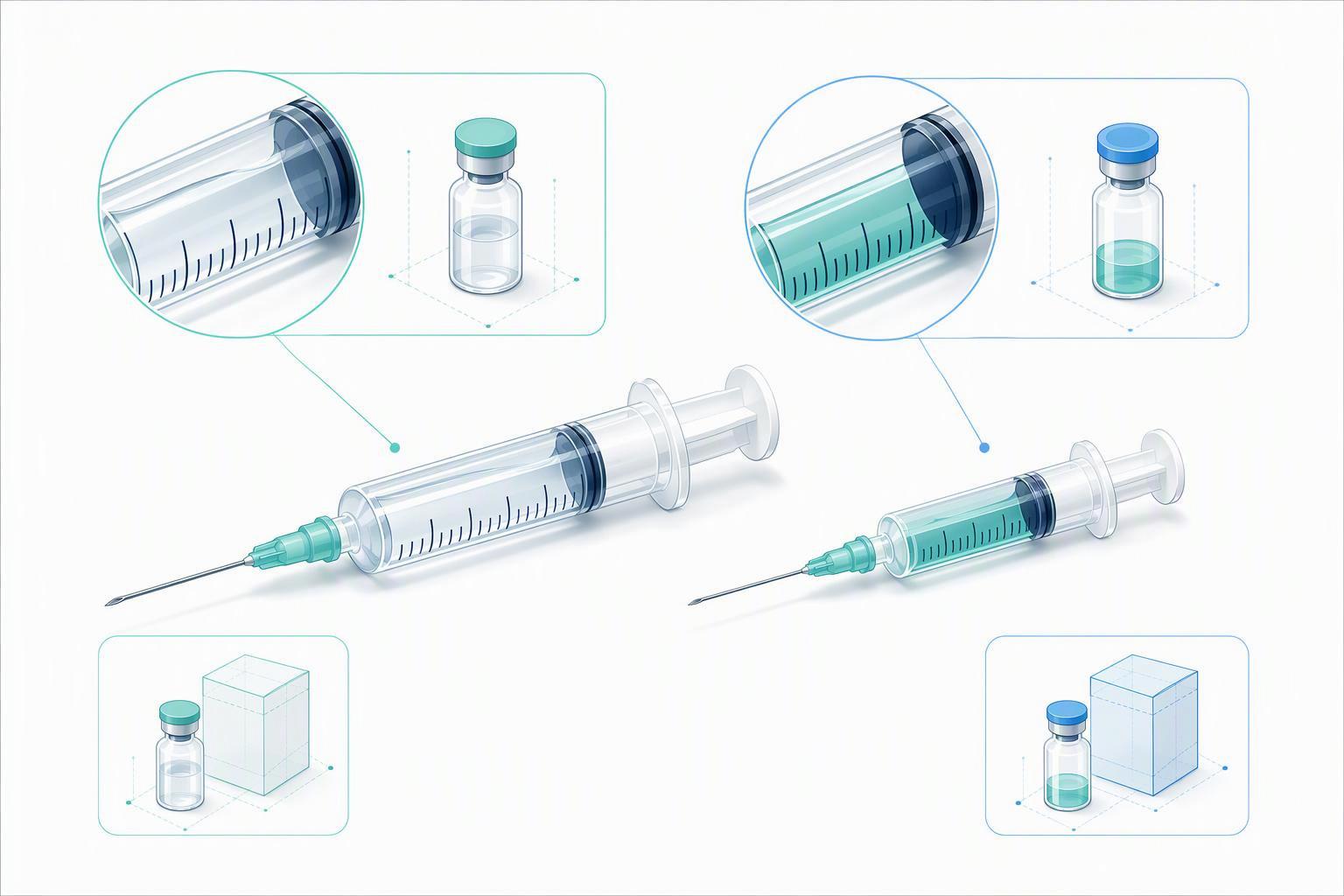
Moving a peptide from intravenous to subcutaneous administration is not a device change. It is a change in the specification the molecule has to meet.

The reason is volume. Intravenous infusion can deliver a large volume at low concentration over time, so the formulation never has to be concentrated. Subcutaneous delivery has to fit the same dose into a small injection volume, and that small volume is where the constraints begin (Subcutaneous Shop Delivery of High-Dose/Volume Biologics, 2021). Traditional subcutaneous delivery was limited to fluid volumes of 1 à 2 mL, extended more recently to about 3 mL, so a fixed dose must be squeezed into a fraction of the space IV allowed (Subcutaneous Delivery of High-Dose/Volume Biologics, 2021).
Synthèse peptidique The shift is driven by program economics as much as by patient preference: self-administration at home, reduced reliance on infusion infrastructure, cost reduction, compliance and payer pressure all push programs toward subcutaneous routes (A New Approach for Preparing Stable High-Concentration Peptide Nanosuspensions, 2023).

That is the process-development consequence. Séquence, salt form and purification endpoint now inherit constraints they were not designed against.
What Concentration the Route Change Actually Demands
The required concentration is not a formulation preference. It is arithmetic: dose mass divided by injection volume. Because the device fixes the volume, the device fixes the concentration, and a high-concentration peptide formulation inherits that number before any excipient is chosen.
Work it through with your own program. UN 100 mg dose delivered in 1.0 mL requires 100 mg/mL. The same dose in 0.5 mL requires 200 mg/mL. Nothing about the molecule changed between those two numbers, only the volume the device can deliver.
That volume ceiling is tight. UN 2023 review of high-concentration peptide nanosuspensions notes that subcutaneous injections are limited to a dosing volume of 1–1.5 mL, potentially resulting in peptide dose concentrations above 100 mg/mL. UN 2021 review of high-dose subcutaneous biologics describes traditional subcutaneous volumes of 1–2 mL, while a 2024 review of large-volume subcutaneous injections reports that 2.0 mL is generally accepted as feasible and commercially viable with hand-held autoinjectors.
The two ranges are not the same claim. The 1–2 mL figure describes what traditional devices have delivered; the 1–1.5 mL figure is the working limit the peptide paper assumes when it derives concentrations above 100 mg/mL. Plan against the tighter one until your device is confirmed.
The Solubility Ceiling Peptides Hit Before Antibodies Do
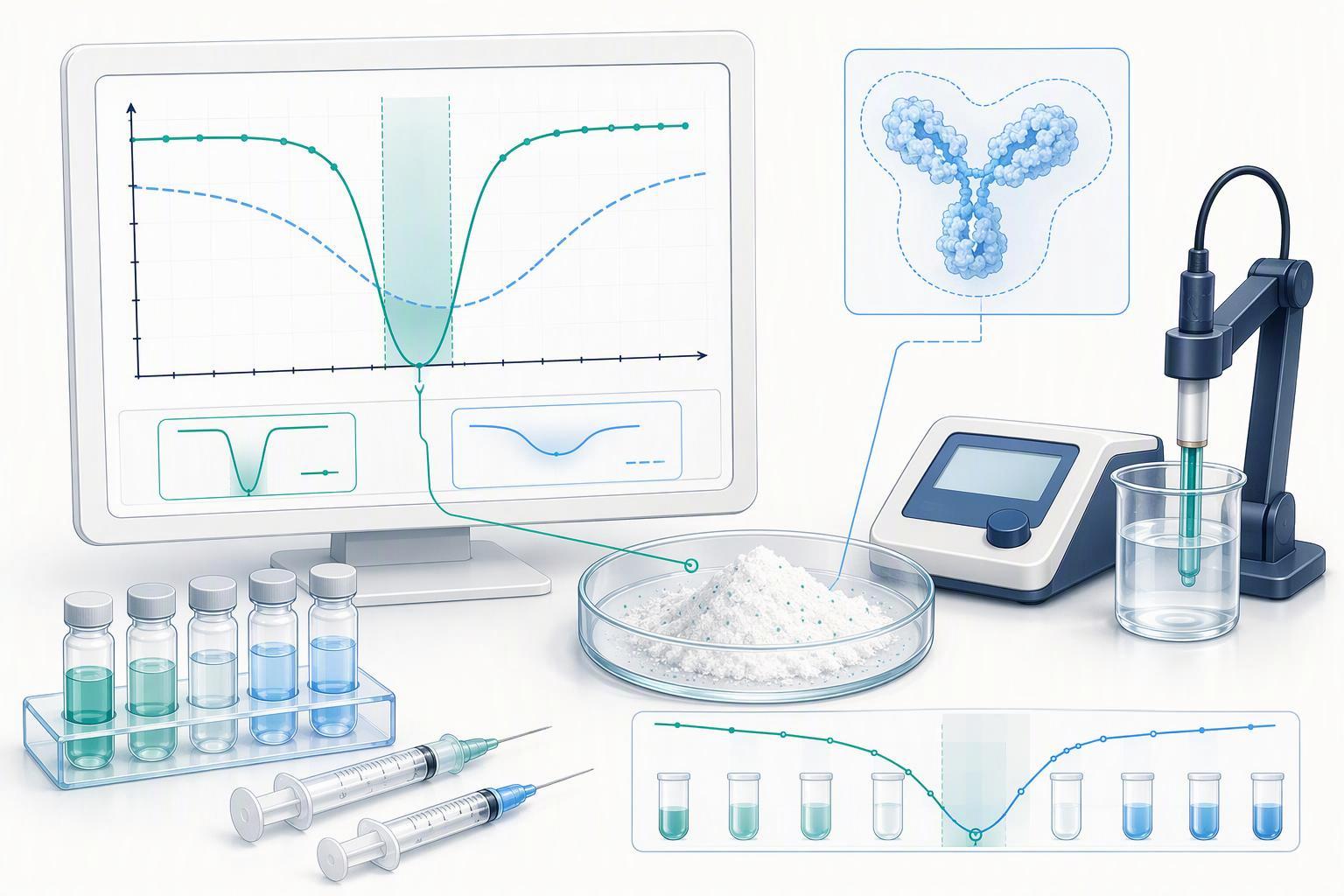
Think of the usable formulation window as a doorway: wide for a typical antibody, narrow for a peptide, and the peptide doorway also moves as pH shifts.
Peptides often exhibit sharp pH-dependent solubility that buffers cannot control well, which is what makes high-concentration aqueous formulation difficult. Hydrophobic residues have a disproportionately large effect on solubility because the lack of strong secondary structure leaves them surface-exposed (A New Approach for Preparing Stable High-Concentration Peptide Nanosuspensions, 2023). An antibody buries those side chains inside a folded core; a short peptide has nowhere to put them, so the same residues that drive potency also drive self-association. This is the practical gap in peptide solubility and excipient compatibility: a buffer that holds an antibody in solution may not hold a peptide, and the failure is often pH-dependent rather than gradual.
The magnitude is sequence-dependent, so treat this as a general mechanism rather than a predicted number. The high-concentration antibody strategy, injectables above 100 mg/mL used to avoid volumes over 3 mL (Subcutaneous Delivery of High-Dose/Volume Biologics, 2021), sets the target, not the achievable ceiling.
Clé à retenir: The feasible concentration range and the true solubility Peptides synthétiques limit are questions to answer before a formulation target is fixed.
Aggregation, Self-Association, Gelation and Fibrillation in Peptides
Peptide aggregation and viscosity problems start with the same root cause: higher peptide concentrations exacerbate peptide–peptide interactions and can lead to conformational change, aggregation, precipitation or gelation, with loss of activity plus toxicity and immunogenicity risk (A New Approach for Preparing Stable High-Concentration Peptide Nanosuspensions, 2023).
Two pathways matter, and they call for different methods. Colloidal aggregation is a solubility-driven assembly of native-structured molecules; conformational aggregation follows partial unfolding that exposes sticky surfaces. Size-exclusion chromatography (SECONDE) resolves size-based aggregate distribution but can perturb self-associating species on the column matrix. Dynamic light scattering (DLS) reports a hydrodynamic size distribution, though its intensity weighting biases results toward the largest species present. Thiolavin T (ThT) fluorescence is sensitive to fibrillar structure but is not a specific identity test. Circular dichroism (CD) tracks secondary structure change without resolving aggregate size. Analytical ultracentrifugation (AUC) gives a solution-phase size distribution without a column matrix, at lower throughput.
Gelation and fibrillation are distinct peptide failure modes, not antibody aggregation relabelled. Which pathway is plausible for a sequence determines what the purification endpoint must remove and what the release panel must detect.
Clé à retenir: A peptide nanosuspension has shown low viscosity above 100 mg/mL in a nanosuspension while remaining chemically and physically stable, though the authors hold an interest in the nanomilling method they evaluate (A New Approach for Preparing Stable High-Concentration Peptide Nanosuspensions, 2023).
Viscosity as Flow Behaviour, Not a Single Number
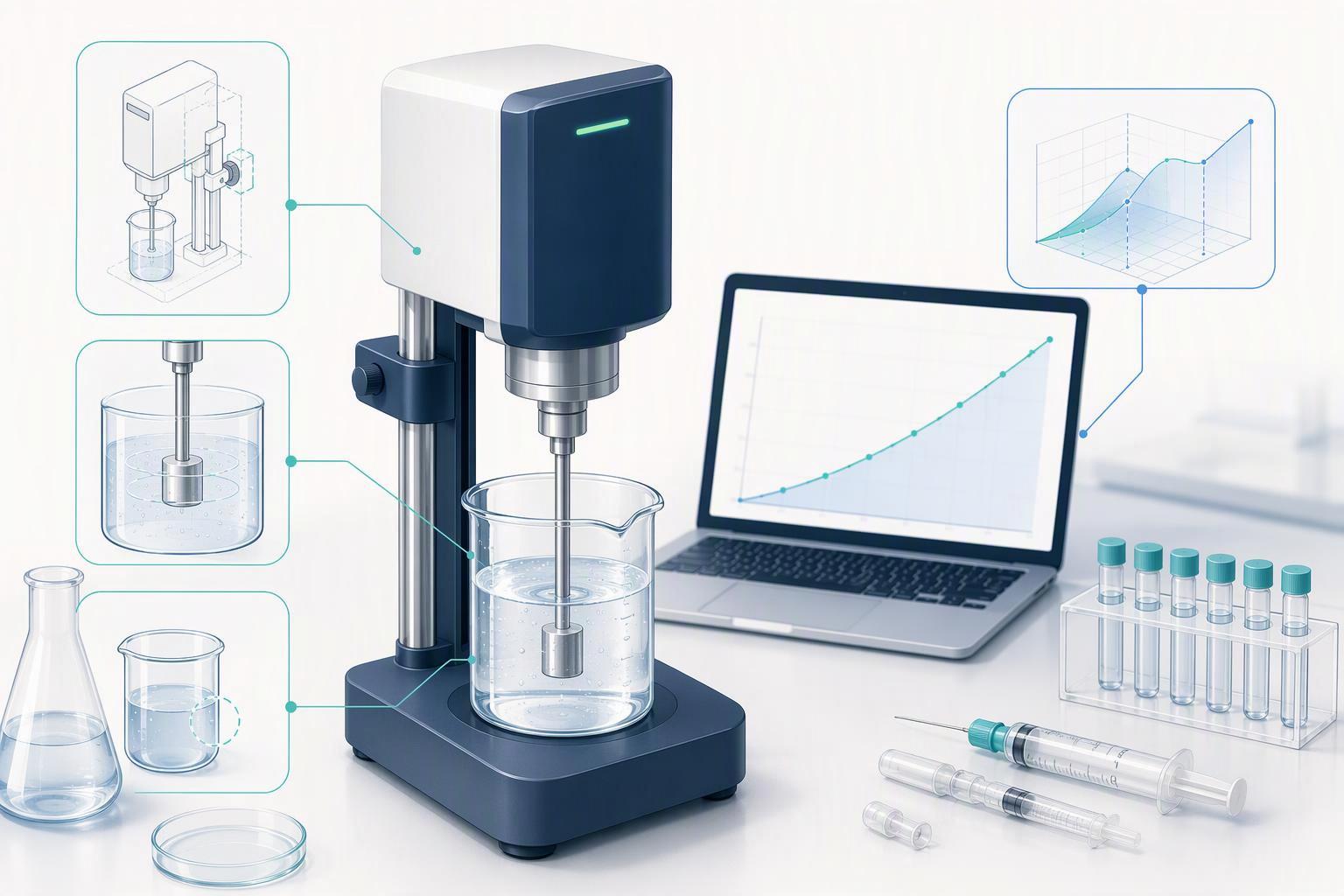
Viscosity in a high-concentration peptide formulation is a flow curve, not a number. A single reading taken at the target concentration can misrepresent how the solution will behave, because concentrated peptide systems are frequently non-Newtonian: apparent viscosity falls as shear rate rises, so the value you record depends on the instrument and the conditions you measured under.
Concentration is the dominant variable. Ci-dessus à peu près 100 mg/mL, small changes in peptide concentration can produce disproportionate changes in flow behaviour, which is why a curve measured across the range tells you more than any single point on it. One reported approach, a peptide nanosuspension, maintained low viscosity above 100 mg/mL while remaining chemically and physically stable (source). Treat that as method-specific: the authors evaluate a nanomilling technique they have an interest in, so it is not a general claim about peptide solutions at that concentration.
The consequence lands in your process, not the syringe. Filtration flux, transfer losses and fill-finish all operate within their own shear and pressure windows, and a formulation that passes one point measurement can still fail at those steps. The ~10 cP figure often quoted for injectability is a typical range reported in the literature, not a universal threshold. Behaviour measured across the concentration range, not at the target point alone, is what tells you whether the target is manufacturable. Production de peptides
Formulation Compatibility, Counterions and Container Contact
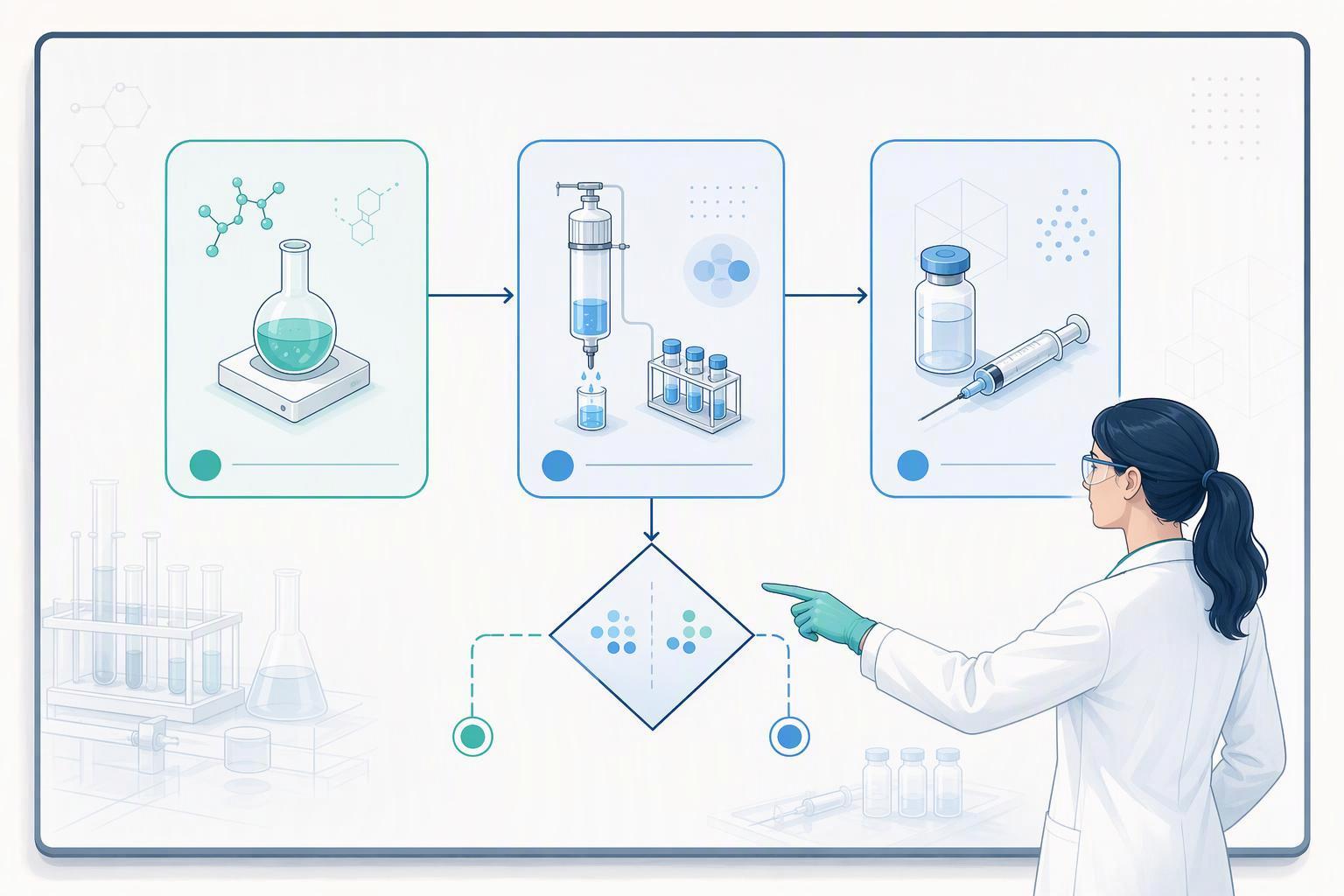
Excipient and buffer compatibility in a high-concentration peptide is constrained by the same self-association behaviour that drives viscosity: the more the peptide interacts with itself, the less predictable its interaction with the excipient set becomes. That is why peptide solubility and excipient compatibility are usually screened together, at the target concentration, rather than sequentially.
The counterion is part of that formulation, not a purification leftover. Acetate has largely replaced TFA in peptide drug synthesis because TFA was found to negatively impact peptide stability and biological activity. The tolerability signal is peptide-specific rather than general: in one named peptide, the TFA salt of the tetra-branched M33 was 5-30% more cytotoxic toward normal bronchial epithelial cells than its acetate counterpart, and a TFA-containing MOG formulation accelerated encephalomyelitis onset by about 5 days versus controls at comparable incidence and severity. Both are direction-of-effect findings in named systems, not rates that transfer to another sequence.
Salt form does not change covalent structure or the mass-spectrometry ion, but it changes the fraction of weighed material that is peptide versus counterion. TFA carries more dead mass per protonated site than acetate, so how salt form changes measured mass propagates directly into lot release. Subcutaneous injection adds a local-tolerability constraint that IV does not, and container-closure contact adds leachables and adsorption questions at the higher concentrations SC demands.
The consequence lands at purification: counterion exchange changes measured mass and therefore release specification, and it is decided there, not at formulation.
Stability Testing in Early Process Development
Peptide stability testing in early process development answers three separate questions, and conflating them is why stability data often arrives too late to change anything. Forced degradation asks what degradation pathways exist and whether the analytical method can see them. Accelerated studies ask whether the molecule survives stress it may meet in handling and transport. Long-term studies ask what the shelf life actually is.
The ICH Q1A(R2) general case conditions set the regulatory frame: long-term storage at 25°C ± 2°C/60% RH ± 5% RH or 30°C ± 2°C/65% RH ± 5% RH for a minimum of 12 months, intermediate at 30°C ± 2°C/65% RH ± 5% RH for 6 months, and accelerated at 40°C ± 2°C/75% RH ± 5% RH for 6 months, with minimum time points of 0, 3 et 6 months at accelerated and 0, 6, 9 et 12 months where intermediate conditions are called for (ICH Q1A(R2) guideline, effective 2003).
The analytical side runs under separate requirements. Photostability and method validation are governed by the ICH Q1B and Q2(R2) requirements, and forced degradation is what challenges method selectivity: until the method is stability-indicating, release and stability numbers describe the assay, not the molecule (ICH Q1A(R2) guideline, 2003).
Practitioners typically run forced degradation as a stress panel: thermal, freeze-thaw, mechanical agitation, light, and pH extremes. The specific stress ranges used across the field came from sources that could not be re-verified for this article, so treat that panel as a working convention rather than a cited protocol; the ranges belong in your own method-development rationale.
The consequence for process development is ordering. A stability-indicating method has to exist before release or stability data mean anything, which places method development upstream of the formulation lock, not after it.
What Must Be Answered at the Synthesis and Purification Stage Before Formulation Locks In
The developability questions that must close before formulation lock are a short, specific list: the feasible concentration range, the true solubility limit, whether the molecule self-associates as concentration rises, how viscosity changes across that range, and which salt form balances solubility, stability and processability. Each is a drug-substance property, and each is cheaper to measure before the formulation target is fixed than after.
The recurring failure mode is a sequencing one. A formulation target gets set first, then the drug substance is characterised for the properties that target depends on. When the answer comes back unfavourable, the program is negotiating against a number it has already committed to.
Self-association deserves early attention for an operational reason as well as a formulation one. At high concentration it can slow ultrafiltration and diafiltration enough to become unacceptable at process scale, which turns a solution-phase behaviour into a manufacturing constraint.
Closing these questions earlier is a workflow change rather than a new technique. It moves characterisation into synthesis and purification, where salt-form and counterion decisions are still open, and where a partner supporting peptide chemistry and manufacturing can help sequence the work.
Common Misconceptions About High-Concentration Peptide Development
Five assumptions carried over from mAb work cause most of the trouble in a high-concentration peptide formulation. Each one is testable, and each has a method that settles it. À propos
That peptide aggregation behaves like antibody aggregation. It does not. Antibodies aggregate around a folded core that can be destabilised and then re-stabilised; peptides have no such core, so the pathway balance shifts toward concentration-driven aggregation and gelation, where the concentration itself is the driving variable. Size-exclusion chromatography and analytical ultracentrifugation separate the species; the mechanism has to be inferred from how the distribution moves with concentration, not read off an antibody model.
That one viscosity number characterises the system. A single measurement at one shear rate cannot distinguish a Newtonian solution from a shear-thinning one. Where a nanosuspension has been reported at low viscosity above 100 mg/mL, that result belongs to the specific dispersed system and method used, not to high-concentration peptides in general.
That a buffer that holds an antibody will hold a peptide. Sharp pH-dependent peptide solubility means a formulation pH chosen for protein stability can sit on a cliff edge for a peptide.
That the counterion is a purification detail. Salt form changes measured mass and has been associated with stability and tolerability differences.
That stability testing is a late-stage activity. The stability-indicating method has to exist before the formulation locks, or there is nothing to lock against.
⚠️ Attention: The recurring pattern behind all five is a formulation target set before the drug substance has been characterised for the properties that target depends on.
Next Steps
The route decision is not a late-stage packaging choice. It propagates backwards through the whole program: sequence design, synthesis, purification, salt form and lot release all carry requirements that the subcutaneous target sets, and each of them is cheaper to answer before the formulation locks than after.
That is the reframe worth keeping from this guide. The IV to subcutaneous peptide manufacturing shift changes the specification the molecule has to meet, and the six question clusters above are the places where that specification is actually decided. Peptide stability testing in early process development sits at the end of that chain, but it verifies decisions made much earlier.
A practical first step is small. Take the question list in this guide and walk it against the analytical and lot-release documentation package you already hold, or raise a difficult sequence with a technical team before the formulation is fixed. MOL Changes publishes as a peptide vendor with a commercial interest in peptide quality standards. Decisions about a specific molecule or program require qualified formulation, regulatory and clinical judgement; this article is technical background, not program-specific advice.
Foire aux questions
Why does moving from IV to subcutaneous change the drug substance rather than just the device?
Because the route change tightens the specification the molecule must meet, not the syringe it travels in. Subcutaneous delivery caps injection volume, and that cap converts directly into a concentration requirement the drug substance has to satisfy. IV infusion has no comparable ceiling, so a program can carry a dilute solution through development without confronting solubility, viscosity or self-association limits. Once the volume is fixed, those limits become drug-substance properties, addressed through salt form, counterion, purification endpoint and sequence design rather than through formulation alone.
What concentration does a subcutaneous peptide formulation actually need?
Concentration is dose mass divided by injection volume, so the target follows arithmetically from the device ceiling: a 100 mg dose in a 1 mL injection requires 100 mg/mL, and the same dose in 0.5 mL requires 200 mg/mL. Because SC injections are limited to a dosing volume of 1–1.5 mL, peptides dosed at or above 100 mg commonly land above 100 mg/mL (Journal of Pharmaceutical Sciences). The exact figure depends on your dose and device, but the arithmetic is not negotiable.
Why is peptide solubility harder to control than antibody solubility at high concentration?
Peptides lack the folded hydrophobic core antibodies use to bury nonpolar side chains, so those residues stay surface-exposed and drive association. The practical consequence is sharp pH-dependent solubility: the usable window is narrower than for a folded protein, and it shifts with ionic strength and counterion. The magnitude is sequence-dependent, so a framework borrowed from mAb development will mispredict where a given peptide becomes unworkable.
Which analytical methods detect peptide aggregation, and what does each one miss?
The method follows the pathway you need to characterise. Size-exclusion chromatography resolves size-based aggregate distribution but can perturb the equilibrium it measures. Dynamic light scattering reports an intensity-weighted hydrodynamic size distribution, which biases toward large species and can miss small oligomers. ThT fluorescence is sensitive to fibrillar structure but is not a specific identity test. Circular dichroism reports secondary structure content without resolving aggregate size. Analytical ultracentrifugation gives a solution-phase size distribution free of column interaction, at the cost of throughput. No single method covers all pathways; orthogonal data is the standard.
Is a single viscosity measurement enough to characterise a high-concentration peptide?
Non. A single-point measurement assumes Newtonian behaviour, and high-concentration peptide solutions frequently are not Newtonian, so one reading can misrepresent how the material behaves during filtration, transfer and fill-finish. Measure a flow curve across the concentration range instead, and report the shear conditions alongside the result.
Does the counterion really matter for a peptide drug substance?
Yes. The counterion determines what fraction of the weighed material is peptide versus counterion, which changes the effective concentration you are formulating and the ionic environment the molecule sees. Trifluoroacetate has largely given way to acetate in peptide drug substance for this reason, and the choice propagates into pH control, solubility and local tolerability at the injection site. It is a drug-substance decision, not a purification detail.
What stability studies are required before a formulation locks in?
At minimum, the ICH Q1A(R2) general case conditions and minimum time points, applied to the drug substance and the proposed formulation. Early process development should also include forced-degradation work to identify the pathways your stability-indicating method has to resolve. The package verifies the solubility, aggregation and viscosity assumptions made earlier; if it cannot detect a pathway, the assumption stays unverified.
Conclusion
The IV to subcutaneous peptide manufacturing shift is, at bottom, a specification decision: the route you choose rewrites what the molecule has to be, not just how it is delivered. Concentration demand, the solubility ceiling peptides reach earlier than antibodies, self-association and gelation pathways, flow behaviour across the concentration range, excipient and counterion compatibility, and the stability package that verifies all of it are six questions that surface together the moment a program moves to SC dosing. Each one is cheaper to answer at synthesis and purification than after a formulation locks.
The direction of travel is not in doubt. Subcutaneous delivery has been consolidating for years across biologics, and as volumes and device formats keep evolving, the requirements they impose will keep moving further upstream into drug-substance design. Programs that treat the route change as a late-stage formulation problem will keep discovering it was a sequence, salt-form and purification-endpoint problem all along.
MOL Changes publishes this material as a peptide vendor with a commercial interest in peptide quality standards.