What a platform HPLC method for GLP-1 impurity analysis actually measures — and what it does not

A platform reversed-phase gradient separates peptides mainly by overall hydrophobicity and accessible nonpolar surface, not by sequence identity, so a single residue substitution or positional isomer can change biological activity substantially while producing a retention change smaller than peak broadening or adsorption variability (Waters’ peptide method-development primer). What the method measures is how much peptide-containing material elutes in a window. What it does not measure is which molecule that material is.

Detection compounds the limit. Detection at 214 nm responds to the peptide backbone amide bonds and therefore to essentially all peptide-containing species including sequence variants and truncations, with response much less dependent on aromatic content than 280 nm; 280 nm mainly detects Trp, Tyr and Phe and can underrepresent impurities lacking them (Waters’ peptide method-development primer). A 280 nm-only method therefore carries a detection blind spot that a 214 nm method does not.
The four claims a peptide method is asked to carry
Čistoća, identity, content and stability are four separate claims, and one unvalidated chromatographic peak-area result does not establish all four. Purity is a relative measure of how much of the integrated area belongs to the main peak, and it says nothing about identity on its own: a sample can read 99% pure by HPLC and still be the wrong molecule. Identity is established by mass, peptide mapping, amino acid analysis or NMR, i EMA synthetic-peptide guideline recommends at least two orthogonal methods for identification at release, with the applicant responsible for showing the combination unambiguously confirms the sequence.
Content is the quantity of the peptide present, normally expressed against a reference standard and corrected for counter-ion, water and salt. Stability is a property of the method as much as the molecule: I Q1A(R2) requires stability studies to use validated stability-indicating procedures and to examine the attributes susceptible to change during storage, with stress testing identifying degradation products and pathways (I Q1A(R2)). A purity method that has never been shown to resolve a forced-degradation species is not a stability-indicating method, whatever its system suitability result says.
Why structurally similar GLP-1 peptides and their impurities defeat a generic reversed-phase gradient
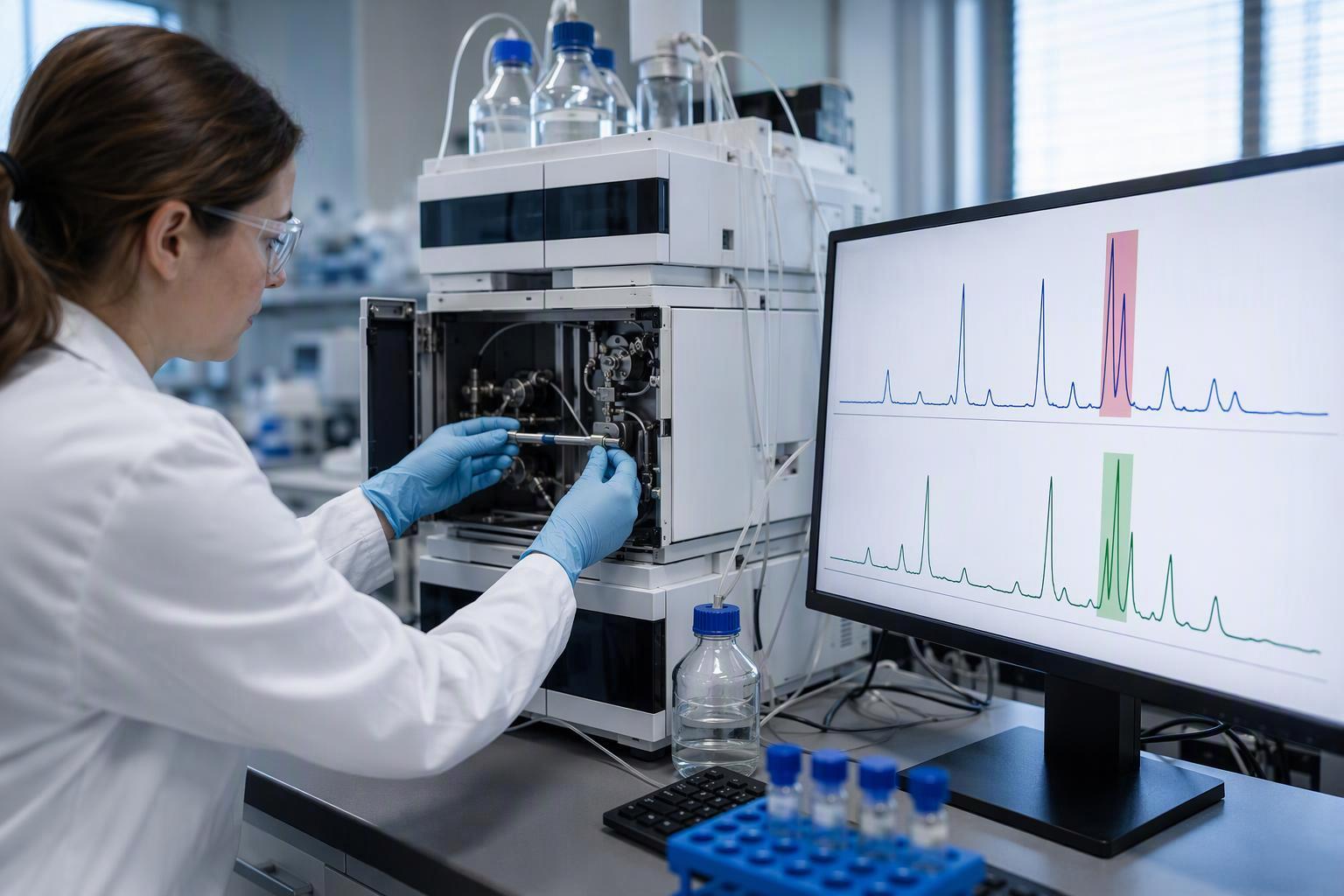
Structural similarity among GLP-1 peptides does not necessarily translate to similar chromatographic behaviour, which is why a platform method may require compound-specific optimization (Thermo Fisher’s argument that structural similarity does not predict chromatographic behaviour). The same source reports that mobile phase composition had a greater influence on impurity separation than stationary phase chemistry, and that TFA-containing mobile phases frequently gave better peak shape and resolution than formic acid.
Column chemistry changes the answer even when the gradient does not. On a single method and gradient, CORTECS Premier C18+ and ACQUITY Premier Peptide CSH C18 isolated the most unique liraglutide variants, while CORTECS Premier C18+ and ACQUITY Premier CSH Phenyl-Hexyl isolated the most unique semaglutide variants; the Peptide CSH C18 separated liraglutide better than semaglutide and the Phenyl-Hexyl column did the reverse (Waters’ column-selection comparison for liraglutide and semaglutide). There is no single best column, only a best column for a named analyte.
The impurity classes that defeat selectivity
Impurity classes differ in how much they change the molecule and in whether that change is visible to a reversed-phase gradient. The mass shifts below come from a third-party peptide testing document and describe the chemistry, not a compendial limit.
|
Impurity class |
Mass shift |
Why reversed phase struggles |
|---|---|---|
|
Oxidation (Met, Trp, Cys) |
+16 Da |
Small polarity change; often elutes close to or under the parent |
|
Double oxidation |
+32 Da |
Second oxidation event, cumulative retention shift |
|
Deamidation (Asn→Asp, Gln→Glu) |
Hobt Coupling +1 Da |
Near-isobaric with parent; the classic co-elution case |
|
N-terminal cyclization (Gln→pyroGlu) |
−17 Da |
Peptide Suppliers Loss of a charged N-terminus changes retention subtly |
|
Deletion Ng Peptides slijed |
Depends on the missing residue and modification |
Missing residue; may be more or less hydrophobic than parent |
|
Residual protecting group (tBu, Pbf, Trt) |
Calculate the net retained group from its molecular formula |
Hydrophobic tag from incomplete deprotection |
Selectivity is not the only failure mode. Peptide HPLC methods also fail through adsorption and nonspecific binding to silica, residual silanols, metal surfaces, frits, tubing, vials and filters; through aggregation and precipitation driven by pH, ionic strength, temperatura, solvent, concentration or freeze-thaw; through secondary stationary-phase interactions producing tailing, splitting or nonelution; through metal-mediated adsorption especially of Asp- and Glu-containing species; through carryover and memory effects; and through on-column degradation (the review of peptide HPLC failure modes). A method can pass every selectivity check and still lose analyte to the system.
Temperature and mobile phase are not one-way levers
Raising column temperature is the reflex fix, and it is not reliable. Increasing column temperature from 30 °C to 60 °C resolved two tirzepatide impurities that co-eluted at the lower temperature, but on semaglutide with a Hypersil GOLD C4 column and TFA-containing mobile phases the same temperature increase reduced resolution and co-eluted two impurities (Thermo Fisher’s RPLC-UV optimization study for semaglutide and tirzepatide). The direction of the effect depends on the column and mobile phase combination, not on a general rule.
The Waters temperature study shows the same non-monotonic behaviour within one method: column temperature changes of ±5 °C produced selectivity differences that impacted resolution of impurity species for liraglutide, tirzepatide and semaglutide, with the best resolution between one critical pair (peaks 9 i 10) na 55 °C and those two species co-eluting at 65 °C (a Hobt Synthesis Waters study on temperature dependence in GLP-1 separations). A five-degree change moved a critical pair from resolved to co-eluting, which is the margin a transfer between laboratories has to survive.
Where UV area percent stops being a defensible purity number
Area normalization is an operational purity measure. Converting it to a mass or molar fraction requires appropriate response-factor assumptions, detection coverage and integration. Different residue compositions or labels may respond differently, and undetected or co-eluting species require further assessment.
Detection wavelength decides which impurities enter the calculation at all. Because 280 nm mainly detects Trp, Tyr and Phe, an impurity lacking those residues can be underrepresented or invisible at that wavelength, while 214 nm responds to essentially all peptide-containing species (Waters’ peptide method-development primer). Read against the EMA requirement that methods be suitable for the 0.1% reporting threshold, a 280 nm-only method carries a detection gap for non-aromatic peptide-related impurities that the guideline does not excuse.
The co-elution consequence
The EMA guideline addresses impurities observed together as one peak and the possible need for independent methods. Apply the relevant qualification assessment to the measured combined level; do not interpret the 1.0% threshold as permission to overlook individual identities or as a change in the reporting threshold.
The practical case is well documented. A peptide can read 98% pure by HPLC while a +16 Da satellite peak, partial oxidation co-eluting with the main peak, stays invisible to UV and plainly visible by mass. The LC-UV/MS work on thermally stressed exenatide found seven peaks with significantly elevated peak area, with the mass detector assigning a +16 Da oxidation difference at a −1.3 min retention-time shift and a non-enzymatic cleavage fragment at 3,254.1 Da (LC-UV/MS impurity profiling of stressed exenatide). The UV trace alone would have reported a purity number that the mass data contradicts.
How to qualify a platform method as fit for purpose for a new sequence before you rely on it
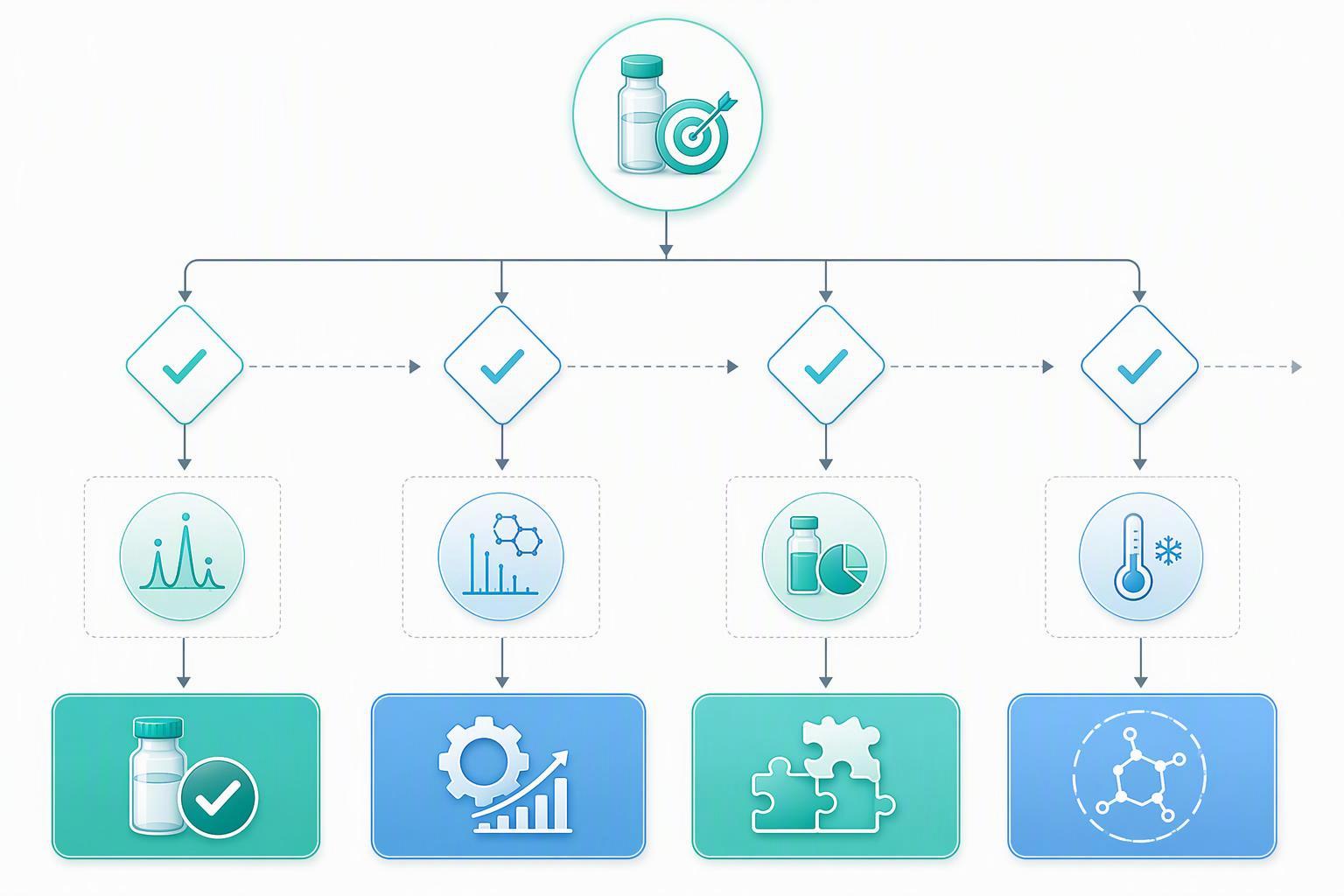
Qualification starts from the intended purpose, not from the method. ICH Q14 defines the analytical target profile as a prospective summary of the performance characteristics describing the intended purpose and the anticipated performance criteria of an analytical measurement, and states that the ATP drives the choice of analytical technology and is maintained over the lifecycle to ensure the procedure remains fit for the intended purpose (ICH Q14’s analytical target profile). Write the ATP for the new sequence first, then test the platform method against it.
The three-tier evidence expectation follows from that. Screening and characterization tolerate flexibility and incomplete robustness data if limitations are recorded; early clinical or development testing requires qualification with defined sample preparation, appropriate specificity, preliminary precision and accuracy, a usable range and basic system suitability; osloboditi, stability and filing-supporting testing require predefined acceptance criteria, validated or qualified performance, robustness across analysts, days and equipment, controlled reference standards and evidence the method is stability-indicating where required (the phase-appropriate analytical control strategy). The tier you are in sets the evidence, and moving up a tier is the decision, not the method’s reputation.
The gate criteria
Work through these in order, and stop at the first failure.
-
Intended purpose is written. The ATP names the attributes to be measured, the performance characteristics and the associated criteria, per ICH Q14. Wholesale Peptides
-
Detection is adequate for the reporting threshold. The method must be suitable to meet the Ph. Eur. 0.1% reporting threshold for synthetic peptides, per the EMA synthetic-peptide guideline. A 280 nm-only method fails this gate for non-aromatic species.
-
Specificity is demonstrated by one of the three ICH Q2(R2) routes. Absence of interference, comparison against an orthogonal procedure, or the underlying scientific principles of the procedure; selectivity can be demonstrated even when the procedure is not specific (I Q2(R2)).
-
Response factors are addressed for any impurity whose response differs from the reference material, per ICH Q2(R2).
-
Stability-indicating capability is shown through forced degradation, per ICH Q1A(R2).
-
System suitability is set by the procedure, not assumed from the chapter. USP <621> requires demonstrating that the complete analytical system performs adequately before and throughout analysis, with criteria set by the monograph or analytical procedure; the harmonised chapter adds a peak symmetry requirement of 0.8 do 1.8 and calculates resolution from peak width at half height (USP <621> system suitability). Passing system suitability is a necessary condition, not fitness for purpose.
Challenging the method with stressed and spiked samples
Forced degradation and spiking are what turn a gate checklist into evidence. The AQbD exenatide study screened four parameters (column chemistry, organic modifier, acidic modifier, gradient time), detected and partially resolved 19 proces- and product-related impurity peaks, and produced a final MODR-verification chromatogram with 20 peaks at integrated area of 0.05% or greater, against an optimization target of USP resolution of at least 1.5 for a majority of identified product-related impurities (the AQbD exenatide method-development study). Those 20 peaks are detected peaks, not limits, and the gap between 19 at screening and 20 at verification is the value of challenging the method rather than trusting it. Kaiser Test For Peptides
When optimization is enough, and what exactly you change
Optimize when plausible changes can meet the analytical target profile. Parameter changes can alter selectivity as well as retention and efficiency. Add an orthogonal procedure or redesign the method when the resulting evidence remains inadequate.
What to change, in order
Choose a structured optimization plan for the actual critical pairs. Mobile phase, stationary phase, gradient and temperature interact; one vendor comparison does not establish a mandatory order of changes or a universal gradient slope.
When you need orthogonal techniques or compound-specific method development
Orthogonal techniques are needed when the method cannot separate all peptide-related impurities, which the EMA synthetic-peptide guideline anticipates by stating that additional independent methods may be needed and that co-eluting impurities fall under the 1.0% qualification threshold unless justified. This is not a theoretical provision. The same exenatide study shows a deamidation pair where RPLC needed a shallow 0.5% organic per minute gradient over 114 minutes for only partial resolution with peak fronting, BEH Amide HILIC co-eluted them even at 150 mm, and BEH HILIC achieved partial resolution at 1% organic per minute in 45 minuta, halving analysis time and doubling throughput at the same 100 mm column length (Waters’ RPLC/HILIC orthogonal profiling study of exenatide).
Choosing the orthogonal mode
The choice follows from what the primary mode cannot see. HILIC is the documented complement for variants that reversed phase cannot baseline-resolve, and the mode matters within HILIC: BEH Amide and BEH HILIC behaved differently on the same deamidation pair. Mass detection is the complement for identity and for co-eluting species, since a mass detector can read the characteristic mass shift of an impurity that stays under the main UV peak. The limit of mass detection is that HRMS cannot by itself distinguish isomeric and isobaric impurities, because racemization produces D-amino acid impurities with the same mass as the parent drug, and TFA used as the ion-pairing agent suppresses peptide ionization in the mass spectrometer (the LCGC interview on GLP-1 analytical challenges). An orthogonal method that shares the same blind spot is not orthogonal.
When compound-specific development is the honest answer
Compound-specific development is the honest answer when the ATP cannot be met by any combination of platform parameters and orthogonal modes without redesigning the method around the analyte. The evidence points that way for the class as a whole: the Thermo Fisher study concluded that method optimization must be compound-specific and that a universal platform method cannot be directly applied to different GLP-1 receptor agonists, with chromatographic conditions tailored to each analyte (Thermo Fisher’s RPLC-UV optimization study for semaglutide and tirzepatide). The regulatory framework accommodates this through ICH Q14, which allows a minimal (traditional) approach or elements of an enhanced approach, with the enhanced approach using prior knowledge and risk assessment to identify influential parameters and establish a MODR through univariate or multivariate studies (ICH Q14). Platform knowledge is the starting point; the ATP decides how far it carries.
What the transfer and records package must carry so a comparability claim survives review
Method transfer for peptides fails on details that small-molecule transfers tolerate. Differences in system dwell volume are a frequent, underappreciated source of transfer failure because peptide separations rely on very shallow gradients, and column temperature and flow rate are more consequential for peptides than for small molecules because large molecules diffuse more slowly (LCGC’s practitioner discussion of GLP-1 method transfer). A shallow gradient amplifies every volume difference between instruments.
The record has to let an independent reviewer reconstruct what each laboratory did. That means method identity and version; column manufacturer, chemistry, dimensions, particle and pore size, serial or lot number, conditioning history, injection count, storage and replacement criteria; instrument and detector IDs with software and firmware versions; measured or qualified dwell volume with the measurement method and any compensation applied; column-oven and autosampler setpoints with actual recorded temperatures and equilibration time; and mobile-phase preparation details including solvent and reagent grades, supplier and lot numbers, water source, pH and adjustment reagent, preparation date and time, preparer and verifier, filtration and degassing, storage container and expiry or hold time (FDA’s comparability and method-transfer expectations).
The data-integrity layer
The record is only defensible if the underlying data meet ALCOA expectations. MHRA defines ALCOA as attributable, čitljiv, istovremeni, originalan i točan, with the plus referring to complete, consistent, enduring and available, and states that raw data must permit full reconstruction of the activities and that where data were captured in a dynamic state and generated electronically, paper copies cannot be considered raw data (MHRA’s ALCOA expectations for chromatographic raw data). For chromatography this is specific: a printed chromatogram loses the ability to reprocess the data and expand the baseline, which is exactly the capability a reviewer needs when a co-elution question arises.
Where a connected data package helps
The practical failure at handoff is not a missing document but a missing connection between documents. When the method version, the column lot, the dwell volume measurement and the integration decisions live in separate files, a reviewer cannot reconstruct the run without asking the originating laboratory, and the comparability claim stalls on correspondence rather than on science. A connected data package that keeps the method record, the instrument record and the raw chromatographic data linked to the same sample and run identifiers removes that reconstruction step. That is the narrow, practical role such a package plays here: it makes the reviewer’s reconstruction possible without a round of questions.
Common mistakes that turn a method question into a filing question
The first mistake is treating system suitability as fitness for purpose. USP <621> requires the complete analytical system to perform adequately, with criteria set by the procedure, and it does not impose a universal resolution value (USP <621> system suitability). Passing suitability says the system is behaving today, not that the method answers the intended question.
The second is reading a UV purity number as an identity or a completeness claim. A resolved peak is not an identified peak, i a 98% area percent is not evidence that the remaining 2% is benign. The third is assuming a resolved peak is a single species: co-eluting impurities observed as one peak take the 1.0% qualification threshold unless otherwise justified (EMA synthetic-peptide guideline). The fourth is assuming a successful in-house transfer means the method is transferable, when dwell volume and shallow gradients move selectivity between instruments (LCGC’s practitioner discussion of GLP-1 method transfer).
Često postavljana pitanja
Does passing system suitability mean the platform method is fit for purpose?
Ne. USP <621> requires demonstrating that the complete analytical system performs adequately before and throughout analysis, and it sets no universal resolution value; criteria come from the monograph or the analytical procedure (USP <621> system suitability). Fitness for purpose is a separate question, answered against the analytical target profile defined in ICH Q14 (ICH Q14).
Can UV area percent serve as the purity number for a release specification?
It can serve as a purity measure, but not as an unqualified one. Area normalization assumes comparable response per mole, and ICH Q2(R2) directs that relative response factors be calculated where an analyte’s response differs from the reference material (I Q2(R2)). Detection wavelength also sets which species enter the calculation, since 280 nm mainly detects Trp, Tyr and Phe (Waters’ peptide method-development primer).
How do I know whether to optimize or to go orthogonal?
Optimize when the problem is parameter range and the critical pair responds to mobile phase, column chemistry, temperature or gradient slope. Go orthogonal when the pair does not respond to any of those, as with the exenatide proline-insertion variant that RPLC could not baseline-resolve after extensive optimization while HILIC reached Rs = 2.94 (Waters’ RPLC/HILIC orthogonal profiling study of exenatide).
What makes a peptide method transfer fail between laboratories?
Dwell volume differences are a frequent and underappreciated cause, because peptide separations rely on very shallow gradients, and column temperature and flow rate matter more for peptides than for small molecules (LCGC’s practitioner discussion of GLP-1 method transfer). The transfer record must therefore carry the measured dwell volume and the measurement method, along with column lot, conditioning history and mobile-phase preparation details (FDA’s comparability and method-transfer expectations).
Zaključak
The decision comes down to one question asked in the right order: what does the intended purpose require, and does the platform method meet it? Write the analytical target profile first, per ICH Q14, then test the method against the EMA 0.1% reporting threshold, the ICH Q2(R2) routes to demonstrating specificity, and forced-degradation evidence of stability-indicating capability. If the method clears those gates, use it as-is and record the limitations. If it fails on parameter range, optimize in the order that matters: mobile phase, column chemistry, temperatura, then gradient slope. If it fails on selectivity, add an orthogonal mode that does not share the same blind spot. If the ATP cannot be met without rebuilding the method around the analyte, commit to compound-specific development, which is what the class-level evidence supports.
The transfer package is where the decision is tested by someone else. Carry the dwell volume measurement, the column lot and conditioning history, the mobile-phase preparation record and the raw electronic data, because MHRA’s reconstruction requirement is what a reviewer will apply. The next step is to take the ATP for the sequence in front of you and run it against the six gate criteria; if you want a second pair of eyes on that assessment, talk to an expert before the method goes into a filing.