펩타이드 변형

FRET 펩타이드

FRET peptides study biological interactions in real time through energy transfer between donor fluorophores and acceptor bursters.

What is FRET peptide?

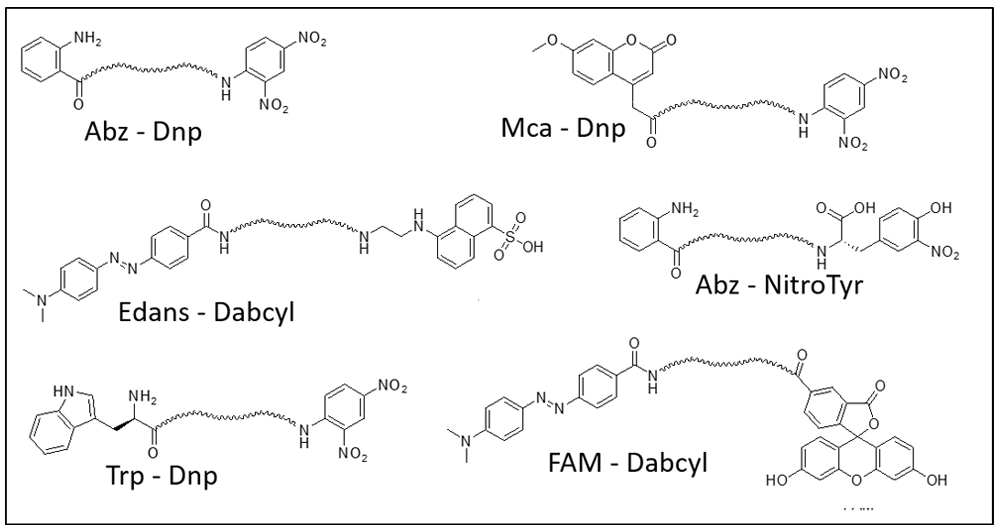
FRET peptide labelling has a donor molecule and an acceptor (bursting agent) molecule. In most cases, the donor and acceptor pairs are two different dyes. If the acceptor is a non-fluorescent dye (bursting agent), the transferred energy from the fluorescent donor is converted into molecular vibrations. When FRET is terminated (by separating the donor and acceptor), an increase in donor fluorescence can be detected. When both donor and acceptor dyes are fluorescent, the transferred energy is emitted as longer wavelength light, allowing changes in the donor and acceptor fluorescence intensity ratio to be measured. For efficient FRET bursting, the fluorophore and bursting agent molecules must be in close proximity to each other (~10-100 Å) and the absorption spectrum of the bursting agent must overlap with the emission spectrum of the fluorophore. Careful comparison of the fluorescence spectrum of the donor and the absorption spectrum of the bursting agent is required when designing donor-bursting agent FRET systems.

FRET peptides science

Key benefits of FRET peptides:

·Real-time monitoring of enzymatic reactions and protein activity.
·Extremely high detection sensitivity due to unique proximity-based energy transfer.
·Versatility for in vitro and in vivo applications, providing insight into complex biological processes.

Fluorophore
Quencher
Donor Ex/Em

Abz

Dnp 2,4-디니트로페닐

320 nm/420 nm

Abz

Dnp 2,4-디니트로페닐

320 nm/420 nm

Mca

Dnp 2,4-디니트로페닐

325 nm/392 nm

Trp

Dnp 2,4-디니트로페닐

280 nm/360 nm

FAM

Dabcyl4-([4'-dimethylamino)phenyl]azo)benzoyl

492 nm/517 nm

Lucifer Yellow

Dabsyl4(Dimethylamino)azobenzene-4'-sulfonyl

430nm/520nm

주요 인용

Ultrasensitive tumour-penetrating nanosensors of protease activity

The ability to identify cancer lesions with endogenous biomarkers is currently limited to tumours ~1 cm in diameter. We recently reported an exogenously administered tumour-penetrating nanosensor that sheds, in response to tumour-specific proteases, peptide fragments that can then be detected in the urine. 여기, we report the optimization, informed by a pharmacokinetic mathematical model, of the surface presentation of the peptide substrates to both enhance on-target protease cleavage and minimize off-target cleavage, and of the functionalization of the nanosensors with tumour-penetrating ligands that engage active trafficking pathways to increase activation in the tumour microenvironment. The resulting nanosensor discriminated sub-5 mm lesions in human epithelial tumours and detected nodules with median diameters smaller than 2 mm in an orthotopic model of ovarian cancer. We also demonstrate enhanced receptor-dependent specificity of signal generation in the urine in an immunocompetent model of colorectal liver metastases, and in situ activation of the nanosensors in human tumour microarrays when re-engineered as fluorogenic zymography probes.

관련 펩타이드 변형 서비스

펩타이드 글리코실화

펩타이드 글리코실화

펩타이드 글리코실화는 잠재적으로 펩타이드의 물리화학적 특성을 향상시킬 수 있는 공유 결합 변형입니다.

자세히 알아보기

펩타이드 인산화

펩타이드 인산화

세린에서는 인산화가 발생할 수 있습니다. (에스, 장차 ~ 가 되는), 트레오닌 (티, Thr) 및 티로신 (와이, 티르) 포스포에스테르 결합 형성에 의한 측쇄

자세히 알아보기

스테이플 펩티드

스테이플 펩티드

α-메틸을 함유한 두 가지 비천연 아미노산 도입, 펩타이드 사슬의 고상 합성 중 α-알케닐 그룹.

자세히 알아보기

고리형 펩타이드

고리형 펩타이드

펩타이드 고리화는 펩타이드의 구조적 안정성을 향상시킵니다. (선형 유사체에 비해) 펩타이드 개발의 일반적인 전략입니다..

자세히 알아보기

펩타이드 변형

펩타이드 변형에 대한 광범위한 경험, 펩타이드 연구를 위한 다양한 실행 가능한 방법 제공.

찾다 왓츠앱 서비스 제품