Comparação rápida: escala de fornecedor de peptídeos versus especialização em resumo
|
Síntese de Peptídeos Categoria |
Grande plataforma |
Especialista |
|---|---|---|
|
Melhor para |
Programas de estágio avançado que necessitam de centenas de quilogramas a cerca de uma tonelada métrica por ano a partir de um único local qualificado |
Sequências complexas, modificações difíceis, e trabalho de conjugação onde a química, não a tonelagem, é a restrição |
|
Intervalo de sequência personalizado |
Catálogo amplo e personalizado, mas a capacidade personalizada de síntese de peptídeos é alocada em slots de grande volume comprometidos |
Taxa de transferência mais estreita, química mais ampla: resíduos não padronizados, modificações peptídicas difíceis, e pequenas corridas exploratórias |
|
Modificações difíceis |
Aceito quando a rota já está comprovada em escala |
Vitórias em nomeado, química fora do padrão, onde o especialista pode descrever a rota antes de cotar |
|
Rotulagem e conjugação |
Disponível, normalmente como uma linha de serviço definida |
Vitórias em manter o conjugado no escopo por meio de caracterização e controle |
|
Suporte analítico e documentação |
Estruturado, pacotes prontos para auditoria vinculados à versão GMP |
Vitórias no desenvolvimento de métodos para impurezas não padronizadas, alinhado à barra de documentação que as diretrizes da EMA definem para o processo, caracterização, especificações e controle analítico |
|
Comunicação técnica |
Camadas de gerenciamento de contas e projetos; mais lento para chegar ao banco |
Vitórias no acesso direto aos cientistas que executam a síntese |
|
Continuidade do projeto e transferência de tecnologia |
Vitórias quando você precisar de um segundo local ou de uma rota validada em grande escala |
Forte cedo, mas entrega o projeto quando o volume ultrapassa a bancada |
|
Escala mínima viável |
Centenas de quilogramas por ano por local, de acordo com o que a escala de compra realmente garante |
Miligramas para quilogramas baixos, incluindo lotes exploratórios únicos |
|
Nosso veredicto |
Vitórias para volume em estágio final e continuidade de nível regulatório |
Vitórias para química em estágio inicial e não padronizada |
Observação: Esta tabela compara fornecedores tipos, não dois fornecedores nomeados. A própria página de capacidade de Bachem descreve o Vista visando até quase uma tonelada métrica por ano, e a divisão especialista/grande volume dentro da própria rede de um fornecedor mostra que ambos os modelos podem coexistir sob o mesmo teto. Nenhum fornecedor é uniformemente melhor; a coluna da direita depende de onde sua molécula está hoje.

Sequências personalizadas: até onde cada modelo realmente se estende?
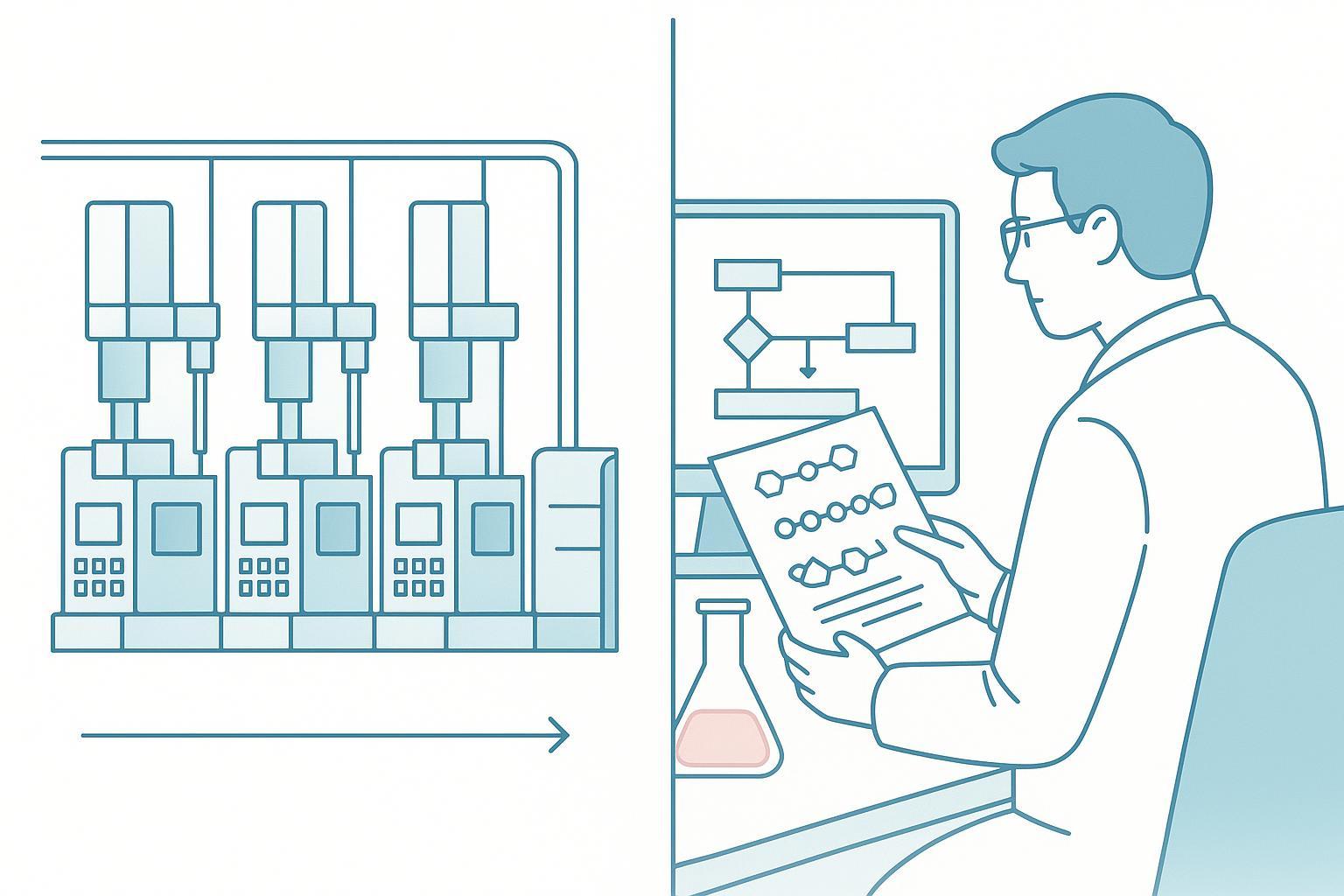
Uma grande plataforma ganha na capacidade de síntese de peptídeos personalizados para sequências que já escalou; um especialista vence em sequências que estão fora do envelope operacional padrão de uma plataforma. A restrição é química, não comercial. De acordo com a literatura técnica sobre síntese em fase sólida, a agregação no SPPS não é provável antes do quinto ou sexto resíduo ou após o vigésimo primeiro, e a agregação de resina peptídica causa desproteção e acoplamento lentos ou incompletos. Sequências longas ou hidrofóbicas são, portanto, onde uma rota padronizada atinge seu limite, e onde a disposição de um especialista em mudar o solvente, carga de resina ou temperatura são importantes. Um especialista como a MOL Changes oferece suporte ao design de sequência personalizada em uma faixa de mg a kg, é assim que essa etapa adicional de revisão de sequência e seleção de rota pode ser usada para lidar com um caso difícil. A nuance: para uma sequência já no catálogo validado de uma plataforma, essa flexibilidade não compra nada.
Modificações difíceis: quem pode nomear a química, não apenas aceitar o pedido?
O diferenciador em modificações difíceis de peptídeos não é a disposição de aceitar o pedido, mas a capacidade de nomear táticas específicas mediante solicitação. Um especialista deve ser capaz de produzir, espontâneo, o catálogo tático na literatura técnica: DBU para desproteção incompleta do Fmoc, NMP ou DMSO como solvente, sais caotrópicos, detergentes não iônicos ou carbonato de etileno, sonicação, temperatura elevada, microondas, resina de baixa substituição, e resina TentaGel ou SURE (peptídeo.com, 2019-10-14).
Para sequências longas ou propensas a agregação, o mesmo teste se aplica a estratégias de proteção de backbone para sequências longas: pseudoprolinas, depsipeptídeos via esterificação em Ser ou Thr, e proteção Hmb/Dmb (peptídeo.com, 2019-10-14). O espaçamento Hmb de seis a sete resíduos é importante porque interrompe a agregação e também evita a formação de aspartimida, e o controle de racemização para His e Cys depende do HOBt, 6-Cl-HOBt ou HOAt (peptídeo.com, 2019-10-14).

Use isso como um teste de comprador: pergunte qual destes o fornecedor propõe para sua sequência, e por que. Uma grande plataforma pode conter cada um desses recursos internamente e ainda encaminhar sua solicitação por meio de uma entrada padronizada que nunca os revela.
Rotulagem e conjugação: qual modelo mantém o conjugado no escopo?
O fornecedor que mantém o vinculador e a carga útil dentro do escopo do trabalho carrega consigo o ônus da caracterização; o fornecedor que trata o peptídeo como produto final o devolve para você. Esse limite, não o tamanho do catálogo, decide quanto trabalho analítico chega à sua mesa.
A diretriz da EMA sobre o desenvolvimento e fabricação de peptídeos sintéticos define o quadro. Abrange o processo, caracterização, especificações e controle analítico para peptídeos sintéticos, conjugação incluída, e nomeia estereoisômero e exclusão, sequências truncadas ou de inserção como classes de impurezas definidas. Essas classes não desaparecem porque o peptídeo está agora ligado a algo.
Serviços Então faça uma pergunta direta antes de fazer o pedido: se o conjugado é o produto, a especificação do seu fornecedor cobre as espécies conjugadas, ou apenas o intermediário peptídico? Uma grande plataforma pode recusar a química do ligante, pois está fora do seu escopo validado. Um especialista pode aceitar, mas subcontratar o trabalho de carga útil. Qualquer uma das respostas é viável, desde que você aprenda antes do lote, não depois que o certificado de análise chegar.
Suporte analítico e documentação: como é uma boa resposta?

A profundidade analítica é verificável, então peça o método em vez do adjetivo. Um fornecedor que reivindique suporte analítico e documentação de peptídeos deve ser capaz de apontar para o O ICH faz referência aos pontos de orientação da EMA para: Eu Q3A(R2) para impurezas em novas substâncias medicamentosas, ICH Q6A para especificações, e ICH M7 para impurezas mutagênicas.
Uma verdadeira troca de solução de problemas de impurezas é assim. Você envia o cromatograma e a especificação com falha. O fornecedor propõe uma mudança de método, retorna os dados de suporte, e altera o CoA para corresponder. Espere dados de HPLC e MS, uma etapa declarada de troca de contra-íon TFA, um resultado do ensaio de endotoxina LAL, e números de consistência entre lotes. Uma não resposta é uma porcentagem de pureza sem nenhum método por trás dela.
A nuance: a documentação de uma grande plataforma costuma ser mais padronizada, o que torna mais fácil a auditoria mesmo quando o desenvolvimento do método de um especialista é mais profundo.
Comunicação técnica: quem responde, e quão rápido?
A diferença observável entre os dois modelos é quem está do outro lado da questão. Uma grande plataforma normalmente encaminha a comunicação técnica através de uma camada de gerenciamento de contas ou projetos, com escalonamento para um cientista quando a consulta ultrapassa um limite definido. Um fornecedor especializado geralmente responde com a pessoa que executou a síntese, porque pode não haver nenhuma camada entre.
Essa diferença pode ser testada antes de você se comprometer. Faça três perguntas e observe como as respostas voltam:
-
O que mudou entre os dois últimos lotes?
-
Qual foi o modo de falha na primeira tentativa de síntese?
-
Que mitigação é proposta, e o que o desencadearia?
Uma resposta substantiva à segunda pergunta é o sinal mais forte de uma experiência real de bancada. Um fornecedor que não consegue descrever um modo de falha na primeira tentativa ou nunca teve um que valesse a pena ser descrito ou nunca viu o registro.
Continuidade do projeto e transferência de tecnologia: o que acontece quando seu projeto ultrapassa a bancada?
O risco de continuidade é maior exatamente onde os dois modelos se transferem. Uma grande plataforma pode absorver uma expansão internamente, e a própria rede de Bachem é o exemplo mais claro: o distribuição em seis locais da capacidade anunciada cobre Bubendorf (Edifício K), Sisslerfeld, Vionnaz, Vista, Torrance e St.. Helena, com o Torrance posicionado no equipamento de escala certa para volumes menores, enquanto o Vista utiliza capacidade para grandes volumes.
O momento é mais importante do que o número do título. Edifício K foi inaugurado em abril 2026 e já fabrica produtos comerciais GMP, mas espera-se que a Fase II contribua para as vendas apenas em 2027, e produção comercial de Sisslerfeld apenas por 2030. That is the announced timeline for usable capacity, and it sits behind the Sisslerfeld phase-one investment of more than CHF 500M, part of a programme that could exceed CHF 1.2B with partners.
⚠️ Aviso: Announced capex is not usable capacity. If your launch depends on 2027 ou 2028 volumes, plan the transfer before you need it, not after your current supplier’s slot is already committed.
Industry veterans quoted on CDMO capacity put the practitioner estimate on construction overruns no 12 para 18 months beyond initial projections. Treat that as a quote-based estimate rather than measured data, but it points the same way as the published dates: build slack into your timeline.
Which brings peptide project continuity and tech transfer back to ownership. When you move, who holds the process knowledge: the analytical methods, the purification route, the deviation history? A specialist that has run your sequence for three years holds tacit knowledge that does not travel in a tech-transfer package. A large platform holds the capacity but not your history. Whichever direction you move, the party that can document the process is the party that can hand it over, so ask for that documentation before you sign, not when you leave.
Preços e condições comerciais: quanto cada modelo realmente custa para você?
Neither model publishes a price list, so the honest comparison is cost structure rather than quoted pricing. A large platform’s commercial case rests on cost per gram at volume: fixed setup is spread across large campaigns, and the more grams you commit to, the lower the unit price falls. A specialist’s case rests on the cost of the project, including the failed first attempt you do not pay for twice.
The inflection points sit where the two structures diverge. Scale-up is the first: below a few grams, the platform’s setup and slot allocation dominate the invoice, while a specialist absorbs that work into a single project. Dedicated equipment and qualification batches are the second: a platform slot is a capacity reservation Peptídeos Sintéticos with its own commercial terms, so you are buying a place in a queue as much as a synthesis. Hidden costs sit on both sides. Moving a validated route means method redevelopment and requalification, and once a route is validated on one supplier’s equipment, switching carries a real lock-in cost that rarely appears in the quote.
For small research quantities, the specialist is frequently cheaper once rework is counted.
Contexto de mercado: por que a capacidade é pequena em 2026
Demand for peptide manufacturing capacity is arriving faster than the industry can build it. Grand View Research’s peptide and oligonucleotide CDMO market model projects the market growing from USD 3.1B in 2025 to USD 3.5B in 2026, then to USD 8.1B by 2033, um 12.9% CAGR, with North America holding 36.3% de 2025 revenue.
The demand-side driver is the launch pipeline CDMO operators point to: multiple late-phase GLP-1 and obesity peptides expected to reach commercial launch through 2027–2028. Industry capacity trackers put GMP synthesis utilization at roughly 78–85% against total GMP synthetic peptide capacity of about 50,000–70,000 kg per year, up around 20% desde 2022, with announced projects adding 12,000–18,000 kg by 2028. Treat that capacity figure as an industry estimate, not audited data, and note it comes from a single source.
Announced peptide-manufacturing CDMO capex has exceeded USD 1.2B since 2024, concentrated in Europe, Asia and the US Southeast. That is the backdrop for the peptide supplier scale vs specialization question: capacity is being added, but not yet at the rate demand is compounding.
Quem deve escolher qual
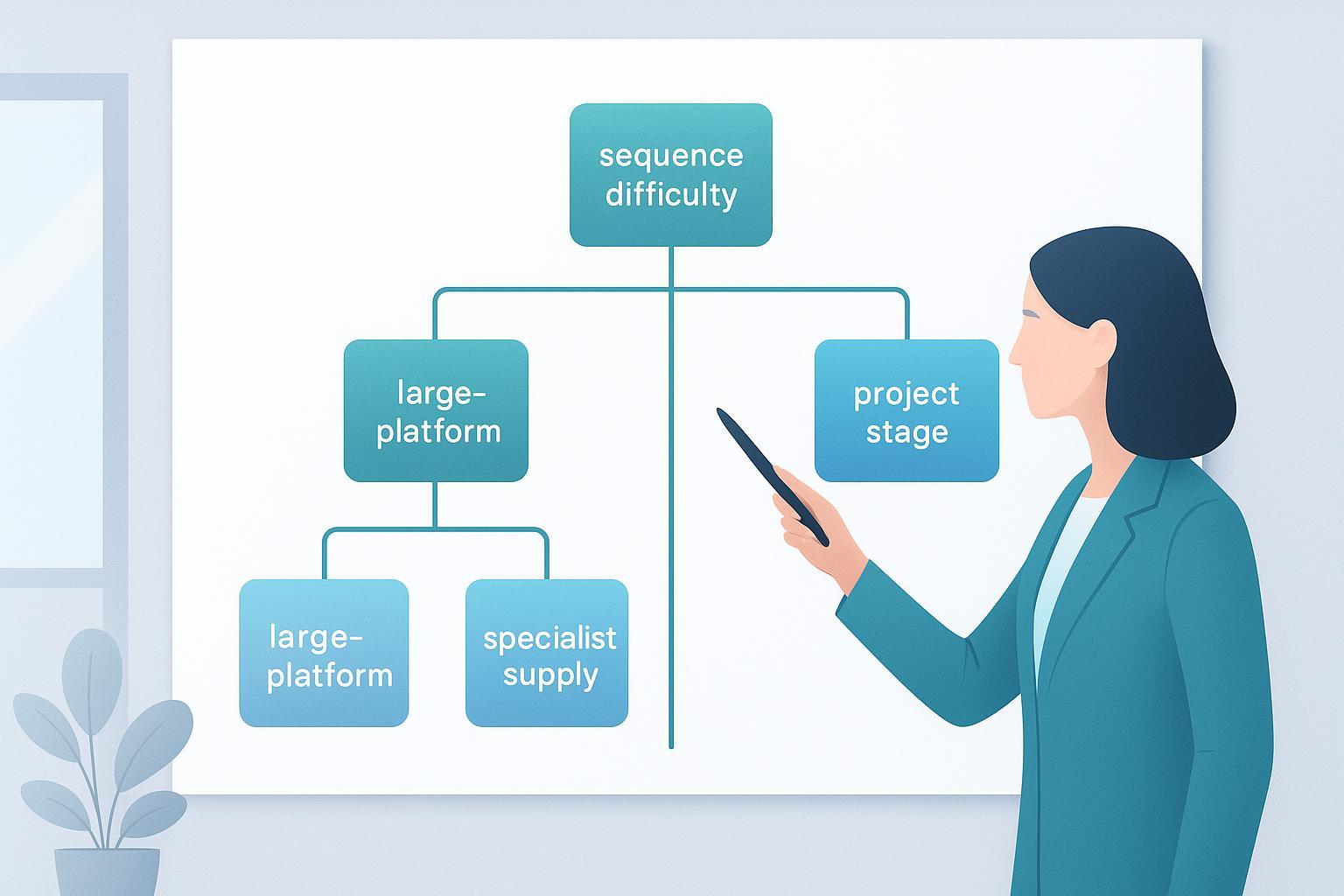
If your sequence is validated and your constraint is capacity, choose a large platform. If your sequence is still fighting you, choose a specialist. Everything else follows from sequence difficulty, project stage, and who owns the process knowledge.
Late-phase scale-up on a validated sequence: A large platform, so you can reserve capacity early and hand auditors documentation that already meets the format they expect.
Longo, hidrofóbico, or heavily modified sequences: A specialist, because route flexibility matters more than throughput when the synthesis itself is the risk.
Conjugation or labelling, where the peptide is one component of a larger construct: Whichever supplier will keep the conjugate in scope. Verify that in writing rather than assuming it from a catalogue page.
Neither fits cleanly: Programmes that need a specialist’s early route work and a platform’s later capacity are common. Plan the tech transfer before you need it, not after the first scale-up batch fails.
“It depends” is the honest answer, and what it depends on is sequence difficulty, project stage, and who owns the process knowledge.
Perguntas frequentes
Um grande fornecedor de peptídeos é sempre melhor que um especialista?
Não. A large platform wins on repeat-batch consistency, audit-ready documentation and cost per gram at volume; a specialist wins on sequences that fall outside a standard operating envelope and on direct access to the person who ran the synthesis. The useful question is not which model is better in the abstract, but which one fits the sequence, the phase and the timeline you are working to. That is the whole of the peptide supplier scale vs specialization decision.
Posso mover um projeto de especialista para uma plataforma grande posteriormente?
It is technically feasible and common, but the effort depends on the transfer package: synthetic route, métodos analíticos, impurity profile and specifications. Ask who owns that documentation before the project starts, not when you decide to leave. A supplier who cannot hand over a complete method package has effectively locked you in.
Posso usar os dois fornecedores no mesmo programa?
Sim, and it is often the rational choice: a specialist for early route development and difficult analogues, a platform for late-phase and commercial volume. The risk sits at the handoff, where knowledge quietly falls through the gap. Define the transfer package contractually at the point you split the work, not afterwards.
Qual modelo oferece melhor suporte analítico?
Judge the documentation, not the company size. Ask both suppliers to map their release testing and impurity control to the ICH references the EMA synthetic-peptide guideline points to, namely ICH Q3A(R2), Q6A and M7. The supplier that can do this without preparation is the one with real analytical depth.
Ainda vale a pena usar um especialista em 2026?
Sim. Capacity is tight and new large-scale capacity is slow to arrive: the announced timelines put Building K Phase II into sales only in 2027 and Sisslerfeld only by 2030 (Fabricação Farmacêutica, recuperado 2026-06-11). A specialist can start difficult work sooner while a platform slot is reserved for scale-up.
Veredicto: combinando o modelo do fornecedor com o seu projeto
|
Critério |
Winning model |
|---|---|
|
Standard or catalogue sequences |
Large-scale supplier |
|
Difficult or non-standard sequences |
Especialista |
|
Complex modifications Comprar and conjugates |
Especialista |
|
Suporte analítico e documentação |
Depends on the individual supplier, not its size Sobre |
|
Technical communication speed |
Especialista, for named-chemistry questions |
|
Continuidade do projeto e transferência de tecnologia Produção de Peptídeos |
Large-scale supplier, once the route is fixed |
|
Pricing on routine volume |
Large-scale supplier |
|
Geral |
Matched to sequence difficulty, project stage and who owns the process knowledge |
Supplier size does not decide this. Dificuldade de sequência, project stage and where the process knowledge sits decide it, and a programme can legitimately move from one model to the other as those change.
For transparency: MOL Changes is a peptide vendor, so weigh our specialist column as a set of demands to verify rather than a neutral scorecard.
If you want to test those demands against a supplier, request a capability matrix or analytical documentation, or speak to a technical lead.