肽供应商规模与专业化: 2026 买家指南

肽供应商规模与专业化: 2026 买家指南

快速比较: 肽供应商规模与专业化一览

多肽合成 类别

大平台

专家

最适合

后期项目每年需要从单个合格地点获取数百公斤至约一吨的货物

复杂序列, 困难的修改, 和共轭工作,其中化学, 不是吨位, 是约束条件

自定义序列范围

广泛的目录和定制, 但定制肽合成能力是根据承诺的大容量插槽分配的

更窄的吞吐量, 更广泛的化学: 非标准残留, 困难的肽修饰, 和短期探索性运行

改装困难

当路线已被大规模验证时接受

胜利 在命名上, 非标准化学, 专家可以在报价前描述路线

标记和缀合

可用的, 通常作为定义的服务线

胜利 通过表征和控制将缀合物保持在范围内

分析支持和文档

结构化, 与 GMP 发布相关的审核就绪包

胜利 非标准杂质的方法开发, 与 EMA 流程指南设置的文档栏一致, 表征, 规格和分析控制

技术交流

账户和项目管理层; 到达替补席的速度较慢

胜利 直接联系进行合成的科学家

项目连续性和技术转让

胜利 一旦您需要第二个站点或经过验证的大规模路线

早强, 但当工作量超出了工作量时就将项目移交

最小可行规模

每个站点每年数百公斤, 根据实际确保的购买规模

毫克至低千克, 包括单个探索批次

我们的判决

胜利 用于后期数量和监管级连续性

胜利 用于早期和非标准化学

笔记: 该表比较了供应商 类型, 不是两个指定的供应商. Bachem 自己的产能页面描述了 Vista 的目标是每年近一吨, 一个供应商自己的网络内的专业/大批量分裂表明这两种模式可以在一个屋檐下共存. 没有哪个供应商是一律更好的; 正确的列取决于您的分子今天所处的位置.

肽供应商规模与专业化: 2026 买家指南

自定义序列: 每个模型实际拉伸多远?

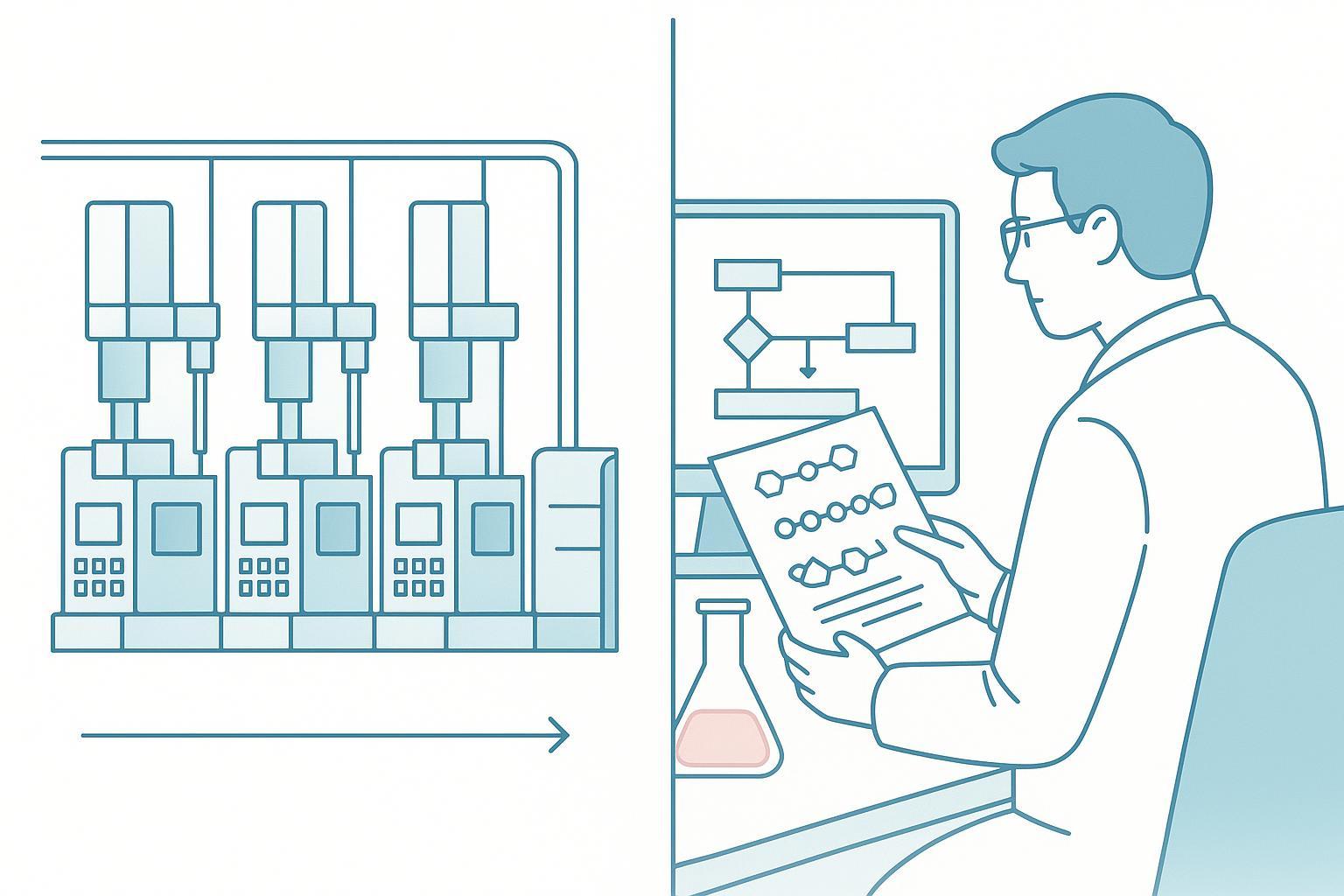
标准平台综合路线与添加了序列审查和路线选择步骤的专业路线的并行流程

大型平台凭借其已规模化序列的定制肽合成能力而获胜; 专家在超出平台标准操作范围的序列上获胜. 约束是化学的, 不商业化. 根据 固相合成技术文献, SPPS 中的聚合不太可能在第五个或第六个残基之前或在第二十一个残基之后, 肽-树脂聚集导致缓慢或不完全的脱保护和偶联. 因此,长序列或疏水序列是标准化路线满足其限制的地方, 以及专家更换溶剂的意愿, 树脂负载或温度很重要. MOL Changes 等专家支持毫克到公斤范围内的定制序列设计, 这就是如何使用添加的序列审查和路线选择步骤来处理困难的情况. 细微差别: 对于已在平台验证目录中的序列, 这种灵活性什么也买不到.

改装困难: 谁能说出化学的名称, 不仅仅是接受订单?

The differentiator on difficult peptide modifications is not willingness to take the order but the ability to name specific tactics on request. A specialist should be able to produce, unprompted, the tactic catalogue in the technical literature: DBU for incomplete Fmoc deprotection, NMP or DMSO as solvent, chaotropic salts, nonionic detergents or ethylene carbonate, sonication, elevated temperature, microwave, low-substitution resin, and TentaGel or SURE resin (peptide.com, 2019-10-14).

For long or aggregation-prone sequences, the same test applies to backbone-protection strategies for long sequences: pseudoprolines, depsipeptides via esterification on Ser or Thr, and Hmb/Dmb protection (peptide.com, 2019-10-14). The six-to-seven-residue Hmb spacing matters because it disrupts aggregation and also prevents aspartimide formation, and racemization control for His and Cys depends on HOBt, 6-Cl-HOBt or HOAt (peptide.com, 2019-10-14).

肽供应商规模与专业化: 2026 买家指南

Use this as a buyer test: ask which of these the supplier proposes for your sequence, and why. A large platform may hold every one of these capabilities internally yet route your request through a standardized intake that never surfaces them.

标记和缀合: 哪个模型将共轭保持在范围内?

The supplier that keeps the linker and the payload inside the scope of work carries the characterisation burden with you; the supplier that treats the peptide as the finished deliverable hands it back to you. That boundary, not catalogue size, decides how much analytical work lands on your desk.

The EMA guideline on the development and manufacture of synthetic peptides sets the frame. It covers process, 表征, specifications and analytical control for synthetic peptides, conjugation included, and it names stereoisomer and deletion, truncated or insertion sequences as defined impurity classes. Those classes do not disappear because the peptide is now attached to something.

服务 So ask a direct question before you order: if the conjugate is the product, does your supplier’s specification cover the conjugated species, or only the peptide intermediate? A large platform may decline the linker chemistry as outside its validated scope. A specialist may accept it but subcontract the payload work. Either answer is workable, provided you learn it before the batch, not after the certificate of analysis arrives.

分析支持和文档: 好的答案是什么样的?

an anonymised excerpt of a certificate of analysis showing purity, method and specification columns

Analytical depth is verifiable, so ask for the method rather than the adjective. A supplier claiming peptide analytical support and documentation should be able to point to the ICH references the EMA guideline points to: 我Q3A(R2) for impurities in new drug substances, ICH Q6A for specifications, and ICH M7 for mutagenic impurities.

A real impurity-troubleshooting exchange looks like this. You send the chromatogram and the failing specification. The supplier proposes a method change, returns the supporting data, and amends the CoA to match. Expect HPLC and MS data, a stated TFA counterion exchange step, an endotoxin LAL assay result, and lot-to-lot consistency figures. A non-answer is a purity percentage with no method behind it.

细微差别: a large platform’s documentation is often more standardized, which makes it easier to audit even when a specialist’s method development runs deeper.

技术交流: 谁回答, 以及多快?

The observable difference between the two models is who is on the other end of the question. A large platform typically routes technical communication through an account or project-management layer, with escalation to a scientist when the query clears a defined threshold. A specialist supplier often answers with the person who ran the synthesis, because there may be no layer in between.

That difference is testable before you commit. Ask three questions and watch how the answers come back:

  1. What changed between the last two lots?

  2. What was the failure mode on the first synthesis attempt?

  3. What mitigation is proposed, and what would trigger it?

A substantive answer to the second question is the strongest single signal of real bench experience. A supplier who cannot describe a first-attempt failure mode either never had one worth describing or never saw the record.

项目连续性和技术转让: 当您的项目规模超出工作台规模时会发生什么?

Continuity risk is highest exactly where the two models hand off to each other. A large platform can absorb a scale-up internally, and Bachem’s own network is the clearest worked example: 这 six-site distribution of announced capacity covers Bubendorf (Building K), Sisslerfeld, Vionnaz, Vista, Torrance and St. Helens, with Torrance positioned on the right scale equipment for smaller volumes while Vista takes large-volume capacity.

The timing matters more than the headline number. Building K was inaugurated in April 2026 and already manufactures commercial GMP products, but Phase II is expected to contribute to sales only in 2027, and Sisslerfeld commercial production only by 2030. That is the announced timeline for usable capacity, and it sits behind the Sisslerfeld phase-one investment of more than CHF 500M, part of a programme that could exceed CHF 1.2B with partners.

⚠️警告: Announced capex is not usable capacity. If your launch depends on 2027 或者 2028 volumes, plan the transfer before you need it, not after your current supplier’s slot is already committed.

Industry veterans quoted on CDMO capacity put the practitioner estimate on construction overruns 在 12 到 18 months beyond initial projections. Treat that as a quote-based estimate rather than measured data, but it points the same way as the published dates: build slack into your timeline.

Which brings peptide project continuity and tech transfer back to ownership. When you move, who holds the process knowledge: 分析方法, the purification route, the deviation history? A specialist that has run your sequence for three years holds tacit knowledge that does not travel in a tech-transfer package. A large platform holds the capacity but not your history. Whichever direction you move, the party that can document the process is the party that can hand it over, so ask for that documentation before you sign, not when you leave.

定价和商业条款: 每种型号的实际成本是多少?

Neither model publishes a price list, so the honest comparison is cost structure rather than quoted pricing. A large platform’s commercial case rests on cost per gram at volume: fixed setup is spread across large campaigns, and the more grams you commit to, the lower the unit price falls. A specialist’s case rests on the cost of the project, including the failed first attempt you do not pay for twice.

The inflection points sit where the two structures diverge. Scale-up is the first: below a few grams, the platform’s setup and slot allocation dominate the invoice, while a specialist absorbs that work into a single project. Dedicated equipment and qualification batches are the second: a platform slot is a capacity reservation 合成肽 with its own commercial terms, so you are buying a place in a queue as much as a synthesis. Hidden costs sit on both sides. Moving a validated route means method redevelopment and requalification, and once a route is validated on one supplier’s equipment, switching carries a real lock-in cost that rarely appears in the quote.

For small research quantities, the specialist is frequently cheaper once rework is counted.

市场背景: 为何产能紧张 2026

Demand for peptide manufacturing capacity is arriving faster than the industry can build it. Grand View Research’s peptide and oligonucleotide CDMO market model projects the market growing from USD 3.1B in 2025 to USD 3.5B in 2026, then to USD 8.1B by 2033, 一个 12.9% 复合年增长率, with North America holding 36.3% 的 2025 revenue.

The demand-side driver is the launch pipeline CDMO operators point to: multiple late-phase GLP-1 and obesity peptides expected to reach commercial launch through 2027–2028. Industry capacity trackers put GMP synthesis utilization at roughly 78–85% against total GMP synthetic peptide capacity of about 50,000–70,000 kg per year, up around 20% 自从 2022, with announced projects adding 12,000–18,000 kg by 2028. Treat that capacity figure as an industry estimate, not audited data, and note it comes from a single source.

Announced peptide-manufacturing CDMO capex has exceeded USD 1.2B since 2024, concentrated in Europe, Asia and the US Southeast. That is the backdrop for the peptide supplier scale vs specialization question: capacity is being added, but not yet at the rate demand is compounding.

谁应该选择哪个

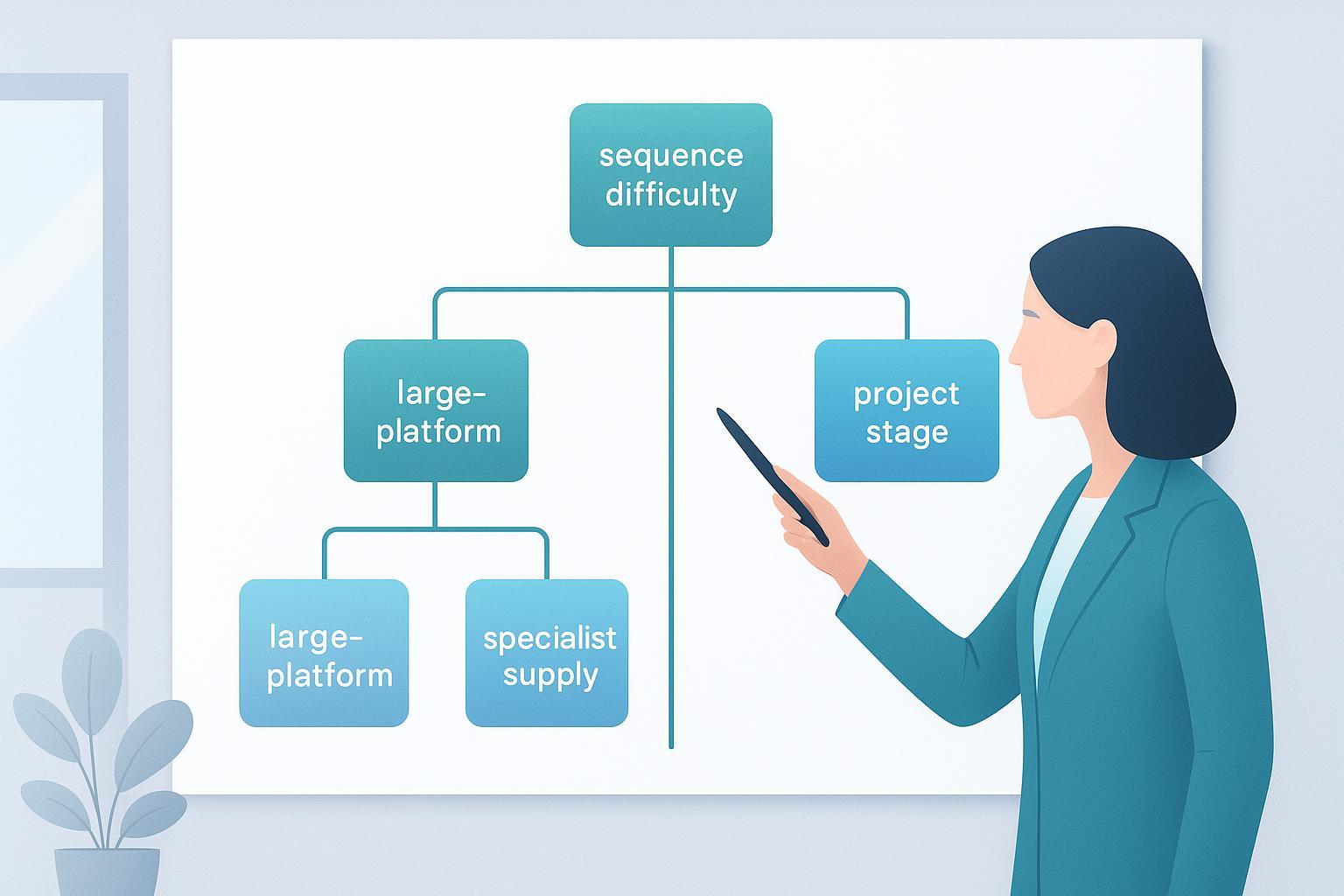
a decision tree branching on sequence difficulty and project stage toward large-platform or specialist supply

If your sequence is validated and your constraint is capacity, choose a large platform. If your sequence is still fighting you, choose a specialist. Everything else follows from sequence difficulty, project stage, and who owns the process knowledge.

Late-phase scale-up on a validated sequence: A large platform, so you can reserve capacity early and hand auditors documentation that already meets the format they expect.

长的, 疏水性的, or heavily modified sequences: A specialist, because route flexibility matters more than throughput when the synthesis itself is the risk.

Conjugation or labelling, where the peptide is one component of a larger construct: Whichever supplier will keep the conjugate in scope. Verify that in writing rather than assuming it from a catalogue page.

Neither fits cleanly: Programmes that need a specialist’s early route work and a platform’s later capacity are common. Plan the tech transfer before you need it, not after the first scale-up batch fails.

“It depends” is the honest answer, and what it depends on is sequence difficulty, project stage, and who owns the process knowledge.

常见问题

大型肽供应商总是比专家更好吗?

不. A large platform wins on repeat-batch consistency, audit-ready documentation and cost per gram at volume; a specialist wins on sequences that fall outside a standard operating envelope and on direct access to the person who ran the synthesis. The useful question is not which model is better in the abstract, but which one fits the sequence, the phase and the timeline you are working to. That is the whole of the peptide supplier scale vs specialization decision.

我可以稍后将项目从专家转移到大型平台吗?

It is technically feasible and common, but the effort depends on the transfer package: synthetic route, 分析方法, impurity profile and specifications. Ask who owns that documentation before the project starts, not when you decide to leave. A supplier who cannot hand over a complete method package has effectively locked you in.

我可以在同一个计划中使用两个供应商吗?

是的, and it is often the rational choice: a specialist for early route development and difficult analogues, a platform for late-phase and commercial volume. The risk sits at the handoff, where knowledge quietly falls through the gap. Define the transfer package contractually at the point you split the work, not afterwards.

哪种模型提供更好的分析支持?

Judge the documentation, not the company size. Ask both suppliers to map their release testing and impurity control to the ICH references the EMA synthetic-peptide guideline points to, namely ICH Q3A(R2), Q6A and M7. The supplier that can do this without preparation is the one with real analytical depth.

专家是否仍然值得使用 2026?

是的. Capacity is tight and new large-scale capacity is slow to arrive: the announced timelines put Building K Phase II into sales only in 2027 and Sisslerfeld only by 2030 (药品制造, 检索到的 2026-06-11). A specialist can start difficult work sooner while a platform slot is reserved for scale-up.

判决: 将供应商模型与您的项目相匹配

标准

Winning model

Standard or catalogue sequences

Large-scale supplier

Difficult or non-standard sequences

专家

复杂的修改 店铺 and conjugates

专家

分析支持和文档

Depends on the individual supplier, not its size 关于

Technical communication speed

专家, for named-chemistry questions

项目连续性和技术转让 多肽生产

Large-scale supplier, once the route is fixed

Pricing on routine volume

Large-scale supplier

全面的

Matched to sequence difficulty, project stage and who owns the process knowledge

Supplier size does not decide this. Sequence difficulty, project stage and where the process knowledge sits decide it, and a programme can legitimately move from one model to the other as those change.

For transparency: MOL Changes is a peptide vendor, so weigh our specialist column as a set of demands to verify rather than a neutral scorecard.

If you want to test those demands against a supplier, request a capability matrix or analytical documentation, or speak to a technical lead.

管理员头像

Bingyan Gao

质量和分析技术员 核心专长: 微量杂质的分离与鉴定, HPLC/MS 方法开发, 手性纯度分析, 并符合国际药典.

轮廓: 高丙彦是多肽纯度和质量的“终极守门人”. 熟练使用各种高端分析仪器,擅长开发高度复杂修饰肽的定制色谱分离方法. 他建立了严格的杂质分析体系,不仅保证了产品的纯度 99% 或更高,但也能精确识别和消除可能导致免疫原性的微量杂质. 深入了解FDA和EMA对肽类药物的监管要求, 他确保从工厂释放的每一批产品都附有全面、权威的分析证书 (COA).

事实已核实 & 编辑指南
审阅者: 主题专家
分享这篇文章
搜索 Whatsapp 服务 产品