So sánh nhanh: Sơ lược về quy mô nhà cung cấp peptide và chuyên môn hóa
|
Tổng hợp peptit Loại |
Nền tảng lớn |
Chuyên gia |
|---|---|---|
|
Tốt nhất cho |
Các chương trình ở giai đoạn cuối cần hàng trăm kilôgam đến khoảng một tấn mỗi năm từ một địa điểm đủ điều kiện |
Trình tự phức tạp, sửa đổi khó khăn, và liên hợp hoạt động trong đó hóa học, không phải trọng tải, là hạn chế |
|
Phạm vi trình tự tùy chỉnh |
Danh mục rộng cộng với tùy chỉnh, nhưng khả năng tổng hợp peptide tùy chỉnh được phân bổ dựa trên các khe có dung lượng lớn đã cam kết |
Thông lượng hẹp hơn, hóa học rộng hơn: dư lượng không chuẩn, sửa đổi peptide khó khăn, và các hoạt động khám phá ngắn hạn |
|
Sửa đổi khó khăn |
Được chấp nhận khi tuyến đường đã được chứng minh ở quy mô lớn |
Thắng trên tên, hóa học không chuẩn, nơi chuyên gia có thể mô tả lộ trình trước khi trích dẫn |
|
Ghi nhãn và chia động từ |
Có sẵn, thường là một dòng dịch vụ được xác định |
Thắng về việc giữ liên hợp trong phạm vi thông qua đặc tính và kiểm soát |
|
Hỗ trợ phân tích và tài liệu |
Có cấu trúc, các gói sẵn sàng kiểm toán gắn liền với việc phát hành GMP |
Thắng về phát triển phương pháp xử lý tạp chất không đạt tiêu chuẩn, được căn chỉnh theo thanh tài liệu mà hướng dẫn của EMA đặt ra cho quy trình, đặc tính, thông số kỹ thuật và kiểm soát phân tích |
|
Truyền thông kỹ thuật |
Các lớp quản lý tài khoản và dự án; chậm hơn để đến được băng ghế |
Thắng về quyền truy cập trực tiếp vào các nhà khoa học điều hành quá trình tổng hợp |
|
Tính liên tục của dự án và chuyển giao công nghệ |
Thắng khi bạn cần địa điểm thứ hai hoặc tuyến đường quy mô lớn đã được xác thực |
Mạnh sớm, nhưng sẽ bàn giao dự án khi số lượng vượt quá số lượng dự kiến |
|
Quy mô khả thi tối thiểu |
Hàng trăm kg mỗi năm trên mỗi địa điểm, theo quy mô mua hàng thực sự đảm bảo |
Miligam đến kg thấp, bao gồm các lô thăm dò đơn lẻ |
|
Phán quyết của chúng tôi |
Thắng cho khối lượng ở giai đoạn cuối và tính liên tục ở cấp quy định |
Thắng cho hóa học giai đoạn đầu và không chuẩn |
Ghi chú: Bảng này so sánh nhà cung cấp các loại, không có hai nhà cung cấp được nêu tên. Trang công suất riêng của Bachem mô tả mục tiêu của Vista lên tới gần một tấn mỗi năm, và sự phân chia chuyên biệt/khối lượng lớn bên trong mạng lưới riêng của một nhà cung cấp cho thấy cả hai mô hình có thể cùng tồn tại dưới một mái nhà. Không có nhà cung cấp nào tốt hơn một cách thống nhất; cột bên phải phụ thuộc vào vị trí phân tử của bạn hôm nay.

Trình tự tùy chỉnh: mỗi mô hình thực sự kéo dài bao xa?
Một nền tảng lớn giành chiến thắng nhờ khả năng tổng hợp peptide tùy chỉnh cho các chuỗi mà nó đã mở rộng quy mô; một chuyên gia chiến thắng ở các chuỗi nằm ngoài phạm vi hoạt động tiêu chuẩn của nền tảng. Hạn chế là hóa học, không thương mại. Theo tài liệu kỹ thuật về tổng hợp pha rắn, sự tổng hợp trong SPPS không có khả năng xảy ra trước phần dư thứ năm hoặc thứ sáu hoặc sau phần dư thứ 21, và sự kết tụ nhựa peptide gây ra sự mất bảo vệ và ghép nối chậm hoặc không hoàn toàn. Do đó, các chuỗi dài hoặc kỵ nước là nơi mà tuyến đường tiêu chuẩn hóa đáp ứng giới hạn của nó, và nơi chuyên gia sẵn sàng thay đổi dung môi, vấn đề tải nhựa hoặc nhiệt độ. Một chuyên gia như MOL Changes hỗ trợ thiết kế trình tự tùy chỉnh trên phạm vi từ mg đến kg, đó là cách có thể sử dụng bước xem xét trình tự và chọn lộ trình bổ sung đó để xử lý một trường hợp khó. Sắc thái: đối với trình tự đã có trong danh mục được xác thực của nền tảng, sự linh hoạt đó không mua được gì.
Sửa đổi khó khăn: ai có thể đặt tên hóa học, không chỉ chấp nhận đơn đặt hàng?
Điểm khác biệt của những sửa đổi peptide khó không phải là sự sẵn lòng thực hiện mệnh lệnh mà là khả năng đưa ra các chiến thuật cụ thể theo yêu cầu. Một chuyên gia phải có khả năng sản xuất, không được nhắc nhở, danh mục chiến thuật trong tài liệu kỹ thuật: DBU để hủy bảo vệ Fmoc không đầy đủ, NMP hoặc DMSO làm dung môi, muối hỗn loạn, chất tẩy rửa không ion hoặc ethylene cacbonat, siêu âm, nhiệt độ tăng cao, lò vi sóng, nhựa thay thế thấp, và nhựa TentaGel hoặc SURE (peptide.com, 2019-10-14).
Đối với các chuỗi dài hoặc dễ bị tổng hợp, thử nghiệm tương tự áp dụng cho các chiến lược bảo vệ xương sống cho các chuỗi dài: pseudoproline, depsipeptide thông qua quá trình este hóa trên Ser hoặc Thr, và bảo vệ Hmb/Dmb (peptide.com, 2019-10-14). Khoảng cách Hmb dư từ 6 đến 7 có ý nghĩa quan trọng vì nó phá vỡ sự kết tụ và cũng ngăn cản sự hình thành aspartimide, và kiểm soát chủng tộc hóa đối với His và Cys phụ thuộc vào HOBt, 6-Cl-HOBt or HOAt (peptide.com, 2019-10-14).

Use this as a buyer test: ask which of these the supplier proposes for your sequence, and why. A large platform may hold every one of these capabilities internally yet route your request through a standardized intake that never surfaces them.
Ghi nhãn và chia động từ: mô hình nào giữ liên hợp trong phạm vi?
The supplier that keeps the linker and the payload inside the scope of work carries the characterisation burden with you; the supplier that treats the peptide as the finished deliverable hands it back to you. That boundary, not catalogue size, decides how much analytical work lands on your desk.
The EMA guideline on the development and manufacture of synthetic peptides sets the frame. It covers process, đặc tính, specifications and analytical control for synthetic peptides, conjugation included, and it names stereoisomer and deletion, truncated or insertion sequences as defined impurity classes. Those classes do not disappear because the peptide is now attached to something.
Dịch vụ So ask a direct question before you order: if the conjugate is the product, does your supplier’s specification cover the conjugated species, or only the peptide intermediate? A large platform may decline the linker chemistry as outside its validated scope. A specialist may accept it but subcontract the payload work. Either answer is workable, provided you learn it before the batch, not after the certificate of analysis arrives.
Hỗ trợ phân tích và tài liệu: một câu trả lời hay trông như thế nào?

Analytical depth is verifiable, so ask for the method rather than the adjective. A supplier claiming peptide analytical support and documentation should be able to point to the ICH references the EMA guideline points to: Tôi Q3A(R2) for impurities in new drug substances, ICH Q6A for specifications, and ICH M7 for mutagenic impurities.
A real impurity-troubleshooting exchange looks like this. You send the chromatogram and the failing specification. The supplier proposes a method change, returns the supporting data, and amends the CoA to match. Expect HPLC and MS data, a stated TFA counterion exchange step, an endotoxin LAL assay result, and lot-to-lot consistency figures. A non-answer is a purity percentage with no method behind it.
Sắc thái: a large platform’s documentation is often more standardized, which makes it easier to audit even when a specialist’s method development runs deeper.
Truyền thông kỹ thuật: ai trả lời, và nhanh như thế nào?
The observable difference between the two models is who is on the other end of the question. A large platform typically routes technical communication through an account or project-management layer, with escalation to a scientist when the query clears a defined threshold. A specialist supplier often answers with the person who ran the synthesis, because there may be no layer in between.
That difference is testable before you commit. Ask three questions and watch how the answers come back:
-
What changed between the last two lots?
-
What was the failure mode on the first synthesis attempt?
-
What mitigation is proposed, and what would trigger it?
A substantive answer to the second question is the strongest single signal of real bench experience. A supplier who cannot describe a first-attempt failure mode either never had one worth describing or never saw the record.
Tính liên tục của dự án và chuyển giao công nghệ: điều gì xảy ra khi dự án của bạn phát triển vượt trội?
Continuity risk is highest exactly where the two models hand off to each other. A large platform can absorb a scale-up internally, and Bachem’s own network is the clearest worked example: cái six-site distribution of announced capacity covers Bubendorf (Building K), Sisslerfeld, Vionnez, Vista, Torrance và St. Helens, with Torrance positioned on the right scale equipment for smaller volumes while Vista takes large-volume capacity.
The timing matters more than the headline number. Building K was inaugurated in April 2026 and already manufactures commercial GMP products, but Phase II is expected to contribute to sales only in 2027, and Sisslerfeld commercial production only by 2030. That is the announced timeline for usable capacity, and it sits behind the Sisslerfeld phase-one investment of more than CHF 500M, part of a programme that could exceed CHF 1.2B with partners.
⚠️ Cảnh báo: Announced capex is not usable capacity. If your launch depends on 2027 hoặc 2028 volumes, plan the transfer before you need it, not after your current supplier’s slot is already committed.
Industry veterans quoted on CDMO capacity put the practitioner estimate on construction overruns Tại 12 ĐẾN 18 months beyond initial projections. Treat that as a quote-based estimate rather than measured data, but it points the same way as the published dates: build slack into your timeline.
Which brings peptide project continuity and tech transfer back to ownership. When you move, who holds the process knowledge: các phương pháp phân tích, the purification route, the deviation history? A specialist that has run your sequence for three years holds tacit knowledge that does not travel in a tech-transfer package. A large platform holds the capacity but not your history. Whichever direction you move, the party that can document the process is the party that can hand it over, so ask for that documentation before you sign, not when you leave.
Giá cả và điều kiện thương mại: mỗi mẫu thực sự có giá bao nhiêu?
Neither model publishes a price list, so the honest comparison is cost structure rather than quoted pricing. A large platform’s commercial case rests on cost per gram at volume: fixed setup is spread across large campaigns, and the more grams you commit to, the lower the unit price falls. A specialist’s case rests on the cost of the project, including the failed first attempt you do not pay for twice.
The inflection points sit where the two structures diverge. Scale-up is the first: below a few grams, the platform’s setup and slot allocation dominate the invoice, while a specialist absorbs that work into a single project. Dedicated equipment and qualification batches are the second: a platform slot is a capacity reservation Peptide tổng hợp with its own commercial terms, so you are buying a place in a queue as much as a synthesis. Hidden costs sit on both sides. Moving a validated route means method redevelopment and requalification, and once a route is validated on one supplier’s equipment, switching carries a real lock-in cost that rarely appears in the quote.
For small research quantities, the specialist is frequently cheaper once rework is counted.
Bối cảnh thị trường: tại sao năng lực lại eo hẹp 2026
Demand for peptide manufacturing capacity is arriving faster than the industry can build it. Grand View Research’s peptide and oligonucleotide CDMO market model projects the market growing from USD 3.1B in 2025 to USD 3.5B in 2026, then to USD 8.1B by 2033, Một 12.9% CAGR, with North America holding 36.3% của 2025 revenue.
The demand-side driver is the launch pipeline CDMO operators point to: multiple late-phase GLP-1 and obesity peptides expected to reach commercial launch through 2027–2028. Industry capacity trackers put GMP synthesis utilization at roughly 78–85% against total GMP synthetic peptide capacity of about 50,000–70,000 kg per year, up around 20% since 2022, with announced projects adding 12,000–18,000 kg by 2028. Treat that capacity figure as an industry estimate, not audited data, and note it comes from a single source.
Announced peptide-manufacturing CDMO capex has exceeded USD 1.2B since 2024, concentrated in Europe, Asia and the US Southeast. That is the backdrop for the peptide supplier scale vs specialization question: capacity is being added, but not yet at the rate demand is compounding.
Ai nên chọn cái nào
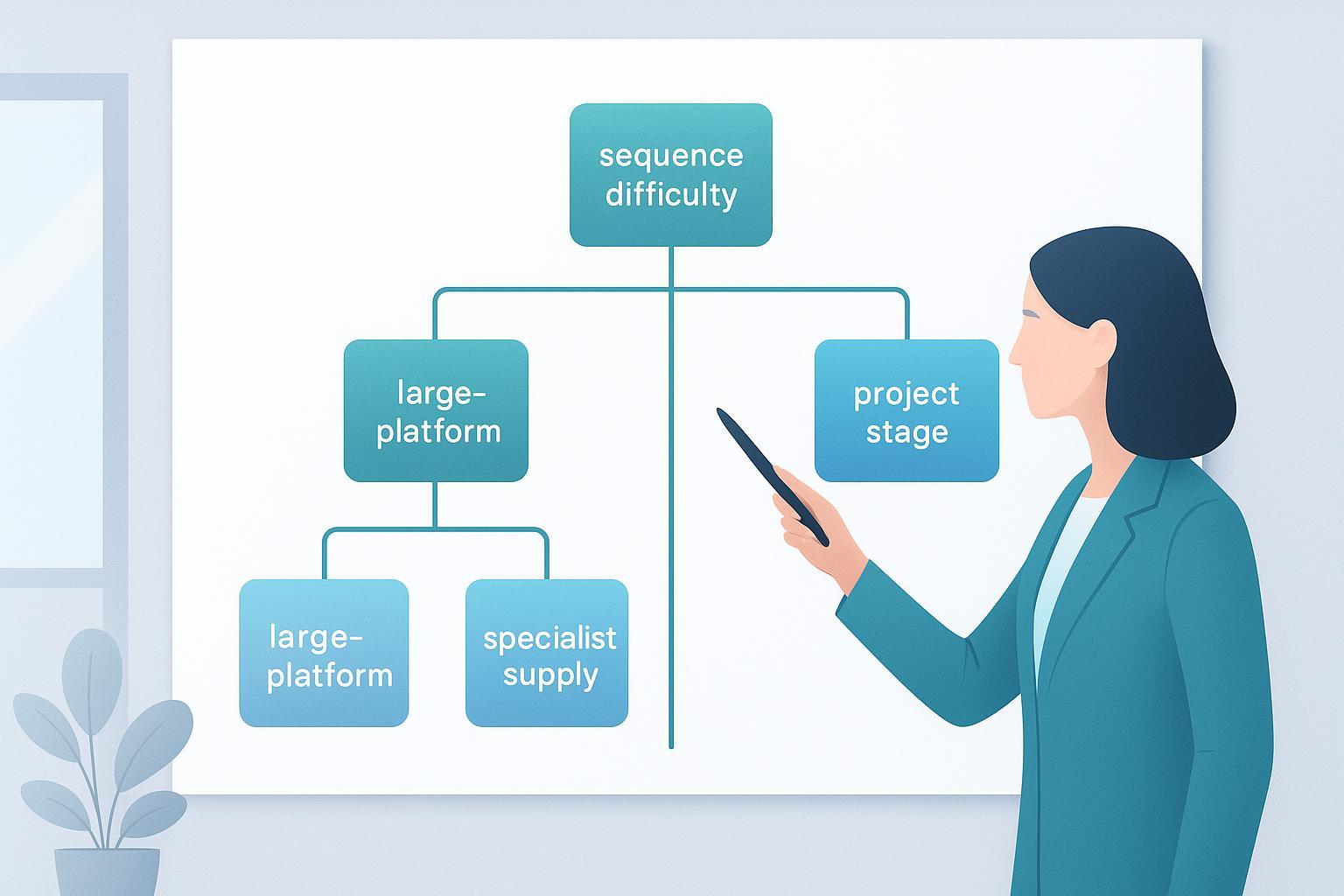
If your sequence is validated and your constraint is capacity, choose a large platform. If your sequence is still fighting you, choose a specialist. Everything else follows from sequence difficulty, project stage, and who owns the process knowledge.
Late-phase scale-up on a validated sequence: A large platform, so you can reserve capacity early and hand auditors documentation that already meets the format they expect.
Dài, kỵ nước, or heavily modified sequences: A specialist, because route flexibility matters more than throughput when the synthesis itself is the risk.
Conjugation or labelling, where the peptide is one component of a larger construct: Whichever supplier will keep the conjugate in scope. Verify that in writing rather than assuming it from a catalogue page.
Neither fits cleanly: Programmes that need a specialist’s early route work and a platform’s later capacity are common. Plan the tech transfer before you need it, not after the first scale-up batch fails.
“It depends” is the honest answer, and what it depends on is sequence difficulty, project stage, and who owns the process knowledge.
Câu hỏi thường gặp
Là nhà cung cấp peptide lớn luôn tốt hơn chuyên gia?
KHÔNG. A large platform wins on repeat-batch consistency, audit-ready documentation and cost per gram at volume; a specialist wins on sequences that fall outside a standard operating envelope and on direct access to the person who ran the synthesis. The useful question is not which model is better in the abstract, but which one fits the sequence, the phase and the timeline you are working to. That is the whole of the peptide supplier scale vs specialization decision.
Sau này tôi có thể chuyển dự án từ chuyên gia sang nền tảng lớn không?
It is technically feasible and common, but the effort depends on the transfer package: synthetic route, phương pháp phân tích, impurity profile and specifications. Ask who owns that documentation before the project starts, not when you decide to leave. A supplier who cannot hand over a complete method package has effectively locked you in.
Tôi có thể sử dụng cả hai nhà cung cấp trên cùng một chương trình không?
Đúng, and it is often the rational choice: a specialist for early route development and difficult analogues, a platform for late-phase and commercial volume. The risk sits at the handoff, where knowledge quietly falls through the gap. Define the transfer package contractually at the point you split the work, not afterwards.
Mô hình nào hỗ trợ phân tích tốt hơn?
Judge the documentation, not the company size. Ask both suppliers to map their release testing and impurity control to the ICH references the EMA synthetic-peptide guideline points to, namely ICH Q3A(R2), Q6A and M7. The supplier that can do this without preparation is the one with real analytical depth.
Là một chuyên gia vẫn có giá trị sử dụng trong 2026?
Đúng. Capacity is tight and new large-scale capacity is slow to arrive: the announced timelines put Building K Phase II into sales only in 2027 and Sisslerfeld only by 2030 (Sản xuất dược phẩm, đã lấy lại 2026-06-11). A specialist can start difficult work sooner while a platform slot is reserved for scale-up.
Phán quyết: kết hợp mô hình nhà cung cấp với dự án của bạn
|
Tiêu chí |
Winning model |
|---|---|
|
Standard or catalogue sequences |
Large-scale supplier |
|
Difficult or non-standard sequences |
Chuyên gia |
|
Sửa đổi phức tạp Cửa hàng and conjugates |
Chuyên gia |
|
Hỗ trợ phân tích và tài liệu |
Depends on the individual supplier, not its size Về |
|
Technical communication speed |
Chuyên gia, for named-chemistry questions |
|
Tính liên tục của dự án và chuyển giao công nghệ Sản xuất peptit |
Large-scale supplier, once the route is fixed |
|
Pricing on routine volume |
Large-scale supplier |
|
Tổng thể |
Matched to sequence difficulty, project stage and who owns the process knowledge |
Supplier size does not decide this. Trình tự khó khăn, project stage and where the process knowledge sits decide it, and a programme can legitimately move from one model to the other as those change.
For transparency: MOL Changes is a peptide vendor, so weigh our specialist column as a set of demands to verify rather than a neutral scorecard.
If you want to test those demands against a supplier, request a capability matrix or analytical documentation, or speak to a technical lead.