Mikä on Ribosomal Exit Tunnel, ja miksi sen koko asettaa kovan rajan venymiselle?
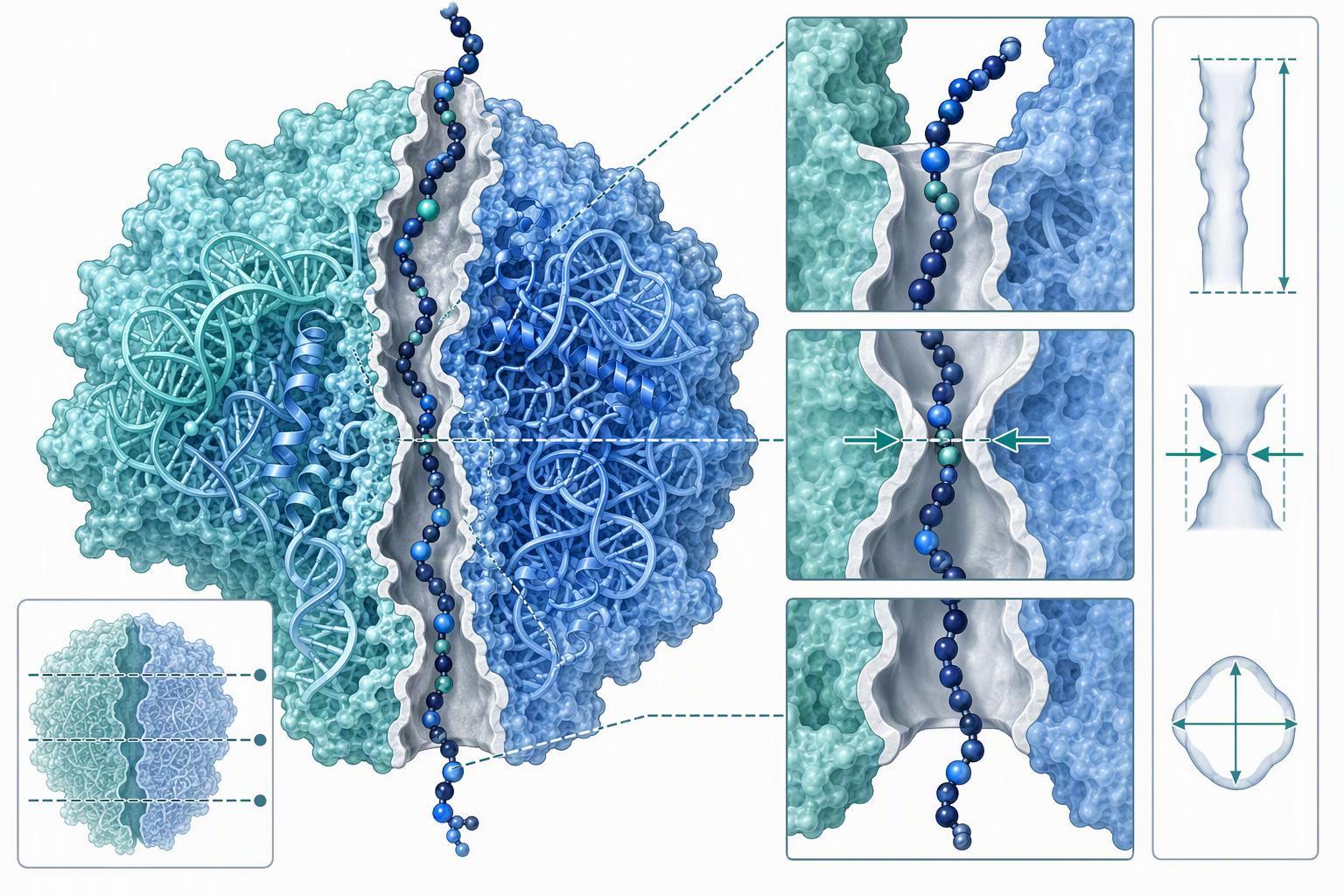
That geometry converts into a residue budget. A fully α-helical polypeptide would bury roughly 23 residues if fully extended and about 53 if fully α-helical, klo 1.5 Å and 3.5 Å per residue respectively (Protein Folding at the Exit Tunnel). Measured protection sits between those estimates: 30–40 residues protected from proteolysis, following Malkin & Rich’s 1967 pulse-chase work on nascent globin in eukaryotic polysomes.

The two figures answer different questions. Proteolysis protection measures what the tunnel shields from enzymes; accommodation measures what fits inside the ribosome. A 2024 preprint synthesis of structural, optical-tweezers and simulation data reports that up to 50 residues can be accommodated, with about 30 C-terminal residues ejected in the final stage (Three epochs of nascent protein translocation through the ribosome exit tunnel, arXiv preprint). The physical bottleneck is the uL4/uL22 constriction, formed by extended loops of those large-subunit proteins (Protein Folding at the Exit Tunnel). The review states the constriction’s identity but not its distance from the PTC, so that distance stays qualitative here rather than estimated.
How Long Does a Nascent Peptide Stay in the Tunnel Before a Release Factor Can Terminate Translation?
There is no measured seconds-scale value for nascent peptide exit tunnel residence time. What time-resolved cryo-EM measures is the accommodation step that precedes release: klo 24 ms reaction time, 25% of ribosome-bound RF1 is in the compact pre-accommodation form, and within 60 ms virtually all ribosome-bound release factors have transformed to their extended forms (The structural basis for release-factor activation during translation termination revealed by time-resolved cryo-EM, Luontoviestintä, 2019).
The same study fixes the peptide’s position at each point. klo 60 ms the RF1-bound ribosome ensemble is dominated by the extended form, with the accommodated complex and the tripeptide still in the exit tunnel; kirjoittaja 45 s the tripeptide density is no longer present in the tunnel. Release factor sequestration during translation termination is therefore not instantaneous, and the window between stop-codon entry and hydrolysis is where sequence-dependent interference acts.
Termination itself is a sequence of defined steps. The release factor binds the A site in a catalytically inactive conformation; on stop-codon recognition the switch loop and domain 3 rearrange, the GGQ motif is inserted into the PTC, and hydrolysis of the peptidyl-tRNA ester bond follows (Structural aspects of translation termination on the ribosome, PMC). The measured release rate combines three elementary steps: release-factor conformational change, hydrolysis of the peptide, and dissociation of the peptide from the ribosome (Dynamic basis of fidelity and speed in translation, PMC, 2017).
That decomposition explains why codon identity matters so much. Changing the codon changed both the release factor’s dissociation rate and the measured release rate by up to three orders of magnitude, with no significant change in the initial association rate. Overall translation runs at approximately 20 amino acids per second in vivo, equivalent to 50 ms per codon, so a tunnel occupancy of 30 to 40 residues corresponds to roughly 1.5 to 2 seconds of transit at that rate. Treat that as a derived estimate, not a measured constant.
Which Sequences Change That Timing, and What Does the Measured Evidence Show?
Against that short window, a handful of sequence motifs reliably tip the balance, and most of them work by interfering with release factor sequestration during translation termination. Proline at the C-terminus next to a stop codon is the dominant arrest signal. A genetic screen of random peptide libraries in E. coli found that the most common cause of stalling, in over 90% of clones, is inefficient termination at the sequence Pro-Stop, with the opal stop codon UGA overrepresented at 23 / 29 clones and Glu overrepresented at 16 / 29 in the −2 position (Genetic Identification of Nascent Peptides That Induce Ribosome Stalling, PMC, 2009). Release is especially inefficient when Pro-Stop is preceded by Asp, Glu, or Pro. This is a single screen, and the frequencies are clone counts from one selection system, not population rates.
Elongation-phase motifs are equally specific. Three consecutive prolines are necessary and sufficient for robust stalling, and robust stalling by PP(X) occurs when X is Asn, Asp, Glu, Gly, Pro, tai Trp (Nascent peptides that block protein synthesis in bacteria, PMC). The same work defines the elongation consensus as RxPP and HGPP, and a termination motif as DTS-stop.
The SecM arrest motif FxxxxWIxxxxGIRAGP shows how far upstream a motif can reach. A Trp side chain 11 residues upstream of the stall site binds near the constriction, the Arg three residues upstream sits close to the PTC, and unreacted Pro-tRNA is bound at the A site (Nascent peptides that block protein synthesis in bacteria, PMC). The critical Pro166 is not incorporated into the stalled chain, and unreacted Pro-tRNA remains in the A site (Modulating the activity of the peptidyl transferase center of the ribosome, PMC, 2008).
A 2025 cryo-EM structure adds a second mechanism at the same step. The PepNL mini-hairpin blocks RF2 at the stop codon: PepNL is a 14-amino-acid ORF that arrests translation at UGA15 by inhibiting RF2, and its penultimate Ile13 occupies the pocket formed by A2451, C2452, and U2506 of 23S rRNA, clashing sterically with the GGQ motif of RF2 (A mini-hairpin shaped nascent peptide blocks translation termination, Luontoviestintä, 2025). After stop-codon read-through the ribosome migrated at approximately one amino acid per minute versus 4.8 to 26.4 per minute in the PURE system.
Key Takeaway: The residues that matter are positional, not compositional. Moving a motif a few residues changes the outcome, and that is the peptide expression truncation risk a sequence file can flag before any bench work starts.
The practical consequence is that proline-rich and penultimate-residue mechanisms recur across independent selection systems, so a C-terminal Pro followed by a stop codon, or a run of prolines mid-sequence, is a flag on the sequence file rather than a surprise at the gel.
Why Do Difficult or Unconventional Sequences Truncate, Stall, or Express Poorly?
Commercial Peptide Synthesis Low yield on a difficult sequence is usually read as one problem. It is at least three, and they need different fixes. Translation-side stalling, stop-codon-independent drop-off, and post-translational instability all reduce the final amount of full-length product, which is why peptide expression truncation risk gets attributed to the wrong step so often.
The translation-side mechanism starts inside the tunnel. The PTC catalyzes peptide bond formation and, together with release factor, peptide release, and its activity is modulated by signaling from the peptide exit tunnel (Modulating the activity of the peptidyl transferase center of the ribosome, RNA Society, 2008). Two named peptides show the direction of that signaling: SecM stalls by inhibiting peptide bond formation, and TnaC suppresses the release-factor-induced hydrolytic activity of the PTC from inside the tunnel. Early elongation is where this is most fragile. Most peptides of five residues would reach a critical region of the PTC cavity, and small residues at positions 3 to 5 impede funneling toward the tunnel, because the conformational freedom they confer keeps the chain from orienting toward the entrance (Jia, Wang & Lehmann, Tieteelliset raportit 11:24061, 2021). The seventh residue sits at the level of U2609.
When stalling is not resolved, quality control takes over. Collided ribosomes are the universal signature of stalling, and stalled ribosomes are defined by an empty mRNA channel in the A site (Detecting and Rescuing Stalled Ribosomes, PMC, 2021). At those ribosomes, Pelota/Dom34 delivered by Hbs1 lacks the GGQ motif and leaves peptidyl-tRNA on the large subunit, while ZNF598/Hel2 ubiquitylates 40S proteins and recruits ASC-1/RQT; the split 60S retains peptidyl-tRNA, which the ribosome quality control pathway degrades (Quality control and signaling pathways at stalled ribosomes, Experimental & Molekyylilääketiede, 2026).
No source read here gives a truncation frequency per se, so treat any percentage you see quoted for a specific sequence as unverified. What is measured is the frequency of the stop-codon-independent drop-off event itself, and that is the number to reason from.
⚠️ Varoitus: Three failure modes, three distinguishing observables. Translation-side stalling shows collided ribosomes and a peptidyl-tRNA pool that quality control is actively clearing. Stop-codon-independent drop-off releases a truncated product while the ribosome keeps translating, so the truncated species appears without a stalled-ribosome signature. Post-translational instability gives full-length product at release that degrades afterwards, so the loss scales with time and handling rather than with expression. Assign your low yield to the wrong one and the construct change you make will not move it.
What Can Be Changed in a Construct to Reduce That Risk?
Peptidi 1 Tehdas If the mechanism is sequence-level, so is the mitigation. The first lever is the C-terminus. Because Pro-Stop is the dominant arrest class and release is especially inefficient when Pro-Stop is preceded by Asp, Glu, or Pro (Genetic Long Peptide Synthesis Identification of Nascent Peptides That Induce Ribosome Stalling), a terminal Pro adjacent to the stop codon is a sequence-level defect that can be removed before any expression run.
The second lever is the proline run. Three consecutive Pro codons are necessary and sufficient for robust stalling, and PP(X) stalls when X is Asn, Asp, Glu, Gly, Pro, tai Trp (Nascent peptides that block protein synthesis in bacteria). The same source reports that EF-P abolishes stalling at polyproline stretches but has little or no effect on other stalling peptides, including RxPP, DTS-stop, and Glu-Pro-stop. That distinction is actionable: polyproline stalling is a host-factor question, while the other motifs are not rescued by EF-P at all.
The third lever is the early chain. Most peptides of five residues would reach a critical region of the PTC cavity, which may result in peptide jamming if the N-terminal residue is not oriented toward the tunnel entrance, and small amino acids in positions 3 to 5 confer high conformational freedom that may prevent the peptide from being funneled toward the tunnel. The 7th amino acid sits at the level of U2609, which may be a key residue ensuring integration of the nascent peptide inside the exit tunnel. Anchoring the initiator methionine in the tunnel would allow the peptide to be straightened from the start.
The fourth lever is the host. Elongation rate in bacteria averages 10 to 20 residues per second and 4 to 5 in eukaryotes, and Stage I, the N-terminus traversing the tunnel, is estimated at 2 to 12 sekuntia (Three epochs of nascent protein translocation through the ribosome exit tunnel, arXiv preprint). A slower ribosome changes how long a marginal motif sits in a position to interfere, which is one reason the same construct can behave differently across hosts.
What Analytical Evidence Is Needed Before a Difficult-Sequence Result Is Treated as Reproducible?
Once the construct is fixed, the remaining question is what evidence makes the result trustworthy. Identity and purity are separate claims and need separate evidence. ICH Q6B requires identity tests that are highly specific to the molecule and states that more than one test may be necessary (Minä Q6B: Tekniset tiedot: Bioteknisten/biologisten tuotteiden testausmenettelyt ja hyväksymiskriteerit, minä, 1999). A single band on a gel is not an identity test.
Purity has to be defined against a method. Peptide purity describes the proportion of the target peptide relative to related synthesis by-products, typistetyt sekvenssit, poistotuotteet, or other impurities visible under the selected analytical method, and a useful specification states the target Peptidi 1 Wholesale puhtaus, the analytical approach, requested documentation, and any special project expectations before production begins. A 95% specification can suit many research and screening workflows, samalla kun 98% may be selected for more demanding analytical, biological, or formulation-sensitive applications.
For a difficult sequence, the failure modes are known and should be named in the specification. Some sequences are inherently difficult due to hydrophobicity, pituus, veloittaa, or propensity to aggregate, and difficulty is driven by sequence behavior, including aggregation, secondary structure, steric effects, or labile motifs, rather than length alone. Higher purity can improve interpretability, but it may increase cost and reduce yield, especially for difficult sequences.
The reproducibility question is answered by lot-level data, not by a certificate of analysis alone. Because truncation arises from a stalled ribosome whose peptidyl-tRNA is degraded by the RQC pathway (Quality control and signaling pathways at stalled ribosomes), a truncated species is a distinct product with its own mass, and it will appear in the same chromatographic window across runs if the construct is unchanged. Lot-specific HPLC and MS data that resolve the truncated species from the target, stated against the method used to define purity, are what make a difficult-sequence result defensible.
When Should a Difficult Sequence Be Made by Chemical Synthesis Instead of Ribosomal Expression?
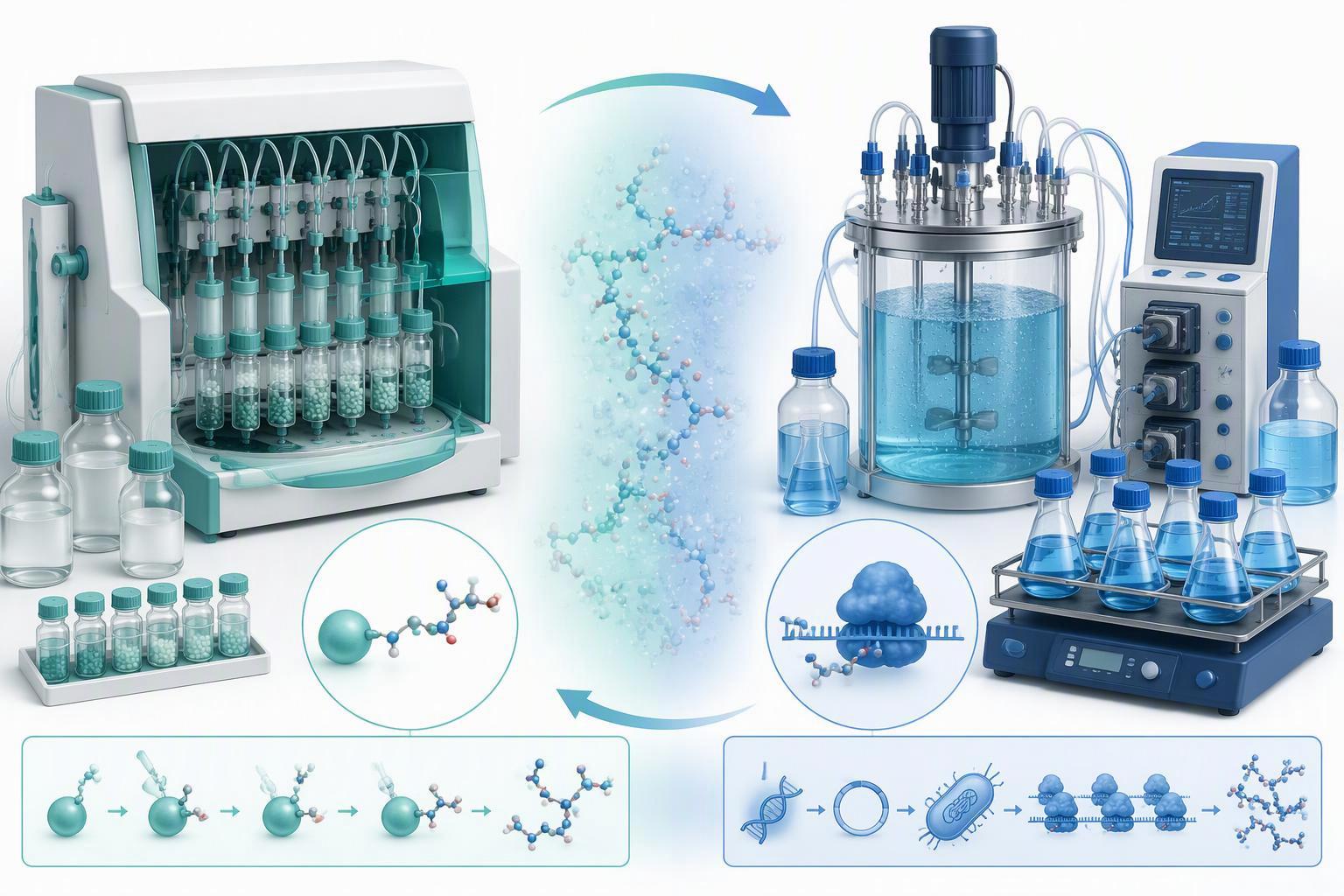
For some sequences, no amount of analytical rigor fixes a route the ribosome will not complete. The market pattern is clear even where the head-to-head data are not: 31 / 38 recently approved small peptide drugs are chemically synthesized, and amino acid length, molekyylipaino, and structural complexity track with whether a drug is made recombinantly or chemically (Chemical vs. Rekombinantti: The Manufacturing Decisions Behind Blockbuster Peptide Drugs, Decibio, 2026). Chemical synthesis suits small to medium quantities with tight purity control; recombinant becomes more cost-effective and scalable at larger quantities and longer sequences. sisään 2021 the FDA issued guidance expecting generic peptide drugs to be produced chemically.
The length threshold is directional, not measured. Sequences over 30 to 50 residues are often flagged as difficult, and difficulty is driven by sequence behavior rather than length alone (Vaikea & Challenging Peptides, Bio-Synthesis). Että 30 to 50 residue threshold is vendor framing rather than a measured result. No controlled head-to-head yield or purity comparison between the two routes exists in the published literature, so the boundary is a trade-off band, not a cutoff.
The mechanism argues the same conclusion from the other side. A sequence that stalls the ribosome will be handled poorly by the ribosomal route regardless of scale, and the arrest motifs are specific enough to check before committing: a C-terminal proline next to a stop codon, a run of three or more prolines, or a penultimate residue that can distort into the GGQ pocket. Where those features are present and the required quantity is small to medium, chemical synthesis removes the ribosomal constraint entirely.
Where the sequence is clean and the quantity is large, the recombinant route’s cost and scale advantages apply. Difficult peptide sequence characterization therefore starts with a route decision made before the first expression run, not a rescue attempted after a truncation ladder appears. Biotinylated Peptide Synthesis
What Do People Get Wrong About the Exit Tunnel?
The second error is assuming the tunnel induces helicity universally. The effect is sequence dependent: FRET work showed a secretory-protein sequence is less helical than a membrane-protein sequence inside the eukaryotic tunnel, and soluble-protein sequences have negligible helicity inside or outside it, while cryo-EM detected helical structure only for sequences with high helical propensity (Protein Folding at the Exit Tunnel). Whether α-helices can form on short nascent peptides during Stage I, before the N-terminus leaves the tunnel, is explicitly not clear in the source.
The third error is reading the 30-to-40-residue figure as a single measured constant. It is a range from proteolysis protection, and it measures something different from the up-to-50-residue accommodation figure (Three epochs of nascent protein translocation through the ribosome exit tunnel, arXiv preprint). Conflating the two produces a capacity estimate that is wrong in both directions.
The fourth error is treating the compact release-factor form as simply inactive. The earlier framing calls it catalytically inactive and the open form catalytically competent (Structural aspects of translation termination on the ribosome), while the time-resolved study calls it pre-accommodation and notes that compact release factors bind the A site regardless of decoding-center conformation, with the selective advantage being rapid binding and dissociation in an accuracy-maximizing state (The structural basis for release-factor activation during translation termination revealed by time-resolved cryo-EM). Pre-accommodated is the more recent and structurally grounded term. Peptidi 2 Toimittaja
The fifth error is expecting EF-P to rescue every proline problem. EF-P abolishes stalling at polyproline stretches but has little or no effect on RxPP, DTS-stop, or Glu-Pro-stop stalling (Nascent peptides that block protein synthesis in bacteria).
Next Steps for a Sequence You Already Suspect
Start with the sequence file, not the expression run. Mark every C-terminal Pro within two residues of a stop codon, every run of three or more consecutive prolines, and the identities of positions 3 kautta 5 and position 7. Those are the features the evidence above ties to stalling, and they are visible before any reagent is committed.
Then decide the route. If the flagged features are present and the quantity is small to medium, chemical synthesis removes the ribosomal constraint, consistent with the pattern that 31 / 38 recently approved small peptide drugs are chemically synthesized (Chemical vs. Rekombinantti: The Manufacturing Decisions Behind Blockbuster Peptide Drugs, Decibio, 2026). If the sequence is clean and the quantity is large, the construct levers, host choice, and the analytical package above are the ones to specify.
Write the specification before production. State the target purity, the analytical approach, the requested documentation, and any special project expectations, and require lot-specific HPLC and MS data that resolve the truncated species from the target against the stated method. ICH Q6B’s requirement that identity tests be highly specific to the molecule, with more than one test where necessary, is the floor rather than the ceiling (Minä Q6B, minä, 1999).
One limit should travel with the plan. No source read here reports a measured seconds-scale residence time for a nascent peptide in the tunnel, and the escape times from simulation, microseconds to milliseconds, have not been experimentally validated (Three epochs of nascent protein translocation through the ribosome exit tunnel, arXiv preprint). Residence time is a derived quantity, and any supplier conversation that treats it as a measured constant is ahead of the evidence.
Usein kysytyt kysymykset
Does the exit tunnel’s width limit which peptides can be expressed?
Ei. The tunnel is wide enough for a fully extended chain and even an α-helix, so size alone rarely blocks expression. The limit is kinetic: a sequence that holds the nascent chain in the tunnel too long, or in the wrong register, can stall elongation or interfere with release. Width sets the geometry; timing sets the outcome.
Are stalling and truncation the same failure?
Ei, and treating them as one sends troubleshooting in the wrong direction. Stalling is a pause in elongation, and the ribosome can often resume once the obstacle clears. Truncation is the permanent result: the ribosome terminates early, or the full-length product is degraded, and the shorter chain is what you recover. A stall that resolves leaves no truncated species; a stall that does not resolve usually does.
How do I tell a translation-side problem from a solubility problem?
Look at where the product goes, not just how much you get. A translation-side problem gives a ladder of shorter bands on gel, which points to premature termination inside the tunnel. A solubility problem gives the right molecular weight in the insoluble fraction, with little or none in the soluble pool. Run both fractions before changing the construct, because the fix is different for each.
Can codon optimization rescue a stalling motif?
Synonymous codon changes preserve the encoded peptide motif but can alter translation kinetics and mRNA behavior. They may affect expression or pausing in some contexts without necessarily removing a peptide-mediated arrest mechanism. Test the proposed change experimentally.
What purity specification suits a difficult sequence?
Set the target before production, ei jälkeen. A 95% specification can suit many research and screening workflows, samalla kun 98% may be selected for demanding analytical, biological, or formulation-sensitive work; higher purity can improve interpretability but may raise cost and lower yield for a difficult sequence. Identity should be confirmed by tests highly specific to the molecule, with more than one test where necessary (Minä Q6B, minä, 1999).
Can the residence-time estimate be used predictively today?
Not as a quantitative predictor. The residence-time figures come from structural and single-molecule work on specific sequences and conditions, and they are not a general model that takes an arbitrary sequence and returns a stall probability. Use them to reason about which constructs carry higher risk and to decide what to measure, then confirm with your own expression and characterization data.
Johtopäätös
The design response follows from those anchors. Flag C-terminal Pro adjacent to a stop codon, flag runs of three or more prolines, check positions 3 kautta 5 and position 7, and choose the host with the elongation rate in mind. Where the flagged features are present and the quantity is small to medium, chemical synthesis removes the ribosomal constraint; where the sequence is clean and the quantity is large, the construct levers and the analytical package carry the risk.
Two limits should travel with any decision. Residence time in the tunnel is a derived quantity, not a measured constant, and the simulation-based escape times have not been experimentally validated. The distance from the PTC to the constriction was not confirmed in the sources read here. A supplier conversation that is precise about those limits, and about the lot-level HPLC and MS data that will resolve a truncated species from the target, is the one that will hold up when the next run is compared to the last.
About the publisher. MOL Changes is a peptide research and development organisation that offers custom sequence design, synthesis and production, including solid-phase and microbial fermentation routes. It therefore has a commercial interest in how difficult sequences are made, and readers should weigh its perspective with that in mind. The guidance above stands on its own and does not depend on its services.