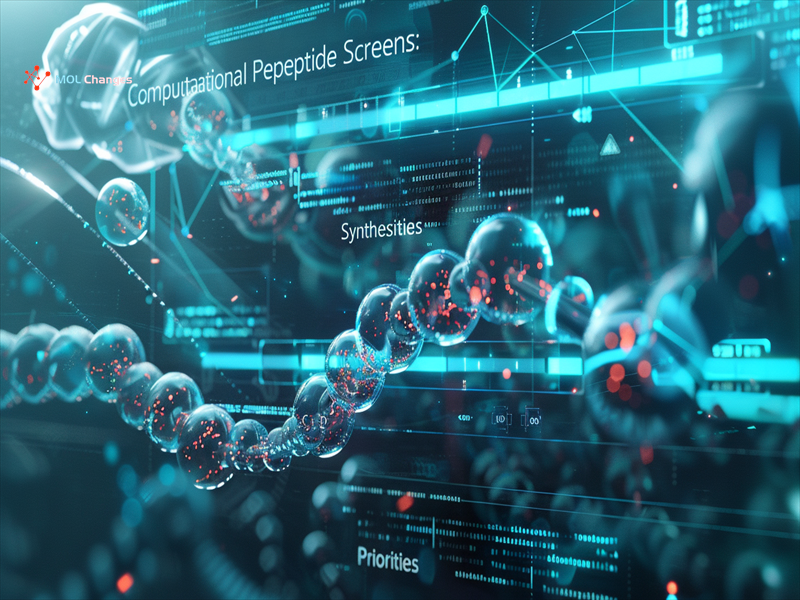
Écrans peptidiques informatiques: Priorités de synthèse
Criblage virtuel à haut débit, IA générative, et les simulations de dynamique moléculaire ont fondamentalement modifié la découverte de peptides à un stade précoce. Les plateformes informatiques modernes peuvent évaluer des millions de séquences candidates en quelques heures, prioriser les coups en fonction de l'énergie libre contraignante (D G lier), densité de contact interfacial, et sélectivité cible prévue. Cependant, les équipes de recherche biopharmaceutique se heurtent souvent à un goulot d'étranglement frustrant lors de la transition des résultats in silico à la validation physique en laboratoire humide: les succès virtuels les mieux classés s'avèrent souvent extrêmement difficiles à synthétiser, purifier, ou dissoudre dans des essais biologiques primaires.

Un peptide optimisé informatiquement qui se classe parmi les meilleurs 0.1% d'un écran virtuel peut facilement échouer lors de la synthèse peptidique en phase solide (SPSS) en raison de l'agrégation inter-chaînes de base, précipiter dans un gel intraitable pendant l'acide trifluoroacétique (ATF) clivage, ou former des assemblages colloïdaux qui génèrent des signaux faussement positifs dans les tests de dépistage. Résoudre ces frictions nécessite d'aller au-delà du dépannage post-hoc. Biopharma R&Les équipes D doivent adopter une approche intégrée flux de travail de triage des peptides qui évalue Responsabilités de la synthèse du criblage informatique des peptides avant de soumettre les séquences à la résine du synthétiseur.
En examinant « Peptide VB », un candidat informatique représentatif de 22 mers conçu pour cibler une interaction protéine-protéine (IPP) interface : cet article décrit un cadre de décision hiérarchisé. Nous examinons comment interpréter les modèles de contact informatiques, cartographier les responsabilités physiques prévues telles que les taches hydrophobes et le risque d'agrégation, et traduire ces prédictions en décisions concrètes de synthèse chimique, y compris les balises solubilisantes, agrafage aux hydrocarbures, et un étiquetage spécifique au site - pour fournir du matériel prêt à être analysé plus rapidement et avec moins d'itérations expérimentales.
À propos de l'auteur:
Docteur. Aris Vance, Doctorat. | Directeur Scientifique & Responsable de la chimie des peptides chez MOL Changes
Docteur. Vance amène 18 années d'expérience dans la conception rationnelle de médicaments, synthèse peptidique en phase solide (SPSS), et tri informatique des hits. Il dirige l'équipe de recherche et développement chez MOL Changes, relier les prédictions de l'apprentissage automatique avec la synthèse chimique personnalisée et la classe 100 fabrication stérile.
Triage informatique des hits: Décoder les modèles de contact interfacial & Mesures structurelles
Quand les bibliothèques virtuelles de criblage produisent des centaines de classeurs potentiels, l'instinct par défaut est souvent de classer les séquences strictement en liant l'énergie libre (D G lier) ou score d'amarrage. Cependant, un Examen de l'IJMS sur le criblage et la validation d'une bibliothèque virtuelle de peptides (2024) souligne que les scores d'amarrage non raffinés sélectionnent fréquemment une surface hydrophobe excessive plutôt que de vrais, contacts complémentaires spécifiques électrostatiques et à liaison hydrogène. Fabricant de tests peptidiques
Pour établir un système efficace flux de travail de triage des peptides, les résultats des calculs doivent être systématiquement évalués par rapport aux paramètres de développement physique pour identifier Responsabilités de la synthèse du criblage informatique des peptides au début de la découverte:

1. Densité de contact interfacial vs. Emballage hydrophobe non spécifique
Les interfaces PPI à haute affinité reposent fréquemment sur des points chauds hydrophobes (par ex., Leu, Avec, Phé, Résidus Trp). Cependant, lorsqu'un impact prédit affiche une carte de contact hydrophobe contiguë couvrant quatre résidus consécutifs ou plus, la force motrice de la cible Hexapeptide 2 la liaison est physiquement impossible à distinguer de la force motrice de l’auto-association. Pendant le tri informatique des hits, les cartes de contact doivent être filtrées pour distinguer les réseaux directionnels de liaisons hydrogène et les ponts salins des zones non polaires contiguës.
2. Surface accessible aux solvants (MAINTENANT) et moment hydrophobe
Fournisseur d'usine de peptides Évaluation du moment hydrophobe (mu_H) et l'amphipathicité révèle si les résidus hydrophobes sont séquestrés le long d'une face d'une hélice α ou répartis de manière aléatoire sur la séquence. Un moment hydrophobe élevé combiné à un SASA non polaire total important signale que le peptide présentera de fortes tendances à l'auto-assemblage amphipathique dans les systèmes tampons aqueux., conduisant à une agrégation micellaire ou fibrillaire.
3. Charge nette et point isoélectrique (pi) Étalonnage
Peptides possédant une charge nette proche de la neutralité (charge nette -1 à +1) à pH physiologique (pH 7.4) manque de forces de répulsion électrostatiques. Sans répulsion coulombienne pour maintenir les chaînes peptidiques individuelles séparées en solution, van der Waals et les interactions hydrophobes dominent, provoquant des précipitations rapides et créant d'importantes Responsabilités de la synthèse du criblage informatique des peptides.
| Paramètre de sortie informatique | Interprétation structurelle physique | Synthèse en laboratoire humide & Gestion de la responsabilité | Seuil d'action de triage |
|---|---|---|---|
| D G lier / Score d'amarrage | Force d’interaction cible prévue | Une dépendance excessive à l'égard de contacts non polaires peut masquer une liaison hors cible ou une auto-agrégation | Filtre en haut 5% résultats contre les scores de développement |
| Contacts hydrophobes contigus | Interface de liaison non polaire étendue | Effondrement des feuilles β inter-chaînes pendant SPPS; insolubilité post-clivage | Marquer les parcours non polaires contigus >4 résidus |
| Moment hydrophobe (mu_H) | Alignement structurel amphipathique | Formation de micelles tensioactives; interférence de test colloïdal | Calculer la propension amphipathique sur les faces hélicoïdales |
| Charge nette au pH 7.4 | Capacité de stabilisation électrostatique | Précipitation isoélectrique; faible dissolution aqueuse dans les milieux de test | Signaler les frais nets entre -1.0 et +1.0 |
| Flexibilité du RMSF de base | Entropie conformationnelle locale | Pénalité entropique lors de la liaison; boucles non structurées sur disquette | Nécessite une pré-organisation de structure secondaire stable |
Cartographie des passifs de synthèse physique: Des signatures In Silico aux échecs du Wet-Lab
Pour illustrer comment les signatures informatiques se traduisent en obstacles physiques, considérer le profil de Peptide VB:
Profil du candidat Peptide VB:
- Longueur de la séquence: 22 acides aminés
- Cible: Domaine de liaison intracellulaire à l'IPP
- Prédit In Silico Affinité: Kd = 14 nM (Δ G liaison = -10.8 kcal/mole)
- Attributs de séquence: Contient un noyau hydrophobe à 6 résidus (
-Leu-Phe-Val-Trp-Ile-Leu-), un pI calculé de $6.2$, une charge nette de $0$ au pH 7.4, et une SAUCE (Grande moyenne d'hydropathicité) score de +0.68.
Alors que Peptide VB représente un succès informatique exceptionnel, son profil de séquence présente presque toutes les responsabilités classiques pour la synthèse chimique et l'évaluation biologique. Sans intervention structurelle, l'envoi du Peptide VB directement au Fmoc-SPPS standard entraîne de graves modes de défaillance opérationnelle:
Coup virtuel: Peptide VB
▼ (Synthèse non modifiée)
- Défaillance du gonflement de la résine ► Agrégation des feuillets β inter-chaînes lors du couplage
- Précipitation du clivage ► Formation de gel amorphe lors du clivage du TFA
- Purification du brut ► Élargissement sévère du pic RP-HPLC (<35% pureté brute)
- Échec du test primaire ► Agrégation colloïdale dans du PBS (Faux négatif / toxicité)
1. Agrégation de feuilles β inter-chaînes pendant SPPS
Au fur et à mesure que la chaîne peptidique s'allonge sur le support solide (par ex., Résine Wang ou Rink Amide), des séquences hydrophobes comme le -Leu-Phe-Val-Trp-Ile-Leu- le motif dans le Peptide VB forme de vastes réseaux de feuilles β inter-chaînes liées à l'hydrogène. Ce phénomène, connu sous le nom d’effondrement de la résine ou « agrégation de séquences difficiles »," limite sévèrement le gonflement de la résine et empêche les acides aminés activés entrants d'accéder à l'amine N-terminale. Le résultat est un couplage incomplet, séquences de suppression étendues ($n-1, n-2$), et des rendements bruts considérablement réduits.
2. Clivage et précipitations du TFA
Une fois l'assemblage de la chaîne terminé, déprotection globale et clivage de la résine à l'aide de combinaisons de cocktails TFA standards (par ex., ATF / TIS / H₂O / HAE) exposer les chaînes latérales hydrophobes entièrement déprotégées. Pour la conduite de motifs séquentiels agrégation peptidique de patchs hydrophobes, l'élimination des groupes protecteurs élimine l'encombrement stérique qui inhibait auparavant l'auto-association. Après avoir laissé tomber le filtrat de clivage dans de l'éther diéthylique froid, Le Peptide VB forme un insoluble, précipité caoutchouteux ou émulsion persistante qui ne peut pas être isolé proprement par centrifugation.
3. Insolubilité aqueuse et artefacts de test
Même si de petites quantités de peptide VB sont purifiées avec succès via une chromatographie liquide haute performance en phase inverse préparative (RP-HPLC), son pi neutre et son score GRAVY élevé signifient qu'il nécessite des concentrations élevées de co-solvants organiques (par ex., >20% DMSO) rester en solution. Un Étude ACS sur les limites de solvatation et d'agrégation du squelette peptidique (2018) démontré qu'une solubilité aqueuse plus élevée est directement corrélée à une durée réduite passée dans des amas agrégés auto-associés. Lorsqu'il est dilué dans des tampons aqueux pour tests primaires (comme le PBS à pH 7.4), les peptides hydrophobes subissent une microprécipitation ou forment des agrégats colloïdaux, produisant une cinétique de liaison erratique, inhibition des faux positifs, ou perturbation non spécifique de la membrane dans les tests cellulaires.
Traduire les prédictions in silico en modifications chimiques ciblées
Plutôt que d'abandonner les hits à haute affinité comme Peptide VB, les chercheurs peuvent appliquer des modifications chimiques stratégiques lors de la conception des séquences pour surmonter Responsabilités de la synthèse du criblage informatique des peptides. Ces modifications préservent la face critique de la liaison à l'objectif tout en atténuant les responsabilités physiques. L'intégration de ces stratégies dans le plan de synthèse constitue le cœur d'un flux de travail efficace pour relier les prédictions peptidiques de l’apprentissage automatique aux séquences prêtes pour le laboratoire.
Triage informatique des hits
Responsabilité de solubilité Responsabilité conformationnelle • Etiquettes Poly-Lys/Arg • Agrafage d'hydrocarbures • Isopeptides O-acyles (je, je+4 / je, je+7) • Protection du squelette • Macrocyclisation
Besoins en matière de lecture du test • Biotine N/C-Terminal • Fluorophores (FITC/Cy5) • Entretoises Ahx Linker
1. Amélioration de la solubilité via des étiquettes de solubilité peptidique et des options d'agrafage
Lorsque le dépistage informatique identifie un impact présentant une hydrophobicité extrême ou une charge nette neutre, les modifications solubilisantes doivent être incorporées directement dans le schéma SPPS. Combinaison étiquettes de solubilité des peptides et agrafage les technologies offrent une double solution pour la manipulation et la stabilité structurelle:
- Étiquettes polycationiques clivables (Poly-Lys / Poly-Arg): Fixation d'une étiquette hydrophile temporaire, telle qu'une penta-lysine (K₅) ou hexa-arginine (R₆) séquence - à l'extrémité C-terminale ou N-terminale via un lieur labile ou sans trace modifie considérablement le profil de solvatation du peptide. Recherche JACS sur des étiquettes de synthèse poly-cationiques clivables (2024) a confirmé que les étiquettes polycationiques inhibent l'agrégation dépendante de la séquence lors de l'assemblage de la chaîne sur la résine et maintiennent une solubilité élevée pendant le clivage du TFA et la purification par RP-HPLC. Suite à la purification, traitement bref avec une base aqueuse (ou clivage enzymatique) supprime la balise sans trace, donnant la séquence native avec une grande pureté.
- Protection du squelette O-acyle isopeptide: Pour les séquences sujettes à l’agrégation des feuilles β inter-chaînes pendant le SPPS, le remplacement des résidus clés sérine ou thréonine par des unités isopeptidiques O-acyle réorganise le squelette peptidique d'une liaison amide à une liaison ester. Cela introduit un pli structurel qui perturbe physiquement l'emballage de la feuille β sur la résine.. Après synthèse et purification à pH acide, incuber le peptide purifié dans un tampon de test neutre (pH 7.4) déclenche une évaluation quantitative, Changement spontané d'acyle O → N qui restaure le squelette peptidique natif.
2. Stabilisation conformationnelle: Agrafage aux hydrocarbures & Cyclisation
Les peptides linéaires flexibles souffrent souvent de pénalités entropiques élevées lors de la liaison, dégradation protéolytique rapide dans le sérum (t 1/2 < 15 min), et l'exposition d'amides hydrophobes du squelette qui favorisent agrégation peptidique de patchs hydrophobes.
- Agrafage aux hydrocarbures ($je, je+4$ et $je, je+7$): En remplaçant deux acides aminés non critiques situés sur la face non liante d'une hélice α par des α non naturels, Acides aminés α-disubstitués portant des chaînes latérales oléfiniques (par ex., S₅ ou R₈), métathèse de fermeture de cycle catalysée par le ruthénium (MRC) crée une réticulation entièrement hydrocarbure ("agrafe"). L'agrafage verrouille le peptide dans une conformation α-hélicoïdale active, protège les liaisons amide du squelette du clivage des protéases, et peut améliorer la perméabilité cellulaire tout en réduisant l'agrégation non spécifique.
- Tête-bêche & Macrocyclisation des chaînes latérales: Conversion de coups linéaires en structures cycliques via des liaisons disulfure, ponts lactames, ou les liaisons thioéther restreignent la liberté conformationnelle, empêcher le peptide d'adopter des géométries étendues de brin β qui conduisent à une fibrillation de type amyloïde.
3. Modification peptidique prête pour le test: Étiquetage spécifique au site & Entretoises
Passer rapidement de la synthèse aux essais biochimiques (par ex., Résonance Plasmon de Surface [SPR], Interférométrie de biocouche [DEVENIR], ou polarisation de fluorescence [FP]), le peptide doit subir modification peptidique prête à l'analyse. Cependant, placer un fluorophore volumineux ou une molécule de biotine directement à côté du domaine de liaison peut perturber l'engagement de la cible. Dipeptide
- Insertion de linkers flexibles (Ahhh / PEG_4): Installer un neutre, espaceur flexible tel que l'acide 6-aminohexanoïque (Ahhh) ou un court polyéthylène glycol (PEG_4) la poignée entre l'extrémité peptidique et l'étiquette fonctionnelle assure la séparation spatiale, empêchant l'empêchement stérique pendant la liaison à la cible.
- Étiquetage régiosélectif: Conjugaison de biotine ou d'isothiocyanate de fluorescéine (FITC) sur résine via des stratégies de groupes protecteurs orthogonaux (par ex., Lys(Mtt) ou Lys(Allouer)) garanties 100% fonctionnalisation spécifique au site avant le clivage final, complétant le modification peptidique prête à l'analyse processus.
Responsabilité In Silico prévue Mécanisme structurel Stratégie de modification chimique recommandée Synthèse primaire & Avantage du test Haute hydrophobie / Faible solubilité Manque de solvatation polaire; pi neutre Étiquette poly-Lysine/Arginine temporaire via un lieur base-labile Empêche l'effondrement de la résine; permet la purification HPLC en milieu aqueux Agrégation de feuilles β sur résine Liaison hydrogène du squelette inter-chaînes O-Acyl Isopeptide ou dipeptides pseudoproline sur les sites Ser/Thr/Pro Perturbe la structure secondaire pendant le SPPS; décalage spontané O → N après purification Instabilité protéolytique & Entropie élevée Structure linéaire disquette; accès rapide aux protéases Agrafage aux hydrocarbures ($je, je+4$ ou $je, i+7$ métathèse d'oléfine) Pré-organise l'hélice α active; améliore la demi-vie sérique (t 1/2) et l'absorption cellulaire Agrégation conformationnelle élevée Rotation des terminaux sans contrainte Disulfure, lactame, ou macrocyclisation du thioéther Restreint la flexibilité du réseau principal; élimine les conformations sujettes aux fibrilles Analyser l'obstacle stérique / Ingérence Fixation directe d'étiquettes volumineuses à l'interface de reliure Conjugaison terminale régiosélective via des lieurs flexibles Ahx ou PEG_4 Préserve l’affinité cible (Kd); fournit des poignées de lecture prêtes pour les tests
Vérification analytique & Contrôle qualité pour la préparation aux tests
Fournisseur d'usine de peptides Une stratégie de modification conçue pour éliminer Responsabilités de la synthèse du criblage informatique des peptides est aussi robuste que sa vérification analytique. La fourniture d’un véritable matériel peptidique prêt à l’analyse nécessite des protocoles de contrôle qualité rigoureux qui valident l’intégrité structurelle, pureté, et absence de contaminants interférant avec les tests.
Synthèse ciblée & Modification
RP-HPLC analytique ► Vérification de la pureté (≥95 % à 98 % de surface sous la courbe) ESI-MS haute résolution ► Masse monoisotopique & Classe de confirmation de modification 100 Traitement en salle blanche ► Contrôle des endotoxines (<0.5 UE/mg) pour les essais biologiques
1. Spectrométrie de masse haute résolution (SGRH/ESI-MS)
Chaque lot synthétisé doit subir une confirmation de masse monoisotopique via la spectrométrie de masse à ionisation par électrospray (ESI-MS) ou temps de vol de désorption/ionisation laser assisté par matrice (MALDI-TOF). Pour les candidats modifiés contenant des hydrocarbures de base, disulfures cycliques, ou des conjugués biotine/fluorophore, La fragmentation MS ou l'analyse de masse à haute résolution confirme la stœchiométrie chimique correcte et exclut les adduits de modification incomplets.
2. Profils de pureté analytiques RP-HPLC
Les tests de liaison primaire et les études structurelles exigent un matériau ultra-pur (≥ 95% ou ≥ 98% pureté par HPLC AUC à 220 nm et 280 nm). Profils analytiques RP-HPLC Kpv devrait présenter une netteté, pics symétriques sans large contamination des épaules, signe de diastéréomères, séquences de suppression, ou oligomères solubles.
3. Manipulation stérile et spécifications à faible teneur en endotoxines
Pour les tests de transduction de signal cellulaire ou les études pharmacocinétiques in vivo, les préparations peptidiques traitées dans des environnements non contrôlés risquent d'être contaminées par des lipopolysaccharides bactériens (LPS/endotoxines). Les endotoxines induisent un récepteur de type péage non spécifique (TLR4) activation, conduisant à une toxicité cellulaire et à de fausses données. Produire des peptides en classe 100 les environnements de salle blanche ultra-stériles garantissent que les niveaux d'endotoxines restent inférieurs aux seuils biopharmaceutiques stricts (<0.5 UE/mg).
Accélérer l’optimisation des leads peptidiques: Un plan d’action priorisé
En reliant les mesures de conception informatique avec des modifications chimiques spécialisées, les équipes de recherche biopharmaceutique peuvent éliminer le cycle itératif d’essais et d’erreurs qui bloque fréquemment les campagnes de découverte de peptides.
• Classer les candidats selon les scores complémentaires de liaison ΔG et de carte de contact.. • Filtre contre la surface hydrophobe, SAUCE, et charge nette. • Sélectionnez des balises solubilisantes clivables pour des hits hautement hydrophobes..
ÉTAPE PRIORITÉE DU FLUX DE TRAVAIL D'OPTIMISATION DES PLOMBES PEPTIDIQUES 1: ÉTAPE DE TRIAGE DES HITS PAR CALCUL 2: CARTOGRAPHIE DE RESPONSABILITÉ IN SILICO • Identifier les parcours apolaires contigus (>4 résidus). • Prédire les risques d'agrégation sur résine et d'insolubilité aqueuse. ÉTAPE 3: CONCEPTION DE MODIFICATIONS CHIMIQUES CIBLÉES • Incorporer des hydrocarbures de base (je, je+4) pour les hélices α disquettes. • Positionnez les étiquettes Biotine/FITC avec des espaceurs Ahx flexibles.. ÉTAPE 4: SYNTHÈSE D'EXPERTS & VÉRIFICATION ANALYTIQUE du CoA • Exécuter Fmoc-SPPS avec des matrices de résine spécialisées. • Valider via RP-HPLC (≥95%+), ESI-MS, et tests d'endotoxines.
Traduire des hits virtuels comme Peptide VB en physiques, Les sondes prêtes pour les tests nécessitent un partenaire de synthèse capable d'exécuter des modifications chimiques complexes selon des normes élevées de pureté et de contrôle stérile..
Grâce à notre plateforme spécialisée de recherche et de fabrication, services de synthèse peptidique sur mesure et de modification spécialisée chez MOL Changes fournit aux équipes biopharmaceutiques un soutien de bout en bout, du triage initial des séquences et de la stratégie de modification à la classe 100 fabrication stérile, installation d'étiquettes de solubilisation personnalisées, macrocyclisation, et certificat d'analyse HPLC/MS complet (CoA) documentation.
En alignant les prédictions informatiques sur la synthèse chimique sur mesure dès le premier jour, les chercheurs peuvent faire progresser en toute confiance leurs peptides candidats les plus prometteurs vers les tests de dépistage plus rapidement, avec une plus grande confiance, et avec des coûts d'itération considérablement réduits.