경쟁사 제품 이동 (펩타이드 펜, GenScript의 GMP 유사 mRNA) 그리고 펩타이드 서비스 제공자에게 보내는 신호
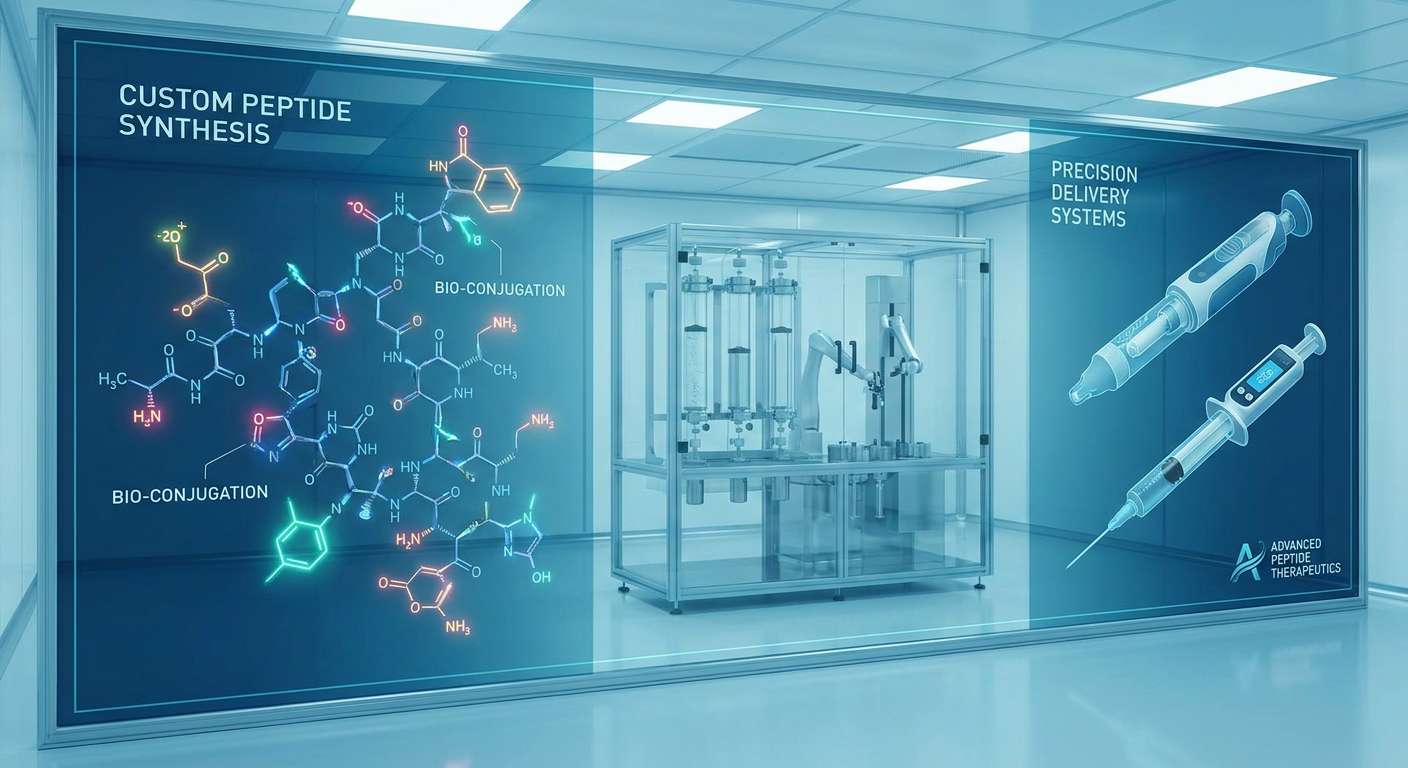
The life sciences outsourcing landscape is undergoing a structural realignment. Recent high-profile commercial moves—ranging from GenScript’s introduction of a bridge-tier GMP-like mRNA platform to the rapid proliferation of ready-to-use Peptide Pen delivery devices—highlight a decisive shift in biopharmaceutical procurement behavior.
Biopharma sponsors, 학술 수석 조사관, 그리고 화장품 R&D teams no longer evaluate Contract Research Organizations (CRO) and Contract Development and Manufacturing Organizations (CDMO) on raw synthesis capacity alone. 대신에, market pressure points are converging on three demands: end-to-end operational convenience, phase-appropriate regulatory alignment, 그리고 delivery-integrated molecular design.
For custom peptide vendors, these market signals carry a clear message: competing solely on low unit price or accelerated turnaround time leads directly to commoditization and margin erosion. Sustainable growth requires a shift toward peptide service provider differentiation anchored in deep analytical characterization, tailored chemical modification expertise, and transparent, sterile manufacturing standards.
The Strategic Catalyst: Analyzing GenScript’s GMP-like mRNA and the Peptide Pen Craze
To understand what biopharma clients expect from peptide suppliers, service providers must first analyze the market forces driving recent platform launches in adjacent therapeutic sectors.
GenScript’s GMP-like mRNA: Normalizing Phase-Appropriate Quality
In drug development, transitioning from discovery-grade material to clinical-grade cGMP lots has historically presented a steep cost and timeline cliff. 에 따르면 FierceBiotech’s analysis of GenScript’s GMP-like mRNA platform launch (2025), life science suppliers are addressing this friction by introducing phase-appropriate quality tiers specifically engineered for preclinical and Investigational New Drug (IND)-enabling studies.
Manufactured within ISO 7 / Grade C cleanroom environments, these intermediate platforms incorporate full batch traceability, standardized double-stranded RNA impurity profiling, and comprehensive IND-support documentation. They deliver turnaround times as fast as seven weeks without imposing full cGMP pricing.
핵심 내용: The success of phase-appropriate platforms proves that biopharma R&D teams prioritize vendors offering structured, regulatory-ready documentation packages over providers offering crude research-use-only (까지) reagents with minimal quality guarantees.
The Peptide Pen Shift: Moving Delivery Convenience Upstream
동시에, the surge in metabolic disease therapeutics—specifically GLP-1, 깁, and glucagon receptor co-agonists—has accelerated the adoption of pre-filled, click-dial peptide injection pens. Recent device innovations, ~와 같은 5 mL dosing configurations and dual-chamber liquid-stable cartridges, eliminate the need for manual lyophilized powder reconstitution at the point of care.
This phenomenon signals that end-user administration mechanics and formulation stability are moving upstream into early-stage sequence design. When researchers and clinical sponsors select a peptide partner, they increasingly look for synthesis workflows capable of accommodating liquid-stable buffers, specialized lipidation, and sterile filling compatibility from day one.
The Trap of Commoditization: Why Competing on Speed and Price Alone Fails
When service providers compete primarily on turn-around speed or discount pricing, they invariably compromise on quality control, cleanroom protocols, or analytical depth. In complex peptide chemistry, these compromises lead directly to project failure during scale-up.
Low-Cost CRO Model:
Fast Lead Time + Minimal QC → Impurity Spikes → Batch Failure at Scale
Integrated CDMO Model:
Orthogonal Testing + Cleanroom Synthesis → Proven Purity → Seamless IND Transition
High Sequence Failure Rates in Complex Candidates
Standard automated Solid-Phase Peptide Synthesis (SPSS) works adequately for short, linear, hydrophilic sequences. 하지만, modern therapeutic and cosmetic pipelines increasingly feature “difficult” sequences characterized by:
- Extreme hydrophobicity and aggregation-prone hydrophobic patches
- Long-chain constructs exceeding 40 에게 80 아미노산
- Multiple native disulfide bridges requiring strict, selective folding pathways
Discount providers relying on standard coupling reagents frequently yield crude mixtures with heavy deletion sequences or misfolded isomers. Without rigorous characterization, these impurities pass undetected until in vitro or in vivo assays fail, wasting months of client research effort. Alpha Elite Peptides Laboratory
Scale-Up Pure Yield Decay and Contamination Risks
A common friction point for biopharma sponsors is the transition from milligram-scale screening to kilogram-scale pilot production. Low-cost vendors often lack Class 100 cleanroom facilities or validated microbial fermentation infrastructure. 따라서, scaling up exposes the product to severe purity degradation, residual solvent contamination, or bioburden spikes—rendering the batch unviable for preclinical safety evaluations.
Three Pillars of Strategic Differentiation for Peptide Service Providers
To escape the commodity trap, forward-thinking peptide vendors must rebuild their value proposition around three core technical pillars.
의사 1: Deep Analytical Testing & Uncompromising Quality Verification
분석 증명서 (CoA) should be a verifiable scientific document, not a promotional check-box. Leading research teams require complete transparency regarding impurity profiles and structural fidelity.
Service providers achieve technical leadership by incorporating orthogonal analytical testing directly into standard delivery packages:
- 고성능 액체 크로마토그래피 (HPLC): Dual-wavelength analytical HPLC establishing exact purity thresholds (≥98% for therapeutic candidates).
- 질량분석법 (MS) & Tandem MS: High-resolution Electrospray Ionization (ESI-MS) or MALDI-TOF verifying exact monoisotopic mass and identifying trace deletion peptides.
- Counter-Ion Content & Residual Solvent Profiling: Precise quantification of trifluoroacetate (TFA) salt levels, 수분 함량, and heavy metal limits via Inductively Coupled Plasma Mass Spectrometry (ICP-MS).
- Peptide Pharma Manufacturer Sterility and Endotoxin Validation: LAL testing ensuring bioburden limits satisfy strict parenteral standards aligned with FDA and EMA pharmacopeial guidelines (예를 들어, USP <85> Endotoxin Testing and ICH Q3A/Q3B impurity thresholds for synthetic peptides).
팁의 경우: Providing raw, downloadable HPLC chromatograms and mass spectra alongside verified CoAs builds immediate institutional trust with quality assurance (품질보증) directors and procurement auditors.
의사 2: Tailored Modification Expertise for Complex Drug Delivery
As delivery systems like pre-filled pens and lipid nanoparticles (LNPs) become mainstream, peptides require custom chemical modifications to enhance enzymatic stability, cellular uptake, and half-life extension.
A differentiated provider offers a broad portfolio of specialized modifications, 포함:
- 지질화 & Fatty Acid Conjugation: 팔미토일화, myristoylation, or di-fatty acid chains (예를 들어, C16, C18, C20) that promote albumin binding and extend circulatory half-life in vivo.
- Head-to-Tail & Side-Chain Cyclization: Lactam bridges, 스테이플 펩티드, and selective disulfide bond formation to enforce active secondary structures and resist proteolysis.
- 형광등 & Diagnostic Labeling: Site-specific attachment of FITC, Cy5, Texas Red, or biotin for high-throughput receptor binding and cellular imaging studies.
- Non-Natural Amino Acid Incorporation: D-아미노산, N-메틸화 잔기, and beta-amino acids engineered to bypass enzymatic degradation.
의사 3: Transparent Cleanroom Infrastructure & Seamless Scale-up
Regulatory bodies like the FDA and EMA have heightened scrutiny around peptide impurity limits and immunogenicity risks. CDMO partners must offer infrastructure that bridges initial discovery to commercial manufacturing without requiring complete process re-validation.
An exemplary model of this integrated capability is demonstrated by specialized platforms like MOL 변경 사항. By maintaining Class 100 ultra-clean sterile manufacturing suites alongside dual SPPS and microbial fermentation production lines, service providers can support clients seamlessly from milligram-scale exploratory synthesis through to kilogram-scale commercial output.
Phase-Appropriate Manufacturing Scale-Up:
Milligram Screening → Gram-Scale Lead Optimization → Kilogram Commercial Production
• High-throughput SPPS • Process Development • Class 100 멸균 클린룸
• Rapid Analytical QC • Salt Exchange (TFA를 아세테이트로) • Full CoA & Regulatory Dossier
Evaluation Framework for Biopharma Scientists and Procurement Teams
When evaluating potential custom peptide vendors, procurement managers and lead scientists should use a structured capability matrix rather than focusing solely on price per gram:
| 평가 차원
Manufacturing Environment Synthesis Of Peptides Wholesale s Of Polypeptides Laboratory |
Standard Commodity CRO | Differentiated Integrated CDMO |
|---|---|---|
| Manufacturing Environment | Standard open lab; unclassified air quality | 펩티드의 수업 100 ultra-clean sterile suites; Grade A/C isolators |
| 분석 문서 | Basic single-wavelength 펩타이드 1 HPLC snippet | Comprehensive CoA with ESI-MS, TFA content, and sterility certificates |
| Modification Breadth | Limited to standard N-terminal acetylation / C-말단 아미드화 | 300+ 기능 그룹 수정 (지질화, 고리화, bioconjugation) |
| Scale-Up Capability | Milligram to gram SPPS only | Scalable from mg screening to kg production via SPPS & 발효 |
| Regulatory Support | Research-use-only (까지) statement | Phase-appropriate IND support documentation & 추적성 |
Strategic Outlook: Becoming an Integrated Life Sciences R&D Partner
The rapid adoption of bridge-tier quality platforms like GenScript’s GMP-like mRNA and convenience-focused hardware like Peptide Pens confirms that life science researchers value vendors who reduce technical risk and regulatory friction.
Peptide service providers that invest in deep analytical characterization, specialized modification chemistries, and transparent sterile cleanroom infrastructure position themselves not merely as toll-synthesis suppliers, but as indispensable long-term R&D partners.
For research organizations seeking rigorous peptide design, 전문적인 수정, and certified sterile production, partnering with an integrated provider like MOL, 맞춤형 펩타이드 합성 플랫폼 변경 ensures that sequence integrity, 분석적 투명성, and regulatory readiness are guaranteed at every stage of development.
저자 소개
MOL Changes Technical R&D팀Specialized Peptide Synthesis & Process Development Specialists
The MOL Changes R&D Team brings over a decade of hands-on technical expertise in custom sequence design, 고체상 펩타이드 합성 (SPSS), 미생물 발효, and sterile cleanroom manufacturing. 수업 내 운영 100 cleanroom environments and utilizing advanced analytical validation (HPLC, ESI-MS, ICP-MS), our team supports academic researchers, pharmaceutical developers, and biotechnology innovators in bridging preclinical lead optimization to commercial production.