생물직교화학, 온화한 생리학적 조건에서 생체분자를 선택적으로 변형하기 위한 다용도 방법, has attracted the attention of the scientific community in recent years due to its wide range of applications and far-reaching impact. 하지만, reactive groups (예를 들어, alkynyl, azide, tetrazine, 등.) in conventional click chemistry are extremely rare in natural biomolecules, making the introduction of these groups a challenging task. Cysteine (사이스) is widely present in peptides and proteins, and it is estimated that about 2% of cysteine (사이스) is present in natural products.This amino acid, which is relatively abundant in proteins and is rich in thiol groups, provides an SH site for the modification of peptides and proteins, based on which an orthogonal chemical modification strategy based on alkyl thiophenium salts has been developed by the research organization.
Technical Highlights
- Highly selective: Alkyl thiophenium salts are able to directly and selectively orthogonally modify cysteine residues via S_N2 reaction, a process that takes place under mild conditions with high chemoselectivity and compatibility.
- Multifunctional modification: The technology is capable of introducing a wide range of functional structures, including PEG chains, fluorescent molecules, 약제, carboboranes, carbohydrates, and peptides, greatly enriching the functionality of biomolecules.
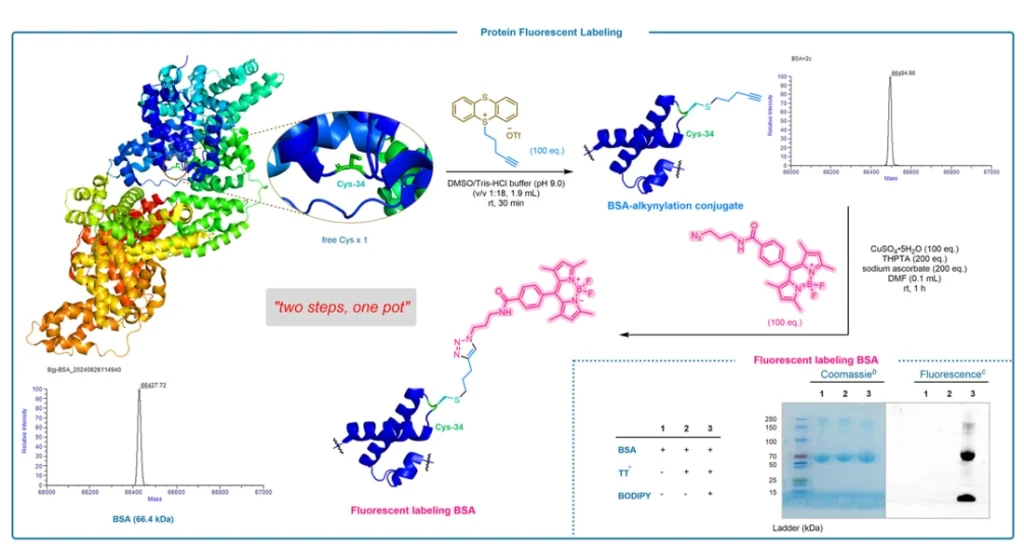
- Multifunctional biocoupling: The study further reveals that the technology enables multifunctional biocoupling by introducing clickable “handles” such as alkynes and azides. This means that a variety of complex biocouplings can be flexibly assembled in a “two-step, one-pot” reaction, further broadening the scope of biomodification applications.
- Successful application to proteins: The application of this technology to complex proteins has also been validated. Scientists successfully labeled bovine serum albumin (BSA) using alkylthioindigo salts, demonstrating the universality and effectiveness of the method in complex biomolecules.

The orthogonal biocoupling technique based on alkylthiophenium salts is an efficient and precise modification method, which provides a powerful tool for efficient and specific modification of peptides and proteins, and has a broad application prospect.