O que são transportadores SLC e por que são alvos difíceis?
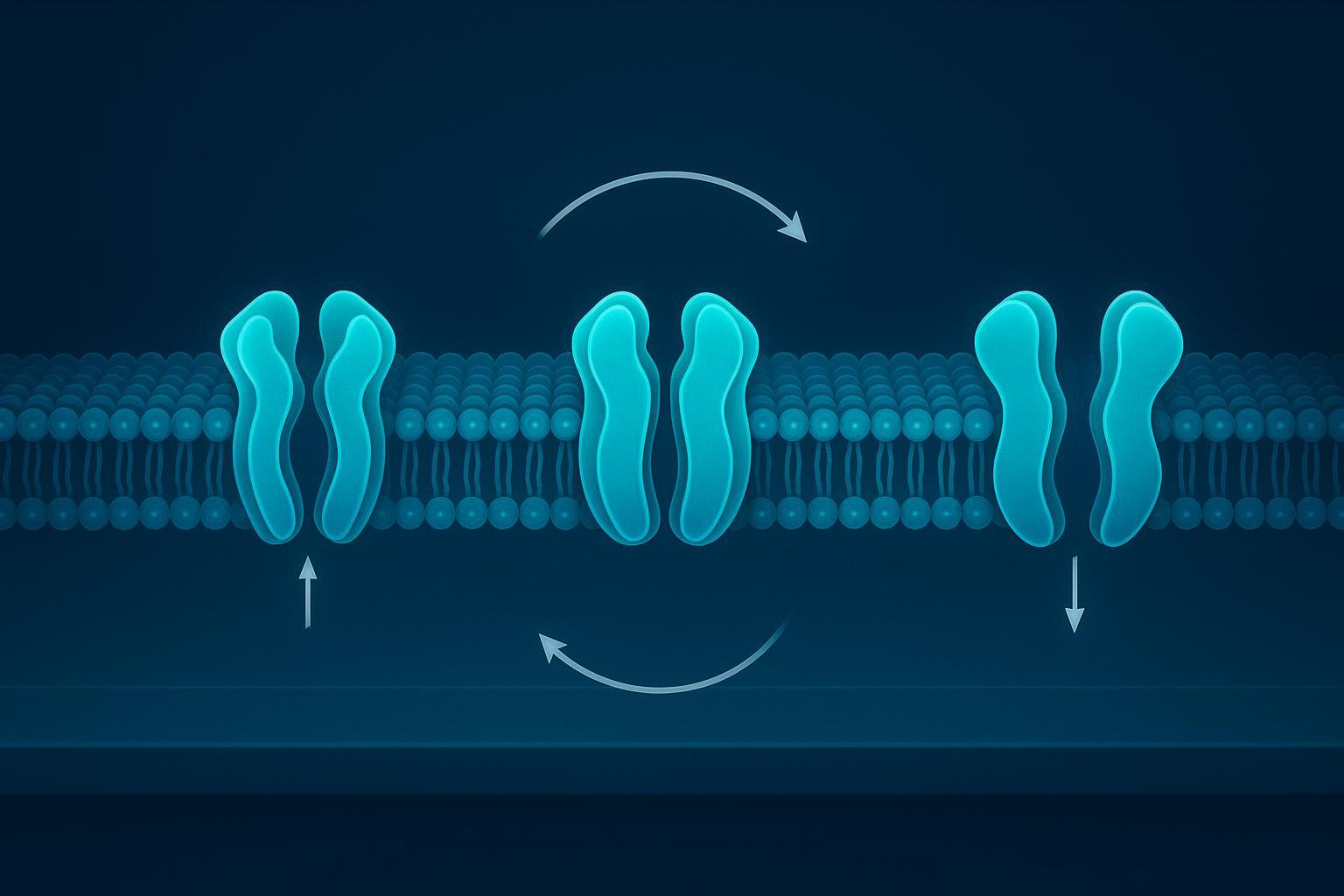
Os transportadores SLC são as proteínas transportadoras de soluto que movem íons, nutrientes, neurotransmissores e drogas através das membranas celulares, e os humanos têm 464 membros conhecidos espalhados por 70 famílias (Notícias-Médicas, 2026-09-10). Eles também são sujeitos de laboratório extraordinariamente teimosos, e as razões são estruturais e não processuais.

A dificuldade começa na arquitetura. Os transportadores SLC são proteínas integrais de membrana construídas a partir de muitas hélices transmembrana, o que os torna difíceis de expressar, solubilizar, purificar e cristalizar (PMC, 2025-09-02). Muitos operam através de um ciclo de acesso alternado, mudando entre voltado para dentro, estados ocluídos e voltados para fora, então um único experimento tende a capturar uma conformação em vez de toda a imagem. Os níveis de expressão nativa são frequentemente baixos, o que complica a purificação, geração de anticorpos e trabalho estrutural, e mover a proteína para uma solução detergente pode distorcer ou desestabilizar a estrutura que você estava tentando estudar.
As leituras funcionais são igualmente restritas. Muitos SLCs não possuem substrato conhecido ou ensaio secundário forte, e medições de transporte são confundidas pela especificidade do substrato, eletroneutralidade, localização, direcionalidade e artefatos, com sobreposição de promiscuidade de substrato adicionando outra camada de interpretação.
A consequência é uma família que a medicina mal tocou. Os medicamentos existentes abordam apenas uma pequena fração da superfamília SLC (Notícias-Médicas, 2026-09-10), e um 2026 artigo de opinião estima que de uma superfamília excedendo 400 membros, cerca de um terço não tem nenhum ligante conhecido (Vanguarda de Ensaios Clínicos, 2026-09-07). Essa combinação, difícil de expressar, difícil de manter em um estado, difícil de medir, é precisamente por isso que um reagente peptídico bem caracterizado ganha seu lugar nos primeiros trabalhos de transportadores.
Por que peptídeos personalizados para pesquisa do SLC Transporter se adaptam à descoberta inicial
Peptídeos personalizados para pesquisa de transportadores SLC se adaptam à descoberta inicial porque são definidos por sequência, reagentes rotuláveis e modificáveis que podem ser construídos contra alvos onde os anticorpos, compostos de ferramentas e biologia estrutural estagnaram. A lacuna ferramenta-composto é a evidência mais clara desse ajuste. UM 2024 levantamento de compostos de ferramentas SLC em Fronteiras em Farmacologia rastreado 20,678 pequenas moléculas únicas em 199 SLCs e, depois de aplicar critérios de composto de ferramenta, chegou em 6,876 inibidores cobrindo apenas 51 transportadores. A mesma pesquisa descobriu que 530 de 810 Pares compostos/SLC com curadoria manual estavam ausentes dos bancos de dados testados, e que para muitos SLCs relevantes para doenças existe um ensaio, embora nenhum composto de ferramenta tenha sido identificado.
Principal vantagem: Quatro alavancas decidem se um reagente peptídico funciona no trabalho de transportador: a sequência que você escolher, a etiqueta que você anexa, a modificação de estabilidade que você aplica, e a evidência analítica que você pode mostrar para o lote.
A cascata de validação: Validação de Alvo, Vinculativo, Imagem, Desenvolvimento de ensaio
Execute os quatro aplicativos em ordem. Os requisitos de reagentes e evidências de cada estágio restringem o próximo, então avançar geralmente significa comprar o mesmo peptídeo duas vezes.
|
Estágio |
Requisito de reagente |
Evidência necessária |
Portão de decisão |
|---|---|---|---|
|
Validação de destino |
Sequência não rotulada ou minimamente modificada |
A proteína se comporta conforme esperado em seu sistema |
Essa meta vale o programa? |
|
Serviços Vinculativo |
Peptídeo biotinilado ou sem rótulo |
Seu ligante envolve o alvo |
A interação se mantém? |
|
Imagem |
Peptídeo marcado fluorescentemente |
Onde está o alvo e quanto |
O sinal é específico? |
|
Desenvolvimento de ensaio |
Síntese de Peptídeos Reagente validado das etapas acima |
Um reproduzível, mudança mensurável |
Você pode executar isso em escala? |
A cascata não é teórica. Os primeiros candidatos direcionados ao SLC usando ativação, abordagens de estabilização e terapia genética já estão em desenvolvimento clínico para epilepsia, transtornos do espectro do autismo e dor crônica, com ensaios de terapia genética avaliando especificamente distúrbios do neurodesenvolvimento relacionados ao SLC6A1, Síndrome de deficiência de GLUT1 e doença relacionada ao SLC13A5 (Revisão do alvo do medicamento, 2026-09-11).
O desenvolvimento do ensaio fica em último lugar por um motivo: the functional-assay landscape for these transporters is narrow, so the readout you can build depends on what the earlier stages proved.
Projetando sequências personalizadas para destinos de transportador

Sequence design starts from the region you need to interrogate, not from a catalogue. Decide first whether the peptide must mimic a natural transporter ligand, compete at a known binding site, ou Comprar simply raise an antibody against a loop. That decision fixes the length, the terminal chemistry, and how much of the sequence can be changed without losing the interaction you want to measure.
SLC transporters are unusually unforgiving here. Their transmembrane stretches are hydrophobic and their cytoplasmic tails are often basic-rich, and both features make solid-phase assembly and reverse-phase purification harder than a typical soluble-protein epitope. Expect lower crude yield, more aggregation during cleavage, and a narrower purification window. PHT1 (SLC15A4) recruitment of TASL is a useful reference point: it shows SLC-ligand recognition resolved at the molecular level, which is the level of detail your sequence has to respect (Comunicações da Natureza, 2023).
Two practical rules follow. Order an unlabeled reference analog alongside every labeled version, so the label’s contribution can be measured rather than assumed. And treat sequence choice as the ceiling on later performance: no purification grade or assay optimisation recovers an interaction the sequence never encoded.
Etiquetas fluorescentes e de biotina: Escolhendo a sonda certa
Pick the label from the assay format, not from what ships fastest. Fluorescent labels suit imaging and subcellular localisation; biotin labels suit binding, pull-down and surface-capture formats. Get that order backwards and the reagent can invalidate the readout.
The caveat is worth stating plainly: the fluorophore itself can alter transport behaviour, so a labelled peptide is not automatically a faithful surrogate for the unlabelled one (PMC, imaging therapeutic peptide transport across intestinal barriers, 2021-06-15). Treat any shift in apparent affinity or uptake rate as a property of the conjugate until you have shown otherwise.
Biotin’s advantage is that it stays out of the optical path. A published single-cell flow cytometry uptake method quantitates peptide fluorescence per cell and uses sodium azide to separate energy-dependent internalisation from surface binding, then trypan blue, trypsin or pronase stripping to separate internalised from surface-bound peptide (PMC, single-cell flow cytometry peptide uptake assay, 2016-12-05). Those controls are what turn a fluorescence number into a mechanistic claim, and they only work if you know which side of the membrane your signal sits on.
Budget the label into the timeline as well as the design. N-terminal biotin, biotin-Ahx, FAM and FITC-Ahx additions carry roughly a two-business-day penalty on top of standard synthesis (GenScript custom peptide services, live service page, recuperado 2026-02-12).
|
Label |
Best-fit assay |
Limitação principal |
Turnaround penalty |
|---|---|---|---|
|
Fluorescente (FAM, FITC-Ahx) |
Imagem, localização, flow-cytometry uptake |
Fluorophore can alter transport behaviour; needs azide and stripping controls to interpret |
+2 dias úteis |
|
Biotina / biotin-Ahx |
Vinculativo, pull-down, surface capture |
No direct optical readout; needs a detection step |
+2 dias úteis |
|
Unlabelled |
Competition binding, transport kinetics |
Requires a separate detection method |
Nenhum |
Principal vantagem: Match the label to the assay format first, then confirm the conjugate behaves like the parent peptide before you build a conclusion on it.
Modificações que melhoram a estabilidade e suas compensações
Stability-enhancing peptide modifications extend how long a construct survives an assay, but the same chemistry that buys that window can shift how tightly the peptide binds its transporter. Treat every modification as a variable that needs its own control, not as a free upgrade.
The routine terminal protections cost nothing extra. N-terminal acetylation and C-terminal amidation are standard options, and suppliers typically offer them at no additional charge alongside a catalog of more than 300 functional-group modifications (GenScript). Terminal blocking mainly defends against exopeptidase trimming, which is often the first thing to erode a peptide in serum or a long incubation.
Each benefit carries a cost. Higher purity grades recover less material: research grade at 85-95% purity returns 40-60% of the crude, and ultra-pure material at 98% or above returns only 20-40% (KeriSite International, recuperado 2026-07-09). Counterion chemistry is a related constraint: trifluoroacetate stays firmly bound to the free N-terminus and to basic residues such as Arg, Lis, and His, and removing it for a biocompatible salt form takes an extra ion-exchange step (Bachem, recuperado 2026-07-28).
Aviso: A stabilized construct can silently change transporter affinity or narrow the very assay window you set out to measure. Run an unmodified comparator in the same experiment so any shift is attributable to the modification rather than to the peptide itself.
Testes Analíticos e CQ: O que seu pacote de dados deve provar

A purity percentage on its own proves nothing. The number only becomes evidence when it arrives with the method that produced it, the identity check that confirms the sequence, and the acceptance criteria the supplier committed to before the run. Ask for all three, and ask for the raw data behind them.
The purity figure you need depends on what the peptide has to do. Bachem’s guide to peptide quality control sets the thresholds at greater than 95% for receptor-ligand interaction studies and blocking or competition assays, 90 para 95% for quantitative enzyme-substrate work, and above 80% for Western blotting. A supplier quoting a single grade for every application is telling you they have not thought about yours.
Identity is a separate test from purity. Um peptídeo pode ser 98% pure and still be the wrong sequence. Wikipept’s QC reference accepts a measured mass within ±2 Da of the theoretical monoisotopic mass, widening to ±5 Da above 3 kDa, enquanto ILS Labs reports tighter windows from LC-MS: ±0.5 Da on a single quadrupole and ±0.01 Da on high-resolution instruments. Match the tolerance to the instrument, and check that the reported mass is the observed one, not the theoretical value restated.
Then there is the gap between purity and quantity. Um frasco rotulado 10 mg may hold only 6 para 8 mg of actual peptide once counterions and moisture are counted, as ILS Labs notes in the same QC overview. That is why net peptide content belongs on the certificate alongside purity, and why basic-rich sequences routinely show low net content from salt formation, a point Bachem makes explicitly. Weigh your working concentration against net content, not vial weight, or every downstream molarity is quietly wrong.
Endotoxin requirements scale with the study. Research-grade material is commonly specified below 10 EU/mg, preclinical below 1 EU/mg, and clinical below 0.25 EU/mg under FDA parenteral limits, with LAL testing per USP <85> as the method of record (wikipept; ILS Labs). For cell-based transporter assays, the research-grade tier is usually sufficient, but the specification should be stated rather than assumed.
A complete research-use package therefore carries RP-HPLC purity run at UV 214 ou 220 nm on a C18 column with an acetonitrile/0.1% TFA gradient, LC-MS identity, conteúdo líquido de peptídeos, LAL endotoxin per USP <85>, a rapid sterility screen, and heavy metals by ICP-MS per USP <233> and ICH Q3D (ILS Labs). Impurities above 0.5% should be characterised rather than merely counted, with LC-MS/MS used for sequence coverage and fraction identification (wikipept).
|
Teste |
Método |
Typical acceptance criterion |
|---|---|---|
|
Pureza |
RP-HPLC, ultravioleta 214/220 nm, Capítulo 18, acetonitrile/0.1% TFA gradient |
>95% receptor-ligand and blocking assays; 90-95% enzyme-substrate; >80% Western blot |
|
Identidade Sobre |
ESI-MS ou MALDI-TOF; LC-MS single quad or high-resolution |
±2 Da (±5 Da above 3 kDa); ±0.5 Da single quad, ±0.01 Da HRMS |
|
Conteúdo líquido de peptídeos |
Quantitative amino acid analysis or nitrogen determination |
Reported per lot; expect 60-80% of vial weight |
|
Contraíon |
Ion chromatography or NMR |
TFA ou acetato, stated on the CoA |
|
Endotoxina |
LAL per USP <85> |
<10 EU/mg research grade; <1 EU/mg preclinical |
|
Perfil de impurezas |
LC-MS/MS for peaks >0.5% |
Individual impurities identified and quantified |
The practical test of a data package is simple: could a reviewer reconstruct your result from it without contacting the supplier? If the chromatogram has no integration window, the mass spectrum has no observed value, or the net content is missing, the answer is no.
Consistência lote a lote e leitura de um certificado de análise
A certificate of analysis is a supplier’s claim about one batch, not a guarantee that the next batch will match it. Treat it as a starting point for verification, and specify the tolerances you will accept before you place the order.
The gap between a stated purity figure and a measured one can be wide. UM 2022 inter-laboratory study found that peptides labeled at 98% or higher by single-method HPLC ranged from 94.2% para 99.1% when three labs re-ran them on different columns and mobile phases (KeriSite International, recuperado 2026-07-09). Method choice alone moves the number.
Independent re-analysis cases point the same way. In one set of five products re-tested from a larger group of 30, four measured more than 10% below their CoA purity, and a product listed above 98% came back at 67%. A separate example showed a 99.2% CoA whose intended-peptide content was 76% because a co-eluting 16-mer variant inflated the purity reading (KeriSite International, recuperado 2026-07-09). Observe a fonte: KeriSite is a competing supplier, and these cases are vendor-authored, so read them as an illustration of the failure mode rather than a neutral survey.
What a CoA reports varies by vendor. A major supplier’s QC suite includes water content by Karl Fischer titration, nitrogen content by elemental analysis as a peptide-content measure, residual TFA by ion chromatography, and co-elution against a reference standard (Bachem, recuperado 2026-07-28). If your CoA lists purity and molecular weight only, you are missing the fields that explain a mid-study shift.
Put the acceptance targets in the order itself. These are the batch-to-batch tolerances worth specifying:
|
Parâmetro |
Acceptance target |
|---|---|
|
HPLC retention time |
±0.2 min |
|
Pureza |
±0.5% area |
|
Observed molecular weight |
±0.5 Da |
|
Conteúdo peptídico |
±5% |
|
Conteúdo de água |
± Peptídeos Sintéticos 2% |
|
Conteúdo de contra-íon |
±3% |
Suppliers working to tighter internal targets report purity CV below 0.5% and retention-time CV below 1.0%, with in-house specification pass rates above 95% (KeriSite International, recuperado 2026-07-09). Ask a prospective supplier for their multi-batch CV data, not just a single-batch CoA. Lot-to-lot consistency is a process claim, and the only evidence for it is a distribution across batches.
Equívocos comuns sobre reagentes peptídicos no trabalho de transportadores
The most expensive misconception in transporter work is that a high purity number means a valid reagent. Purity is one property among several, and the assumptions that quietly invalidate a peptide usually sit outside the purity figure entirely.
A labeled peptide is interchangeable with its unlabeled analog. Não é. Adding a fluorophore or biotin changes molecular weight, hidrofobicidade, and often transporter affinity, so a labeled probe needs its own binding characterization rather than inheriting the unlabeled peptide’s numbers. Produção de Peptídeos
A certificate-of-analysis purity figure transfers across analytical methods. Não. A value obtained by one HPLC method is not comparable to a value from a different gradient, coluna, or detection wavelength, so compare figures only when the method matches.
Net peptide content is ignored when calculating molarity. Net peptide content changes every molarity calculation. Weighing out material by gross mass and treating it as pure peptide overstates the amount of active reagent in the tube, sometimes by a wide margin.
TFA-salt material goes straight into counterion-sensitive cell assays. Cell-based assays are affected by counterion, and the grade listed for those assays is ≥98% peptide content supplied as a TFA or acetate salt (KeriSite International, 2026-07-09). Where the counterion itself perturbs the readout, confirm the salt form before the assay, não depois.
Principal vantagem: The costliest error is not a low purity number. It is a reagent that passed every stated specification while resting on an unchecked assumption about labeling, método, molarity, or salt form.
Um exemplo prático: Uma construção através da cascata
A transporter team starting from a known substrate motif typically designs three peptides in parallel: an unlabeled reference analog, a fluorescently labeled probe, and a biotinylated capture reagent. The reference analog sets the baseline. Without it, a shift in signal from the labeled probe cannot be attributed to the label rather than to the sequence itself.
Sequence design begins with the recognition determinants the target is known to use, since how peptide recognition by an SLC can be resolved structurally depends on preserving those contacts. The labeled and biotinylated versions then carry the same core sequence, with the modification placed at a terminus or a solvent-exposed position rather than inside the binding face.
At the assay handoff, the azide and stripping controls establish that signal reflects specific binding rather than nonspecific adsorption. QC gates the construct before it reaches that step: the purity-by-application matrix confirms the peptide performs in the intended buffer and detection mode, and net peptide content, not gross weight, sets the molarity used in the binding calculation.
Limitações e quando os peptídeos são a ferramenta errada
Peptides are the wrong tool when a program needs a functional transport readout that does not yet exist. The transporter field has a narrow functional-assay landscape, so a peptide reagent can supply binding, localization or affinity data, but it cannot stand in for a measurement of transport itself. If the question is whether a substrate moves across a membrane, a peptide probe answers a different question.
Alternating-access mechanics impose a second boundary. Because these proteins cycle between inward- and outward-facing conformations, experiments often capture one state at a time, and a peptide optimized against one state may not report on the other. Label perturbation compounds this: attaching a fluorophore or biotin can invalidate a binding measurement outright, and stability-enhancing modifications can shift affinity enough that a stabilized construct no longer serves as a direct comparator against the parent sequence.
Treat any of these as a reason to reach for structural biology, a validated tool compound or an orthogonal assay instead. Over-claiming what a reagent class can prove costs a program quarter.
Começando: Primeiros passos para um projeto de peptídeo transportador
Define the assay the reagent has to serve before you request anything. The acceptance criteria come first: grau de pureza, conteúdo líquido de peptídeos, forma de sal, batch-to-batch tolerances, and the analytical methods that will demonstrate each one. A quote requested before those specs exist usually comes back with assumptions you did not choose.
Three steps remove most of the friction:
-
Write the acceptance criteria, then request the quote. State the assay format, buffer, working concentration, and the tolerances you will accept between lots.
-
Order an unlabeled reference analog alongside the labeled construct. It gives you a control for the label itself and a way to confirm that any signal change comes from the modification, não o peptídeo.
-
Request the full analytical package, not a purity figure. HPLC, espectrometria de massa, and a certificate of analysis let you verify identity as well as purity.
Plan the timeline around the chemistry. Standard custom synthesis runs about 2 para 3 semanas, sequências modificadas 4 para 6 semanas, e conjugação 3 para 5 semanas (Tsingke peptide synthesis services, recuperado 2026-08-21). If your assay date is fixed, start with the modified construct.
If you want a second opinion on whether your target and readout are compatible before committing to a sequence, talk to an expert or request a feasibility assessment. MOL Changes offers custom peptide services, so treat this as a commercial interest when weighing the advice above.
Perguntas frequentes
Qual grau de pureza eu preciso para um ensaio de ligação ao transportador?
Acima 95% is the working threshold for receptor-ligand interaction and blocking or competition assays, per Bachem’s peptide purity guidance. Purity alone does not make a reagent fit for use: pair it with identity confirmation and a net peptide content figure before you calculate molarity.
Um rótulo fluorescente pode mudar a forma como meu peptídeo interage com um transportador?
Sim. The fluorophore itself can alter transport behaviour, as reported in a 2021 study of fluorescent substrate analogues. Run an unlabeled comparator in the same assay so you can separate label effects from sequence effects.
How do I verify a peptide’s identity and not just its purity?
Verify by mass. Measured mass should fall within ±2 Da of the theoretical monoisotopic mass by ESI-MS or MALDI-TOF, tightening to ±0.5 Da by single-quad LC-MS and ±0.01 Da by high-resolution MS, according to ILS Laboratories’ analytical specifications. A purity trace without a mass spectrum tells you nothing about whether the correct sequence was made.
O que significa o conteúdo líquido de peptídeos e por que isso importa?
Net peptide content is the mass of actual peptide in the vial once counterions and residual water are accounted for, and it can sit well below the purity figure. ILS Laboratories notes that 10 mg of lyophilized powder may contain only 6 para 8 mg de peptídeo, which changes every molarity calculation downstream.
Devo solicitar um formulário de TFA ou sal de acetato?
It depends on the assay. Trifluoroacetate binds firmly to the free N-terminus and basic side chains and cannot be fully removed, so counterion-sensitive cell-based work calls for an ion-exchanged biocompatible salt, as Bachem and KeriSite both describe. Binding assays in buffer are usually tolerant of TFA; live-cell transport assays often are not.
Quanta variação de lote para lote devo esperar entre lotes de peptídeos?
More than most researchers assume. Peptides labeled at 98% or higher by single-method HPLC ranged from 94.2% para 99.1% across three laboratories in a 2022 inter-laboratory comparison published in Amino Acids. Specify batch-to-batch tolerances in the order: retention time within ±0.2 min, purity within ±0.5% area, peptide content within ±5%.
Para onde vão os programas transportadores SLC??
Toward assay formats that read transporter function in living systems rather than in isolated membrane preparations, which raises the bar for probe design. Fluorescently labeled peptides for transporter imaging and biotinylated peptides for transporter binding studies are increasingly specified together in the same project so that one sequence serves both readouts.
Conclusão
The reagent is only as good as the analytical evidence behind it, and the cascade order decides which evidence you need first. A custom peptide for SLC transporter research earns its place in a project when the sequence fits the target, the label does not distort the biology you are measuring, any stability modification is justified against its trade-offs, and the data package proves identity, pureza, and net content rather than asserting them. Get the order wrong and you pay for it later, which is exactly where the lot-to-lot variability seen in independent re-analysis becomes expensive.
The field is not standing still. The emerging SLC programmes now in clinical development are pushing toward activation and gene-therapy modalities, so the reagent requirements you write into a specification today will keep shifting. Build the habit now: define the assay first, then the probe, then the analytical acceptance criteria. The first steps in Getting Started are the ones to take back to your team this week.