What Happened and Why It Matters for AI-Ready Peptide Discovery
Επί 2026-09-16, GenScript’s own announcement of the TuneLab agreement confirmed the company now offers preferred-rate wet-lab terms in the announcement: protein expression, purification and characterization of prioritized sequences, performed under standardized, fully documented protocols. Read the scope carefully. No peptide data standard, no machine-readable format and no peptide-specific deliverables are named anywhere in it.
That gap is the story. Ray Chen, President of GenScript Life Science Group, framed the rationale in GenScript’s stated rationale for the partnership: “AI-enabled drug discovery will advance only as fast as the industry can generate reliable biological evidence.”

TuneLab itself is not new. Lilly’s launch announcement for TuneLab dates it to 2025-09-09, operated by Eli Lilly rather than an independent company, with a first release covering drug disposition, safety and preclinical models. The scale behind it is the reason suppliers are paying attention: proprietary data obtained at a cost of over $1 δισεκατομμύριο, drawn from hundreds of thousands of unique molecules, per the scale of the data behind TuneLab. Access runs through TuneLab’s federated-learning design, which lets biotechs tap Lilly’s models without directly exposing their own proprietary data or Lilly’s.
The platform is also being embedded into the software computational teams already use, διά μέσου the Schrödinger LiveDesign integration ανακοινώθηκε 2026-01-09 and CDD Vault’s TuneLab integration announced 2026-05-20.

So treat this as a signal about evidence generation, όχι προδιαγραφή. Nothing in the announcement tells you what AI-ready peptide discovery requires of your records. That burden falls on the lab.
Clean Data: The Four Pillars of AI-Ready Peptide Discovery
AI-ready peptide discovery means your experimental output can be read, merged and reused by a model without a human retyping it. Machine-readable data carries its units, sample identity and method version in structured fields instead of a PDF or a notebook page. The design-build-test-learn cycle is the loop those models run on: design sequences, synthesise and test them, feed the results back, design again.
Four pillars hold that loop up: cleaner experimental data, reproducible synthesis records, assay-ready formats and analytical datasets. The bar is lower than most teams assume. Cradle’s data-collection guidance for protein design puts generative-ML protein design within reach of any lab that can consistently test around 96 protein sequence variants for each property, and notes that a few dozen wisely chosen sequences can yield significant progress. Published best-practice guidance on ML-assisted protein engineering reports that protein-engineering ML datasets often hold fewer than 1,000 instances, which is why validation commonly uses 10-fold cross-validation rather than a single held-out split.
Small datasets punish sloppy records. GEN’s analysis of why AI drug-discovery efforts underperform states that models fed inconsistent, incomplete, ambiguous or poorly formatted data learn the noise along with the signal, yielding confident but less reliable predictions. The failure pattern is mundane: units recorded as mg/mL in one run and µg/µL in the next, free-text sample names that no join key can match, missing batch identifiers, and no versioning of the assay method or the analysis code. Any one of these stops a dataset from merging across runs.
The upstream cause is fragmentation, not carelessness. LabKey’s overview of practical assay data management describes assay data that lives in silos, on shared drives, in lab notebooks, or embedded in emails, with instrument heterogeneity across vendors and file types and no consistent format. Peptide data quality for AI models is therefore a records problem before it is a modelling problem.
Key Takeaway: A campaign that tests around 96 variants per property is already in generative-design territory. What disqualifies the dataset is inconsistent units, free-text sample names, missing batch IDs and unversioned methods, not the sample count.
Reproducible Synthesis Records and Assay-Ready Formats
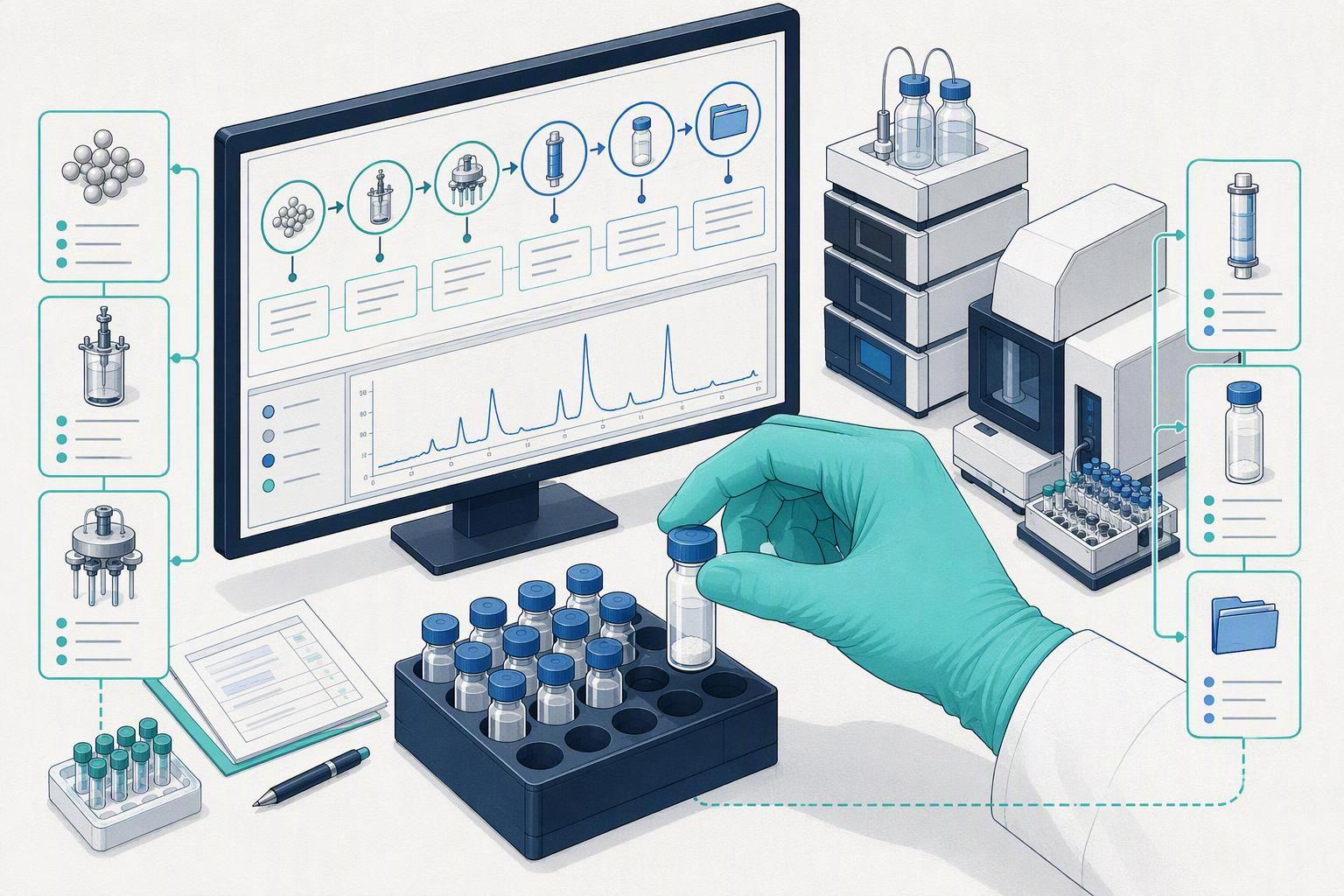
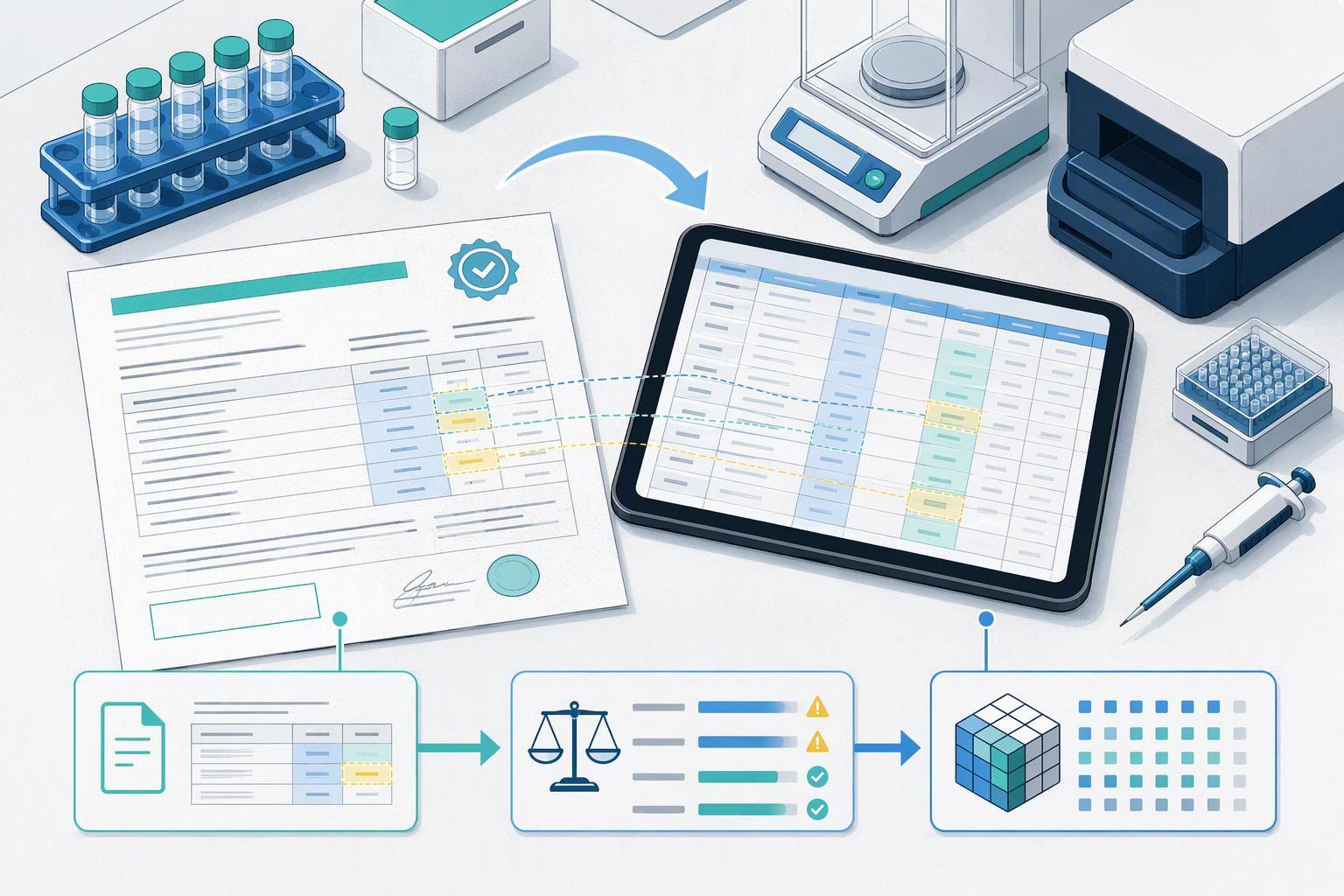
A certificate of analysis is not a reproducible peptide synthesis record. The unit of reproducibility is the lot file: ο American Peptide Society’s SPPS primer describes a batch record detailed enough for a third party to recreate the run, covering resin type and loading, per-cycle deprotection and coupling with reagents and equivalents, wash steps and equipment. The standard manual Fmoc cycle it documents prescribes 20% piperidine/DMF deprotection (5 πρακτικά, τότε 15 πρακτικά) και 3 × 1 mL DMF washes per cycle. MOL Changes’ stage-by-stage chain-of-custody framework extends that into nine stages, from raw material sourcing and incoming qualification through synthesis lot records, isotope labelling traceability, analytical release and complete lot-file assembly, citing ICH Q7 for starting-material characterization and flagging a supplier who cannot name the resin lot or amino-acid source.
Assay-ready peptide data formats carry a parallel requirement. LabKey’s overview of practical assay data management identifies what recurs across CSV, JSON, AnIML and SDRF: stable identifiers for samples, files and runs; controlled vocabularies or ontologies; explicit units and datatypes; links between raw data, processed data and metadata; and open, long-lived formats. Identity confirmation by mass spectrometry is not purity determination by HPLC, and neither settles counterion or content questions such as TFA counterion exchange. Ι Ε2(R2), δημοσιευμένο 30 Νοέμβριος 2023, requires an analytical procedure to be shown fit for its intended purpose under a predefined validation protocol, with the reportable range confirmed to include upper and lower specification or reporting limits, and extends those principles to mass spectrometry and other spectrometric data.
|
What a standard supplier package contains |
What a computational team needs |
|---|---|
|
CoA plus summary analytics |
Lot-linked records with stable identifiers |
|
Final purity and identity values |
Per-cycle synthesis detail and versioning |
|
Πεπτίδιο 1 Static PDF or printed report |
Cyclic Peptide Synthesis Machine-readable tables with explicit units |
|
Certificate as the deliverable |
Provenance from raw Peptide Services material to release |
No documentation standard removes the need Πεπτίδιο 2 for orthogonal confirmation of hits.
What This Means for Suppliers, Computational Teams and Buyers
The announcement lands differently depending on where you sit. For the synthesizing supplier, documentation completeness becomes a differentiator rather than an afterthought. GenScript’s AIDD service page advertises sequence-to-data in as fast as 4 calendar days, 4000+ designs per day, 20M+ AI-ready data points generated per year, υπό $10 per data point, και 3500+ global partner organizations. Read it closely, αν και, and it names no peptides at all; its listed modalities are VHHs, miniproteins, IgG, bispecifics, enzymes and de novo proteins. Peptide chemistry is not yet the demonstrated centre of that pipeline, which is the opening for suppliers who can show it. Calcitonin Synthesis
For the computational team, the binding constraint is dataset size and metadata sufficiency. Published best-practice guidance on ML-assisted protein engineering treats 10-fold cross-validation as the norm on sub-1,000-instance datasets, which tells you how thin the training material usually is. TuneLab’s federated-learning design matters here: biotechs tap into Lilly’s models without directly exposing proprietary data. The non-obvious implication is that the Schrödinger LiveDesign integration means most teams will meet these models inside software they already run. The models are not the variable you control. The data you feed them is.
For the buyer or QC lead, “documented” already has a definition. The ten ALCOA+ data-integrity principles require records to be attributable, ευανάγνωστος, σύγχρονος, πρωτότυπο, ακριβής, πλήρης, συνεπής, ανθεκτικό και διαθέσιμο, and the ICH Q2(R2) analytical validation guideline requires an analytical procedure to be shown fit for its intended purpose under a predefined validation protocol, with the revision extending those principles to mass spectrometry. A documentation-complete peptide delivery, in those terms, means a lot file where the sample identifier ties back to the batch, the assay version and units travel with the result, and the controls and error metrics are stated rather than implied. MOL Changes is one supplier whose analytical package is built around that chain, though no independent audit of its AI-specific data formats was found.
Four questions to ask of your own records today: Can a model read this table? Can a third party recreate this batch? Does this assay output carry identifiers and units? Can this dataset be merged with last quarter’s? Πεπτίδιο 3
What to Do Now and the Bigger Picture
Start with the export, not the platform. Three actions, in order of urgency.
-
This week: audit one recent campaign’s assay export against your machine-readable field list and write down what is missing. Most teams find the gaps in an afternoon.
-
This month: add batch identifiers, μονάδες, assay version and analysis-code version to the export template, and start versioning the assay method itself.
-
This quarter: request the full lot file, including resin lot and amino-acid source, before committing to a campaign. A supplier who cannot name the resin lot or the amino-acid source is a red flag.
Two things not to do. Do not rebuild a data platform before fixing the export format, and do not treat a CoA as a training-ready dataset.
The cautionary context is worth keeping in view. In a manual FAIR reusability audit of archived datasets, 45.9% of assessed open datasets were rated reusable, meaning 54.1% were not. In the energy-domain dataset audit, 82% of datasets had missing data in at least one key dimension and 27% were missing more than half. Figures of this type vary by source and domain, and they are cited here as an illustration of metadata loss rates, not as peptide benchmarks.
That is the bigger picture for AI-ready peptide discovery: evidence generation, not model capability, is becoming the rate-limiting step. Documentation standards are turning into a procurement criterion, and the labs that version their records now will be the ones whose data is still usable in three years.
Επόμενο βήμα: review the chain-of-custody documentation framework and use its nine-stage checklist to score your current lot files.
Αποκάλυψη: MOL Changes publishes this blog as a peptide vendor.
Συχνές Ερωτήσεις
Does the GenScript–TuneLab partnership cover peptides?
Οχι. GenScript’s own announcement of the TuneLab agreement scopes the service to protein expression, purification and characterization of prioritized sequences. Peptide synthesis is not named in that scope, so peptide teams should read the announcement as a signal about where AI-assisted discovery is heading rather than as a service they can buy today.
What does “AI-ready” data actually mean in practice?
It means five concrete properties: stable identifiers for every entity, controlled vocabularies instead of free-text fields, explicit units and datatypes, linked raw, processed and metadata files, and open long-lived formats rather than vendor-locked exports. LabKey’s overview of practical assay data management sets out these requirements for assay data. A file that satisfies them can be parsed by a model without a human rewriting column headers first. That is the whole test.
How large does a peptide analytical dataset need to be before machine learning helps?
Smaller than most teams assume, but not trivially small. Cradle’s data-collection guidance for protein design puts generative design at practical from around 96 variants per property. Typical protein-engineering datasets, αντίθετα, hold fewer than 1,000 instances and are validated with 10-fold cross-validation, as published best-practice guidance on ML-assisted protein engineering describes. The binding constraint is usually consistency across those instances, not their count.
What should I ask a supplier for?
Ask for the full lot file, not the CoA alone. MOL Changes’ stage-by-stage chain-of-custody framework treats a supplier who cannot name the resin lot or the amino-acid source as a red flag, and asks for machine-readable analytical data alongside the certificate. If the assay-ready peptide data formats you receive cannot be loaded without manual transcription, the AI-ready peptide discovery pipeline stops at your inbox.
Σύναψη
The GenScript-TuneLab partnership is a signal about how peptide evidence gets generated, not a peptide data standard. No independent test data published after 2024 was found that would let anyone treat the announcement as a settled specification, so the practical work stays where it always was: in the record your lab already produces.
That record has four requirements you can act on now. Clean data means fields a model can parse without manual repair. Reproducible peptide synthesis records mean lot-level traceability back to resin and amino acid sources. Assay-ready peptide data formats mean results that survive transfer between instruments and collaborators. Peptide analytical datasets for computational design mean the underlying measurements stay attached to the sequences they describe.
The next logical step is small and unglamorous: take one completed campaign, export it as it stands today, and check it field by field against a machine-readable specification. Whatever fails that audit is your AI-ready peptide discovery roadmap, and it will be more specific than any announcement.