La conversión es un rediseño., no es un complemento
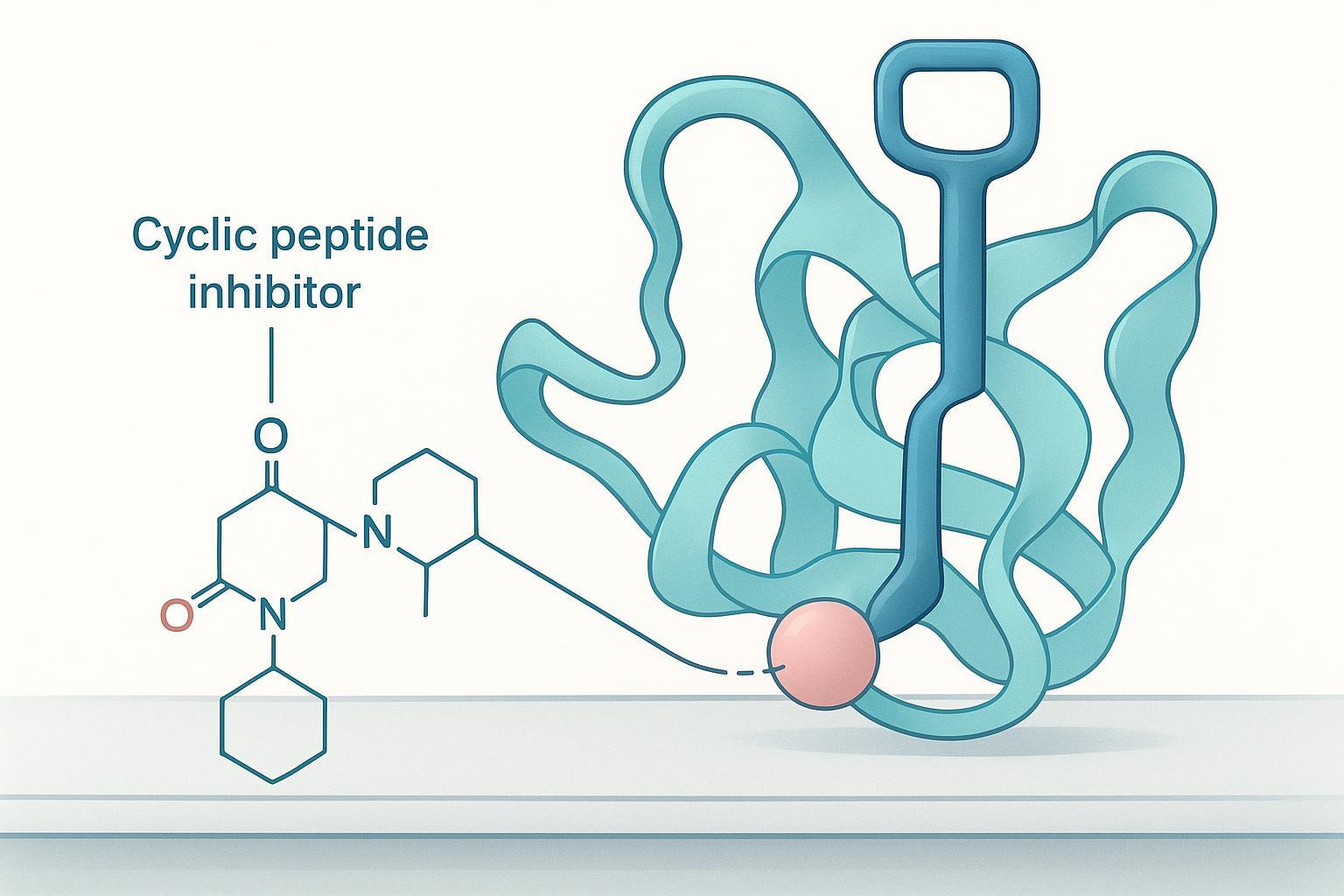
Un péptido cíclico que inhibe HIF-1α al ocupar el bolsillo PAS-B es una llave cortada para encajar en una cerradura. Convertirlo en un degradador significa soldar una manija a esa llave.: un enlazador más un elemento de reclutamiento de la BVS, colocado de modo que el anillo aún se asiente en el bolsillo mientras el nuevo brazo se extiende para reclutar la ligasa. Los dientes no pueden cambiar.. Todo lo demás puede.
Esa distinción impulsa todo el proyecto.. En el caso del ancla, el conector y el ligando VHL se incorporaron como un aminoácido bifuncional personalizado y se incorporaron directamente durante la síntesis de péptidos en fase sólida., en lugar de unirse después de la ciclación (GATOS, Los péptidos cíclicos PROTAC restauran la degradación de HIF-1α mediada por VHL en hipoxia, 2026). La consecuencia práctica es que el punto de unión se convierte en una elección de diseño fijada en el momento del montaje de la cadena., No es una variable que afines más tarde en el banquillo..
Cada decisión posterior se deriva de ese compromiso.: qué gradiente resuelve el conjugado, ¿Qué verificación conformacional confirma que el anillo sobrevivió?, y qué ensayo puede distinguir la degradación de la mera ocupación.

¿Qué vector de salida debe llevar el enlazador??
La selección del sitio de conjugación es la primera decisión que limita todas las decisiones posteriores., y la regla es simple de enunciar: Elija la posición con menor probabilidad de perturbar la unión y con mayor probabilidad de estar expuesta a solventes. (Estrategias actuales para el diseño de enlazadores PROTAC., 2020). Cuando está disponible una estructura cocristalina de su péptido cíclico unido al objetivo, esa regla es responsable por inspección. cuando no es, La inspección no puede decidir la cuestión., y pretender lo contrario es como los programas pierden meses.
Servicios El punto de unión tampoco es un paso de derivatización que se realiza después de optimizar el péptido.. Es una elección de diseño de conjunto de cadena., arreglado antes de que comience la síntesis, como fue en el caso del ancla. Cambiar de opinión más tarde significa resintetizar el péptido, no editar una cadena lateral.
La regla de clasificación empírica: clasificar los vectores candidatos según lo que cada uno conserva, en este orden: afinidad objetivo, luego comportamiento complejo ternario, luego degradación. Un SAR estrecho en una posición que parecía expuesta a solventes es una advertencia, no ruido. Esa posición es conformacionalmente portadora de carga., y hay que rehacer el ranking.
Instalación del enlazador y el elemento E3
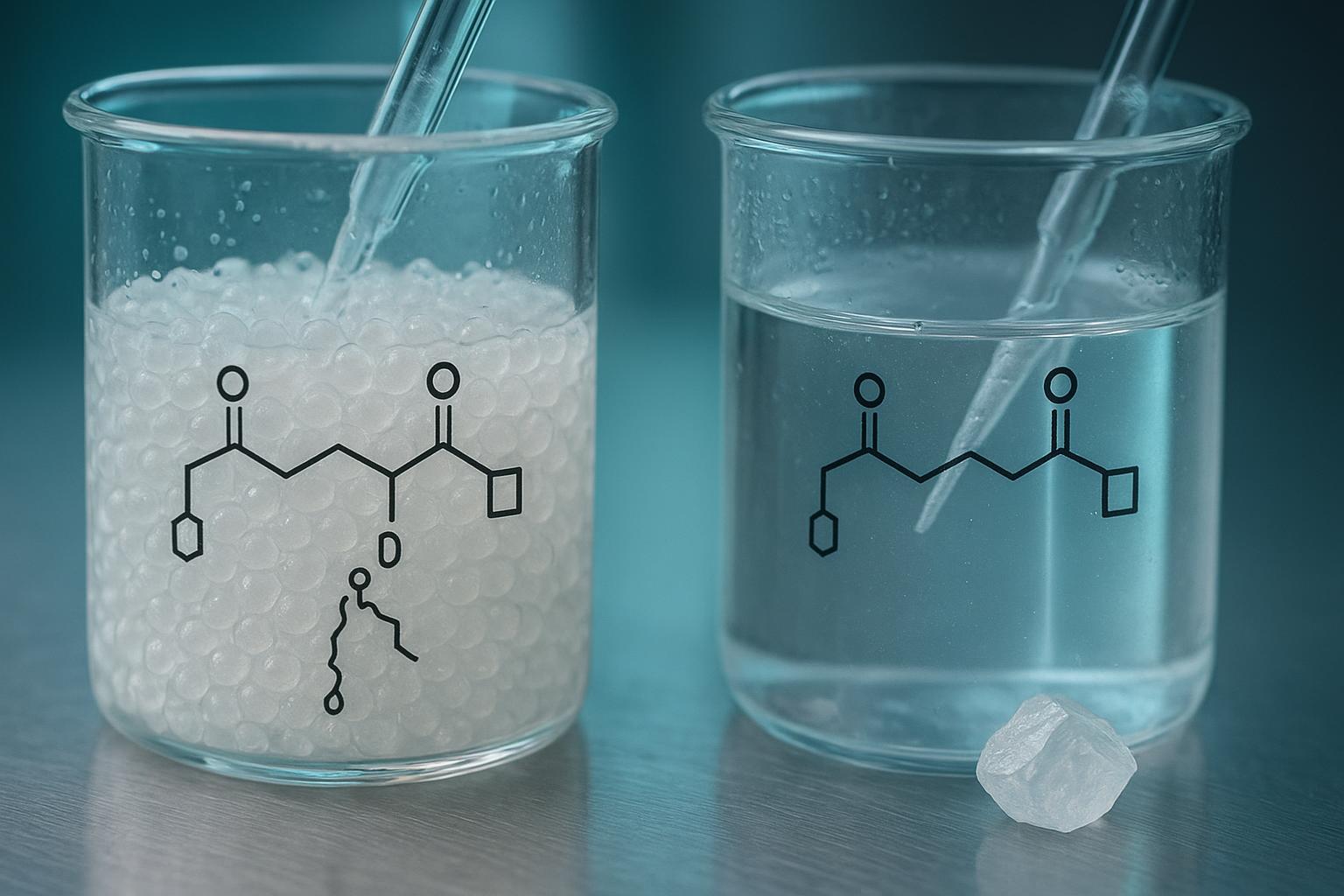
La decisión de ruta es lo primero, porque la conjugación en resina y en solución falla en diferentes lugares. La instalación en resina de un aminoácido bifuncional construye el conector en la propia cadena., por lo que el esquema del grupo protector tiene que mantener intacto el mango ortogonal del enlazador a través de Comercio cada acoplamiento posterior y el paso de ciclación. La conjugación de la solución después de la ciclación es más rápida de iterar, pero expone el péptido libre a la química de activación dos veces y lo deja purificando una mezcla de isómeros posicionales si el residuo reactivo no es único..
El trabajo de Southampton muestra lo que compra esa iteración. La serie que comenzó con cyclo-CLLFVY pasó a una ojiva de segunda generación., ciclo-CLLF(CF3)SI(hermano), carrying longer unnatural amino acid linkers built into the sequence rather than appended afterwards (McDermott et al., 2025). Building the linker into the chain is what makes linker length a design variable instead of a purification problem.
That matters because the main threat to peptide purity and folding on this route is epimerization, and it is mechanistically avoidable. Activating an amino acid forms a planar oxazolone that is temporarily achiral at the α-carbon, so reprotonation can return either the L- or the D-configuration. Risk climbs with extended activation, highly reactive coupling reagents, and accumulated activated intermediate, and residues such as phenylglycine, cysteine and histidine are especially prone (Bachem; Epimerisation in Peptide Synthesis, 2023).
The magnitude is route-dependent, and one vendor’s feasibility work illustrates the spread rather than setting a benchmark: fragment-route conjugation produced roughly 13% epimer formation and was discontinued, while the alternative route showed 2–3% epimerization rising to about 5% after purification, and linear SPPS gave the highest yield with no epimerization detected (Bachem). Read that as a signal about which route classes carry the risk, not as a rate you can expect on your own sequence. Acerca de
Qué pueden y no pueden decirle los datos de pureza de RP-HPLC
A single main-peak percentage at 214 nm confirms neither correct conjugation nor correct folding. It tells you that the UV-absorbing species in your sample elute as one band on one gradient. That is a useful fact, and it is a smaller fact than most programs treat it as.
For a larger, more hydrophobic conjugate, the method resolves less than it did for the parent cyclic peptide. The linker and E3 element add hydrophobic surface area, the retention time shifts, and species that were baseline-separated on the parent gradient start to co-elute. A published disulfide-cyclized peptide degrader program reports its preparative practice plainly: one RP-HPLC step on a 0.1% TFA water/acetonitrile gradient running 26–43% over 40 minutes at 10 ml/min, detection at 220 Nuevo Méjico, oxidation monitored by mass spectrometry alongside HPLC, and a final HPLC quality check before lyophilization (Frontiers in Immunology, 2023). Note what that paper does not state: any purity threshold. The number is a process output, no es una especificación.
Suppliers commonly specify ≥95% RP-HPLC purity as the floor for biological evaluation, ≥98% for quantitative binding and dose-response work, and ≥99% for reference-standard work, with purity defined as main-peak area over total peak area by UV detection at 214–220 nm (GenScript; Proteómica creativa, 2025). Treat those bands as purchasing convention rather than a measured finding about your molecule. They describe what a vendor will certify, not what your conjugate needs.
The gap matters because peptide purity and folding are different questions, and RP-HPLC answers only the first. A co-eluting epimer, a misfolded disulfide isomer, or an unreacted parent that happens to run at the same retention time all present as a clean single peak. Mass identity, stereochemistry, and solution conformation each require an orthogonal method.
Read the matrix as a coverage check, no es una clasificación. RP-HPLC covers hydrophobicity and purity. LC-MS and HRMS cover mass identity, which is how you confirm the linker actually installed. Chiral LC covers stereochemistry, which is how you catch epimerization at the conjugation site. NMR and CD cover solution conformation, which is how you distinguish a folded conjugate from an unfolded one. No single row covers more than one column, and a program that reports only the first row has evidence for exactly one of four questions.
The practical consequence for conjugation-site selection: if your analytical package is one RP-HPLC trace, you cannot yet tell whether the exit vector you chose produced the conjugate you designed. Add the orthogonal methods before you commit the route, not after a binding assay comes back flat.
Verificación de plegado y conformacional.
Síntesis de péptidos Cyclization constrains the backbone, but it does not guarantee that the bioactive conformation survives linker addition. That distinction is why conformational evidence has to be orthogonal to purity evidence: each method class answers a question the others cannot.
Chiral LC resolves stereochemistry, so it tells you whether the conjugate racemized at the residues you care about. CD reports on solution secondary structure, and NMR reports on the specific contacts that define the bound fold. None of these substitutes for another, and none of them substitutes for a functional readout. The same principle governs the assay stage: a ternary-complex signal alone is insufficient, and cellular DC50/Dmax values alone are phenotypic rather than mechanistic (Methods to Study the Molecular Mechanism and Drive the Design of Degraders, recuperado 2026-05-14).
Conclusión clave: High HPLC purity is not correct conjugate. A peak that is clean and mass-confirmed can still carry the wrong fold into the assay stage.
For your data package, that gap is the risk to close. A conjugate that passes purity and mass identity but was never conformationally checked carries an unquantified risk forward, and the assay team inherits it. Treat peptide purity and folding as two separate evidence lines, each with its own method and its own acceptance criterion, before the material is released to biology.
La cadena de evidencia del ensayo funcional.
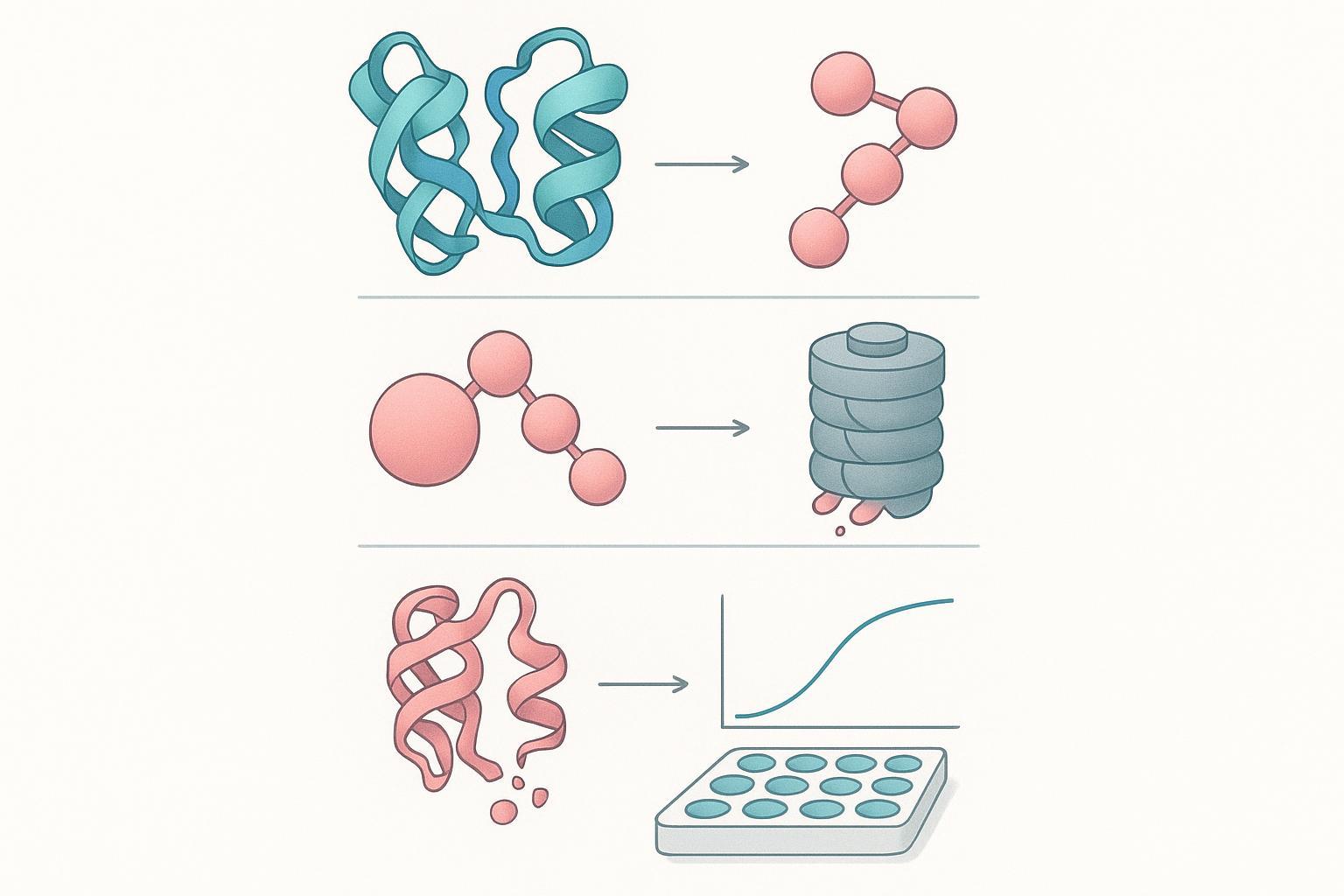
A degradation claim is a mechanism claim, and no single assay carries it. The evidence chain has four links, and a reviewer will look for all four: ternary complex formation, target ubiquitination, proteasomal dependence, and a quantitative potency and ceiling readout. If your package stops after the first link, you have shown binding, not degradation.
Work down the chain against your own data. Ternary complex: a co-crystal or a biophysical assay showing target, PROTAC and E3 ligase in one assembly. Ubiquitinación: a direct or indirect readout that the target itself acquires ubiquitin. Proteasomal dependence: rescue by a proteasome inhibitor. Potency and ceiling: DC50 and Dmax from the same dose-response series.
The third link is the one most often skipped, and it is cheap to close. In the cyclic peptide work, PD-L1 loss at 2.5 µM after 4 hours was blocked by MG132, which is what separates degradation from a downstream transcriptional effect (Frontiers in Immunology, 2023). Target engagement can be shown the same way: cellular thermal shift assays moved DHHC3 from 49 °C in untreated cells to 55 °C in peptide-treated cells, evidence that the compound reaches the protein before any degradation is measured (Frontiers in Immunology, 2023).
That chart is the strongest quantified argument in this article for treating the E3 element as a design variable rather than an afterthought. Swapping CRBN for VHL, with the same warhead chemistry, moved DC50 from 0.103 µM en 1.92 µM, and the IAP arm to 7.530 µM (Cell Death & Disease, 2024). Nearly two orders of magnitude separate the best and worst arm in the same cellular assay.
Now the gap. The same series reports DC50 values but no Dmax, so potency is comparable across arms while the ceiling of degradation is not (Cell Death & Disease, 2024). A compound can be potent and still leave most of the target standing. When you hand a package from chemistry to biology, ask for the full dose-response curve, not the single number: functional assay support means the curve, the rescue control, and the engagement assay together, because that is what a reviewer will ask for on HIF-1α degradation or any other target you take forward.
El límite del estado de oxígeno en la caja del ancla.
The anchor cyclic peptide PROTAC restores VHL-mediated HIF-1α degradation robustly at 3% O₂, and shows no net degradation at 1% O₂. That is not a potency failure. Under the reported conditions the degrader stays engagement- and degradation-competent at 1% O₂, but the target’s resynthesis outpaces clearance, so the steady-state pool never falls (GATOS, Los péptidos cíclicos PROTAC restauran la degradación de HIF-1α mediada por VHL en hipoxia, 2026).
Read that as a design rule rather than a footnote: a degradation readout is only interpretable against the resynthesis rate of the target in the same cellular context. A DC50 measured at one oxygen tension does not transfer to another, because the number you measured is a net balance, not a clearance constant.
Before you compare your conjugate against a published DC50, confirm the oxygen tension, the cell line, and the resynthesis behavior of the target under that same condition.
Conceptos erróneos comunes que cuestan tiempo a los programas
Four decision errors account for most of the lost time in a cyclic peptide PROTAC design program. Each one substitutes a cheaper measurement for the question the program actually needs answered.
High HPLC purity is not a correct conjugate. A single sharp peak at 95% tells you the material is homogeneous by one detection method. It does not tell you the linker sits on the intended residue, that the stereochemistry survived conjugation, or that the E3 ligand is intact. The fix is orthogonal characterization: LC-MS for mass confirmation, and a second chromatographic or spectroscopic method that separates the conjugate from its positional isomers.
Retained target binding is not degradation achieved. A binding assay reports occupancy. Degradation requires ubiquitination, proteasomal engagement and target loss, none of which a binding readout detects. The fix is to treat binding as a gate, not an endpoint, and to require target protein quantification before claiming degradation.
A ternary complex in a biophysical assay is not cellular degradation. Ternary complex formation is necessary but not sufficient; a stable complex can still fail to ubiquitylate. The fix is to carry the claim into cells and measure target protein levels directly.
A DC50 without a Dmax is a partial potency picture. Potency and extent are separate properties, and a compound that degrades 40% of the target at saturation is a different proposition from one that clears 90%. The fix is to report both, always, from the same dose-response series.
Un marco de decisión para la conversión
Run these five checks in order against your own program. Each one has a failure mode attached, and each one is cheaper to fix before the next.
-
Rank candidate exit vectors empirically, not by inspection. Express the same cyclic inhibitor with the linker at two or three different positions, run the conjugate series through the target-binding assay, and let the rank order pick the winner. Modo de falla: choosing the vector that looks most accessible on the model and discovering after scale-up that binding is gone.
-
Decide the route before you commit the linker. On-resin versus solution conjugation determines how much epimerization risk you carry, so treat it as a route decision rather than a late optimization. Modo de falla: a conjugate that purifies cleanly but has lost the stereochemistry the binding data depended on.
-
Purify, then characterize orthogonally. RP-HPLC purity and mass confirmation answer different questions, and neither one reports on conformation. Modo de falla: a single-method release criterion that passes a misfolded batch.
-
Verify folding before you spend assay budget. dicroísmo circular, RMN, or a structure-sensitive binding readout confirms the conjugate still occupies the intended conformation.
-
Build the assay chain before claiming degradation. Ternary complex formation, compromiso objetivo, Péptidos sintéticos and a degradation readout are three separate claims, and a binary binding result supports only the first.
Conclusión clave: Conformational verification is the item programs skip most often. Purity data and mass confirmation cannot tell you whether the conjugate folded correctly, so a batch can pass every analytical gate and still fail functionally.
The sequence matters more than any single step: a program that ranks vectors first and verifies conformation before assay work avoids re-synthesizing a conjugate it has already characterized.
Próximos pasos
If a cyclic peptide PROTAC design program is on your roadmap, the useful next move is a scoping conversation rather than a purchase decision. Bring three things: your anchor sequence and any structural data, the exit vector you have chosen or the candidates you are weighing, and the assay readouts your team will accept as evidence of degradation. Those three inputs determine whether the conversion is a straightforward linker installation or a redesign that needs new chemistry.
For teams that need a synthesis and characterization partner, MOL Changes states capabilities across solid-phase and microbial fermentation synthesis, controlled-environment purification, HPLC/MS and sterility QC, and mg-to-kg scale. That range matters most when a conjugate program moves from analytical-scale material to the quantities a functional assay series requires. Producción de péptidos
Conclusión clave: The constructs described here are research reagents. Any clinical translation requires independent validation, and nothing in this guide substitutes for your own analytical and biological confirmation.
Divulgación: the author’s organization provides peptide synthesis and characterization services of the kind discussed in this article.
Discuss a custom conjugate program. Share your anchor sequence, target exit vector and required assay endpoints, and request the analytical documentation package (purity method, gradiente, MS confirmation and folding data) alongside a scoping call. Start a program discussion.
Preguntas frecuentes
¿Qué hago si no hay una estructura cocristalina de mi péptido cíclico unido al objetivo??
Rank candidate attachment positions empirically instead of waiting for a structure. Express the peptide with the linker at each candidate residue, then measure in sequence: preserved target affinity, ternary-complex formation with the E3 ligase, and cellular degradation. A position that tolerates substitution keeps its affinity; one that does not is disqualified. Treat narrow structure-activity relationships at a candidate position as a stop signal, because the exit vector is probably buried in the binding interface.
¿Es siempre mejor un conector más largo para un péptido cíclico PROTAC??
No. Linker length and composition change ternary-complex geometry, and that geometry drives potency in both directions. The frequently quoted 5-15 atom window comes from secondary recaps whose primary pages could not be read in this run, so treat any specific range as a starting hypothesis to test across a small series, not a specification to design against.
¿Cómo distingo la epimerización de un problema de plegado en mis datos analíticos??
Use orthogonal methods, because a single RP-HPLC main peak cannot separate the two failure modes. Chiral LC or NMR resolves stereochemistry at the affected residue; circular dichroism and NMR report on solution conformation. Epimerization is a known hazard of the conjugation chemistry rather than a vendor talking point, so when peptide purity and folding both look acceptable and activity still drops, run the stereochemical check before redesigning the linker.
¿Cuál es el ensayo mínimo establecido para afirmar degradación en lugar de inhibición??
Four measurements: ternary-complex formation, target ubiquitination, proteasomal dependence confirmed by MG132-type rescue, and quantitative DC50 and Dmax from dose-response curves. Ternary complex alone is insufficient, since binding without ubiquitination transfer proves nothing about degradation. DC50 and Dmax alone are phenotypic: they show the target disappeared without showing the proteasome caused it. Report the set together, and state the cell line and time point for each.