La conversione è una riprogettazione, non un componente aggiuntivo
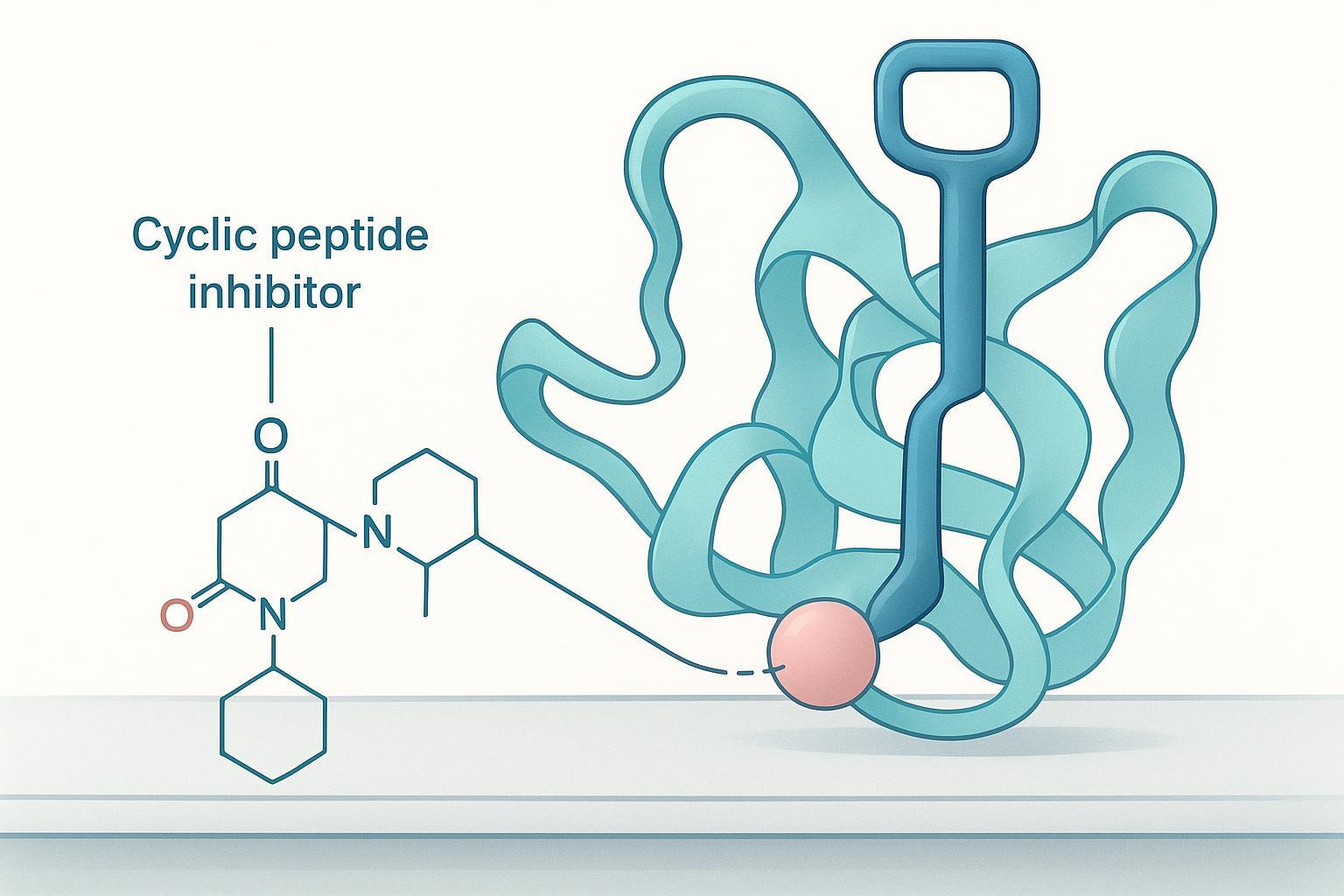
Un peptide ciclico che inibisce HIF-1α occupando la tasca PAS-B è una chiave tagliata per adattarsi a una serratura. Trasformarlo in un degradatore significa saldare una maniglia su quella chiave: un linker più un elemento di reclutamento VHL, posizionato in modo che l'anello sia ancora nella tasca mentre il nuovo braccio si allunga per reclutare la ligasi. I denti non possono cambiare. Tutto il resto può.
Questa distinzione guida l’intero progetto. Nel caso dell'ancora, il linker e il ligando VHL sono stati incorporati come amminoacido bifunzionale personalizzato e incorporati direttamente durante la sintesi del peptide in fase solida, piuttosto che essere attaccato dopo la ciclizzazione (JACK, I PROTAC del peptide ciclico ripristinano la degradazione di HIF-1α mediata da VHL nell'ipossia, 2026). La conseguenza pratica è che il punto di attacco diventa una scelta progettuale fissata al momento del montaggio della catena, non è una variabile che si sintonizza più tardi in panchina.
Ogni decisione a valle deriva da tale impegno: quale gradiente risolve il coniugato, quale controllo conformazionale conferma che l'anello è sopravvissuto, e quale analisi può distinguere il degrado dalla mera occupazione.

Quale vettore di uscita dovrebbe trasportare il linker?
La selezione del sito di coniugazione è la prima decisione che vincola tutte le successive, e la regola è semplice da enunciare: scegliere la posizione che meno probabilmente perturberà il legame e che avrà maggiori probabilità di essere esposta al solvente (Strategie attuali per la progettazione dei linker PROTAC, 2020). Quando è disponibile una struttura co-cristallina del tuo peptide ciclico legata al bersaglio, a tale regola si risponde mediante ispezione. Quando non lo è, l'ispezione non può decidere la questione, e fingere il contrario è il modo in cui i programmi perdono mesi.
Servizi Inoltre, il punto di attacco non è una fase di derivatizzazione a cui si accede dopo che il peptide è stato ottimizzato. Si tratta di una scelta progettuale di assemblaggio a catena, risolto prima dell'inizio della sintesi, come nel caso dell'ancora. Cambiare idea in seguito significa risintetizzare il peptide, non modificare una catena laterale.
La regola del ranking empirico: classificare i vettori candidati in base a ciò che ciascuno preserva, in questo ordine: affinità di destinazione, quindi comportamento complesso ternario, poi il degrado. Un SAR ristretto in una posizione che sembrava esposta a solventi è un avvertimento, non rumore. Quella posizione è conformazionalmente portante, e la classifica è da rifare.
Installazione del linker e dell'elemento E3
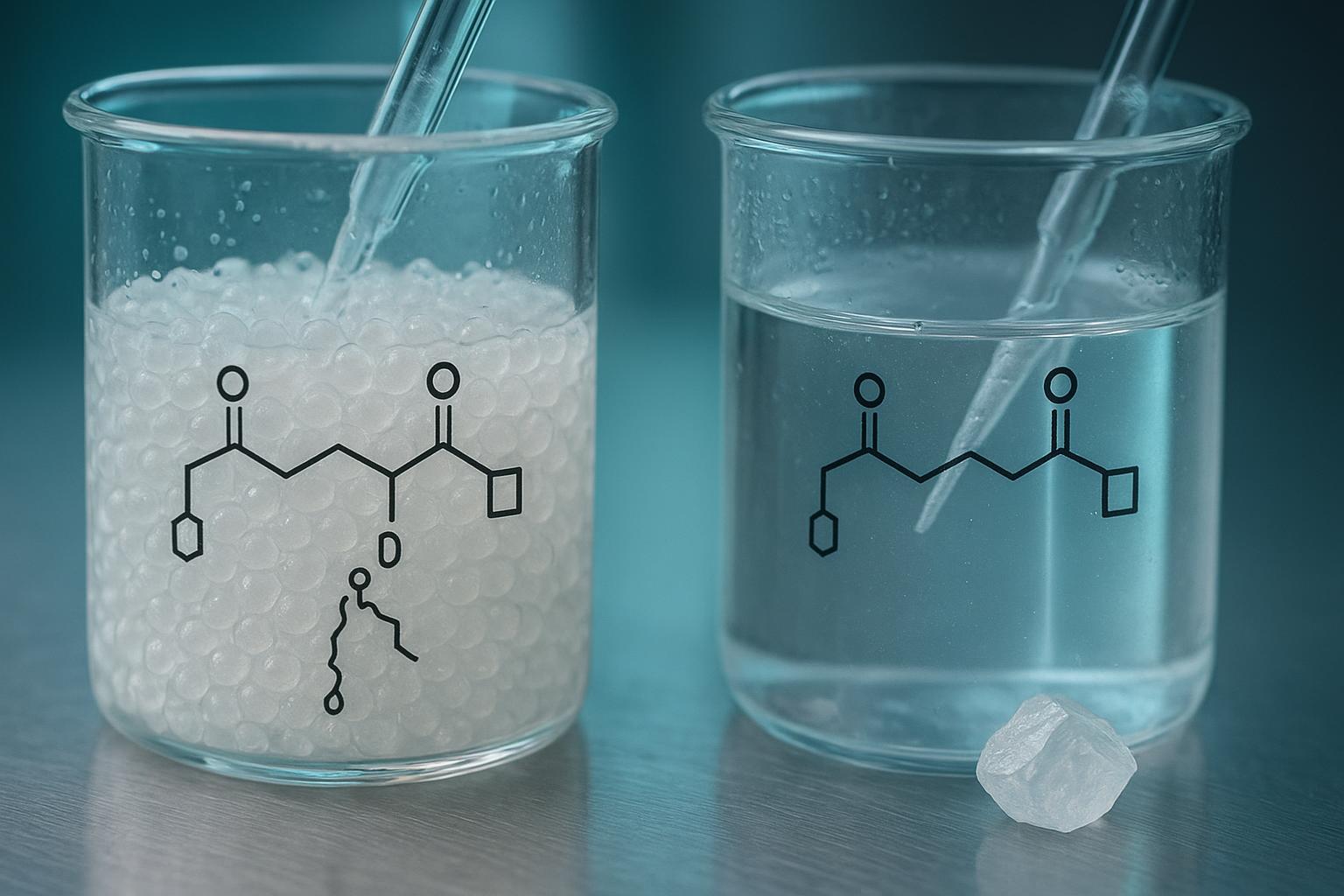
La decisione sul percorso viene prima, perché la coniugazione in resina e in soluzione fallisce in punti diversi. L'installazione sulla resina di un amminoacido bifunzionale costruisce il linker nella catena stessa, quindi lo schema del gruppo protettore deve mantenere intatto l'handle ortogonale del linker Negozio ogni successivo accoppiamento e la fase di ciclizzazione. La coniugazione della soluzione dopo la ciclizzazione è più veloce da ripetere, ma espone due volte il peptide libero alla chimica di attivazione e lascia purificare una miscela di isomeri posizionali se il residuo reattivo non è unico.
Il lavoro di Southampton mostra i vantaggi di tale iterazione. La serie iniziata con il ciclo-CLLFVY è passata a una testata di seconda generazione, ciclo-CLLF(CF3)SE(Fratello), trasportando linker di amminoacidi innaturali più lunghi incorporati nella sequenza anziché aggiunti successivamente (McDermott et al., 2025). Costruire il linker nella catena è ciò che rende la lunghezza del linker una variabile di progettazione invece che un problema di purificazione.
Ciò è importante perché la principale minaccia alla purezza e al ripiegamento dei peptidi su questa via è l’epimerizzazione, ed è meccanicamente evitabile. L'attivazione di un amminoacido forma un ossazolone planare che è temporaneamente achirale sul carbonio α, quindi la riprotonazione può restituire sia il L- o la configurazione D. Il rischio aumenta con l’attivazione estesa, reagenti di accoppiamento altamente reattivi, e intermedio attivato accumulato, e residui come la fenilglicina, la cisteina e l'istidina sono particolarmente inclini (Bachem; Epimerizzazione nella sintesi peptidica, 2023).
La grandezza dipende dal percorso, e il lavoro di fattibilità di un fornitore illustra lo spread piuttosto che stabilire un punto di riferimento: coniugazione del percorso del frammento prodotta approssimativamente 13% formazione di epimeri ed è stato interrotto, mentre il percorso alternativo ha mostrato un'epimerizzazione del 2-3% che sale a circa 5% dopo la purificazione, e l'SPPS lineare ha dato la resa più elevata senza rilevare alcuna epimerizzazione (Bachem). Leggilo come un segnale su quali classi di percorso comportano il rischio, non come una tariffa che puoi aspettarti dalla tua sequenza. Di
Ciò che i dati sulla purezza RP-HPLC possono e non possono dirti
Una singola percentuale di picco principale a 214 nm non conferma né la coniugazione corretta né il ripiegamento corretto. Ti dice che le specie che assorbono i raggi UV nel tuo campione eluiscono come una banda su un gradiente. Questo è un fatto utile, ed è un fatto minore di quanto lo considerino la maggior parte dei programmi.
Per uno più grande, coniugato più idrofobico, il metodo risolve meno di quanto ha fatto per il peptide ciclico genitore. Il linker e l'elemento E3 aggiungono un'area superficiale idrofobica, il tempo di ritenzione cambia, e le specie che erano separate dalla linea di base sul gradiente genitore iniziano a coeluire. Un programma pubblicato di degradazione dei peptidi ciclizzati con disolfuro riporta chiaramente la sua pratica di preparazione: un passaggio RP-HPLC su a 0.1% Gradiente TFA acqua/acetonitrile superiore al 26–43%. 40 minuti a 10 ml/min, rilevamento a 220 nm, ossidazione monitorata mediante spettrometria di massa insieme all'HPLC, e un controllo finale di qualità HPLC prima della liofilizzazione (Frontiere dell'immunologia, 2023). Nota ciò che quel documento non afferma: qualsiasi soglia di purezza. Il numero è un output del processo, non una specifica.
I fornitori comunemente specificano una purezza RP-HPLC ≥95% come livello minimo per la valutazione biologica, ≥98% per il legame quantitativo e il lavoro dose-risposta, e ≥99% per il lavoro basato su standard di riferimento, con purezza definita come area del picco principale sull'area totale del picco mediante rilevamento UV a 214–220 nm (GenScript; Proteomica creativa, 2025). Tratta queste bande come una convenzione di acquisto piuttosto che come un risultato misurato sulla tua molecola. Descrivono ciò che un fornitore certificherà, non quello di cui ha bisogno il tuo coniugato.
Il divario è importante perché la purezza e il ripiegamento dei peptidi sono questioni diverse, e RP-HPLC risponde solo al primo. Un epimero coeluito, un isomero disolfuro mal ripiegato, o un genitore non reagito che sembra funzionare allo stesso tempo di ritenzione, tutto presente come un unico picco pulito. Identità di massa, stereochimica, e la conformazione della soluzione richiedono ciascuno un metodo ortogonale.
Leggere la matrice come controllo di copertura, non una classifica. RP-HPLC copre l'idrofobicità e la purezza. LC-MS e HRMS coprono l'identità di massa, in questo modo confermi il linker effettivamente installato. La LC chirale copre la stereochimica, che è il modo in cui si rileva l'epimerizzazione nel sito di coniugazione. Conformazione della soluzione di copertura NMR e CD, che è il modo in cui si distingue un coniugato piegato da uno spiegato. Nessuna riga singola copre più di una colonna, e un programma che riporta solo la prima riga ha prove esattamente per una delle quattro domande.
La conseguenza pratica per la selezione del sito di coniugazione: se il tuo pacchetto analitico è una traccia RP-HPLC, non puoi ancora dire se il vettore di uscita che hai scelto ha prodotto il coniugato che hai progettato. Aggiungi i metodi ortogonali prima di confermare il percorso, non dopo che un test legante risulta piatto.
Verifica pieghevole e conformazionale
Sintesi peptidica La ciclizzazione vincola la spina dorsale, ma non garantisce che la conformazione bioattiva sopravviva all'aggiunta del linker. Questa distinzione è il motivo per cui l’evidenza conformazionale deve essere ortogonale all’evidenza di purezza: ogni classe di metodo risponde a una domanda che le altre non possono.
La LC chirale risolve la stereochimica, quindi ti dice se il coniugato ha racemizzato sui residui che ti interessano. Il CD riporta la struttura secondaria della soluzione, e rapporti NMR sui contatti specifici che definiscono la piega rilegata. Nessuno di questi ne sostituisce un altro, e nessuno di essi sostituisce una lettura funzionale. Lo stesso principio governa la fase di analisi: un segnale del complesso ternario da solo non è sufficiente, e i valori cellulari DC50/Dmax da soli sono fenotipici piuttosto che meccanicistici (Metodi per studiare il meccanismo molecolare e guidare la progettazione dei degradatori, recuperato 2026-05-14).
Chiave da asporto: L'elevata purezza HPLC non è un coniugato corretto. A peak that is clean and mass-confirmed can still carry the wrong fold into the assay stage.
For your data package, that gap is the risk to close. A conjugate that passes purity and mass identity but was never conformationally checked carries an unquantified risk forward, and the assay team inherits it. Treat peptide purity and folding as two separate evidence lines, each with its own method and its own acceptance criterion, before the material is released to biology.
La catena delle prove dei test funzionali
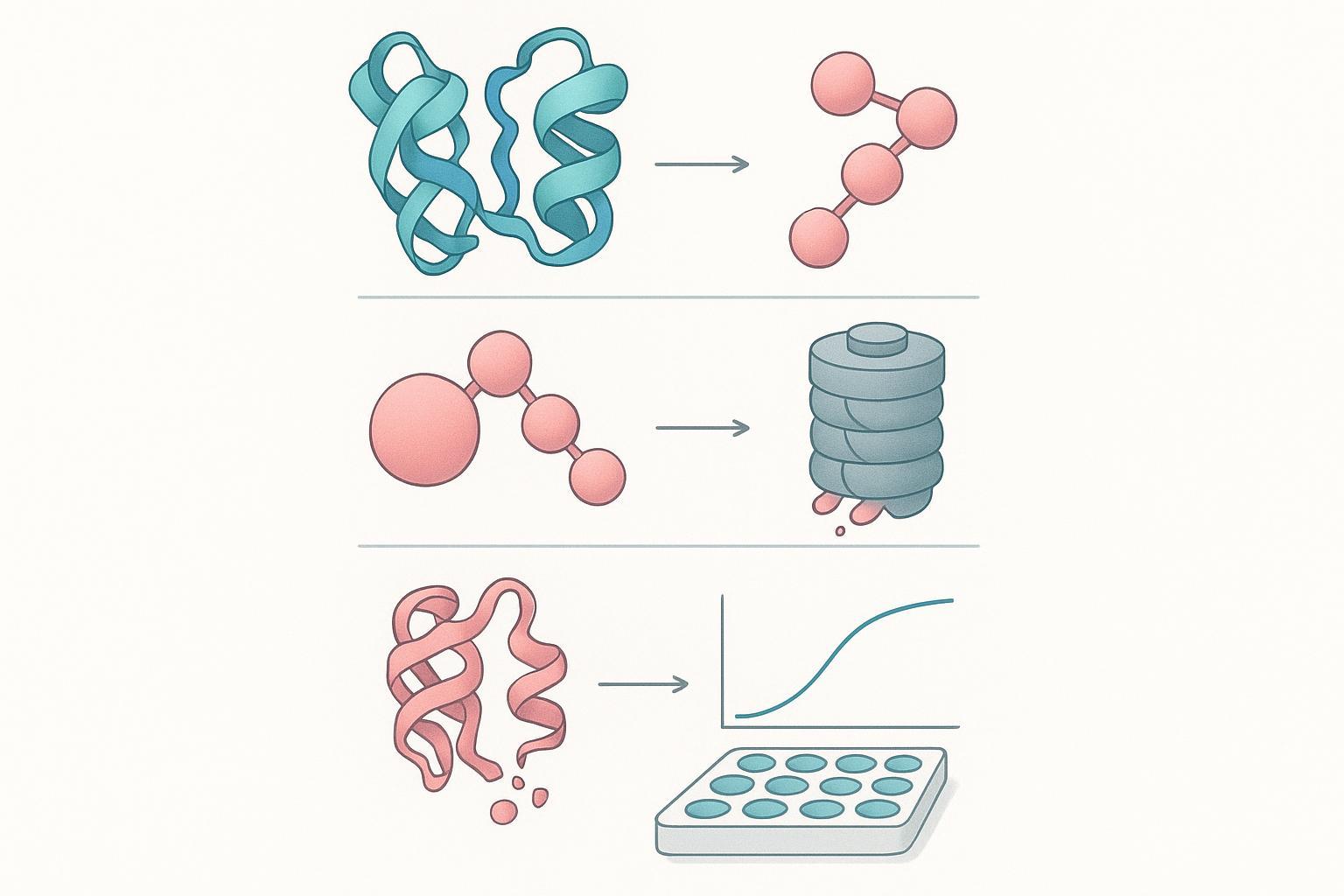
A degradation claim is a mechanism claim, and no single assay carries it. The evidence chain has four links, and a reviewer will look for all four: ternary complex formation, target ubiquitination, proteasomal dependence, and a quantitative potency and ceiling readout. If your package stops after the first link, you have shown binding, not degradation.
Work down the chain against your own data. Ternary complex: a co-crystal or a biophysical assay showing target, PROTAC and E3 ligase in one assembly. Ubiquitinazione: a direct or indirect readout that the target itself acquires ubiquitin. Proteasomal dependence: rescue by a proteasome inhibitor. Potency and ceiling: DC50 and Dmax from the same dose-response series.
The third link is the one most often skipped, and it is cheap to close. In the cyclic peptide work, PD-L1 loss at 2.5 µM after 4 hours was blocked by MG132, which is what separates degradation from a downstream transcriptional effect (Frontiere dell'immunologia, 2023). Target engagement can be shown the same way: cellular thermal shift assays moved DHHC3 from 49 °C in untreated cells to 55 °C in peptide-treated cells, evidence that the compound reaches the protein before any degradation is measured (Frontiere dell'immunologia, 2023).
That chart is the strongest quantified argument in this article for treating the E3 element as a design variable rather than an afterthought. Swapping CRBN for VHL, with the same warhead chemistry, moved DC50 from 0.103 µM a 1.92 µM, and the IAP arm to 7.530 µM (Cell Death & Disease, 2024). Nearly two orders of magnitude separate the best and worst arm in the same cellular assay.
Now the gap. The same series reports DC50 values but no Dmax, so potency is comparable across arms while the ceiling of degradation is not (Cell Death & Disease, 2024). A compound can be potent and still leave most of the target standing. When you hand a package from chemistry to biology, ask for the full dose-response curve, not the single number: functional assay support means the curve, the rescue control, and the engagement assay together, because that is what a reviewer will ask for on HIF-1α degradation or any other target you take forward.
Il limite dello stato di ossigeno sul caso dell'ancora
The anchor cyclic peptide PROTAC restores VHL-mediated HIF-1α degradation robustly at 3% O₂, and shows no net degradation at 1% O₂. That is not a potency failure. Under the reported conditions the degrader stays engagement- and degradation-competent at 1% O₂, but the target’s resynthesis outpaces clearance, so the steady-state pool never falls (JACK, I PROTAC del peptide ciclico ripristinano la degradazione di HIF-1α mediata da VHL nell'ipossia, 2026).
Read that as a design rule rather than a footnote: a degradation readout is only interpretable against the resynthesis rate of the target in the same cellular context. A DC50 measured at one oxygen tension does not transfer to another, because the number you measured is a net balance, not a clearance constant.
Before you compare your conjugate against a published DC50, confirm the oxygen tension, the cell line, and the resynthesis behavior of the target under that same condition.
Idee sbagliate comuni che costano tempo ai programmi
Four decision errors account for most of the lost time in a cyclic peptide PROTAC design program. Each one substitutes a cheaper measurement for the question the program actually needs answered.
High HPLC purity is not a correct conjugate. A single sharp peak at 95% tells you the material is homogeneous by one detection method. It does not tell you the linker sits on the intended residue, that the stereochemistry survived conjugation, or that the E3 ligand is intact. The fix is orthogonal characterization: LC-MS for mass confirmation, and a second chromatographic or spectroscopic method that separates the conjugate from its positional isomers.
Retained target binding is not degradation achieved. A binding assay reports occupancy. Degradation requires ubiquitination, proteasomal engagement and target loss, none of which a binding readout detects. The fix is to treat binding as a gate, non un punto finale, and to require target protein quantification before claiming degradation.
A ternary complex in a biophysical assay is not cellular degradation. Ternary complex formation is necessary but not sufficient; a stable complex can still fail to ubiquitylate. The fix is to carry the claim into cells and measure target protein levels directly.
A DC50 without a Dmax is a partial potency picture. Potency and extent are separate properties, and a compound that degrades 40% of the target at saturation is a different proposition from one that clears 90%. The fix is to report both, Sempre, from the same dose-response series.
Un quadro decisionale per la conversione
Run these five checks in order against your own program. Each one has a failure mode attached, and each one is cheaper to fix before the next.
-
Rank candidate exit vectors empirically, not by inspection. Express the same cyclic inhibitor with the linker at two or three different positions, run the conjugate series through the target-binding assay, and let the rank order pick the winner. Modalità di fallimento: choosing the vector that looks most accessible on the model and discovering after scale-up that binding is gone.
-
Decide the route before you commit the linker. On-resin versus solution conjugation determines how much epimerization risk you carry, so treat it as a route decision rather than a late optimization. Modalità di fallimento: a conjugate that purifies cleanly but has lost the stereochemistry the binding data depended on.
-
Purify, then characterize orthogonally. RP-HPLC purity and mass confirmation answer different questions, and neither one reports on conformation. Modalità di fallimento: a single-method release criterion that passes a misfolded batch.
-
Verify folding before you spend assay budget. Dicroismo circolare, RMN, or a structure-sensitive binding readout confirms the conjugate still occupies the intended conformation.
-
Build the assay chain before claiming degradation. Ternary complex formation, coinvolgimento dell'obiettivo, Peptidi sintetici and a degradation readout are three separate claims, and a binary binding result supports only the first.
Chiave da asporto: Conformational verification is the item programs skip most often. Purity data and mass confirmation cannot tell you whether the conjugate folded correctly, so a batch can pass every analytical gate and still fail functionally.
The sequence matters more than any single step: a program that ranks vectors first and verifies conformation before assay work avoids re-synthesizing a conjugate it has already characterized.
Prossimi passi
If a cyclic peptide PROTAC design program is on your roadmap, the useful next move is a scoping conversation rather than a purchase decision. Bring three things: your anchor sequence and any structural data, the exit vector you have chosen or the candidates you are weighing, and the assay readouts your team will accept as evidence of degradation. Those three inputs determine whether the conversion is a straightforward linker installation or a redesign that needs new chemistry.
For teams that need a synthesis and characterization partner, MOL Changes states capabilities across solid-phase and microbial fermentation synthesis, controlled-environment purification, HPLC/MS and sterility QC, and mg-to-kg scale. That range matters most when a conjugate program moves from analytical-scale material to the quantities a functional assay series requires. Produzione di peptidi
Chiave da asporto: The constructs described here are research reagents. Any clinical translation requires independent validation, and nothing in this guide substitutes for your own analytical and biological confirmation.
Divulgazione: the author’s organization provides peptide synthesis and characterization services of the kind discussed in this article.
Discuss a custom conjugate program. Share your anchor sequence, target exit vector and required assay endpoints, and request the analytical documentation package (metodo di purezza, pendenza, MS confirmation and folding data) alongside a scoping call. Start a program discussion.
Domande frequenti
Cosa faccio se non c'è una struttura co-cristallina del mio peptide ciclico legata al bersaglio?
Rank candidate attachment positions empirically instead of waiting for a structure. Express the peptide with the linker at each candidate residue, then measure in sequence: preserved target affinity, ternary-complex formation with the E3 ligase, and cellular degradation. A position that tolerates substitution keeps its affinity; one that does not is disqualified. Treat narrow structure-activity relationships at a candidate position as a stop signal, because the exit vector is probably buried in the binding interface.
Un linker più lungo è sempre migliore per un peptide ciclico PROTAC?
NO. Linker length and composition change ternary-complex geometry, and that geometry drives potency in both directions. The frequently quoted 5-15 atom window comes from secondary recaps whose primary pages could not be read in this run, so treat any specific range as a starting hypothesis to test across a small series, not a specification to design against.
Come distinguere l'epimerizzazione da un problema di ripiegamento sui miei dati analitici?
Use orthogonal methods, because a single RP-HPLC main peak cannot separate the two failure modes. Chiral LC or NMR resolves stereochemistry at the affected residue; circular dichroism and NMR report on solution conformation. Epimerization is a known hazard of the conjugation chemistry rather than a vendor talking point, so when peptide purity and folding both look acceptable and activity still drops, run the stereochemical check before redesigning the linker.
Qual è il test minimo impostato per dichiarare la degradazione piuttosto che l'inibizione??
Four measurements: ternary-complex formation, target ubiquitination, proteasomal dependence confirmed by MG132-type rescue, and quantitative DC50 and Dmax from dose-response curves. Ternary complex alone is insufficient, since binding without ubiquitination transfer proves nothing about degradation. DC50 and Dmax alone are phenotypic: they show the target disappeared without showing the proteasome caused it. Report the set together, and state the cell line and time point for each.