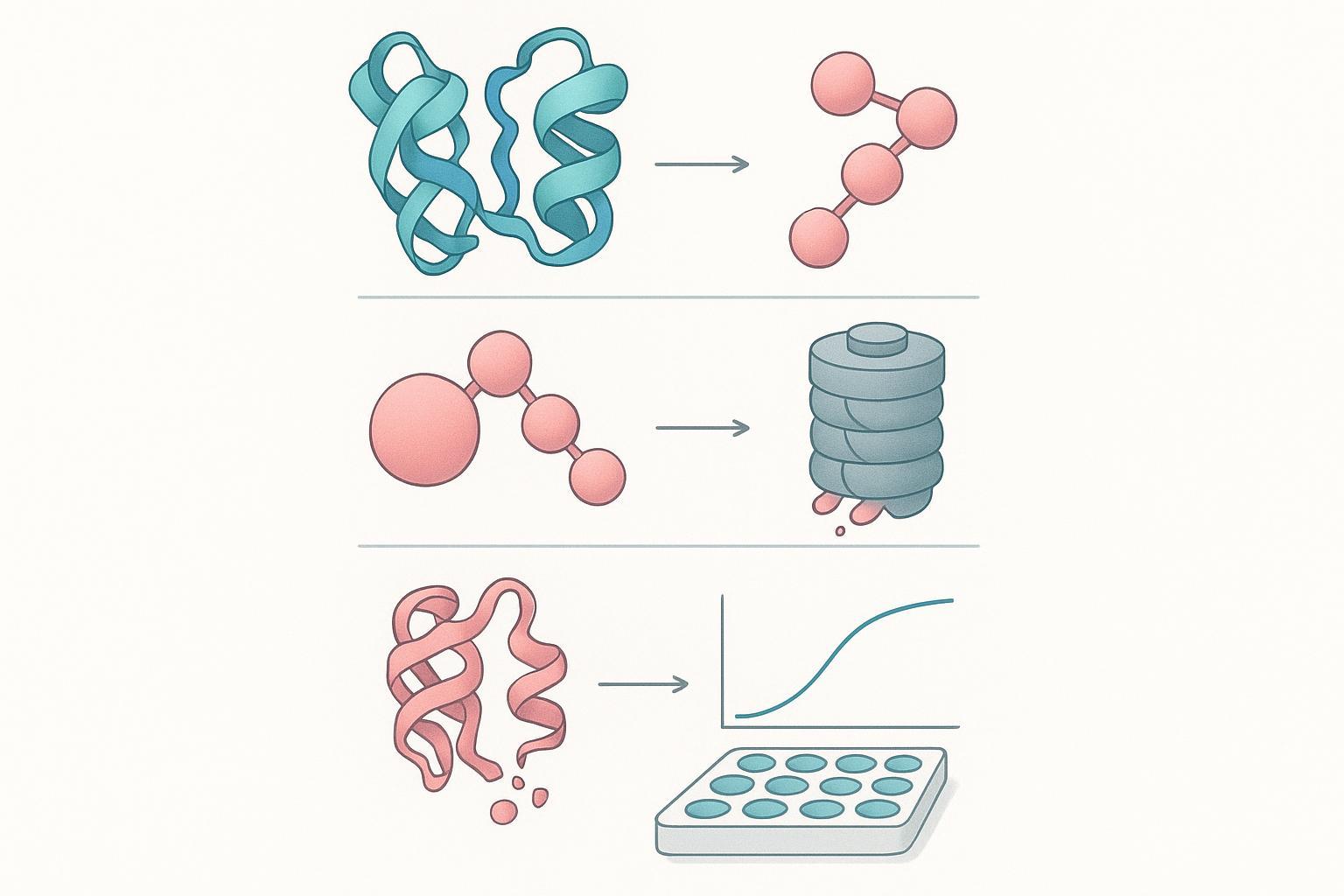
环肽PROTAC设计: HIF-1α 降解指南

环肽PROTAC设计: HIF-1α 降解指南

此次改造是一次重新设计, 不是附加组件

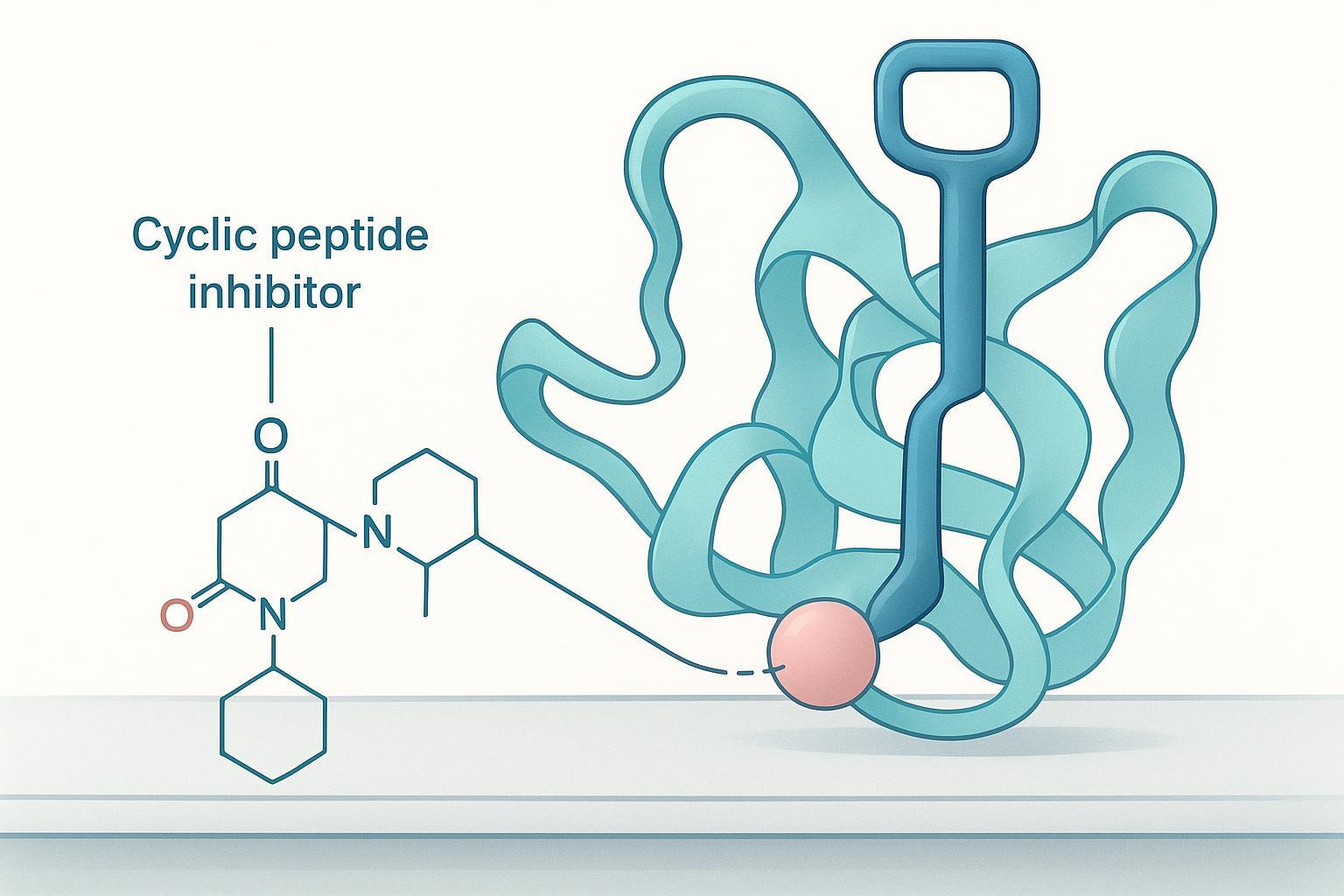
一种有效的环状 HIF-1α 抑制剂,显示为 PAS-B 口袋中的钥匙, 带有连接器和 VHL 招募元件,绘制为焊接到环上的手柄

通过占据 PAS-B 口袋来抑制 HIF-1α 的环肽是一把钥匙就能安装一把锁. 将其变成降级器意味着将手柄焊接到该钥匙上: 一个链接器加上一个 VHL 招募元件, 定位,使环仍然位于口袋中,同时新臂伸出以招募连接酶. 牙齿无法改变. 其他都可以.

这种区别推动了整个项目. 在锚案例中, 连接子和 VHL 配体作为定制双功能氨基酸内置,并在固相肽合成过程中直接掺入, 而不是环化后附着 (杰克斯, 环肽 PROTAC 恢复缺氧时 VHL 介导的 HIF-1α 降解, 2026). 实际结果是,连接点成为链条组装时固定的设计选择, 不是您稍后在工作台上调整的变量.

每个下游决策都源于该承诺: 哪个梯度解析共轭, 哪种构象检查证实环幸存下来, 哪种检测可以区分退化和单纯的占用.

环肽PROTAC设计: HIF-1α 降解指南

哪个退出向量应携带链接器?

接合位点的选择是第一个决定,制约着以后的每一个决定, 规则很简单: 选择最不可能干扰结合且最有可能暴露于溶剂的位置 (目前 PROTAC 连接子的设计策略, 2020). 当与靶标结合的环肽的共晶结构可用时, 该规则可以通过检查来回答. 当它不是时, 检查不能决定问题, 假装不然,程序就会损失几个月的时间.

服务 连接点也不是肽优化后固定的衍生化步骤. 这是一种链条装配设计选择, 在合成开始之前修复, 就像锚案例一样. 稍后改变主意意味着重新合成肽, 不编辑侧链.

经验排名规则: 根据每个候选向量保留的内容对候选向量进行排名, 按这个顺序: 目标亲和力, 然后是三元复合体行为, 然后降解. 看起来有偿付能力的头寸的较窄SAR是一个警告, 不是噪音. 该位置在构象上是承重的, 并且排名必须重做.

安装链接器和 E3 元素
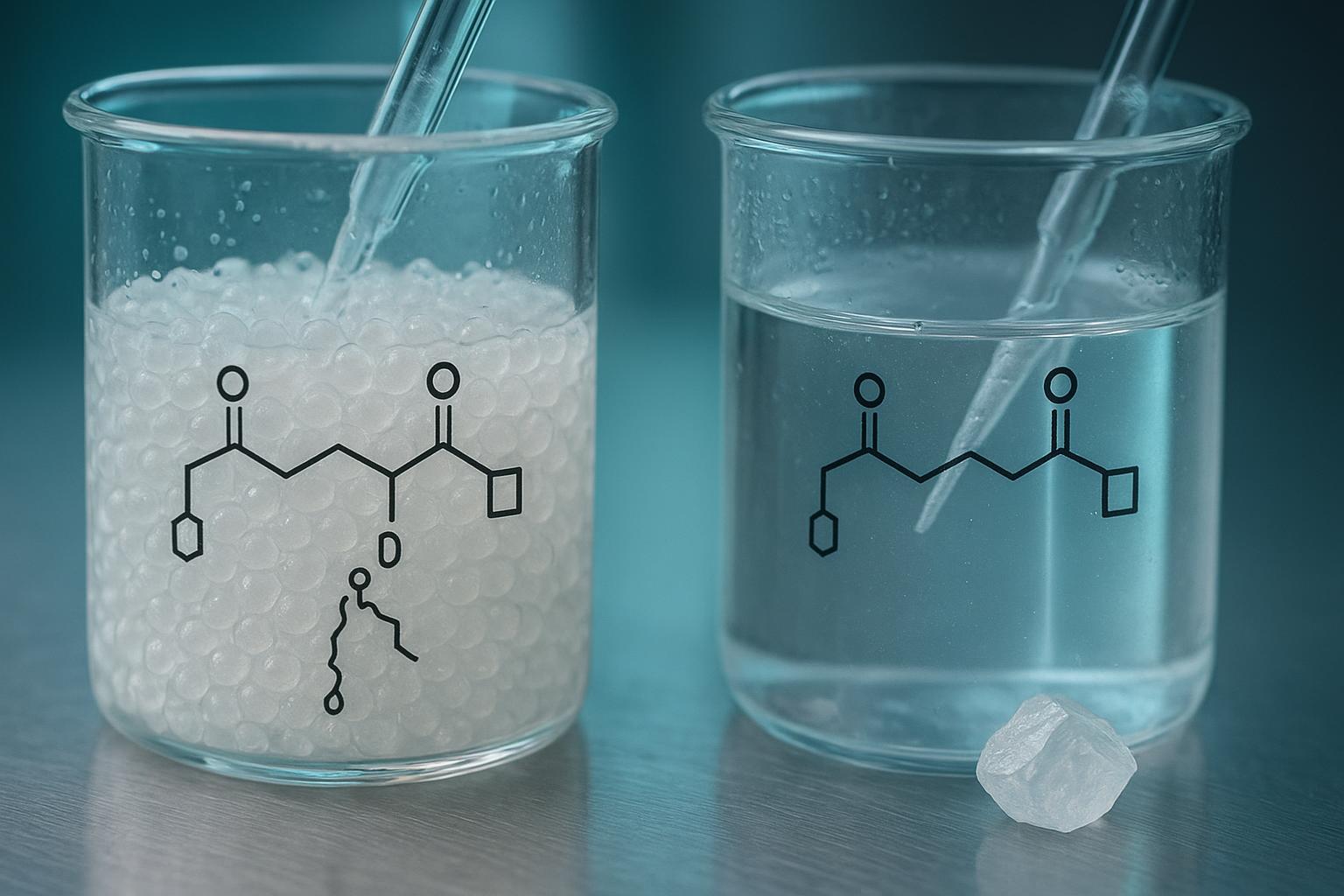
环肽的树脂上与溶液缀合的并排示意图, 显示双功能氨基酸进入 e 链的位置

路线决定是第一位的, 因为树脂上和溶液缀合在不同的地方失败. 双功能氨基酸在树脂上的安装将连接子构建到链本身中, 因此保护基团方案必须通过以下方式保持链接器的正交句柄完整 店铺 每个后续偶联和环化步骤. 环化后溶液共轭的迭代速度更快, 但它会将游离肽暴露于活化化学两次,并且如果反应残基不是唯一的,则可以纯化位置异构体的混合物.

南安普顿的工作展示了迭代的意义. 该系列从环-CLLFVY开始转向第二代弹头, 环CLLF(CF3)如果(溴), carrying longer unnatural amino acid linkers built into the sequence rather than appended afterwards (McDermott et al., 2025). Building the linker into the chain is what makes linker length a design variable instead of a purification problem.

That matters because the main threat to peptide purity and folding on this route is epimerization, and it is mechanistically avoidable. Activating an amino acid forms a planar oxazolone that is temporarily achiral at the α-carbon, so reprotonation can return either the L- or the D-configuration. Risk climbs with extended activation, highly reactive coupling reagents, and accumulated activated intermediate, and residues such as phenylglycine, cysteine and histidine are especially prone (巴赫姆; Epimerisation in Peptide Synthesis, 2023).

The magnitude is route-dependent, and one vendor’s feasibility work illustrates the spread rather than setting a benchmark: fragment-route conjugation produced roughly 13% epimer formation and was discontinued, while the alternative route showed 2–3% epimerization rising to about 5% after purification, and linear SPPS gave the highest yield with no epimerization detected (巴赫姆). Read that as a signal about which route classes carry the risk, not as a rate you can expect on your own sequence. 关于

RP-HPLC 纯度数据可以告诉您什么,不能告诉您什么

A single main-peak percentage at 214 nm confirms neither correct conjugation nor correct folding. It tells you that the UV-absorbing species in your sample elute as one band on one gradient. That is a useful fact, and it is a smaller fact than most programs treat it as.

For a larger, more hydrophobic conjugate, the method resolves less than it did for the parent cyclic peptide. The linker and E3 element add hydrophobic surface area, the retention time shifts, and species that were baseline-separated on the parent gradient start to co-elute. A published disulfide-cyclized peptide degrader program reports its preparative practice plainly: one RP-HPLC step on a 0.1% TFA water/acetonitrile gradient running 26–43% over 40 分钟在 10 毫升/分钟, detection at 220 纳米, oxidation monitored by mass spectrometry alongside HPLC, and a final HPLC quality check before lyophilization (Frontiers in Immunology, 2023). Note what that paper does not state: any purity threshold. The number is a process output, 不是规格.

Suppliers commonly specify ≥95% RP-HPLC purity as the floor for biological evaluation, ≥98% for quantitative binding and dose-response work, and ≥99% for reference-standard work, with purity defined as main-peak area over total peak area by UV detection at 214–220 nm (金斯瑞; 创意蛋白质组学, 2025). Treat those bands as purchasing convention rather than a measured finding about your molecule. They describe what a vendor will certify, not what your conjugate needs.

The gap matters because peptide purity and folding are different questions, and RP-HPLC answers only the first. A co-eluting epimer, a misfolded disulfide isomer, or an unreacted parent that happens to run at the same retention time all present as a clean single peak. Mass identity, stereochemistry, and solution conformation each require an orthogonal method.

Read the matrix as a coverage check, 不是排名. RP-HPLC covers hydrophobicity and purity. LC-MS and HRMS cover mass identity, which is how you confirm the linker actually installed. Chiral LC covers stereochemistry, which is how you catch epimerization at the conjugation site. NMR and CD cover solution conformation, which is how you distinguish a folded conjugate from an unfolded one. No single row covers more than one column, and a program that reports only the first row has evidence for exactly one of four questions.

The practical consequence for conjugation-site selection: if your analytical package is one RP-HPLC trace, you cannot yet tell whether the exit vector you chose produced the conjugate you designed. Add the orthogonal methods before you commit the route, not after a binding assay comes back flat.

折叠和构象验证

多肽合成 Cyclization constrains the backbone, but it does not guarantee that the bioactive conformation survives linker addition. That distinction is why conformational evidence has to be orthogonal to purity evidence: each method class answers a question the others cannot.

Chiral LC resolves stereochemistry, so it tells you whether the conjugate racemized at the residues you care about. CD reports on solution secondary structure, and NMR reports on the specific contacts that define the bound fold. None of these substitutes for another, and none of them substitutes for a functional readout. The same principle governs the assay stage: a ternary-complex signal alone is insufficient, and cellular DC50/Dmax values alone are phenotypic rather than mechanistic (Methods to Study the Molecular Mechanism and Drive the Design of Degraders, 检索到的 2026-05-14).

要点: High HPLC purity is not correct conjugate. A peak that is clean and mass-confirmed can still carry the wrong fold into the assay stage.

For your data package, that gap is the risk to close. A conjugate that passes purity and mass identity but was never conformationally checked carries an unquantified risk forward, and the assay team inherits it. Treat peptide purity and folding as two separate evidence lines, each with its own method and its own acceptance criterion, before the material is released to biology.

功能分析证据链

a four-step evidence chain drawn as a vertical sequence: ternary complex formation, target ubiquitination, proteasomal rescue, quantitative DC50/Dmax,

A degradation claim is a mechanism claim, and no single assay carries it. The evidence chain has four links, and a reviewer will look for all four: ternary complex formation, target ubiquitination, proteasomal dependence, and a quantitative potency and ceiling readout. If your package stops after the first link, you have shown binding, not degradation.

Work down the chain against your own data. Ternary complex: a co-crystal or a biophysical assay showing target, PROTAC and E3 ligase in one assembly. 泛素化: a direct or indirect readout that the target itself acquires ubiquitin. Proteasomal dependence: rescue by a proteasome inhibitor. Potency and ceiling: DC50 and Dmax from the same dose-response series.

The third link is the one most often skipped, and it is cheap to close. In the cyclic peptide work, PD-L1 loss at 2.5 µM after 4 hours was blocked by MG132, which is what separates degradation from a downstream transcriptional effect (Frontiers in Immunology, 2023). Target engagement can be shown the same way: cellular thermal shift assays moved DHHC3 from 49 °C in untreated cells to 55 °C in peptide-treated cells, evidence that the compound reaches the protein before any degradation is measured (Frontiers in Immunology, 2023).

That chart is the strongest quantified argument in this article for treating the E3 element as a design variable rather than an afterthought. Swapping CRBN for VHL, with the same warhead chemistry, moved DC50 from 0.103 µM 至 1.92 微米, and the IAP arm to 7.530 微米 (Cell Death & Disease, 2024). Nearly two orders of magnitude separate the best and worst arm in the same cellular assay.

Now the gap. The same series reports DC50 values but no Dmax, so potency is comparable across arms while the ceiling of degradation is not (Cell Death & Disease, 2024). A compound can be potent and still leave most of the target standing. When you hand a package from chemistry to biology, ask for the full dose-response curve, not the single number: functional assay support means the curve, the rescue control, and the engagement assay together, because that is what a reviewer will ask for on HIF-1α degradation or any other target you take forward.

锚壳的氧态极限

The anchor cyclic peptide PROTAC restores VHL-mediated HIF-1α degradation robustly at 3% O₂, and shows no net degradation at 1% O₂. That is not a potency failure. Under the reported conditions the degrader stays engagement- and degradation-competent at 1% O₂, but the target’s resynthesis outpaces clearance, so the steady-state pool never falls (杰克斯, 环肽 PROTAC 恢复缺氧时 VHL 介导的 HIF-1α 降解, 2026).

Read that as a design rule rather than a footnote: a degradation readout is only interpretable against the resynthesis rate of the target in the same cellular context. A DC50 measured at one oxygen tension does not transfer to another, because the number you measured is a net balance, not a clearance constant.

Before you compare your conjugate against a published DC50, confirm the oxygen tension, the cell line, and the resynthesis behavior of the target under that same condition.

浪费计划时间的常见误解

Four decision errors account for most of the lost time in a cyclic peptide PROTAC design program. Each one substitutes a cheaper measurement for the question the program actually needs answered.

High HPLC purity is not a correct conjugate. A single sharp peak at 95% tells you the material is homogeneous by one detection method. It does not tell you the linker sits on the intended residue, that the stereochemistry survived conjugation, or that the E3 ligand is intact. The fix is orthogonal characterization: 用于质量确认的 LC-MS, and a second chromatographic or spectroscopic method that separates the conjugate from its positional isomers.

Retained target binding is not degradation achieved. A binding assay reports occupancy. Degradation requires ubiquitination, proteasomal engagement and target loss, none of which a binding readout detects. The fix is to treat binding as a gate, 不是端点, and to require target protein quantification before claiming degradation.

A ternary complex in a biophysical assay is not cellular degradation. Ternary complex formation is necessary but not sufficient; a stable complex can still fail to ubiquitylate. The fix is to carry the claim into cells and measure target protein levels directly.

A DC50 without a Dmax is a partial potency picture. Potency and extent are separate properties, and a compound that degrades 40% of the target at saturation is a different proposition from one that clears 90%. The fix is to report both, always, from the same dose-response series.

转换的决策框架

Run these five checks in order against your own program. Each one has a failure mode attached, and each one is cheaper to fix before the next.

  1. Rank candidate exit vectors empirically, not by inspection. Express the same cyclic inhibitor with the linker at two or three different positions, run the conjugate series through the target-binding assay, and let the rank order pick the winner. 失效模式: choosing the vector that looks most accessible on the model and discovering after scale-up that binding is gone.

  2. Decide the route before you commit the linker. On-resin versus solution conjugation determines how much epimerization risk you carry, so treat it as a route decision rather than a late optimization. 失效模式: a conjugate that purifies cleanly but has lost the stereochemistry the binding data depended on.

  3. Purify, then characterize orthogonally. RP-HPLC purity and mass confirmation answer different questions, and neither one reports on conformation. 失效模式: a single-method release criterion that passes a misfolded batch.

  4. Verify folding before you spend assay budget. 圆二色性, 核磁共振, or a structure-sensitive binding readout confirms the conjugate still occupies the intended conformation.

  5. Build the assay chain before claiming degradation. Ternary complex formation, 目标参与度, 合成肽 and a degradation readout are three separate claims, and a binary binding result supports only the first.

要点: Conformational verification is the item programs skip most often. Purity data and mass confirmation cannot tell you whether the conjugate folded correctly, so a batch can pass every analytical gate and still fail functionally.

The sequence matters more than any single step: a program that ranks vectors first and verifies conformation before assay work avoids re-synthesizing a conjugate it has already characterized.

后续步骤

If a cyclic peptide PROTAC design program is on your roadmap, the useful next move is a scoping conversation rather than a purchase decision. Bring three things: your anchor sequence and any structural data, the exit vector you have chosen or the candidates you are weighing, and the assay readouts your team will accept as evidence of degradation. Those three inputs determine whether the conversion is a straightforward linker installation or a redesign that needs new chemistry.

For teams that need a synthesis and characterization partner, MOL Changes states capabilities across solid-phase and microbial fermentation synthesis, controlled-environment purification, HPLC/MS and sterility QC, and mg-to-kg scale. That range matters most when a conjugate program moves from analytical-scale material to the quantities a functional assay series requires. 多肽生产

要点: The constructs described here are research reagents. Any clinical translation requires independent validation, and nothing in this guide substitutes for your own analytical and biological confirmation.

披露: the author’s organization provides peptide synthesis and characterization services of the kind discussed in this article.

Discuss a custom conjugate program. Share your anchor sequence, target exit vector and required assay endpoints, and request the analytical documentation package (纯度法, 坡度, MS confirmation and folding data) alongside a scoping call. Start a program discussion.

常见问题

如果我的环肽没有与靶标结合的共晶结构,我该怎么办?

Rank candidate attachment positions empirically instead of waiting for a structure. Express the peptide with the linker at each candidate residue, then measure in sequence: preserved target affinity, ternary-complex formation with the E3 ligase, and cellular degradation. A position that tolerates substitution keeps its affinity; one that does not is disqualified. Treat narrow structure-activity relationships at a candidate position as a stop signal, because the exit vector is probably buried in the binding interface.

对于环肽 PROTAC 来说,连接体越长越好吗??

不. Linker length and composition change ternary-complex geometry, and that geometry drives potency in both directions. The frequently quoted 5-15 atom window comes from secondary recaps whose primary pages could not be read in this run, so treat any specific range as a starting hypothesis to test across a small series, not a specification to design against.

如何根据分析数据区分差向异构化和折叠问题?

Use orthogonal methods, because a single RP-HPLC main peak cannot separate the two failure modes. Chiral LC or NMR resolves stereochemistry at the affected residue; circular dichroism and NMR report on solution conformation. Epimerization is a known hazard of the conjugation chemistry rather than a vendor talking point, so when peptide purity and folding both look acceptable and activity still drops, run the stereochemical check before redesigning the linker.

声称降解而不是抑制的最低检测设置是多少?

Four measurements: ternary-complex formation, target ubiquitination, proteasomal dependence confirmed by MG132-type rescue, and quantitative DC50 and Dmax from dose-response curves. Ternary complex alone is insufficient, since binding without ubiquitination transfer proves nothing about degradation. DC50 and Dmax alone are phenotypic: they show the target disappeared without showing the proteasome caused it. Report the set together, and state the cell line and time point for each.

管理员头像

Jinling Liu

过程R&研发及制造技术员 核心专长: 工艺放大, 绿色化学, 产量提高, GMP生产合规性.

轮廓: 刘金岭专注于实验室规模多肽药物的工艺转化 (毫克级) 到商业规模生产 (公斤级). 她致力于通过优化裂解条件来显着降低肽生产成本并最大限度地减少环境污染, 提高缩合试剂的比例, 并引进连续流合成技术. 主导优化多个多肽项目, 成功实现低成本, 100公斤级高纯度量产.

事实已核实 & 编辑指南
审阅者: 主题专家
分享这篇文章
家 搜索 Whatsapp 服务 产品