Por qué una evaluación LIMS genérica falla en el control de calidad de péptidos
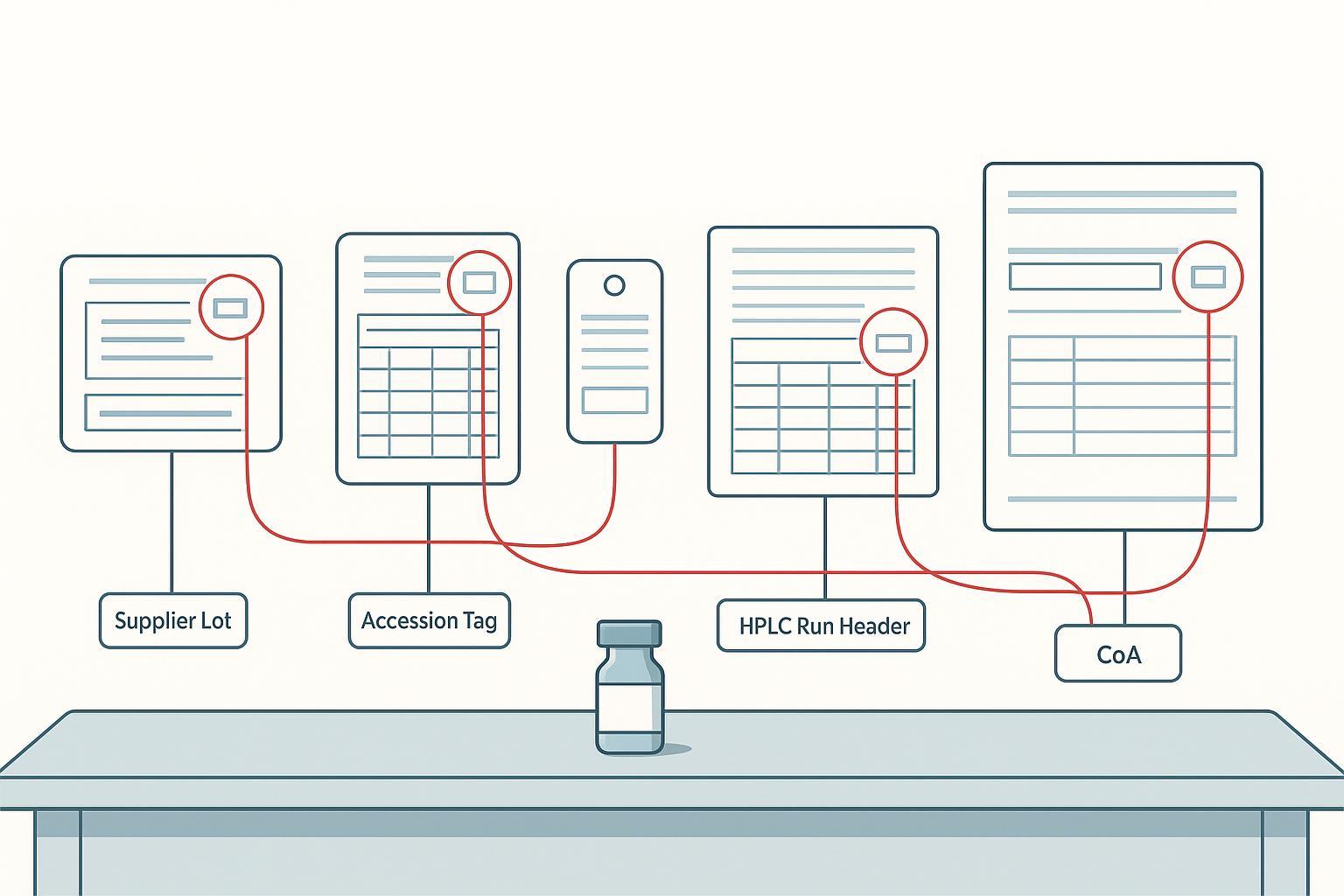
La trazabilidad de los lotes de péptidos rompe la lista de verificación que la mayoría de los laboratorios heredan de las guías LIMS genéricas. Un panel de liberación de péptidos no es una prueba en una muestra. Abarca la identidad de la espectrometría de masas., Pureza por HPLC de fase inversa, Contenido de contraión y ácido trifluoroacético., endotoxina por ensayo LAL, y esterilidad, y cada uno de esos registros lleva identificadores que deben coincidir exactamente: lote de proveedor, lote interno, número de acceso, tabla de secuencia, encabezado del cromatograma, y certificado de análisis. Las guías genéricas no prueban nada de ese acuerdo..
También se detienen en el límite equivocado.. En la práctica, La gestión de datos cromatográficos se divide en dos sistemas.. El CDS controla el instrumento., ejecuta la secuencia, adquiere e integra el cromatograma, evalúa la idoneidad del sistema, y posee el archivo sin formato nativo. El LIMS posee el registro., cadena de custodia, tarea de prueba, procesamiento por lotes, agregación de resultados, verificación de especificaciones, informar, y el registro de disposición. El LIMS impulsa la lista de trabajo y recupera los resultados aprobados., cuál es la transferencia que una evaluación de péptidos debe interrogar en lugar de asumir.
Si su lista de verificación actual proviene de una guía LIMS general, fue escrito para un modelo de datos que nunca tuvo que conciliar una tabla de secuencia con un encabezado de cromatograma.
Pregunta 1: ¿Puede el sistema demostrar la trazabilidad de secuencias y lotes de principio a fin??
La trazabilidad del lote de péptidos solo se puede demostrar cuando aparecen los mismos identificadores en la tabla de secuencia, el encabezado de ejecución y el CoA, y el sistema puede recorrer esa cadena en una sola consulta. En la práctica, eso significa que tres grupos de campos tienen que coincidir entre sí en lugar de vivir en módulos separados.
|
tabla de secuencia |
Ejecutar encabezado |
Estándar de referencia |
|---|---|---|
|
Secuencia y modificaciones |
Nombre y ruta del archivo de datos |
Nombre estándar y lote |
|
Identificador de muestra |
ID del instrumento |
Potencia o pureza asignada |
|
Síntesis de péptidos Nombre y versión del método |
Fecha de caducidad o nueva prueba |
|
|
Fecha y hora de adquisición |
Enlace a la curva de calibración |
|
|
Servicios ID del analista |
||
|
Posición del vial o lista de trabajo |
Los identificadores compartidos son el identificador de la muestra y la versión del método.: Rompe cualquiera de los dos y la cadena se detiene.. Trate esta lista como una guía profesional para estructurar su propio guión de demostración., no como una lista de verificación regulatoria.
Luego haga que el proveedor lo ejecute al revés.. Deles un número de lote de CoA y pídales que produzcan el registro de secuencia., la carrera, la versión del método y el analista en una sola vista, sin salir del sistema ni reconstruir la consulta manualmente.
Pregunta 2: ¿Cómo maneja el LIMS la cadena de custodia de alícuotas y tirones de estabilidad??

La cadena de custodia en el LIMS es un registro de transferencias y estados., no es un bloque de firma. Recepción y cuarentena, cada alícuota dividida, cada evento de congelación/descongelación, Cada punto de estabilidad y la entrada de disposición final necesitan su propia marca de tiempo., registro atribuible. 21 Parte CFR 11 requiere seguridad, generado por computadora, pistas de auditoría con marca de tiempo que capturan de forma independiente la fecha, tiempo y operador detrás de cada acción que crea, modifica o elimina un registro electrónico. La misma regulación sostiene que esos registros deben estar fácilmente disponibles para la inspección de la FDA., ¿Cuál es el estándar que debe cumplir un historial de custodia sin reconstrucción manual?.
For a peptide lot, that means a reviewer can open one view and see receipt, liberación de cuarentena, tres divisiones alícuotas, dos tiradores de estabilidad y una entrada de eliminación, each carrying a timestamp, an operator and a reason.
Pregunta 3: ¿El LIMS controla los datos cromatográficos sin procesar y las versiones de los métodos??
Chromatographic data management and method version control decide whether a release decision can be reconstructed years later. The LIMS must know which method version produced each result, and it must block reporting a result against a superseded version. If it cannot resolve that link, the batch record is incomplete no matter how clean the audit trail looks.
The boundary matters here. The chromatography data system owns instrument control, sequence execution, acquisition, integration, system suitability and the native raw file. El LIMS posee el registro., custody, tarea de prueba, procesamiento por lotes, agregación de resultados, verificación de especificaciones, reporting and the disposition record. A CDS alone will not carry the lot-level context; a LIMS alone will not hold the raw signal.
Map the method lifecycle to a recognised framework. Yo Q2(R2), the harmonised analytical procedure validation framework issued in March 2024, covers validation principles including the analytical use of spectroscopic data, and supports justified post-approval change management. For the instruments themselves, USP 〈1058〉 frames instrument qualification as fitness for intended use, official as of 1 Agosto 2017.
In the demo, ask the vendor to revise a method, then show what happens to results already reported under the prior version.
Pregunta 4: ¿Cómo se dirigen y preservan las investigaciones fuera de especificación??
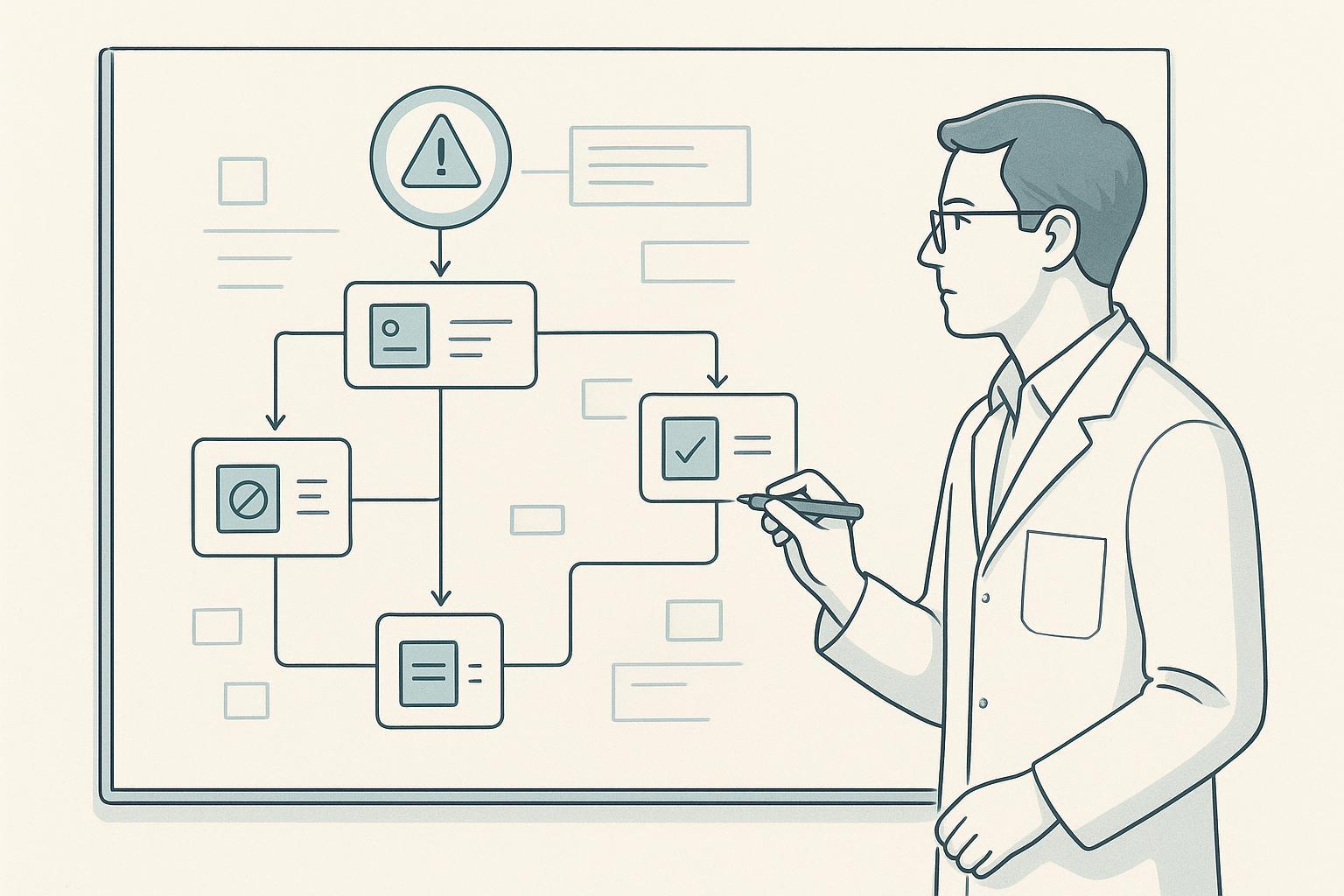
An out-of-specification investigation in a peptide QC lab is a routing and preservation problem before it is a compliance exercise. Industry-standard two-phase practice, framed by the FDA’s guidance on investigating out-of-specification test results, starts with a Phase I laboratory investigation: the lab checks its own work for an assignable cause before the result is treated as a product failure. Only when Phase I finds no assignable laboratory cause does the event escalate to Phase II, where the investigation moves beyond the laboratory.
The routing matters less than what survives it. For any OOS event, the record an auditor must be able to reconstruct includes the original reported result with sample ID, método, instrumento, run sequence, fecha y hora, analyst, and batch or lot context; the raw data behind it, including chromatograms, integrations, weights, calculations, and system-suitability and calibration records; an audit trail of every addition, supresión, modificación, reprocessing, and re-integration, with who authorised each one and why; the investigation record itself, with its phase assignment, evidence reviewed, conclusions, CAPA, and disposition; and the full retest history showing why retests were permitted, whether the initial result was invalidated, and which result became reportable (NCI Frederick, Managing Out-of-Specification Test Results or Unexpected Test Results, 2022).
A LIMS that stores only the final disposition cannot reconstruct any of this. Ask the vendor to walk one OOS event through the system end to end, from the first reported value to the reportable result.
Pregunta 5: ¿Se genera el certificado de análisis únicamente a partir de resultados aprobados??
Certificate of analysis generation is a controlled-document function, not a reporting template. A CoA is assembled from approved results, and its header fields must agree exactly with the sequence table, run header and reference standard records for that lot. The fields that carry the most weight are product name, número de lote, COA date and testing laboratory, because those four are what a customer checks first and what an auditor reconciles against the batch record.
That is why the release-blocking test belongs in the demo. Ask the vendor to generate a CoA for a lot that still has an open out-of-specification investigation against it, then watch what the system does. A LIMS built for peptide QA refuses, flags, or routes for approval. A reporting tool prints the certificate anyway, and you have just seen how a non-conforming lot reaches a customer.
|
CoA header field |
Source record it must agree with |
|---|---|
|
Product name |
tabla de secuencia |
|
Lot number |
Sequence table and run header |
|
COA date |
Approval record for the released results |
|
Testing laboratory |
Run header and reference standard records |
If the vendor cannot show that agreement in the demo, treat the CoA as unverified until they do.
Cómo se ve una cadena de pruebas defendible de principio a fin
A defensible peptide lot traceability chain is a sequence of handoffs, and each handoff needs a named record plus a control that keeps the record honest. Walk it in the demo from the vial label through accession, analytical run, versión del método, analyst, review, disposition, y certificado de análisis. At every one of those steps, ask which record carries the handoff and what stops that record from being edited after the fact. Chain of custody in the LIMS is only as strong as its weakest handoff, so a system that names the record but cannot show the control is showing you a form, not a control.
MOL Changes supports this kind of staged handoff, and can be used to keep method versions and review records attached to the lot they belong to.
Errores comunes en la selección de LIMS para el control de calidad de péptidos

The most common failure in choosing a LIMS for peptide QA is evaluating on a feature checklist instead of asking the vendor to produce a record. Checklists are easy to score and hard Péptidos sintéticos to falsify, which is exactly why they survive procurement. The five mistakes below are the ones that cost labs the most, and each has a cheap fix you can apply in the next demo.
Accepting a demo on synthetic data. Vendors demo with clean, pre-built lots because real data exposes gaps. Ask them to start from one of your own CoA lot numbers and walk to the sequence record, la carrera, the method version and the analyst who signed it. If the walk breaks anywhere, you have found your answer.
Treating the CDS/LIMS boundary as an integration detail. It is a data-ownership decision. Whoever holds the raw chromatographic data controls the audit trail, so settle that before you discuss connectors.
Letting method versioning be a free-text field. Free text cannot prove which method produced a result. Require a version history that binds each result to the method revision in force at the time of the run.
Assuming CoA generation is a reporting feature. It is a release control. Ask what the system does when an out-of-specification investigation is still open at the moment someone tries to issue the certificate.
Not asking what happens to an open OOS at release. This is the question that separates a defensible system from a document repository, and it takes thirty seconds to ask.
Cómo calificar las respuestas y decidir
Score each of the five questions on three axes, and score the vendor’s behavior, not the feature list. Primero: did they demonstrate the record in the system, or only describe it? A traceability claim shown live, with a real lot walked from synthesis through release, is worth more than a slide. Segundo: was the evidence exportable? Ask them to export the audit trail, the method-version history, or the OOS record as a file you can open. If the answer lives only inside their interface, you cannot audit it. Tercero: did the answer survive a follow-up? Ask what happens when a stability pull is split across two analysts, or when a method is revised mid-study. Vendors who know their product answer immediately; vendors who do not will offer a call with an engineer.
For a LIMS for peptide QA, the scoring criteria should also include the cost and timeline of validation, because that is often the deciding factor. Regulated LIMS validation is reported at roughly $15,000 a $80,000 for validation alone, with full regulated implementations commonly reported at $150,000 a $500,000 and timelines of 6 a 12 months single-site and 18 a 36 months multi-site (1LIMS, recuperado 2026-08-10). Treat these as indicative only: they come from vendor and consultancy estimates that vary widely, with no stated methodology or sample, so they should not anchor your decision. Use them to frame a budget conversation, not to choose a system.
|
Pregunta |
Demonstrated the record |
Evidence exportable |
Survived follow-up |
|---|---|---|---|
|
1. Sequence and lot traceability |
|||
|
2. Chain of custody for aliquots and stability pulls |
|||
|
3. Raw chromatographic data and method versions |
|||
|
4. OOS investigation routing and preservation Acerca de |
|||
|
5. CoA generated from approved results only |
Two limitations deserve a place in the scoring. Instrument-vendor lock-in is real: a system built tightly around one chromatography vendor’s data format can make a second instrument line expensive to onboard later. Migration cost is the other. Moving historical peptide data out of a legacy system, with its audit trails intact, is a project in itself, and vendors rarely quote it upfront. Ask both questions before you sign, and score the answers honestly.
If the scoring leaves you with two viable options, talk to a peptide QC specialist who has run these systems in a regulated lab, not just a sales engineer.
Preguntas frecuentes
¿Puede un sistema de datos de cromatografía cubrir por sí solo la trazabilidad del control de calidad de los péptidos??
No. A chromatography data system is the system of record for acquisition, integration, and the native raw file, but registration, custody, procesamiento por lotes, verificación de especificaciones, and the disposition record sit in the LIMS. That boundary matters for your evaluation because chromatographic data management and peptide lot traceability are two different record chains, and only one of them ends in a release decision. Ask the vendor to show where the CDS record is referenced by the LIMS record, and what happens to that reference when a result is reprocessed.
¿Qué pasa si el proveedor no puede mostrar un historial de versiones del método en la demostración??
Treat it as an unresolved release-blocking control, not a roadmap item. Method version control is what lets you prove which procedure produced a released result, so a demo that cannot display it is an incomplete demo, not a scheduling problem. Ask for the method lifecycle in writing, including how a version is retired and how historical results stay bound to the version that generated them, then ask for a reference lab that has been audited on exactly that. If the vendor cannot supply either, the out-of-specification investigation path downstream is unverifiable too.
¿Cuánta validación necesita un péptido QC LIMS??
Scope validation to the records your lab releases on, and map instrument qualification to USP 〈1058〉 “fitness for intended use” rather than treating it as a separate exercise. In practice that means the validated scope covers registration, custody transfer, specification evaluation, y el registro de disposición, with the instruments feeding those records qualified for the purpose they serve. A LIMS for peptide QA does not need to be validated as a whole system beyond what those release decisions depend on.
¿Un ELN cambia alguna de estas cinco preguntas??
No. An ELN changes where the analyst writes, not who owns custody, versión del método, or the disposition record. If an ELN is in the stack, the same five questions apply to whichever system holds those records, and you should confirm in the demo which one that is.
Conclusión
You now have a working evaluation framework: five questions for a LIMS for peptide QA, each paired with a specific record to demand and a specific request to send. Sequence and lot traceability maps to the full analytical record set, which for a typical peptide lot runs to roughly six to eight core documents covering MS identity, Pureza RP-HPLC, contraión, endotoxina, esterilidad, y disolventes residuales (Polypeptide QC specifications, sin fecha). Chain of custody maps to aliquot and stability-pull logs. Raw chromatographic data and method versions map to the instrument export and version history. OOS routing maps to the investigation record. CoA generation maps to the approved-results gate.
The value of asking this way is that it moves the conversation from a feature list to an audit. A vendor can claim traceability; only the records show whether it holds.
The next step is deliberately small. Request a representative CoA and analytical data package, then run the five questions against it before you book a second demo. If the answers are thin, ask to speak with a peptide QC specialist on the vendor’s team and put the same five questions to them.
Divulgación: MOL Changes has a commercial interest in peptide quality standards and LIMS evaluation practice.