पेप्टाइड उत्पादन के लिए siRNA विनिर्माण मॉडल क्या उधार ले सकता है और क्या नहीं
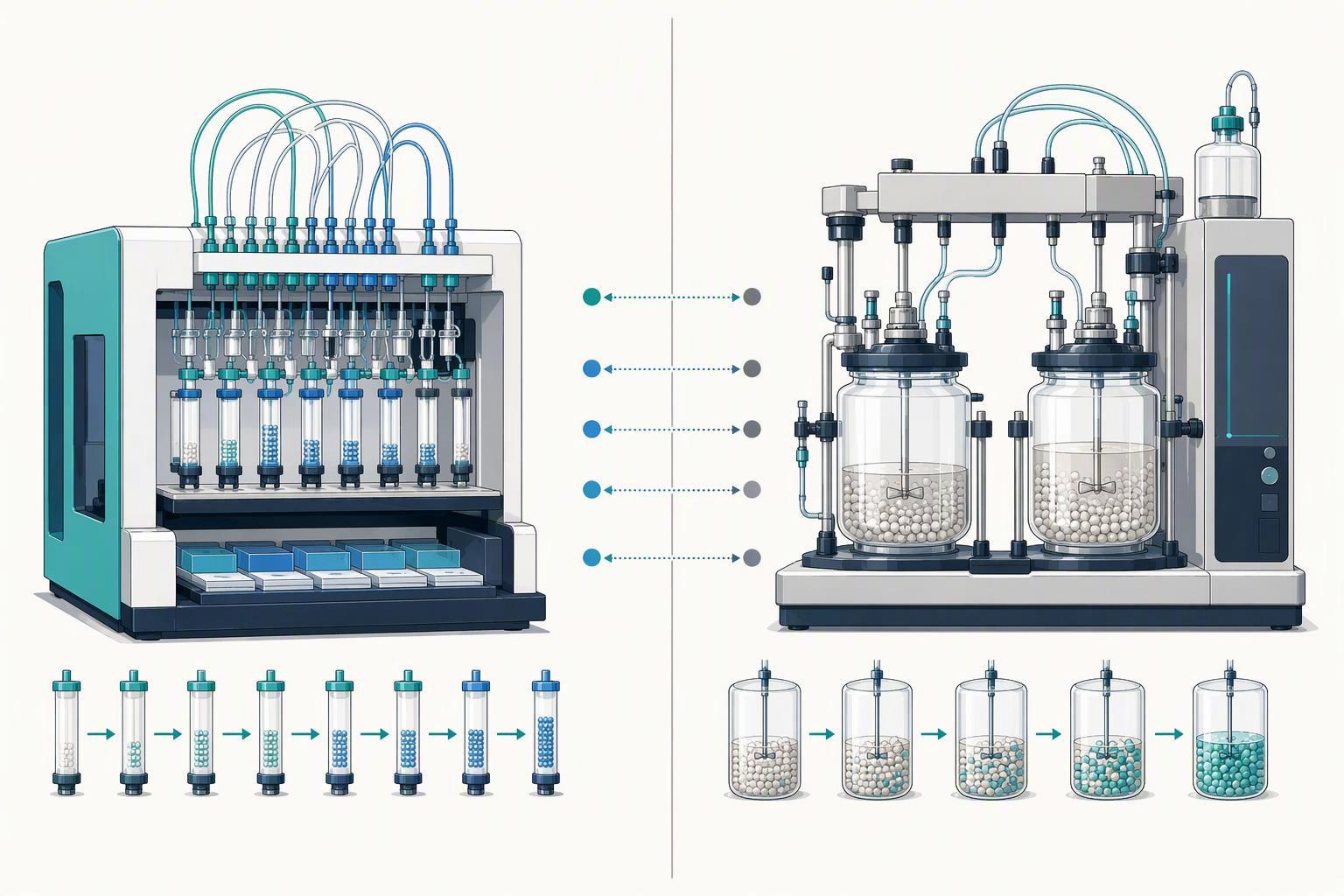
यदि आपका पेप्टाइड प्रोग्राम उस बिंदु पर पहुंच गया है जहां स्केल-अप और अशुद्धता का बोझ बेंच प्रैक्टिस से अधिक हो गया है, पेप्टाइड उत्पादन के लिए siRNA विनिर्माण मॉडल ध्यान से पढ़ने लायक है, और संदेहपूर्वक पढ़ने लायक है. बैचेम के प्रकट टुकड़े-और-बंधाव मामले के अध्ययन में छोटे आरएनए टुकड़ों के निर्माण और एक लंबी श्रृंखला को इकट्ठा करने के बजाय उन्हें एंजाइमेटिक रूप से जोड़ने का वर्णन किया गया है।, कम और सरल डाउनस्ट्रीम शुद्धिकरण कदमों के घोषित आर्थिक तर्क के साथ, कम विलायक उपयोग, कम अपशिष्ट और ग्राम से बहु-किलोग्राम पैमाने पर वस्तुओं की कम लागत (बाकेम, पुनर्प्राप्त 2026-09-21).
विखंडन-और-बंधाव का अर्थ है परिभाषित टुकड़ों को अलग-अलग संश्लेषित करना और फिर उन्हें जोड़ना, एक सतत शृंखला बढ़ने के बजाय. एक एन-1 शॉर्टमर एक श्रृंखला है जिसमें एक अवशेष गायब है, और रेसमाइज़ेशन एक चिरल केंद्र के इच्छित विन्यास का नुकसान है, जैसे-जैसे जंजीरें लंबी होती जाती हैं, इन दोनों को नियंत्रित करना कठिन हो जाता है. फ़िट-फॉर-पर्पस एनालिटिक्स का अर्थ है किसी निर्णय की आवश्यकता के अनुरूप परीक्षण करना, किसी निश्चित पैनल पर नहीं.

यह सार्वजनिक सामग्री की व्याख्या है, पेप्टाइड नुस्खा नहीं. न्यूक्लिक-एसिड निर्माण बनाम पेप्टाइड रसायन विज्ञान में अलग-अलग युग्मन शामिल है, सुरक्षा-समूह और स्टीरियोकैमिस्ट्री समस्याएं, इसलिए हस्तांतरणीय भाग प्रक्रिया डिज़ाइन है, रसायन शास्त्र नहीं.
बाकेम द्वारा प्रकट किया गया siRNA मार्ग वास्तव में क्या वर्णन करता है
बाकेम के प्रकट टुकड़े-और-बंधाव मामले का अध्ययन, कोडेक्सिस के साथ चलाएं और मॉडल siRNA के रूप में वुट्रीसिरन का उपयोग करें, छोटे आरएनए टुकड़ों से अणु के निर्माण का वर्णन करता है जिन्हें अलग से संश्लेषित किया जाता है और फिर एंजाइमेटिक रूप से जोड़ा जाता है. कंपनी की रिपोर्ट है कि यह मार्ग "उच्च बंधाव क्षमता प्राप्त कर सकता है।", शुद्धिकरण को सरल बनाएं, और बहु-किलोग्राम जीएमपी उत्पादन का समर्थन करें,उत्पाद की गुणवत्ता के मामले में इसे पारंपरिक संश्लेषण के बराबर बताया गया है (बैचेम केस स्टडी, पुनर्प्राप्त 2026-09-21).

बेकेम की एंजाइमैटिक लिगेशन की स्वयं की रूपरेखा आर्थिक तर्क देती है: एक लंबी श्रृंखला बनाने के बजाय छोटे टुकड़ों को जोड़ने से "उच्च पैदावार और कम शुद्धिकरण बोझ" मिलता है,“विशेषकर बड़ी मात्रा में (बैचेम ज्ञान केंद्र, पुनर्प्राप्त 2026-03-24).
दो सीमाएँ मायने रखती हैं. यह एक विक्रेता की स्वयं-रिपोर्ट है: पन्ने कोई उपज नहीं बताते हैं, शुद्धता या लागत के आंकड़े, इसलिए माल की दक्षता और लागत के दावों की जाँच प्रकाशित आंकड़ों से नहीं की जा सकती. और प्रकटीकरण एक व्यापक स्थिति के अंदर बैठता है, चूँकि बाकेम का ऑलिगोन्यूक्लियोटाइड विनिर्माण पृष्ठ इसे पेप्टाइड्स और ऑलिगोन्यूक्लियोटाइड्स दोनों में एक भागीदार के रूप में प्रस्तुत करता है, किक-ऑफ के नौ महीने के भीतर एक समर्पित जीएमपी ऑलिगोन्यूक्लियोटाइड साइट और पहले जीएमपी बैच के साथ (बैचेम ऑलिगोन्यूक्लियोटाइड एनसीई पेज, पुनर्प्राप्त 2026-07-30).
जहां सादृश्य टूट जाता है
विनिर्माण के दो तर्क रसायन शास्त्र में ही भिन्न हैं. ऑलिगोन्यूक्लियोटाइड्स 5′-डीएमटी-संरक्षित न्यूक्लियोसाइड-3′-फॉस्फोरामिडाइट्स से न्यूक्लियोटाइड द्वारा न्यूक्लियोटाइड निर्मित होते हैं, डीट्रिटाइलेशन के माध्यम से साइकिल चलाना, युग्मन, ऑक्सीकरण या सल्फ्यूराइजेशन, और कैपिंग. पेप्टाइड्स को एफएमओसी या बीओसी ठोस-चरण संश्लेषण द्वारा अमीनो एसिड द्वारा अमीनो एसिड बनाया जाता है, पुनरावृत्तीय डिप्रोटेक्शन और युग्मन के साथ. अगल-बगल रसायन विज्ञान की तुलना आरएससी ग्रीन केमिस्ट्री 2023 समीक्षा ध्यान दें कि विशेष सुरक्षा-समूह डिज़ाइन के बिना दोनों मार्ग सीधे संगत नहीं हैं.
अशुद्धता वर्गीकरण में भी उतनी ही तेजी से भिन्नता होती है. एफडीए की ऑलिगोन्यूक्लियोटाइड विश्लेषणात्मक सोच ऑलिगोन्यूक्लियोटाइड अशुद्धियों को श्रृंखला-लंबाई वाली प्रजातियों के रूप में वर्णित करता है (शॉर्टमर्स, longmers, एन-1) और फॉस्फोरस-स्टीरियोकेमिस्ट्री वेरिएंट जैसे फॉस्फोरोथियोएट डायस्टेरोमर्स, पूर्ण-लंबाई और लगभग पूर्ण-लंबाई वाली प्रजातियों के साथ जिन्हें क्रोमैटोग्राफी नहीं हटाती है. सिंथेटिक पेप्टाइड्स पर ईएमए दिशानिर्देश विलोपन को केंद्र में रखता है, काट-छाँट, नस्लीकरण, ऊपर- और अंडर-कपलिंग, डिमर और समुच्चय, और अवशिष्ट अभिकर्मक, विलायक और प्रतिकारक.
|
आयाम |
ऑलिगोन्यूक्लियोटाइड संश्लेषण |
पेप्टाइड्स का पेप्टाइड एसपीपीएस |
|---|---|---|
|
बिल्डिंग ब्लॉक |
5′-डीएमटी न्यूक्लियोसाइड-3′-फॉस्फोरामिडाइट |
Fmoc- या बोक-संरक्षित अमीनो एसिड |
|
चक्र |
पॉलीपेप्टाइड उत्पादन क्षरण, युग्मन, ऑक्सीकरण/सल्फरीकरण, कैपिंग |
संरक्षण, युग्मन, पेप्टाइड्स की तैयारी धोना |
|
प्रमुख अशुद्धियाँ |
शॉर्टमर्स, longmers, एन-1, फॉस्फोरोथियोएट डायस्टेरोमर्स |
हटाए, काट-छाँट, एपिमर्स, समुच्चय, प्रतिवाद |
|
कठिन-से-निकालने वाली प्रजातियाँ |
पूर्ण-लंबाई और लगभग-पूर्ण-लंबाई वाली अशुद्धियाँ |
अनुक्रम-निर्भर समुच्चय |
पेप्टाइड्स न्यूक्लियोटाइड रीढ़ से अनुपस्थित चिरल केंद्रों को भी ले जाते हैं, और एकत्रीकरण पूर्वानुमेय के बजाय अनुक्रम-निर्भर है. जैसा peptide.com का SPPS साइड-रिएक्शन संदर्भ बताते हैं, resin aggregation causes incomplete deprotection and coupling, is signalled by failure of the resin to swell, and cannot be predicted reliably from sequence, though hydrophobic sequences are more prone and it is unlikely before residue 5-6 or after residue 21.
चार सिद्धांत जो स्थानांतरण करते हैं
Four things carry over from oligonucleotide manufacturing: modular process design for peptide synthesis, mechanism-level impurity control, staged scale-up planning, and fit-for-purpose analytics for peptide manufacturing. Each is a principle, not a copied protocol. Solid Phase Organic Synthesis
Modular process design. The available building-block toolbox already includes standardized protected amino acids, pseudoprolines and Dmb or isoacyl dipeptides, alongside deliberate resin and linker selection (Merck/Novabiochem). Module-based plants reuse qualified blocks to add capacity with lower qualification risk.
Impurity control at the mechanism. Control what generates the impurity, not the peak on the chromatogram. The SPPS side-reaction reference lists mitigations that transfer as principles: DBU deprotection, NMP or DMSO cosolvent, higher coupling temperature, and hydrogen-bond-disrupting elements such as pseudoprolines and Hmb or Dmb backbone protection (peptide.com, 2019-10-14).
Scale-up planning. Confirm route behavior, impurity trend, and downstream performance at small scale before committing to larger equipment. The exponential yield-decay relationship explains why: पर 99% युग्मन दक्षता, full-length yield falls to roughly 82% बाद 20 couplings, 67% बाद 40, और 45% बाद 80 (Peptides Codex, 2026-09-14).
Fit-for-purpose analytics. मैं Q2(आर2) validation expectations cover specificity and discrimination, शुद्धता, शुद्धता, linearity and range, मजबूती, and a quantitation limit at or below the reporting threshold; where authentic impurities are unavailable, specificity may be shown with a second well-characterized orthogonal procedure (मैं Q2(आर2), 2023-11-30, error correction 2025).
पेप्टाइड डेवलपर्स के लिए इसका क्या मतलब है, सीडीएमओ चयन और कार्यक्रम की समयसीमा
पेप्टाइड डेवलपर्स के लिए, the four principles change one thing above all: peptide impurity control and scale-up planning become a control-strategy problem rather than a purification problem. ICH Q11’s control-strategy expectations require a science- and risk-based strategy that justifies starting-material specifications, controls starting-material impurities, and demonstrates process reproducibility against predefined quality attributes. Applied to a peptide route, that means impurity trends are tracked from route confirmation onward, not discovered at release testing.
For CDMO selection, the same logic converts into questions rather than claims. Ask a candidate to describe the staged supply-agreement structure it uses: small-scale technical confirmation first, impurity trend data second, downstream performance third, व्यावसायिक पेप्टाइड संश्लेषण scale last. CDMO-practice disclosures, including Polypeptide Group’s strategy reporting and the 2026 DCAT CDMO review, describe this staged pattern as the norm for long-term agreements, which is why it works as an evaluation lens rather than a vendor promise.
Timelines follow from that staging. A program that confirms route and analytics before committing to commercial scale absorbs more cost early and less rework later; one that skips confirmation compresses the front end and pays at scale-up. पेप्टाइड्स का
टिप के लिए: Ask for the staged confirmation plan in writing before signing. MOL Changes supports this kind of front-loaded planning through process development and scale-up services, from milligrams to kilograms.
अगले कदम
If the transferability question is now the live one for your program, the useful next step is a technical feasibility assessment rather than a commercial conversation. Ask for documentation covering three things: route-confirmation data for the sequence you actually intend to scale, impurity-profile reporting that shows how the profile is tracked across batches rather than reported as a single release number, and the release-testing documentation behind the analytical methods. Those three items let your CMC team judge fit before any supply commitment is discussed.
MOL Changes provides custom peptide synthesis, process development and quality control for programs moving from milligrams to kilograms, and can supply that documentation package on request.
अक्सर पूछे जाने वाले प्रश्नों
क्या टुकड़ा-और-बंधाव रसायन वास्तव में पेप्टाइड्स पर लागू होता है?
आंशिक रूप में, and the distinction matters. Native chemical ligation and its variants were developed for peptide chemistry before oligonucleotide synthesis borrowed the concept, so the underlying idea is not foreign to peptides at all. What does not carry over is the scale of the win. The side-by-side chemistry comparison shows that oligonucleotide assembly gains far more from switching to a modular route than peptide assembly does, because peptide couplings already run at high efficiency on solid support. Treat ligation as a targeted tool for sequences that resist stepwise synthesis, not as a replacement platform.
हम पहले ही पारंपरिक एसपीपीएस मार्ग के लिए प्रतिबद्ध हैं. कौन सा शुल्क?
Nothing about the chemistry, and a great deal about the planning. The available building-block toolbox for peptides is already broad, so the practical move is to keep SPPS and apply the modular thinking to how you stage development: confirm the route early, track impurity trends as a distinct workstream, and defer scale commitment until the trend is stable. Programs that treat impurity control as a late-stage cleanup problem rather than a running measurement tend to discover the hard numbers at the worst possible time.
विश्लेषणात्मक कार्य वास्तव में कितना आवश्यक है?
More than most early programs budget for, and less than a fully validated commercial panel. मैं Q2(आर2) validation expectations give you the framework: decide which methods are stability-indicating and which are merely in-process checks, then validate each to the standard its decision actually requires. Running a full release panel on every in-process sample is overengineering. Running nothing until the first scale batch is the opposite mistake.
The transferable elements are staged route confirmation, impurity tracking and defined analytical decisions. RNA fragment preparation and enzymatic ligation involve different substrates, enzyme requirements and impurity mechanisms from peptide synthesis. Demonstrate a peptide-specific route before borrowing process-efficiency or scale-up claims.
निष्कर्ष
The siRNA model’s value to peptide production is architectural, not chemical. What transfers is the discipline of confirming a route in stages, controlling impurities at the mechanism level, and matching analytics to the decision they inform. What does not transfer is the synthesis chemistry itself, and any plan that treats oligonucleotide process knowledge as directly portable will misallocate effort.
If staged confirmation and mechanism-level impurity control become normal practice in peptide programs, the practical effects show up in three places. Developers stop discovering late that a route cannot hold its impurity profile at scale. CDMO selection shifts from comparing headline purity numbers to comparing how a supplier confirms a route before committing to it. Program timelines absorb more cost early and less rework later, which is a better trade for any peptide heading toward commercial supply.
The next step is not a technology decision. It is a scoping one: before the next scale-up campaign, write down which impurities your current route can and cannot control, and at what point in the process you would know. That list is what makes a technical feasibility conversation useful, whether you have it internally or with a manufacturing partner.