Што може и што не може да позајми моделот на производство на siRNA за производство на пептиди
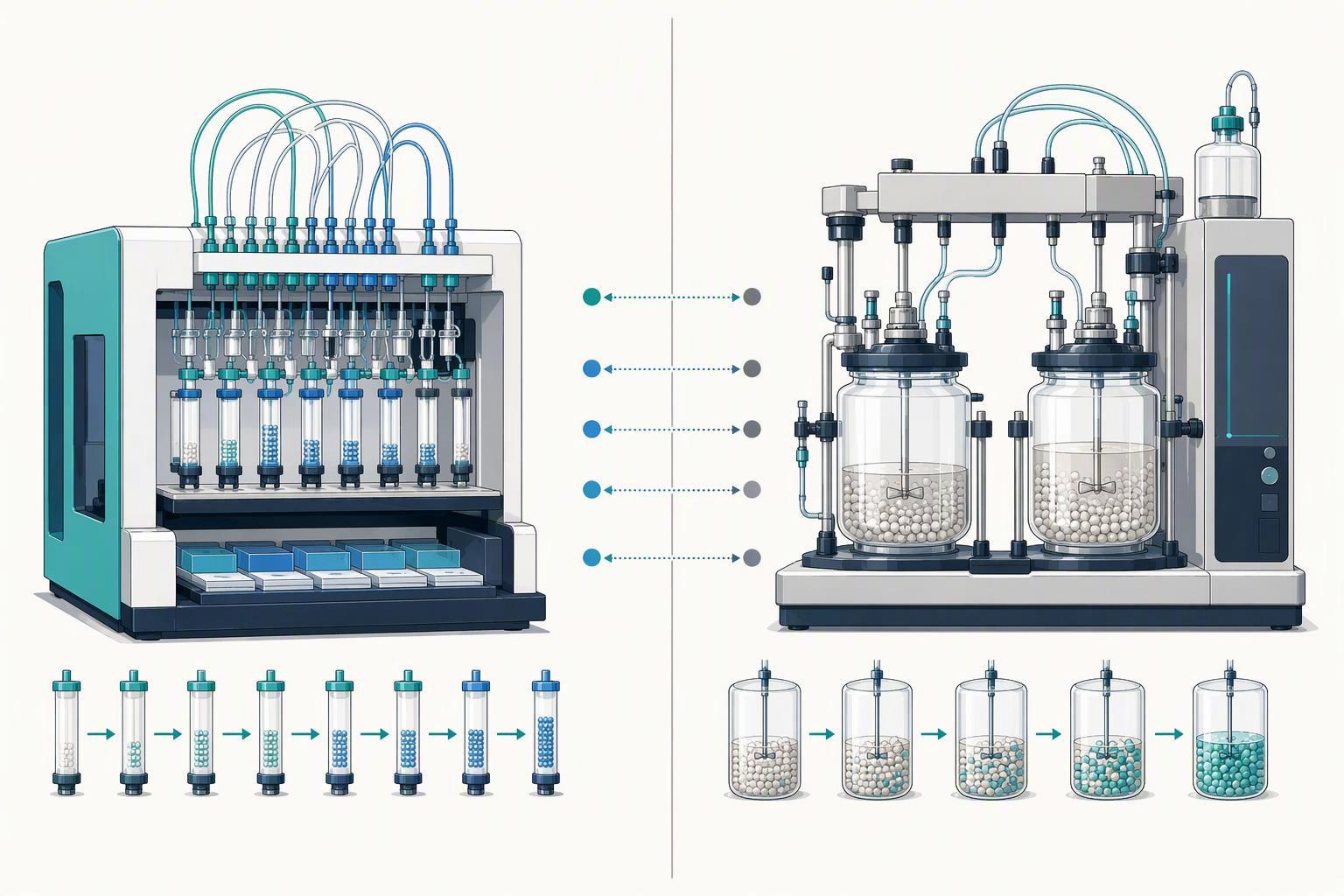
Ако вашата програма за пептиди достигнала точка каде што зголемувањето на скалата и оптоварувањето со нечистотии ја надминале практиката на клупата, моделот на производство на siRNA за производство на пептиди вреди да се прочита внимателно, и вреди да се чита скептично. Откриената студија на случај на фрагмент и лигатура на Бахем опишува градење кратки фрагменти на РНК и нивно спојување ензимски, наместо да составува еден долг ланец, со наведеното економско образложение за помалку и поедноставни чекори за прочистување низводно, помала употреба на растворувачи, помалку отпад и пониска цена на стоката во размер од грам до повеќе килограми (Бахем, извадено 2026-09-21).
Fragment-and-ligation значи синтетизирање на дефинираните парчиња одделно и потоа нивно спојување, наместо да расте еден континуиран синџир. На n-1 пократок е синџир на кој му недостасува еден остаток, а расемизацијата е губење на наменетата конфигурација на хиралниот центар, и двете стануваат потешко да се контролираат како што синџирите се издолжуваат. Погодна за намена аналитика значи тестирање кое одговара на она што е потребно за една одлука, не на фиксен панел.
Ова е толкување на јавниот материјал, не е пептиден рецепт. Производството на нуклеинска киселина наспроти хемијата на пептидите вклучува различно спојување, проблеми со заштитната група и стереохемија, така што преносливиот дел е дизајн на процесот, не хемија.
Што всушност опишува обелоденетата рута на siRNA на Бахем
Откриена студија на случај на фрагмент и лигатура на Бахем, работи со Codexis и користејќи vutrisiran како модел siRNA, опишува градење на молекулата од кратки фрагменти на РНК кои се синтетизираат одделно и потоа се спојуваат ензимски. Компанијата известува дека оваа рута може да „постигне висока ефикасност на лигатурата, поедноставување на прочистувањето, и поддржува производство на GMP од повеќе килограми,“ со квалитетот на производот го опишува како споредлив со конвенционалната синтеза (Бахем студија на случај, извадено 2026-09-21).

Сопствената рамка на Бахем на ензимската лигатура го дава економското образложение: спојувањето на кратки фрагменти наместо изградбата на еден долг ланец нуди „поголеми приноси и намалени оптоварувања за прочистување,“ особено во големи количини (Центар за знаење Бахем, извадено 2026-03-24).
Две граници се важни. Ова е самоизвештај на продавачот: на страниците стои без принос, бројки за чистота или трошоци, така што побарувањата за ефикасност и трошоци за стоки не можат да се проверат според објавените бројки. И обелоденувањето се наоѓа во пошироко позиционирање, бидејќи страницата за производство на олигонуклеотиди на Бахем ја претставува како партнер и кај пептидите и кај олигонуклеотидите, со посветена локација на олигонуклеотид GMP и првите GMP серии во рок од девет месеци од почетокот (Бахем олигонуклеотид NCE страница, извадено 2026-07-30).
Онаму каде што се прекинува аналогијата
Двете производствени логики се разминуваат во самата хемија. Олигонуклеотидите се изградени нуклеотид по нуклеотид од 5'-DMT-заштитени нуклеозид-3'-фосфорамидити, возење велосипед низ детритилација, спојување, оксидација или сулфуризација, и ограничување. Пептидите се изградени амино киселина со амино киселина со Fmoc или Boc синтеза во цврста фаза, со итеративна дезаштита и спојување. Споредбата на хемијата рамо до рамо во RSC Green Chemistry’s 2023 преглед забележува дека двете правци не се директно компатибилни без посебен дизајн на заштитна група.
Таксономите на нечистотии се разликуваат исто толку остро. Олигонуклеотидното аналитичко размислување на ФДА ги опишува олигонуклеотидните нечистотии како видови со должина на синџирот (пократки, долгогодишници, n-1) и варијанти на фосфор-стереохемија како што се фосфоротиоат диастереомери, со целосни и речиси целосни видови кои хроматографијата не ги отстранува. Упатството за ЕМА за синтетички пептиди наместо тоа ги центрира бришењата, скратувања, расемизација, над- и недоволно спојување, димери и агрегати, и резидуални реагенси, растворувачи и контрајони.
|
Димензија |
Синтеза на олигонуклеотиди |
На пептиди Пептид SPPS |
|---|---|---|
|
Градежен блок |
5′-DMT нуклеозид-3′-фосфорамидит |
Fmoc- или амино киселина заштитена со Boc |
|
Циклус |
Производство на полипептиди Детритилација, спојување, оксидација/сулфуризација, ограничување |
Дезаштита, спојување, Подготовка на пептиди мие |
|
Доминантни нечистотии |
Пониски, долгогодишници, n-1, фосфоротиоат диастереомери |
Бришење, скратувања, епимери, агрегати, контрајони |
|
Видови кои тешко се отстрануваат |
Нечистотии со цела и речиси целосна должина |
Агрегати зависни од низата |
Пептидите исто така носат хирални центри отсутни од нуклеотидниот 'рбет, а агрегацијата е повеќе зависна од секвенцата отколку предвидлива. Како референца за несакани реакции на SPPS на peptide.com објаснува, resin aggregation causes incomplete deprotection and coupling, is signalled by failure of the resin to swell, and cannot be predicted reliably from sequence, though hydrophobic sequences are more prone and it is unlikely before residue 5-6 or after residue 21.
Четири принципи кои се пренесуваат
Four things carry over from oligonucleotide manufacturing: modular process design for peptide synthesis, mechanism-level impurity control, staged scale-up planning, and fit-for-purpose analytics for peptide manufacturing. Each is a principle, not a copied protocol. Solid Phase Organic Synthesis
Modular process design. The available building-block toolbox already includes standardized protected amino acids, pseudoprolines and Dmb or isoacyl dipeptides, alongside deliberate resin and linker selection (Merck/Novabiochem). Module-based plants reuse qualified blocks to add capacity with lower qualification risk.
Impurity control at the mechanism. Control what generates the impurity, not the peak on the chromatogram. The SPPS side-reaction reference lists mitigations that transfer as principles: DBU deprotection, NMP or DMSO cosolvent, higher coupling temperature, and hydrogen-bond-disrupting elements such as pseudoprolines and Hmb or Dmb backbone protection (пептид.com, 2019-10-14).
Scale-up planning. Confirm route behavior, impurity trend, and downstream performance at small scale before committing to larger equipment. The exponential yield-decay relationship explains why: на 99% ефикасност на спојување, full-length yield falls to roughly 82% после 20 couplings, 67% после 40, и 45% после 80 (Peptides Codex, 2026-09-14).
Fit-for-purpose analytics. I Q2(R2) validation expectations cover specificity and discrimination, прецизност, точност, линеарност и опсег, robustness, and a quantitation limit at or below the reporting threshold; where authentic impurities are unavailable, specificity may be shown with a second well-characterized orthogonal procedure (I Q2(R2), 2023-11-30, корекција на грешка 2025).
Што значи ова за развивачите на пептиди, Избор на CDMO и временски рокови
For peptide developers, the four principles change one thing above all: peptide impurity control and scale-up planning become a control-strategy problem rather than a purification problem. ICH Q11’s control-strategy expectations require a science- and risk-based strategy that justifies starting-material specifications, controls starting-material impurities, and demonstrates process reproducibility against predefined quality attributes. Applied to a peptide route, that means impurity trends are tracked from route confirmation onward, not discovered at release testing.
For CDMO selection, the same logic converts into questions rather than claims. Ask a candidate to describe the staged supply-agreement structure it uses: small-scale technical confirmation first, impurity trend data second, downstream performance third, комерцијални Синтеза на пептиди scale last. CDMO-practice disclosures, including Polypeptide Group’s strategy reporting and the 2026 DCAT CDMO review, describe this staged pattern as the norm for long-term agreements, which is why it works as an evaluation lens rather than a vendor promise.
Timelines follow from that staging. A program that confirms route and analytics before committing to commercial scale absorbs more cost early and less rework later; one that skips confirmation compresses the front end and pays at scale-up. На пептиди
За Совет: Ask for the staged confirmation plan in writing before signing. MOL Changes supports this kind of front-loaded planning through process development and scale-up services, from milligrams to kilograms.
Следни чекори
If the transferability question is now the live one for your program, the useful next step is a technical feasibility assessment rather than a commercial conversation. Ask for documentation covering three things: route-confirmation data for the sequence you actually intend to scale, impurity-profile reporting that shows how the profile is tracked across batches rather than reported as a single release number, and the release-testing documentation behind the analytical methods. Those three items let your CMC team judge fit before any supply commitment is discussed.
MOL Changes provides custom peptide synthesis, process development and quality control for programs moving from milligrams to kilograms, and can supply that documentation package on request.
Најчесто поставувани прашања
Дали хемијата на фрагменти и лигатура всушност се однесува на пептидите?
Делумно, and the distinction matters. Native chemical ligation and its variants were developed for peptide chemistry before oligonucleotide synthesis borrowed the concept, so the underlying idea is not foreign to peptides at all. What does not carry over is the scale of the win. The side-by-side chemistry comparison shows that oligonucleotide assembly gains far more from switching to a modular route than peptide assembly does, because peptide couplings already run at high efficiency on solid support. Treat ligation as a targeted tool for sequences that resist stepwise synthesis, not as a replacement platform.
Веќе се обврзавме на конвенционална рута SPPS. Што се менува?
Nothing about the chemistry, and a great deal about the planning. The available building-block toolbox for peptides is already broad, so the practical move is to keep SPPS and apply the modular thinking to how you stage development: confirm the route early, track impurity trends as a distinct workstream, and defer scale commitment until the trend is stable. Programs that treat impurity control as a late-stage cleanup problem rather than a running measurement tend to discover the hard numbers at the worst possible time.
Колку работи аналитиката е навистина неопходна?
More than most early programs budget for, and less than a fully validated commercial panel. I Q2(R2) validation expectations give you the framework: decide which methods are stability-indicating and which are merely in-process checks, then validate each to the standard its decision actually requires. Running a full release panel on every in-process sample is overengineering. Running nothing until the first scale batch is the opposite mistake.
The transferable elements are staged route confirmation, impurity tracking and defined analytical decisions. RNA fragment preparation and enzymatic ligation involve different substrates, enzyme requirements and impurity mechanisms from peptide synthesis. Demonstrate a peptide-specific route before borrowing process-efficiency or scale-up claims.
Заклучок
The siRNA model’s value to peptide production is architectural, not chemical. What transfers is the discipline of confirming a route in stages, controlling impurities at the mechanism level, and matching analytics to the decision they inform. What does not transfer is the synthesis chemistry itself, and any plan that treats oligonucleotide process knowledge as directly portable will misallocate effort.
If staged confirmation and mechanism-level impurity control become normal practice in peptide programs, the practical effects show up in three places. Developers stop discovering late that a route cannot hold its impurity profile at scale. CDMO selection shifts from comparing headline purity numbers to comparing how a supplier confirms a route before committing to it. Program timelines absorb more cost early and less rework later, which is a better trade for any peptide heading toward commercial supply.
The next step is not a technology decision. It is a scoping one: before the next scale-up campaign, write down which impurities your current route can and cannot control, and at what point in the process you would know. That list is what makes a technical feasibility conversation useful, whether you have it internally or with a manufacturing partner.