O que julho 2026 A votação mudou e não mudou
Em julho 23-24, 2026, o Comitê Consultivo de Compostos Farmacêuticos revisou sete peptídeos não aprovados e recomendou seis deles para a lista de volumes 503A (McDermott Will & Esmeril, 2026-07-28). BPC-157, KPV, e TB-500 cada um liberado 8-6 com uma abstenção; MOTs-c aprovado 7-5; Semax passou 8-5; Epitalon passou 7-4; Emideltida (DSIP) fracassado 6-7. RAPS registrou a contagem do Epitalon como 7-5, então trate essa única figura como instável.
⚠️ Aviso: A recomendação é apenas consultiva. Como Mintz notas, um voto consultivo não é uma ação da agência, e qualquer listagem ainda requer regulamentação de aviso e comentário. Nada mudou legalmente ainda, e aparecer na lista é uma questão de status composto, não é uma descoberta de segurança.
O que já se aplica permanece inalterado: sob a seção 503A, uma substância medicamentosa a granel precisa de um certificado de análise válido e deve vir de um estabelecimento registrado no FDA na seção 510 (FDA, 2026-05-14). A FDA também descreve a lista 503A como atualizada continuamente sob uma política provisória com três categorias. É por isso que a lista de verificação de documentação de peptídeos abaixo se concentra nos registros que você controla hoje.
Como usar esta lista de verificação de documentação de peptídeos
Esta lista de verificação cobre seis áreas: identidade, pureza, métodos analíticos, perfis de impurezas, fornecimento, e uso pretendido. Eles mapeiam quatro fases de trabalho: pré-síntese, em processo, liberar, e entregar. Cada item é formulado como um julgamento binário, então você pode responder sim ou não e seguir em frente.
|
Área de Cobertura |
Pré-Síntese |
Em processo |
Liberar |
Entregar |
|---|---|---|---|---|
|
Identidade |
Sequência e alvo confirmados |
Registros de blocos de construção |
Confirmação de identidade |
Registro de sequência transferido |
|
Pureza |
Conjunto de especificações |
Verificações em processo registradas |
Resultado de pureza declarado |
Método de pureza referenciado |
|
Métodos analíticos |
Método selecionado |
Método executado conforme escrito |
Resumo de validação anexado |
Arquivo de método fornecido |
|
Perfis de impurezas |
Impurezas conhecidas listadas |
Perfil monitorado |
Perfil denunciado |
Dados de perfil incluídos |
|
Fornecimento |
Fornecedor e lote registrados |
Serviços Cadeia de custódia mantida |
Fonte t Comprar jogável |
Origem documentada |
|
Uso pretendido |
Caso de uso definido |
Escopo inalterado |
Use correspondências de instruções |
Limites de uso comunicados |
Aplicam-se dois limites de escopo. Esta é uma orientação de documentação, não é aconselhamento jurídico ou regulatório; consulte um consultor regulatório qualificado antes de tomar decisões de conformidade. E o status da lista e o status de segurança são questões separadas: aparecer dentro ou fora de uma lista não estabelece por si só se um peptídeo é seguro.
Trabalhe nas fases em ordem, em seguida, use a tabela consolidada no final para confirmar que nada foi perdido. As seções a seguir definem o que conta como documentação adequada de síntese de peptídeos personalizada para cada item.
Fase 1 - Registros de pré-síntese e fornecimento

Os registros mais baratos de criar são os mais difíceis de reconstruir posteriormente. Um número de lote escrito em um registro de recebimento na entrada leva segundos; recuperando o mesmo número de lote dezoito meses depois, quando um parceiro pergunta quais blocos de construção foram incluídos em um lote, pode levar dias e terminar em uma resposta que ninguém pode defender.
Quatro itens pertencem a esta fase, e cada um é uma verificação binária:
-
Os blocos de construção de aminoácidos e os números de lote de resina são registrados, com o CoA do fornecedor arquivado para cada. A rastreabilidade tem que sobreviver no nível do lote, não é o nível do catálogo. Um pacote de qualificação de fornecedor deve conter um CoA específico do lote que registre os testes, especificações e resultados para esse lote, além de rastreabilidade de lote e SKU até uma rota de síntese documentada (notas de laboratório de lyochem, 2026-06-01). O próprio esboço dos requisitos da seção 503A do FDA aponta na mesma direção, esperando um CoA válido e fabricação registrada 510 (FDA, 2026-05-14).
-
Identidade padrão de referência, o número do lote e a validade estão documentados.
-
Uma declaração de uso pretendido por escrito distingue o uso em pesquisa de manipulação.
-
A cadeia de custódia, desde o recebimento até o armazenamento, está documentada.
A data de validade do padrão de referência é o item que as equipes mais frequentemente arquivam no lugar errado. Pertence ao registro do lote, não em um caderno de laboratório, porque o registro do lote é o que um revisor ou parceiro realmente lê. Se o padrão expirou antes da execução, os dados de identidade gerados contra ele carregam uma qualificação que o registro deve indicar em seu rosto, e uma entrada de caderno a três prateleiras de distância não revelará isso.
Fase 2 — Documentação de Identidade
Identidade é uma questão separada da pureza, e um 98% purity figure does not answer it. Purity testing confirms how much of the material elutes as the main peak; it does not confirm that the main peak is the peptide you ordered. Como Peptra Labs explains in its certificate of analysis guide, purity testing is not identity confirmation “unless an identity assay exists for that batch” (2026-05-22). That conditional wording is the whole point: identity has to be demonstrated by a method that can distinguish your sequence from a near neighbour.
Three methods carry that specificity. Mass spectrometry establishes molecular mass, with electrospray ionization tolerances of ±1 Da below 5,000 Da and ±2 Da above it, and MALDI-TOF holding ±0.5 Da on shorter peptides (Lyos Labs, 2026-04-08). Amino-acid analysis reports composition after hydrolysis, and peptide mapping locates the sequence itself. Each produces its own record: the spectrum or composition report, the expected versus observed value, the instrument and acquisition parameters, and the analyst and date.
On validation scope, the reading of ICH Q2(R2) that Peptide Staff applies to peptide methods is that identity methods do not need full validation across every characteristic, but they do need to show specificity (2026-09-11). Read that as a documentation instruction rather than a relaxation: the file still has to prove the method discriminates, which means a specificity rationale, a representative spectrum, and a stated acceptance window. This is where peptide analytical method validation expectations differ most sharply between identity and assay work, and where a thin file is easiest to spot.
Fase 3 – Documentação de pureza e o que o número significa
A CoA purity figure is an area-percent measure, and it systematically reads high. The record has to state what was measured and how, or the number invites a false conclusion about content.
The distinction is not academic. In one cited metrology example, a manufacturer-stated content of 983.72 mg/g sat against a mass-balance determination of 896.36 ± 0.68 mg/g, a gap on the order of seventy-plus milligrams per gram (lineara, 2026-05-01). Treat that as a single-upstream illustration, not a general rule.
Water and counter-ions explain much of the difference. Lyophilized peptides are hygroscopic, and failing to correct for water can bias results by several percent; Karl Fischer reports water as % w/w and feeds the net-content and salt-correction calculation (clarascience, 2026-07-15). Counter-ions such as trifluoroacetate, acetate and chloride contribute to batch mass but are not detected at 214 nm (peptidetrace, 2026-05-23).
So the record must state the reporting convention: as-is, anhydrous, or salt-free. O 95%, 98% e 99%+ bands are marketing conventions rather than validated specifications; um 95% specification may contain up to 5% by weight of related substances, synthesis byproducts, residual protecting groups or counter-ions (peptidetrace, 2026-05-23).
Principal vantagem: An area-percent figure answers “how much of the UV-absorbing material is the main peak”, not “how much peptide is in the vial”.
Fase 4 — Registros de métodos analíticos
A method is only reconstructable if the file names the column, the mobile phase, o gradiente, the detection wavelength and the integration rules. Everything else is a summary that a receiving lab has to rebuild from scratch.
Conventional peptide practice records a defined parameter set. Column chemistry defaults to C18 for short and mid-length peptides, with C8 for over-retained hydrophobic sequences and 300 Å for longer chains. Dimensions are typically 4.6 × 150 mm for UV purity work and 2.1 × 100 mm for LC-MS, with pore sizes of 100-130 Å and particle sizes of 3.5 ou 2.7 µm, dropping to 1.7-1.8 µm for LC-MS (reversed-phase HPLC method parameters for peptides, 2026-09-15). Mobile phases run 0.1% TFA (aproximadamente 13 mm) in water and acetonitrile, switching to 0.1% formic acid for LC-MS. Gradients are scouting at 5-65% B over 60 minutes at 1.0 mL/min, or focused at 0.25-0.5% B/min, com um 90-95% B wash of at least 5 minutes and re-equilibration of about 10 column volumes. The measured dwell volume belongs in the method, and detection sits at 214 nm for the peptide bond.
Method status is a separate record from method content. A validated method has been formally demonstrated fit for its intended purpose across the relevant performance characteristics, while a qualified method is a limited demonstration of fitness for a narrower, defined purpose without the full validation evidence (peptide analytical method validation guidelines, 2026-09-11). Which characteristics apply depends on method purpose. Under the adopted Eu Q2(R2) guideline, eficaz 14 Junho 2024, the named characteristics include accuracy, precisão, especificidade, limite de detecção, limite de quantificação, linearity and range. In peptide practice, assay methods carry the full set, with a range of 80-120% of target, recovery of 98-102%, RSD at or below 2% and r² of at least 0.999. Impurity methods lean on specificity and sensitivity instead: a range from the reporting threshold to 120% of the specification limit, a limit of detection well below the reporting threshold, a limit of quantitation at or below it, and forced degradation to establish specificity. Treat those figures as peptide convention rather than as ICH requirements.
|
Method status |
Síntese de Peptídeos What it demonstrates |
Documentation it requires |
|---|---|---|
|
Validated |
Fitness for the intended purpose across the relevant performance characteristics |
Full validation protocol, predefined acceptance criteria, dados brutos, and a validation report covering each assigned characteristic |
|
Qualificado |
Limited fitness for a narrower, defined purpose |
Scope statement naming the defined purpose, the characteristics actually tested, resultados, and an explicit note of what was not assessed |
System suitability criteria and integration settings are records in their own right, not settings buried in the software. Write down the resolution, fator de cauda, retention time repeatability and signal-to-noise thresholds that a run must meet before its result counts, and record Peptídeos Sintéticos the integration rules (baseline mode, smoothing, minimum area threshold, manual intervention and who authorised it). A purity figure produced under unstated integration rules cannot be defended, and a method that cannot be reconstructed cannot be transferred to a larger scale.
Fase 5 — Documentação do perfil de impurezas
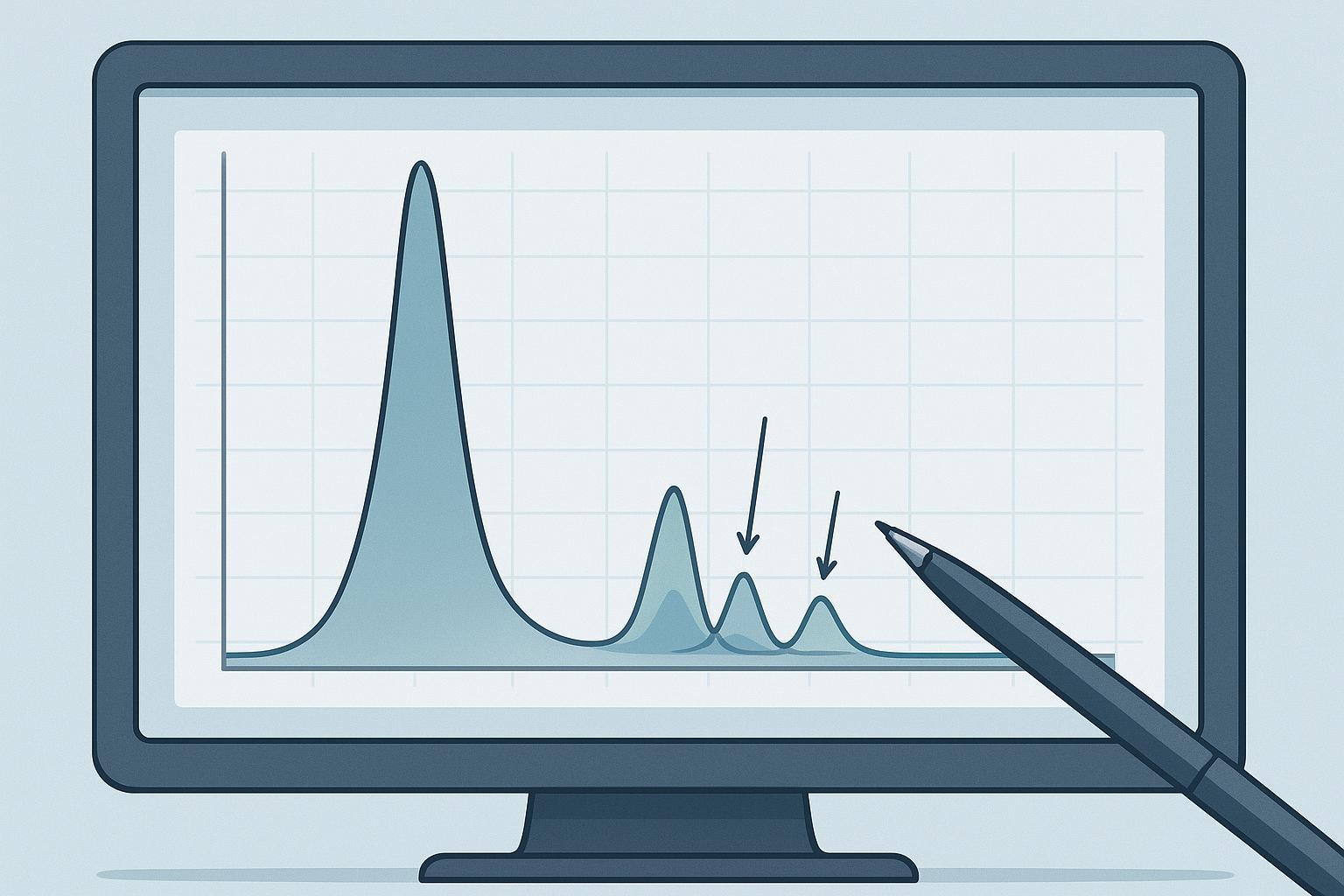
A defensible impurity record lists the classes you looked for and the method that would have found each one. Deletion sequences show as a mass deficit for the absent residue; truncated chains sit at lower mass; oxidised methionine appears as a +16 Da satellite; deamidated Asn or Gln shifts by +1 Da with altered retention; racemisation changes activity without changing mass; TFA adducts show up directly in the chromatogram (lyoslabs, 2026-04-08). Because these species can be close in both mass and retention, a single chromatogram will not separate them all, which is why peptide purity and impurity profile documentation pairs orthogonal methods rather than one run.
Thresholds for reporting, identification and qualification trace to ICH Q3B(R2), which sets identification typically at 0.10% ou 1.0 mg per day intake, whichever is lower. That framework does not apply to research-grade material in the same formal sense, so state which threshold basis your record uses.
Fase 6 - Registros de lançamento e entrega
Assemble the hand-over as a package, not as a folder of files. The package is the artifact a partner actually reads, and a missing element blocks a program even when the underlying work was sound. Start with the peptide certificate of analysis requirements: the product name must match the vial label, the batch or lot must match both the vial and the order paperwork, and the report must carry the test date, the analytical method, the batch-specific purity result, the testing laboratory, and a lab-controlled public report URL rather than a supplier-hosted page alone (Peptra Labs, 2026-05-22). Produção de Peptídeos
Bind every reported value to the raw data behind it, and keep the version and approval trail with the record set. Records should be attributable, legível, contemporâneo, original and accurate, and the set should let a reviewer reconstruct the batch without contacting the lab.
Para dica: If a reviewer has to email you to understand a number, the package is incomplete. Sobre
Documentation packages of this kind are the workflow Mudanças no MOL supports.
Lista de verificação de documentação consolidada de peptídeos
This peptide documentation checklist condenses the six coverage areas into one printable page. Each row is a binary judgment: either the record exists in the lot file or it does not. Hand it to the team before the next campaign starts, and treat any “no” as an open item rather than a formality.
|
Fase |
Item da lista de verificação |
Record that satisfies it |
Sim / Não |
|---|---|---|---|
|
1. Pre-synthesis and sourcing |
Is the resin, each amino acid, and each reagent lot identified with supplier and lot number? |
Sourcing log with supplier certificates |
|
|
1. Pre-synthesis and sourcing |
Is the intended sequence, including any non-natural or modified residues, written down before synthesis begins? |
Approved target sequence sheet |
|
|
1. Pre-synthesis and sourcing |
Is the counterion and salt form specified up front? |
Specification sheet |
|
|
2. Identidade |
Is the peptide confirmed by mass spectrometry against the theoretical mass? |
Mass spectrum with calculated versus observed mass |
|
|
2. Identidade |
Is the primary sequence confirmed independently of mass alone? |
Sequencing or MS/MS fragmentation data |
|
|
2. Identidade |
Are the chromatographic identity markers recorded? |
Analytical HPLC retention data |
|
|
3. Pureza |
Is the purity figure stated with its method, coluna, e comprimento de onda de detecção? |
HPLC chromatogram and method reference |
|
|
3. Pureza |
Is the purity expressed on a defined basis, with counterion and water content stated separately? |
Purity calculation sheet |
|
|
3. Pureza |
Is the integration method and any peak exclusion rule documented? |
Integration report |
|
|
4. Analytical method records |
Is the method described well enough for another laboratory to reproduce it? |
Method file with column, fase móvel, gradiente, fluxo, and detection |
|
|
4. Analytical method records |
Is method validation or verification data on file for the intended use? |
Validation or verification report |
|
|
4. Analytical method records |
Are system suitability criteria defined and met on the day of analysis? |
System suitability record |
|
|
5. Perfil de impurezas |
Are related substances reported individually rather than as one lumped figure? |
Impurity table with retention times and relative amounts |
|
|
5. Perfil de impurezas |
Are specified, não especificado, and total impurity limits stated? |
Specification with impurity thresholds |
|
|
5. Perfil de impurezas |
Are residual solvents, conteúdo de contra-íon, and water addressed? |
Residual solvent and content data |
|
|
6. Release and hand-over |
Does the certificate of analysis match the batch record values exactly? |
CoA cross-checked against raw data |
|
|
6. Release and hand-over |
Is the stability or retest date supported by data rather than assumed? |
Stability summary or retest justification |
|
|
6. Release and hand-over |
Is the full data package transferable to a partner or regulator without further explanation? |
Complete lot file index |
Two habits keep this page useful. Primeiro, review it at the point each record is generated, not at release, because reconstructing an integration rule or a system suitability result months later is where most gaps appear. Segundo, keep the raw data behind every row, since a summary table without the underlying chromatogram or spectrum does not survive scrutiny.
Principal vantagem: A documentation package is only as strong as its weakest row. If any item above cannot be answered with a specific record, that is the item to fix before the next lot is released.
Perguntas comuns sobre documentação de peptídeos
Por quanto tempo a documentação do peptídeo deve ser retida?
Retain records for as long as the material can be in use or referenced, then add a defined margin on top of that. Because a lot may be held, re-tested, or shipped years after release, the retention period should be set by the longest plausible use window, not by the release date. Where a lot is tied to a sterility or endotoxin claim, the retention clock follows the longest applicable requirement, since those records are the ones most likely to be requested later.
What if a supplier’s certificate of analysis omits a method detail?
Ask the supplier for the missing detail in writing before you accept the lot, and record the request and the response. A certificate that reports a purity figure without naming the method, coluna, or detection wavelength cannot be independently interpreted, so the gap is a documentation defect rather than a formatting preference. If the supplier will not supply it, treat the lot as unverified for that attribute and say so in your own records.
Um método qualificado é aceitável para um determinado propósito??
Sim, provided the qualification is documented against the intended use and the limits are stated. A qualified method is acceptable when its fitness for the specific purpose has been demonstrated and recorded; it is not acceptable as a substitute for a validated method where the purpose requires validated performance. The deciding question is what the result will be used to support, not how the method was labeled.
O que devemos fazer quando muita coisa falha na adequação do sistema?
Do not release the lot, and do not re-integrate or re-run until the failure is investigated and the cause is identified. A system suitability failure is a signal about the method or the instrument as much as about the sample, so the investigation should establish which before any repeat injection is treated as a valid result. Document the failure, the investigation, and the resolution together, because the failed run is part of the lot’s record.
Principal vantagem: Each answer above stands alone, so you can lift the one you need into a supplier query, an SOP note, or a review meeting without losing its context.
Próximas etapas
The regulatory outcome is not yours to control; the record set is. Start tomorrow with the phase that is weakest in your current files, usually Phase 4, and work forward. A peptide documentation checklist only helps if someone can hand the file to a reviewer who was not in the room.
If you would like a worked example, MOL Changes supports teams with a sample documentation package covering method files, impurity tables and lot-level release records, which can be used to benchmark your own template before your next audit cycle.
This article is documentation guidance, não é aconselhamento jurídico ou regulatório. Consult qualified regulatory counsel before making compliance decisions. Reviewed by the MOL Changes technical documentation team. MOL Changes provides custom peptide synthesis and analytical services; this article is educational and does not constitute a product recommendation.