O que o IND Clearance certifica ou não para um programa de peptídeos
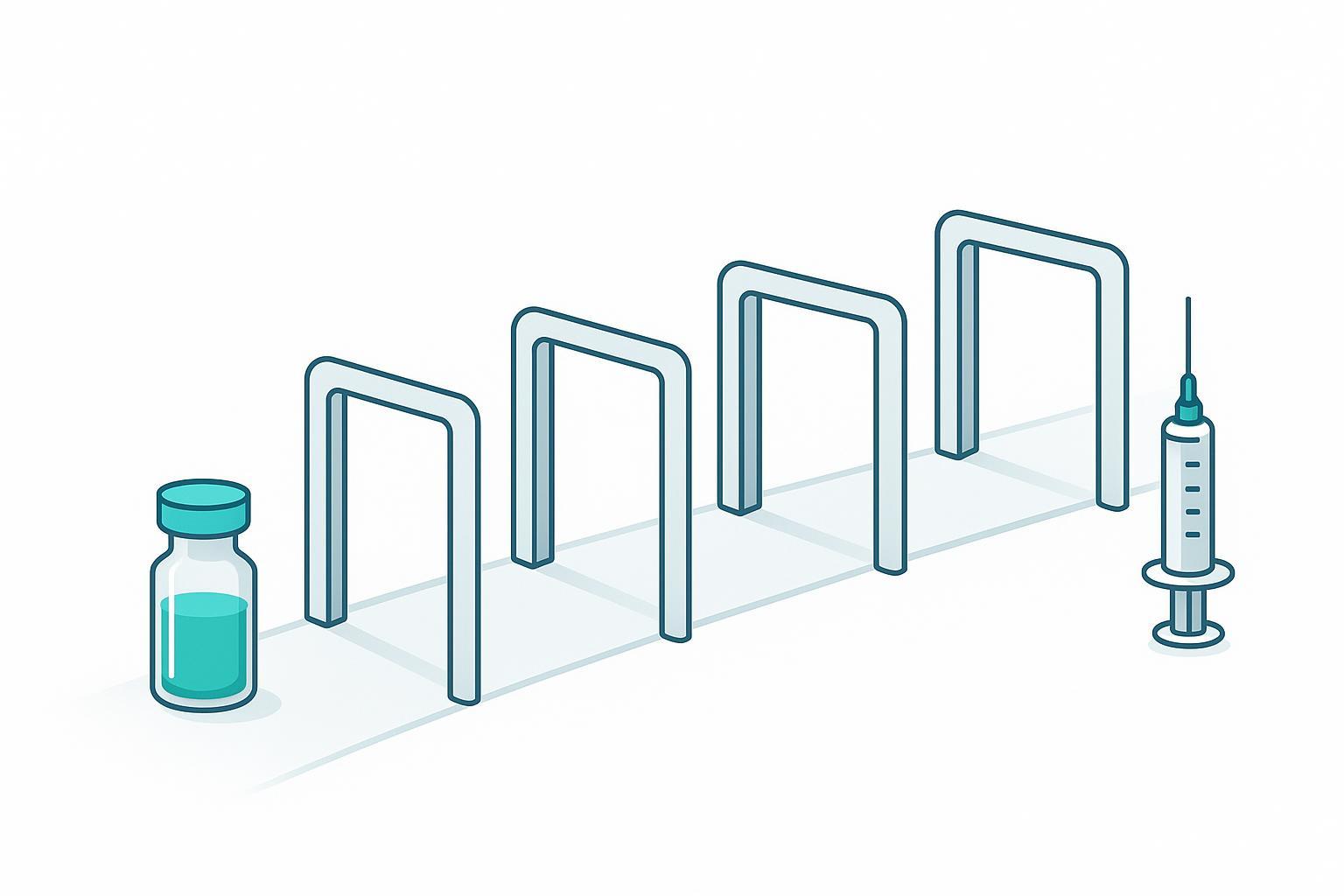
A autorização do Peptide IND é uma permissão, não é um certificado de qualidade. Quando o FDA autorizou o IND do ENDO-205 em 23 Marchar 2026, permitiu o início de um primeiro teste em humanos em mulheres saudáveis na pré-menopausa (arquivo ENDO-205 peptídeoinsider.org, recuperado 2026-09-11). Não validou o pacote CMC, bloquear as especificações, ou estabelecer que o peptídeo funciona.
Essa distinção é fácil de perder no anúncio interno. Como diz claramente o mesmo dossiê, “A autorização do IND não é aprovação. É o primeiro de vários portões… Não foi revisada nenhuma evidência de que o ENDO-205 funcione em uma pessoa, porque ainda não existe tal evidência” (arquivo ENDO-205 peptídeoinsider.org, recuperado 2026-09-11).
Principal vantagem: “Autorizado para prosseguir” e “demonstrado seguro ou eficaz” são afirmações diferentes. Apenas o primeiro foi feito.

As próprias expectativas do CMC da FDA para um primeiro IND em humanos confirmam o quão restrita é a revisão: nenhum dado de validação de método analítico é esperado, e dados de estabilidade do lote clínico específico “podem não ser necessários” (FDA, Aplicações IND: Informações CMC, recuperado 2026-06-22).
O que preenche esse espaço é o pacote de evidências pós-IND, e cinco áreas de requisitos carregam isso: sequência e controle de impurezas, caracterização ortogonal, métodos indicadores de estabilidade, rotulagem e fechamento de recipientes, e testes adequados à finalidade com escopo para a fase.
O pacote de evidências pós-IND: Cinco áreas de requisitos para a primeira dose
Os requisitos de desenvolvimento pós-IND do peptídeo não são uma lista de verificação única. São cinco áreas de evidência que devem ser fortes o suficiente para apoiar a dosagem em um ser humano., e cada um amadurece em um ritmo diferente ao longo dos estágios clínicos.
|
Síntese de Peptídeos Área de requisitos |
O que deve ser estabelecido antes da primeira dose |
Qual fase 1 não requer |
Como é o fracasso |
|---|---|---|---|
|
Sequência e controle de impurezas |
A sequência pretendida é confirmada e a propagação de impurezas é compreendida do nível do bloco de construção para cima |
Processos em escala comercial totalmente qualificados |
Uma espécie de truncamento ou exclusão não identificada aparece acima do limite de relatório |
|
Caracterização ortogonal |
Mais de um método independente concorda com a identidade, pureza, e estrutura |
Um bloqueado, painel de lançamento validado para cada atributo |
Um único ensaio carrega toda a reivindicação de identidade, e um segundo método o contradiz |
|
Métodos indicadores de estabilidade |
Caminhos de degradação são conhecidos Peptídeos Sintéticos e o método os detecta |
Dados de longo prazo em conformidade com ICH em todas as condições de armazenamento |
Um método passa na liberação, mas perde um produto de degradação que se forma no armazenamento |
|
Rotulagem e fechamento de recipientes |
O rótulo, o contêiner, e o encerramento são consistentes com o pacote de evidências |
Configuração final da embalagem comercial |
Superfícies extraíveis ou uma interação de fechamento após o início da dosagem |
|
Testes analíticos adequados à finalidade |
Cada método é qualificado para a pergunta que a fase realmente faz |
Validação completa para padrões comerciais |
Um método é superconstruído para Fase 1 e atrasa o cronograma sem agregar valor à decisão |
A curva de maturidade por trás dessa tabela é o modelo mental útil: a maturidade do CMC apropriada à fase em todos os estágios clínicos vai desde o primeiro em humanos até a Fase 2, Fase 3, e fechadura comercial, com a maturidade do método aumentando do exploratório (0) através de qualificação (1) para validar (2). The five areas below are ordered by how early they become load-bearing, not by how much documentation they generate.
Como os requisitos de desenvolvimento pós-IND do peptídeo diferem das expectativas pré-IND

Peptide post-IND development requirements shift the central question from “is this molecule defensible” to “is this lot reproducible, and is this method fit for its purpose.” Before clearance, the work is largely about identity, route, and feasibility. After it, the same data set has to support lot-to-lot control, tendências, and tech-transfer documentation that a pre-IND package was never asked to carry.
That shift is deliberate, not a loophole. FDA’s own CMC expectations for a first-in-human IND state that sponsors can reduce application development time by up to 12 months by not over-building the initial CMC section, which means the pre-IND question set does not simply carry forward. What replaces it is phase-appropriate rigor: methods that are qualified rather than validated, specifications that are justified rather than locked, and a stability program that distinguishes the retest-period versus shelf-life distinction for drug substance and drug product respectively.
Prática 1: Sequência de controle e propagação de impurezas no nível dos blocos de construção
Peptide impurity control is decided long before final release. For a synthetic peptide, the impurity profile of the finished lot is largely set upstream, at the building-block and coupling stages, which means post-IND control has to reach back into those stages rather than wait for the release panel.
Serviços The thresholds worth applying come from a specific regulatory upstream. FDA’s synthetic-peptide impurity thresholds, reported in 2026, require that peptide-related impurities at or above 0.10% be individually identified, with a categorical upper limit of 0.5% for new peptide-related impurities not present in the reference listed drug.
|
Development stage |
Purity by RP-HPLC area |
Individual impurities |
Total impurities |
|---|---|---|---|
|
Fase 1 target |
~95–98% |
NMT 0.5% |
NMT 2–5% |
|
Commercial expectation |
~98–99% |
NMT 0.1% |
NMT 1.0% |
The Phase 1 versus commercial purity bands are illustrative development targets, não é uma especificação. Define your own reporting, identificação, and qualification thresholds, then trend them from the first clinical lot forward.
Nota de escopo: O 0.10% e 0.5% figures trace to a single regulatory upstream, FDA 2021 ANDA guidance for highly purified synthetic peptide products referencing rDNA-origin reference listed drugs. They are not a universal IND requirement.
O modo de falha é previsível: impurities that appear only at scale, or that were never individually identified because they sat below the threshold at small scale.
Prática 2: Construa um pacote de caracterização ortogonal, Nem um único ensaio

Peptide characterization fails when one technique is asked to answer every identity question. No single assay establishes that a synthetic peptide is the intended molecule, so the post-IND package pairs methods that each resolve a different ambiguity.
Reverse-phase HPLC monitored at 220 nm establishes purity and main-peak content, while LC-MS/MS confirms monoisotopic mass and full amino-acid sequence coverage. In a published leuprolide acetate example, the theoretical monoisotopic mass of m/z 1209.6533 matched an experimental 1209.6515, and MS/MS delivered complete sequence coverage (Reference Standards to Support Quality of Synthetic Peptide Therapeutics, 2023). The same source notes that multiple orthogonal techniques are typically used to verify peptide identity, including HPLC retention time, RMN, EM, and chiral testing.
The failure mode is a mass-confirmed but sequence-ambiguous peptide. A deletion sequence can share nominal mass behavior with the parent while differing by a single residue, and a purity method alone will not separate them. Pairing mass confirmation with sequence coverage, and adding chiral or NMR testing where the reference standard demands it, closes that gap and keeps the package defensible across a lot or supplier change.
ENDO-205’s amino-acid sequence, route, and dose remain undisclosed, so this package is described generically rather than for that molecule (the program’s disclosed status as of September 2026).
Prática 3: Projete métodos indicadores de estabilidade antes de precisar deles
Peptide stability testing earns its place in the post-IND package by converting a degradation observation into a specification you Comprar can control. That only works if the method resolves degradants from the parent peak before the first clinical lot goes on study.
Run forced degradation first, under acid, base, oxidative, thermal, and photolytic stress, and confirm the method separates every degradant it generates from the main peak. Then place the clinical lot on long-term, intermediário, and accelerated conditions in the same container-closure system you propose for storage and distribution. The storage statement on the label is derived from that evaluation, which is why “room temperature” or “ambient conditions” cannot appear in place of a defined condition.
|
Parâmetro |
Drug substance |
Drug product |
|---|---|---|
|
Long-term |
25°C/60% RH or 30°C/65% RH Produção de Peptídeos |
25°C/60% RH or 30°C/65% RH |
|
Intermediate |
30°C/65% RH |
30°C/65% RH |
|
Accelerated |
40°C/75% RH Sobre |
40°C/75% RH |
|
Commitment derived |
Retest period |
Shelf life |
Pending confirmation: The numeric conditions above follow ICH Q1A(R2) stability conditions, but the ICH Q1A(R2) PDF was not machine-readable in this run. Treat the figures as corroborated by secondary summaries only until the primary text is checked.
O modo de falha é silencioso. A method that co-elutes a degradant with the parent peak produces a stability table that looks clean while the product is not, and the problem surfaces after the clinical lot is already on study.
Prática 4: Trate a rotulagem e o fechamento do recipiente como parte do pacote de evidências
Peptide labeling requirements are a regulated control, not a design afterthought, and the storage statement printed on the label is an output of the stability program rather than a marketing decision. Sob 21 CFR 312.6, the immediate package of an investigational drug must bear the caution statement “Caution: New Drug, Limited by Federal (or United States) law to investigational use,” and the labeling may not carry any statement that is false or misleading or represent that the investigational drug is safe or effective for the purposes under investigation.
That second clause is the one that catches teams. A storage statement that overstates stability, or label copy that implies a clinical benefit the program has not demonstrated, breaches 312.6(b) even when the underlying data are sound.
Sequence container-closure selection ahead of the stability study, não depois disso. Extractables and leachables findings, moisture transmission, and light protection all feed the storage statement, so a closure chosen late forces the stability protocol to be rewritten. No efficacy or safety claim is made here for ENDO-205; the labeling requirement is procedural, and the caution statement is the only claim the immediate package carries.
Prática 5: Teste analítico adequado ao escopo para a fase, Não para o destino

Fit-for-purpose analytical testing in the post-IND window means matching each method’s rigor to what Phase 1 actually needs, not to what a commercial filing will eventually demand. The FDA’s own CMC expectations for a first-in-human IND do not include analytical method validation data, and process controls unrelated to product safety are not expected at this stage. That is a deliberate allowance, not a loophole: it lets a program defer validation until the process is locked, when the validation will still describe the process it was written against.
The practical split is per method, not per program. A release assay that supports a safety decision needs qualification now; a method whose only job is to trend a parameter you have not fixed yet can wait.
[TABLE] Method-to-phase expectation matrix: columns for method, Fase 1 expectation (not expected / qualificado / validado), and documented rationale.
Sterility and endotoxin testing are the exception to any deferral logic, because they run on compendial mechanics rather than on your process. The 14-day USP <71> sterility test incubates membrane-filtered or directly inoculated samples in fluid thioglycollate at 30–35°C and soybean-casein digest at 20–25°C, filtering the contents of at least 10 containers through 0.45-µm cellulose acetate membranes (FormBlends, Sterility Testing for Peptides, reviewed 2026-05-14). Endotoxin limits come from the USP <85> cálculo do limite de endotoxina, K/M, where K is 5 EU/kg/hour for non-intrathecal routes and 0.2 EU/kg/hour for intrathecal. Because the limit is dose-based, no universal EU/mL value exists. Note that this formula is compendial arithmetic; the primary FDA PDF could not be opened in this run, so treat the threshold values as USP-derived rather than FDA-confirmed.
The failure mode runs in both directions. A team that validates a stability-indicating method to commercial rigor before the process is locked will repeat that validation after every process change, paying twice for the same assurance. A team that leaves a safety-critical method unqualified creates a data gap that surfaces at the Phase 2 transition, when the agency asks what supported the release decision in the first place. The fix is documentation: for every method you deliberately leave unvalidated, write down why, what substitutes for it in the interim, and what trigger will force validation. That rationale is the artifact a reviewer reads.
Um exemplo prático: Sequenciando o pacote pós-IND em um fluxo de trabalho de desenvolvimento neutro
The five practices form a sequence, not a checklist. Impurity thresholds and the characterization package come first, because the release panel you set at that stage determines what later work has to measure. Stability-indicating methods and container-closure follow, since both depend on knowing which degradants and leachables the panel can detect. Labeling and fit-for-purpose testing close the sequence, because both describe a control strategy that only exists once the earlier steps are fixed.
A peptide synthesis and analytical workflow such as MOL Changes supports this ordering by keeping building-block control, purificação, and characterization inside one traceable chain, which helps teams avoid re-qualifying methods after a late process change.
Principal vantagem: This sequence is illustrative, not prescriptive. Fase 1 programs deliberately leave some methods unlocked while the process is still moving, and locking them early can cost more than it protects.
Erros comuns na janela pós-IND
The five errors below are the ones that survive a careful review of the obvious ones. Each has a specific fix.
Treating IND clearance as validation of the CMC package. An accepted IND means FDA found the submitted package adequate to proceed, not that the package is complete or final. A correção: keep the CMC section under active revision through Phase 1 and log every open item with an owner and a target date.
Applying the 0.10% e 0.5% thresholds as if they were IND requirements. Those figures come from FDA’s synthetic-peptide impurity thresholds, which govern ANDA submissions, not investigational new drug applications. A correção: set your own reporting and qualification thresholds from toxicology and clinical exposure, then document the rationale.
Validating analytical methods before the process is locked. Method validation against a moving process produces data you will repeat. A correção: qualify methods for the intended use first, and reserve full validation for a frozen process.
Selecting container-closure after the stability study has started. Extractables and leachables interact with the formulation, so the study design depends on the closure. A correção: choose the primary container before the first stability lot is placed.
Writing label copy that implies clinical benefit. 21 CFR 312.6 requires the caution statement on investigational drug labeling, and the regulation bars any representation that the drug is safe or effective for the purposes under investigation. A correção: describe the dosage form and route only, and route all promotional language through regulatory review.
Como é o sucesso antes da primeira dose
A complete post-IND package is one you can hand to a reviewer and defend line by line. Concretamente, that means five things are in place before the first dose: orthogonal identity confirmation of the peptide sequence, a stability-indicating method demonstrated by forced degradation, a clinical lot on stability in its proposed container-closure, investigational labeling that meets the applicable requirements, and a written rationale for every method you deliberately have not validated yet.
That last item is the one teams skip, and it is the one that most often turns a routine review into a rebuild. FDA’s own CMC expectations for a first-in-human IND are phase-appropriate rather than exhaustive, so an unvalidated method is not automatically a gap. An unvalidated method with no documented justification is.
The stretch goal is a lot-to-lot trending plan. Build it now and the Phase 2 transition becomes a data review instead of a redevelopment project. The retest-period versus shelf-life distinction is the practical lever here: a retest period supported by trending data is a far easier position to extend than one assembled retroactively.
Perguntas frequentes
Os limites de impureza peptídica da FDA se aplicam a um IND?
Não. O 0.10% identification threshold and the 0.5% cap on new peptide-related impurities come from FDA’s 2021 ANDA guidance for certain highly purified synthetic peptide drug products. Those thresholds are written for abbreviated applications referencing an rDNA-origin reference listed drug, not for an investigational new drug application. Importing a commercial impurity ceiling into a Phase 1 setting misreads the scope of the document.
Fase 1 requerem métodos analíticos validados?
FDA states that it does not expect analytical method validation data for a first-in-human Phase 1 IND, and stability data from the specific clinical lot may not be required either. Treat that as a floor rather than a ceiling: a method that supports a safety decision still has to be fit for its purpose, and the retest-period versus shelf-life distinction governs how far the supporting data can be stretched.
What is ENDO-205’s current development status?
As of September 2026, the disclosed picture is narrow. The IND cleared on 23 Marchar 2026 and permits a first human trial in healthy pre-menopausal women of reproductive age. Fase 1 status reads “Planning,” with no ClinicalTrials.gov record, no peer-reviewed data, and the sequence and route undisclosed. That is the program’s disclosed status as of September 2026, and nothing beyond it should be assumed.
Conclusão
You can now sequence the five peptide post-IND development requirements that carry a program to first dose: sequence and impurity control at the building-block level, an orthogonal characterization package, stability-indicating methods designed before they are needed, labeling and container-closure treated as evidence, e testes adequados à finalidade com escopo para a fase. The end state is concrete: a characterized peptide with orthogonal identity confirmation, a stability-indicating method demonstrated by forced degradation, a clinical lot on stability in its proposed container-closure, compliant investigational labeling, and a documented rationale for every method deliberately left unvalidated.
That last item matters as much as the others. Peptide IND clearance does not obligate commercial-grade validation at Phase 1, and treating it as though it does is the most common way sponsors spend time they did not need to spend.
Planning the evidence package for your own post-IND window?
Review how a phase-appropriate analytical package is assembled, covering characterization, métodos indicadores de estabilidade, and fit-for-purpose testing, before the first clinical lot goes on study. Talk to an expert or review the analytical package with the team that supports peptide quality standards.
Disclosure: MOL Changes has a commercial interest in peptide quality standards and analytical services.