Giải phóng mặt bằng IND có và không chứng nhận cho chương trình peptide
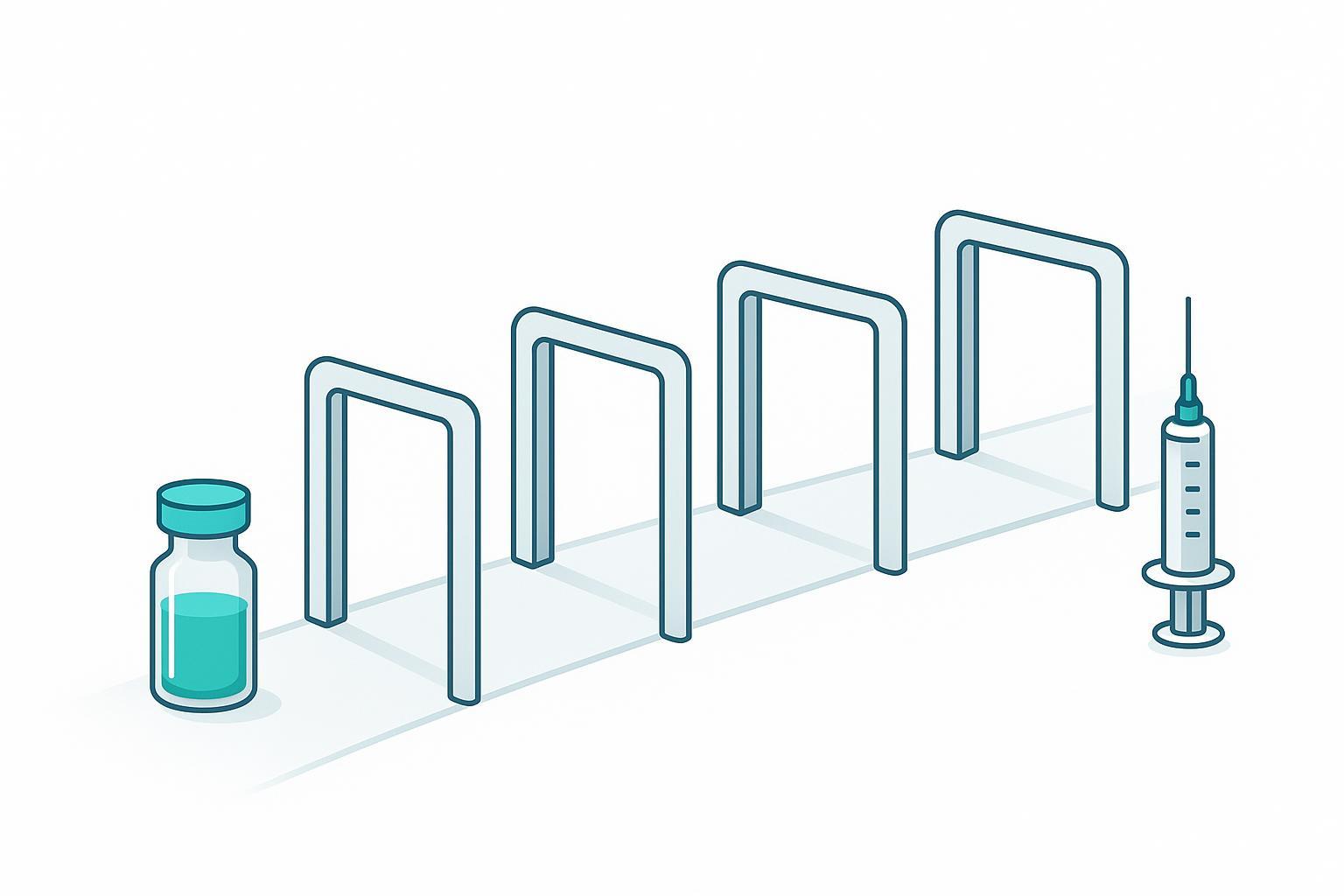
Giải phóng mặt bằng peptide IND là giấy phép, không phải là giấy chứng nhận chất lượng. Khi FDA xóa IND của ENDO-205 trên 23 Bước đều 2026, nó cho phép bắt đầu thử nghiệm đầu tiên trên người ở phụ nữ tiền mãn kinh khỏe mạnh (tập tin peptideinsider.org ENDO-205, đã lấy lại 2026-09-11). Nó không xác nhận gói CMC, khóa thông số kỹ thuật, hoặc chứng minh rằng peptit hoạt động.
Sự khác biệt đó rất dễ bị mất đi trong thông báo nội bộ. Như cùng một hồ sơ đã trình bày rõ ràng, “Thông quan IND không được chấp thuận. Đây là cổng đầu tiên trong số nhiều cổng… Nó chưa xem xét bất kỳ bằng chứng nào cho thấy ENDO-205 hoạt động ở người, vì chưa có bằng chứng nào như vậy tồn tại” (tập tin peptideinsider.org ENDO-205, đã lấy lại 2026-09-11).
Chìa khóa mang đi: “Đã được phê duyệt để tiếp tục” và “đã được chứng minh là an toàn hoặc hiệu quả” là những tuyên bố khác nhau. Chỉ có cái đầu tiên được thực hiện.

Kỳ vọng CMC của FDA đối với IND đầu tiên ở người xác nhận mức độ thu hẹp của đánh giá: không có dữ liệu xác nhận phương pháp phân tích được mong đợi, và dữ liệu về độ ổn định từ lô lâm sàng cụ thể “có thể không cần thiết” (FDA, Ứng dụng IND: Thông tin CMC, đã lấy lại 2026-06-22).
Thứ lấp đầy khoảng trống đó là gói bằng chứng sau IND, và năm lĩnh vực yêu cầu mang nó: kiểm soát trình tự và tạp chất, đặc tính trực giao, phương pháp đánh giá độ ổn định, ghi nhãn và đóng thùng, và thử nghiệm phù hợp với mục đích trong phạm vi giai đoạn.
Gói bằng chứng sau IND: Năm lĩnh vực yêu cầu mang theo liều đầu tiên
Các yêu cầu phát triển peptide sau IND không phải là một danh sách kiểm tra duy nhất. Đó là năm lĩnh vực bằng chứng mà mỗi lĩnh vực phải đủ mạnh để hỗ trợ việc định lượng thuốc cho con người., và mỗi người trưởng thành với tốc độ khác nhau qua các giai đoạn lâm sàng.
|
Tổng hợp peptit Khu vực yêu cầu |
Những gì nó phải thiết lập trước liều đầu tiên |
Giai đoạn nào 1 không yêu cầu |
Thất bại trông như thế nào |
|---|---|---|---|
|
Kiểm soát trình tự và tạp chất |
Trình tự dự định được xác nhận và sự lan truyền tạp chất được hiểu từ cấp khối xây dựng trở lên |
Quy trình quy mô thương mại đủ điều kiện |
Một loài bị cắt bớt hoặc xóa không xác định xuất hiện trên ngưỡng báo cáo |
|
Đặc tính trực giao |
Nhiều hơn một phương pháp độc lập đồng ý về danh tính, sự tinh khiết, và cấu trúc |
bị khóa, bảng phát hành được xác thực cho mọi thuộc tính |
Một xét nghiệm duy nhất mang toàn bộ yêu cầu nhận dạng, và phương pháp thứ hai mâu thuẫn với nó |
|
Phương pháp chỉ thị độ ổn định |
Con đường thoái hóa đã được biết Peptide tổng hợp và phương pháp phát hiện chúng |
Dữ liệu dài hạn tuân thủ ICH ở mọi điều kiện lưu trữ |
Một phương thức được phát hành nhưng bỏ lỡ một sản phẩm xuống cấp hình thành trong bộ lưu trữ |
|
Ghi nhãn và đóng thùng |
Nhãn, thùng chứa, và việc đóng cửa phù hợp với gói bằng chứng |
Cấu hình bao bì thương mại cuối cùng |
Các chất có thể chiết xuất hoặc bề mặt tương tác đóng lại sau khi bắt đầu dùng thuốc |
|
Thử nghiệm phân tích phù hợp với mục đích |
Mỗi phương pháp đều đủ điều kiện cho câu hỏi mà giai đoạn thực sự đặt ra |
Xác nhận đầy đủ các tiêu chuẩn thương mại |
Một phương thức được xây dựng quá mức cho Giai đoạn 1 và trì hoãn dòng thời gian mà không thêm giá trị quyết định |
Đường cong trưởng thành phía sau bảng đó là mô hình tinh thần hữu ích: Sự trưởng thành CMC phù hợp với từng giai đoạn trong các giai đoạn lâm sàng bắt đầu từ giai đoạn đầu tiên ở người đến Giai đoạn 2, Giai đoạn 3, và khóa thương mại, với sự trưởng thành của phương pháp tăng dần từ quá trình khám phá (0) thông qua đủ điều kiện (1) để xác nhận (2). Năm lĩnh vực dưới đây được sắp xếp theo thời gian chúng bắt đầu chịu tải, không phải bằng số lượng tài liệu họ tạo ra.
Các yêu cầu phát triển sau IND khác với kỳ vọng trước IND như thế nào

Các yêu cầu phát triển peptide sau IND chuyển câu hỏi trọng tâm từ “liệu phân tử này có thể bảo vệ được không” sang “liệu lô này có thể tái sản xuất được không?”, và phương pháp này có phù hợp với mục đích của nó không.” Trước khi giải phóng mặt bằng, công việc chủ yếu là về danh tính, tuyến đường, và tính khả thi. Sau nó, cùng một bộ dữ liệu phải hỗ trợ kiểm soát theo lô, có xu hướng, and tech-transfer documentation that a pre-IND package was never asked to carry.
That shift is deliberate, not a loophole. FDA’s own CMC expectations for a first-in-human IND state that sponsors can reduce application development time by up to 12 months by not over-building the initial CMC section, which means the pre-IND question set does not simply carry forward. What replaces it is phase-appropriate rigor: methods that are qualified rather than validated, specifications that are justified rather than locked, and a stability program that distinguishes the retest-period versus shelf-life distinction for drug substance and drug product respectively.
Luyện tập 1: Trình tự kiểm soát và sự lan truyền tạp chất ở cấp độ khối xây dựng
Peptide impurity control is decided long before final release. For a synthetic peptide, the impurity profile of the finished lot is largely set upstream, at the building-block and coupling stages, which means post-IND control has to reach back into those stages rather than wait for the release panel.
Dịch vụ The thresholds worth applying come from a specific regulatory upstream. FDA’s synthetic-peptide impurity thresholds, reported in 2026, require that peptide-related impurities at or above 0.10% be individually identified, with a categorical upper limit of 0.5% for new peptide-related impurities not present in the reference listed drug.
|
Development stage |
Purity by RP-HPLC area |
Individual impurities |
Total impurities |
|---|---|---|---|
|
Giai đoạn 1 target |
~95–98% |
NMT 0.5% |
NMT 2–5% |
|
Commercial expectation |
~98–99% |
NMT 0.1% |
NMT 1.0% |
The Phase 1 versus commercial purity bands are illustrative development targets, không phải là một đặc điểm kỹ thuật. Define your own reporting, nhận dạng, and qualification thresholds, then trend them from the first clinical lot forward.
Ghi chú phạm vi: các 0.10% Và 0.5% figures trace to a single regulatory upstream, của FDA 2021 ANDA guidance for highly purified synthetic peptide products referencing rDNA-origin reference listed drugs. They are not a universal IND requirement.
Chế độ thất bại có thể dự đoán được: impurities that appear only at scale, or that were never individually identified because they sat below the threshold at small scale.
Luyện tập 2: Xây dựng gói đặc tính trực giao, Không phải một xét nghiệm duy nhất

Peptide characterization fails when one technique is asked to answer every identity question. No single assay establishes that a synthetic peptide is the intended molecule, so the post-IND package pairs methods that each resolve a different ambiguity.
Reverse-phase HPLC monitored at 220 nm establishes purity and main-peak content, while LC-MS/MS confirms monoisotopic mass and full amino-acid sequence coverage. In a published leuprolide acetate example, the theoretical monoisotopic mass of m/z 1209.6533 matched an experimental 1209.6515, and MS/MS delivered complete sequence coverage (Reference Standards to Support Quality of Synthetic Peptide Therapeutics, 2023). The same source notes that multiple orthogonal techniques are typically used to verify peptide identity, including HPLC retention time, NMR, bệnh đa xơ cứng, and chiral testing.
The failure mode is a mass-confirmed but sequence-ambiguous peptide. A deletion sequence can share nominal mass behavior with the parent while differing by a single residue, and a purity method alone will not separate them. Pairing mass confirmation with sequence coverage, and adding chiral or NMR testing where the reference standard demands it, closes that gap and keeps the package defensible across a lot or supplier change.
ENDO-205’s amino-acid sequence, tuyến đường, and dose remain undisclosed, so this package is described generically rather than for that molecule (the program’s disclosed status as of September 2026).
Luyện tập 3: Thiết kế các phương pháp chỉ báo độ ổn định trước khi bạn cần chúng
Peptide stability testing earns its place in the post-IND package by converting a degradation observation into a specification you Cửa hàng can control. That only works if the method resolves degradants from the parent peak before the first clinical lot goes on study.
Run forced degradation first, under acid, căn cứ, oxidative, thermal, and photolytic stress, and confirm the method separates every degradant it generates from the main peak. Then place the clinical lot on long-term, trung cấp, and accelerated conditions in the same container-closure system you propose for storage and distribution. The storage statement on the label is derived from that evaluation, which is why “room temperature” or “ambient conditions” cannot appear in place of a defined condition.
|
tham số |
Drug substance |
Drug product |
|---|---|---|
|
Long-term |
25°C/60% RH or 30°C/65% RH Sản xuất peptit |
25°C/60% RH or 30°C/65% RH |
|
Intermediate |
30°C/65% RH |
30°C/65% RH |
|
Accelerated |
40°C/75% RH Về |
40°C/75% RH |
|
Commitment derived |
Retest period |
Shelf life |
Pending confirmation: The numeric conditions above follow ICH Q1A(R2) stability conditions, but the ICH Q1A(R2) PDF was not machine-readable in this run. Treat the figures as corroborated by secondary summaries only until the primary text is checked.
Chế độ thất bại yên tĩnh. A method that co-elutes a degradant with the parent peak produces a stability table that looks clean while the product is not, and the problem surfaces after the clinical lot is already on study.
Luyện tập 4: Coi việc ghi nhãn và đóng thùng như một phần của gói bằng chứng
Peptide labeling requirements are a regulated control, not a design afterthought, and the storage statement printed on the label is an output of the stability program rather than a marketing decision. Dưới 21 CFR 312.6, the immediate package of an investigational drug must bear the caution statement “Caution: New Drug, Limited by Federal (or United States) law to investigational use,” and the labeling may not carry any statement that is false or misleading or represent that the investigational drug is safe or effective for the purposes under investigation.
That second clause is the one that catches teams. A storage statement that overstates stability, or label copy that implies a clinical benefit the program has not demonstrated, breaches 312.6(b) even when the underlying data are sound.
Sequence container-closure selection ahead of the stability study, không theo sau nó. Extractables and leachables findings, moisture transmission, and light protection all feed the storage statement, so a closure chosen late forces the stability protocol to be rewritten. No efficacy or safety claim is made here for ENDO-205; the labeling requirement is procedural, and the caution statement is the only claim the immediate package carries.
Luyện tập 5: Phạm vi thử nghiệm phân tích phù hợp với mục đích cho từng giai đoạn, Chưa tới đích

Fit-for-purpose analytical testing in the post-IND window means matching each method’s rigor to what Phase 1 actually needs, not to what a commercial filing will eventually demand. The FDA’s own CMC expectations for a first-in-human IND do not include analytical method validation data, and process controls unrelated to product safety are not expected at this stage. That is a deliberate allowance, not a loophole: it lets a program defer validation until the process is locked, when the validation will still describe the process it was written against.
The practical split is per method, not per program. A release assay that supports a safety decision needs qualification now; a method whose only job is to trend a parameter you have not fixed yet can wait.
[TABLE] Method-to-phase expectation matrix: columns for method, Giai đoạn 1 expectation (not expected / đạt tiêu chuẩn / xác thực), and documented rationale.
Sterility and endotoxin testing are the exception to any deferral logic, because they run on compendial mechanics rather than on your process. The 14-day USP <71> sterility test incubates membrane-filtered or directly inoculated samples in fluid thioglycollate at 30–35°C and soybean-casein digest at 20–25°C, filtering the contents of at least 10 containers through 0.45-µm cellulose acetate membranes (Dạng pha trộn, Sterility Testing for Peptides, reviewed 2026-05-14). Endotoxin limits come from the USP <85> endotoxin limit calculation, K/M, K ở đâu 5 EU/kg/hour for non-intrathecal routes and 0.2 EU/kg/hour for intrathecal. Because the limit is dose-based, no universal EU/mL value exists. Note that this formula is compendial arithmetic; the primary FDA PDF could not be opened in this run, so treat the threshold values as USP-derived rather than FDA-confirmed.
The failure mode runs in both directions. A team that validates a stability-indicating method to commercial rigor before the process is locked will repeat that validation after every process change, paying twice for the same assurance. A team that leaves a safety-critical method unqualified creates a data gap that surfaces at the Phase 2 chuyển tiếp, when the agency asks what supported the release decision in the first place. The fix is documentation: for every method you deliberately leave unvalidated, write down why, what substitutes for it in the interim, and what trigger will force validation. That rationale is the artifact a reviewer reads.
Một ví dụ đã làm việc: Sắp xếp thứ tự gói Post-IND trong quy trình phát triển trung tính
The five practices form a sequence, not a checklist. Impurity thresholds and the characterization package come first, because the release panel you set at that stage determines what later work has to measure. Stability-indicating methods and container-closure follow, since both depend on knowing which degradants and leachables the panel can detect. Labeling and fit-for-purpose testing close the sequence, because both describe a control strategy that only exists once the earlier steps are fixed.
A peptide synthesis and analytical workflow such as MOL Changes supports this ordering by keeping building-block control, thanh lọc, and characterization inside one traceable chain, which helps teams avoid re-qualifying methods after a late process change.
Chìa khóa mang đi: This sequence is illustrative, not prescriptive. Giai đoạn 1 programs deliberately leave some methods unlocked while the process is still moving, and locking them early can cost more than it protects.
Những lỗi thường gặp trong thời kỳ hậu IND
The five errors below are the ones that survive a careful review of the obvious ones. Each has a specific fix.
Treating IND clearance as validation of the CMC package. An accepted IND means FDA found the submitted package adequate to proceed, not that the package is complete or final. Cách khắc phục: keep the CMC section under active revision through Phase 1 and log every open item with an owner and a target date.
Applying the 0.10% Và 0.5% thresholds as if they were IND requirements. Those figures come from FDA’s synthetic-peptide impurity thresholds, which govern ANDA submissions, not investigational new drug applications. Cách khắc phục: set your own reporting and qualification thresholds from toxicology and clinical exposure, then document the rationale.
Validating analytical methods before the process is locked. Method validation against a moving process produces data you will repeat. Cách khắc phục: qualify methods for the intended use first, and reserve full validation for a frozen process.
Selecting container-closure after the stability study has started. Extractables and leachables interact with the formulation, so the study design depends on the closure. Cách khắc phục: choose the primary container before the first stability lot is placed.
Writing label copy that implies clinical benefit. 21 CFR 312.6 requires the caution statement on investigational drug labeling, and the regulation bars any representation that the drug is safe or effective for the purposes under investigation. Cách khắc phục: describe the dosage form and route only, and route all promotional language through regulatory review.
Thành công trông như thế nào trước liều đầu tiên
A complete post-IND package is one you can hand to a reviewer and defend line by line. Concretely, that means five things are in place before the first dose: orthogonal identity confirmation of the peptide sequence, a stability-indicating method demonstrated by forced degradation, a clinical lot on stability in its proposed container-closure, investigational labeling that meets the applicable requirements, and a written rationale for every method you deliberately have not validated yet.
That last item is the one teams skip, and it is the one that most often turns a routine review into a rebuild. FDA’s own CMC expectations for a first-in-human IND are phase-appropriate rather than exhaustive, so an unvalidated method is not automatically a gap. An unvalidated method with no documented justification is.
The stretch goal is a lot-to-lot trending plan. Build it now and the Phase 2 transition becomes a data review instead of a redevelopment project. The retest-period versus shelf-life distinction is the practical lever here: a retest period supported by trending data is a far easier position to extend than one assembled retroactively.
Câu hỏi thường gặp
Ngưỡng tạp chất peptide của FDA có áp dụng cho IND không??
KHÔNG. các 0.10% identification threshold and the 0.5% cap on new peptide-related impurities come from FDA’s 2021 ANDA guidance for certain highly purified synthetic peptide drug products. Those thresholds are written for abbreviated applications referencing an rDNA-origin reference listed drug, not for an investigational new drug application. Importing a commercial impurity ceiling into a Phase 1 setting misreads the scope of the document.
Có giai đoạn 1 yêu cầu các phương pháp phân tích được xác nhận?
FDA states that it does not expect analytical method validation data for a first-in-human Phase 1 IND, and stability data from the specific clinical lot may not be required either. Treat that as a floor rather than a ceiling: a method that supports a safety decision still has to be fit for its purpose, and the retest-period versus shelf-life distinction governs how far the supporting data can be stretched.
What is ENDO-205’s current development status?
Tính đến tháng 9 2026, the disclosed picture is narrow. The IND cleared on 23 Bước đều 2026 and permits a first human trial in healthy pre-menopausal women of reproductive age. Giai đoạn 1 status reads “Planning,” with no ClinicalTrials.gov record, no peer-reviewed data, and the sequence and route undisclosed. That is the program’s disclosed status as of September 2026, and nothing beyond it should be assumed.
Phần kết luận
You can now sequence the five peptide post-IND development requirements that carry a program to first dose: sequence and impurity control at the building-block level, an orthogonal characterization package, stability-indicating methods designed before they are needed, labeling and container-closure treated as evidence, và thử nghiệm phù hợp với mục đích trong phạm vi giai đoạn. The end state is concrete: a characterized peptide with orthogonal identity confirmation, a stability-indicating method demonstrated by forced degradation, a clinical lot on stability in its proposed container-closure, compliant investigational labeling, and a documented rationale for every method deliberately left unvalidated.
That last item matters as much as the others. Peptide IND clearance does not obligate commercial-grade validation at Phase 1, and treating it as though it does is the most common way sponsors spend time they did not need to spend.
Planning the evidence package for your own post-IND window?
Review how a phase-appropriate analytical package is assembled, covering characterization, phương pháp đánh giá độ ổn định, and fit-for-purpose testing, before the first clinical lot goes on study. Talk to an expert or review the analytical package with the team that supports peptide quality standards.
Tiết lộ: MOL Changes has a commercial interest in peptide quality standards and analytical services.