肽 IND 后开发要求: 证据包

肽 IND 后开发要求: 证据包

IND 许可可以证明什么,不可以证明什么是肽项目
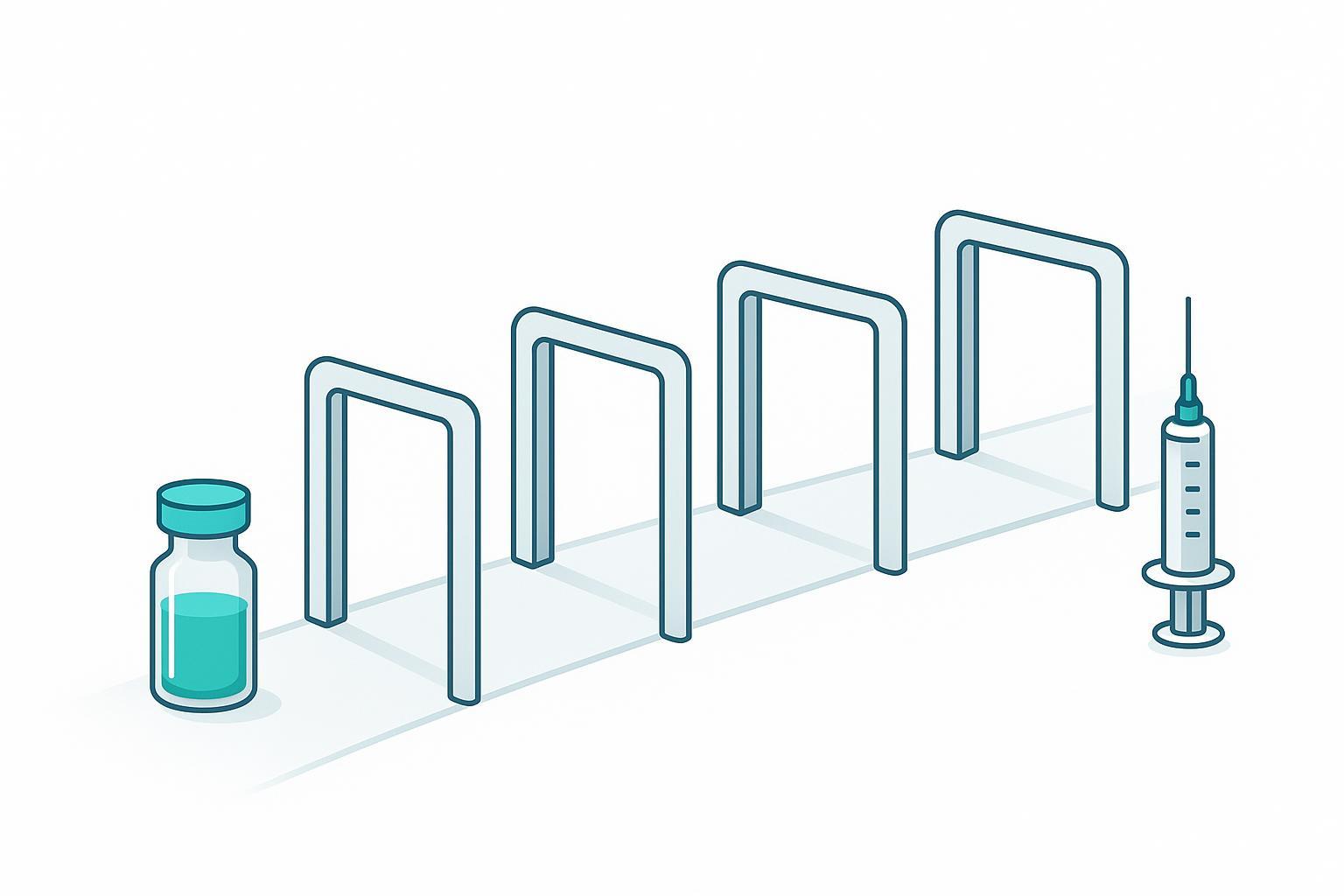
一个简单的门图,将 IND 间隙显示为多门路径上的一个门, IND 后证据包位于许可和首个 d 之间

肽 IND 许可是一份许可单, 不是质量证书. 当 FDA 批准 ENDO-205 的 IND 时 23 行进 2026, 它允许在健康的绝经前妇女中开始首次人体试验 (eptideinsider.org ENDO-205 文件, 检索到的 2026-09-11). 它没有验证 CMC 包, 锁定规格, 或确定该肽有效.

在内部公告中很容易失去这种区别. 正如同一份档案明确指出的那样, “IND 许可不是批准. 这是几个门中的第一个……它尚未审查任何 ENDO-205 对人体起作用的证据, 因为目前还没有这样的证据” (eptideinsider.org ENDO-205 文件, 检索到的 2026-09-11).

要点: “已获准继续进行”和“已证明安全或有效”是不同的说法. 只做了第一个.

肽 IND 后开发要求: 证据包

FDA 自己的 CMC 对首次人体 IND 的期望证实了审查的范围有多窄: 预计没有分析方法验证数据, 特定临床批次的稳定性数据“可能不需要” (美国FDA, IND申请: 管委会信息, 检索到的 2026-06-22).

填补这一空间的是 IND 后证据包, 五个需求领域都有它: 序列和杂质控制, 正交表征, 稳定性指示方法, 标签和容器密封, 以及适合该阶段范围的测试.

IND 后证据包: 携带第一剂疫苗的五个要求领域

肽 IND 后开发要求不是单一的清单. 它们是五个领域的证据,每个领域都必须足够有力以支持对人类进行给药, 并且每个人在临床阶段的成熟速度都不同.

多肽合成 需求领域

首次给药前必须确定什么

什么阶段 1 不需要

失败是什么样子的

序列和杂质控制

确认了预期的序列,并从构建块级别向上理解了杂质传播

完全合格的商业规模流程

未识别的截断或缺失物种出现在报告阈值之上

正交表征

不止一种独立方法就身份达成一致, 纯度, 和结构

一个锁着的, 每个属性都经过验证的发布面板

一次检测即可获得完整的身份声明, 第二种方法与它相矛盾

稳定性指示方法

降解途径已知 合成肽 该方法检测到它们

每种存储条件下的长期数据均符合 ICH 标准

一种方法通过了释放,但错过了在存储中形成的降解产物

标签和容器封闭

标签, 容器, 且结案与证据包一致

最终商业包装配置

给药开始后可提取物或封闭物相互作用表面

适合用途的分析测试

每种方法都适用于该阶段实际提出的问题

全面验证商业标准

为 Phase 过度构建了一个方法 1 并延迟时间表而不增加决策价值

该表后面的成熟度曲线是有用的心智模型: 跨临床阶段的阶段适当的 CMC 成熟度从首次人体试验到阶段 2, 阶段 3, 和商业锁, 方法成熟度从探索性上升 (0) 通过合格的 (1) 进行验证 (2). The five areas below are ordered by how early they become load-bearing, not by how much documentation they generate.

肽 IND 后开发要求与 IND 前期望有何不同

the FDA IND CMC information page section listing what is and is not expected for a first-in-human Phase 1 临床试验

Peptide post-IND development requirements shift the central question from “is this molecule defensible” to “is this lot reproducible, and is this method fit for its purpose.” Before clearance, the work is largely about identity, 路线, and feasibility. After it, the same data set has to support lot-to-lot control, 趋势, and tech-transfer documentation that a pre-IND package was never asked to carry.

That shift is deliberate, not a loophole. FDA’s own CMC expectations for a first-in-human IND state that sponsors can reduce application development time by up to 12 months by not over-building the initial CMC section, which means the pre-IND question set does not simply carry forward. What replaces it is phase-appropriate rigor: methods that are qualified rather than validated, specifications that are justified rather than locked, and a stability program that distinguishes the retest-period versus shelf-life distinction for drug substance and drug product respectively.

实践 1: 构建块级别的控制序列和杂质传播

Peptide impurity control is decided long before final release. For a synthetic peptide, the impurity profile of the finished lot is largely set upstream, at the building-block and coupling stages, which means post-IND control has to reach back into those stages rather than wait for the release panel.

服务 The thresholds worth applying come from a specific regulatory upstream. FDA’s synthetic-peptide impurity thresholds, reported in 2026, require that peptide-related impurities at or above 0.10% be individually identified, with a categorical upper limit of 0.5% for new peptide-related impurities not present in the reference listed drug.

Development stage

Purity by RP-HPLC area

Individual impurities

Total impurities

阶段 1 目标

~95–98%

NMT 0.5%

NMT 2–5%

Commercial expectation

~98–99%

NMT 0.1%

NMT 1.0%

The Phase 1 versus commercial purity bands are illustrative development targets, 不是规格. Define your own reporting, 鉴别, and qualification thresholds, then trend them from the first clinical lot forward.

Scope note: 这 0.10% 和 0.5% figures trace to a single regulatory upstream, FDA的 2021 ANDA guidance for highly purified synthetic peptide products referencing rDNA-origin reference listed drugs. They are not a universal IND requirement.

失效模式是可预测的: impurities that appear only at scale, or that were never individually identified because they sat below the threshold at small scale.

实践 2: 构建正交表征包, 没有一次检测

an orthogonal characterization stack showing RP-HPLC, 液质联用/质谱, 氨基酸分析, and chiral/NMR each answering a different identity question

Peptide characterization fails when one technique is asked to answer every identity question. No single assay establishes that a synthetic peptide is the intended molecule, so the post-IND package pairs methods that each resolve a different ambiguity.

Reverse-phase HPLC monitored at 220 nm establishes purity and main-peak content, while LC-MS/MS confirms monoisotopic mass and full amino-acid sequence coverage. In a published leuprolide acetate example, the theoretical monoisotopic mass of m/z 1209.6533 matched an experimental 1209.6515, and MS/MS delivered complete sequence coverage (Reference Standards to Support Quality of Synthetic Peptide Therapeutics, 2023). The same source notes that multiple orthogonal techniques are typically used to verify peptide identity, including HPLC retention time, 核磁共振, 多发性硬化症, and chiral testing.

The failure mode is a mass-confirmed but sequence-ambiguous peptide. A deletion sequence can share nominal mass behavior with the parent while differing by a single residue, and a purity method alone will not separate them. Pairing mass confirmation with sequence coverage, and adding chiral or NMR testing where the reference standard demands it, closes that gap and keeps the package defensible across a lot or supplier change.

ENDO-205’s amino-acid sequence, 路线, and dose remain undisclosed, so this package is described generically rather than for that molecule (the program’s disclosed status as of September 2026).

实践 3: 在需要之前设计稳定性指示方法

Peptide stability testing earns its place in the post-IND package by converting a degradation observation into a specification you 店铺 can control. That only works if the method resolves degradants from the parent peak before the first clinical lot goes on study.

Run forced degradation first, under acid, 根据, oxidative, thermal, and photolytic stress, and confirm the method separates every degradant it generates from the main peak. Then place the clinical lot on long-term, 中间的, and accelerated conditions in the same container-closure system you propose for storage and distribution. The storage statement on the label is derived from that evaluation, which is why “room temperature” or “ambient conditions” cannot appear in place of a defined condition.

范围

Drug substance

Drug product

Long-term

25°C/60% RH or 30°C/65% RH 多肽生产

25°C/60% RH or 30°C/65% RH

Intermediate

30°C/65% RH

30°C/65% RH

Accelerated

40°C/75% RH 关于

40°C/75% RH

Commitment derived

Retest period

Shelf life

Pending confirmation: The numeric conditions above follow ICH Q1A(R2) stability conditions, but the ICH Q1A(R2) PDF was not machine-readable in this run. Treat the figures as corroborated by secondary summaries only until the primary text is checked.

故障模式很安静. A method that co-elutes a degradant with the parent peak produces a stability table that looks clean while the product is not, and the problem surfaces after the clinical lot is already on study.

实践 4: 将标签和容器密封视为证据包的一部分

Peptide labeling requirements are a regulated control, not a design afterthought, and the storage statement printed on the label is an output of the stability program rather than a marketing decision. 在下面 21 病死率 312.6, the immediate package of an investigational drug must bear the caution statement “Caution: New Drug, Limited by Federal (or United States) law to investigational use,” and the labeling may not carry any statement that is false or misleading or represent that the investigational drug is safe or effective for the purposes under investigation.

That second clause is the one that catches teams. A storage statement that overstates stability, or label copy that implies a clinical benefit the program has not demonstrated, breaches 312.6(乙) even when the underlying data are sound.

Sequence container-closure selection ahead of the stability study, 不在它之后. Extractables and leachables findings, moisture transmission, and light protection all feed the storage statement, so a closure chosen late forces the stability protocol to be rewritten. No efficacy or safety claim is made here for ENDO-205; the labeling requirement is procedural, and the caution statement is the only claim the immediate package carries.

实践 5: 适合阶段的分析测试范围, 未到达目的地

a method qualification matrix with columns for method, 阶段 1 expectation, and documented rationale

Fit-for-purpose analytical testing in the post-IND window means matching each method’s rigor to what Phase 1 actually needs, not to what a commercial filing will eventually demand. The FDA’s own CMC expectations for a first-in-human IND do not include analytical method validation data, and process controls unrelated to product safety are not expected at this stage. That is a deliberate allowance, not a loophole: it lets a program defer validation until the process is locked, when the validation will still describe the process it was written against.

The practical split is per method, not per program. A release assay that supports a safety decision needs qualification now; a method whose only job is to trend a parameter you have not fixed yet can wait.

[TABLE] Method-to-phase expectation matrix: columns for method, 阶段 1 expectation (not expected / 合格的 / 已验证), and documented rationale.

Sterility and endotoxin testing are the exception to any deferral logic, because they run on compendial mechanics rather than on your process. The 14-day USP <71> sterility test incubates membrane-filtered or directly inoculated samples in fluid thioglycollate at 30–35°C and soybean-casein digest at 20–25°C, filtering the contents of at least 10 containers through 0.45-µm cellulose acetate membranes (形式混合, Sterility Testing for Peptides, reviewed 2026-05-14). Endotoxin limits come from the USP <85> endotoxin limit calculation, K/M, where K is 5 EU/kg/hour for non-intrathecal routes and 0.2 EU/kg/hour for intrathecal. Because the limit is dose-based, no universal EU/mL value exists. Note that this formula is compendial arithmetic; the primary FDA PDF could not be opened in this run, so treat the threshold values as USP-derived rather than FDA-confirmed.

The failure mode runs in both directions. A team that validates a stability-indicating method to commercial rigor before the process is locked will repeat that validation after every process change, paying twice for the same assurance. A team that leaves a safety-critical method unqualified creates a data gap that surfaces at the Phase 2 transition, when the agency asks what supported the release decision in the first place. The fix is documentation: for every method you deliberately leave unvalidated, write down why, what substitutes for it in the interim, and what trigger will force validation. That rationale is the artifact a reviewer reads.

一个可行的例子: 在中性开发工作流程中对 IND 后包进行测序

The five practices form a sequence, not a checklist. Impurity thresholds and the characterization package come first, because the release panel you set at that stage determines what later work has to measure. Stability-indicating methods and container-closure follow, since both depend on knowing which degradants and leachables the panel can detect. Labeling and fit-for-purpose testing close the sequence, because both describe a control strategy that only exists once the earlier steps are fixed.

A peptide synthesis and analytical workflow such as MOL Changes supports this ordering by keeping building-block control, 纯化, and characterization inside one traceable chain, which helps teams avoid re-qualifying methods after a late process change.

要点: This sequence is illustrative, not prescriptive. 阶段 1 programs deliberately leave some methods unlocked while the process is still moving, and locking them early can cost more than it protects.

IND 后窗口中的常见错误

The five errors below are the ones that survive a careful review of the obvious ones. Each has a specific fix.

Treating IND clearance as validation of the CMC package. An accepted IND means FDA found the submitted package adequate to proceed, not that the package is complete or final. 修复: keep the CMC section under active revision through Phase 1 and log every open item with an owner and a target date.

Applying the 0.10% 和 0.5% thresholds as if they were IND requirements. Those figures come from FDA’s synthetic-peptide impurity thresholds, which govern ANDA submissions, not investigational new drug applications. 修复: set your own reporting and qualification thresholds from toxicology and clinical exposure, then document the rationale.

Validating analytical methods before the process is locked. Method validation against a moving process produces data you will repeat. 修复: qualify methods for the intended use first, and reserve full validation for a frozen process.

Selecting container-closure after the stability study has started. Extractables and leachables interact with the formulation, so the study design depends on the closure. 修复: choose the primary container before the first stability lot is placed.

Writing label copy that implies clinical benefit. 21 病死率 312.6 requires the caution statement on investigational drug labeling, and the regulation bars any representation that the drug is safe or effective for the purposes under investigation. 修复: describe the dosage form and route only, and route all promotional language through regulatory review.

第一次注射之前的成功是什么样子

A complete post-IND package is one you can hand to a reviewer and defend line by line. 具体来说, that means five things are in place before the first dose: orthogonal identity confirmation of the peptide sequence, a stability-indicating method demonstrated by forced degradation, a clinical lot on stability in its proposed container-closure, investigational labeling that meets the applicable requirements, and a written rationale for every method you deliberately have not validated yet.

That last item is the one teams skip, and it is the one that most often turns a routine review into a rebuild. FDA’s own CMC expectations for a first-in-human IND are phase-appropriate rather than exhaustive, so an unvalidated method is not automatically a gap. An unvalidated method with no documented justification is.

The stretch goal is a lot-to-lot trending plan. Build it now and the Phase 2 transition becomes a data review instead of a redevelopment project. The retest-period versus shelf-life distinction is the practical lever here: a retest period supported by trending data is a far easier position to extend than one assembled retroactively.

常见问题解答

FDA 肽杂质阈值是否适用于 IND?

不. 这 0.10% identification threshold and the 0.5% cap on new peptide-related impurities come from FDA’s 2021 ANDA guidance for certain highly purified synthetic peptide drug products. Those thresholds are written for abbreviated applications referencing an rDNA-origin reference listed drug, not for an investigational new drug application. Importing a commercial impurity ceiling into a Phase 1 setting misreads the scope of the document.

是否相 1 需要经过验证的分析方法?

FDA states that it does not expect analytical method validation data for a first-in-human Phase 1 临床试验, and stability data from the specific clinical lot may not be required either. Treat that as a floor rather than a ceiling: a method that supports a safety decision still has to be fit for its purpose, and the retest-period versus shelf-life distinction governs how far the supporting data can be stretched.

What is ENDO-205’s current development status?

As of September 2026, the disclosed picture is narrow. The IND cleared on 23 行进 2026 and permits a first human trial in healthy pre-menopausal women of reproductive age. 阶段 1 status reads “Planning,” with no ClinicalTrials.gov record, no peer-reviewed data, and the sequence and route undisclosed. That is the program’s disclosed status as of September 2026, and nothing beyond it should be assumed.

结论

You can now sequence the five peptide post-IND development requirements that carry a program to first dose: sequence and impurity control at the building-block level, an orthogonal characterization package, stability-indicating methods designed before they are needed, labeling and container-closure treated as evidence, 以及适合该阶段范围的测试. The end state is concrete: a characterized peptide with orthogonal identity confirmation, a stability-indicating method demonstrated by forced degradation, a clinical lot on stability in its proposed container-closure, compliant investigational labeling, and a documented rationale for every method deliberately left unvalidated.

That last item matters as much as the others. Peptide IND clearance does not obligate commercial-grade validation at Phase 1, and treating it as though it does is the most common way sponsors spend time they did not need to spend.

Planning the evidence package for your own post-IND window?

Review how a phase-appropriate analytical package is assembled, covering characterization, 稳定性指示方法, and fit-for-purpose testing, before the first clinical lot goes on study. Talk to an expert or review the analytical package with the team that supports peptide quality standards.

Disclosure: MOL Changes has a commercial interest in peptide quality standards and analytical services.

管理员头像

Bingyan Gao

质量和分析技术员 核心专长: 微量杂质的分离与鉴定, HPLC/MS 方法开发, 手性纯度分析, 并符合国际药典.

轮廓: 高丙彦是多肽纯度和质量的“终极守门人”. 熟练使用各种高端分析仪器,擅长开发高度复杂修饰肽的定制色谱分离方法. 他建立了严格的杂质分析体系,不仅保证了产品的纯度 99% 或更高,但也能精确识别和消除可能导致免疫原性的微量杂质. 深入了解FDA和EMA对肽类药物的监管要求, 他确保从工厂释放的每一批产品都附有全面、权威的分析证书 (COA).

事实已核实 & 编辑指南
审阅者: 主题专家
分享这篇文章
搜索 Whatsapp 服务 产品