
What Peptide Mucosal Delivery Research Has to Solve
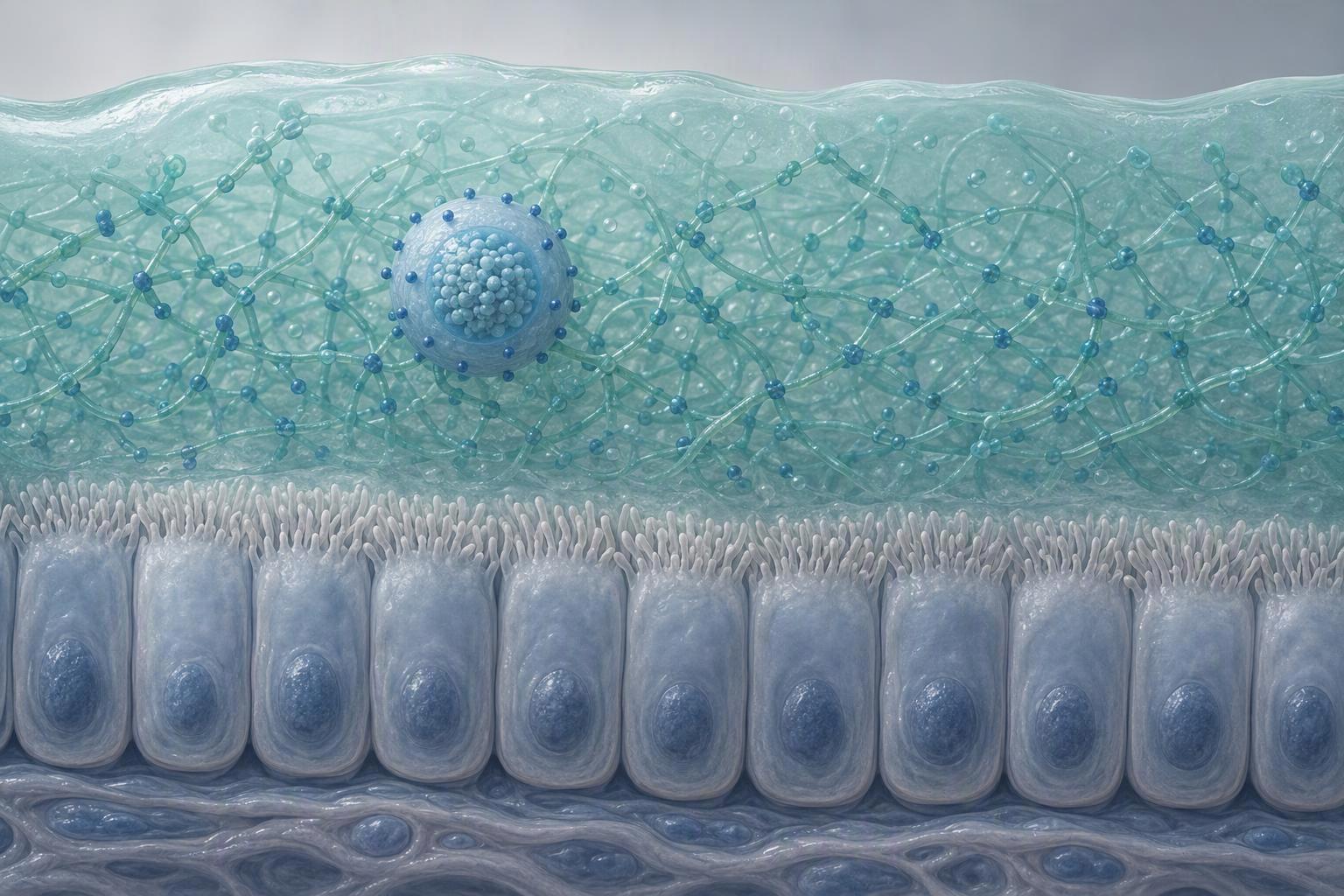
Peptide mucosal delivery research exists because the routes that avoid injection, nasal, pulmonary, buccal, vaginal and gastrointestinal, all place the same physical obstacle between the dose and the epithelium: mucus. That barrier is not a single filter but three acting together. A crosslinked mucin mesh restricts what diffuses through it, secreted and membrane-bound enzymes degrade the peptide on the way, and local pH and ionic conditions decide how much of it stays intact and permeable.
The mesh dimensions set the scale of the problem. Mucus interfiber spacing spans 10 нм до 200 нм, with individual fibers roughly 10 nm in diameter, and diffusion models use a mucin fiber radius of 3.5 nm against a mesh spacing of 100 нм (Позволять, Ван & Hanes, Advanced Drug Delivery Reviews, 2009). That range is why the mucus-penetrating particle concept turns on surface properties rather than size alone: particles that adhere to mucin are efficiently trapped and then cleared, and rapid mucus turnover removes trapped particles before they reach the epithelium.

Three failure points follow from this, and the rest of this guide treats each as a decision made before an order is placed: how much peptide the carrier can load, how that load is released at the mucosal surface, and whether the peptide survives long enough to arrive.
Why the Sequence Decision Comes Before the Carrier Decision
That barrier makes the peptide sequence and its modifications the first constraint, because they set the loading and release envelope before a single colloid is screened. Change the sequence, and the formulation window moves with it.
The modification toolkit acts at the mechanism level, not by fixed numbers. Cyclization and stapling stiffen the backbone and can improve protease resistance while altering how the peptide packs against a carrier surface. PEGylation adds a hydration shell that can extend circulation time but also introduces a steric barrier that slows release and can block loading into a tight colloid interior. Lipidation raises hydrophobicity and drives membrane or carrier association. D-amino acid substitution and prodrug conjugation change stability and activation timing. Each effect is directional, and no source supports a single universal loading rule that applies across peptides and carriers alike.
That is why carrier screening done first is often wasted work. A sequence optimized for enzymatic protection through PEGylation arrives at the formulation group with the very steric barrier that limits encapsulation. The sequence decision constrains the carrier decision, not the reverse.
The stakes are not small. More than 200 FDA-approved therapeutic peptides and proteins exist in the US, the global peptide therapeutic market is approximately $49 миллиард, and the majority remain approved for parenteral delivery (therapeutic peptides and proteins: status and developments, 2026-04-05). That market figure is vendor-adjacent, so treat it as directional context rather than a precise measure; the review itself is the upstream source. Non-injection mucosal routes are still the minority, which is exactly why sequence-first thinking matters for peptide mucosal delivery research.
Упражняться 1: Match Net Charge and Hydrophobicity to the Colloid Before Ordering
Charge and hydrophobicity decide whether a peptide partitions into the carrier interior or adsorbs to its surface, and that decision is made long before the first lot is ordered. A peptide that is too hydrophilic for the chosen core will sit at the interface or stay in solution, and no amount of process tuning recovers the loading you assumed.
The acceptance criterion is measurable, so write it as one: encapsulation efficiency determined indirectly from unencapsulated peptide in the supernatant, with the separation method named (ultrafiltration, centrifugation, or size-exclusion) and the quantification method stated alongside it. Published method literature on peptide-loaded PLGA nanocarriers sets out this indirect approach together with the companion measures, drug loading from encapsulated peptide relative to particle dry mass, and release quantified by sample-and-separate, dialysis, or continuous flow with HPLC.
Failure takes two forms. A peptide can load well and then desorb once it meets simulated mucosal fluid at mucosal pH, or it can never load at all because its net charge and hydrophobicity do not suit the core. A liposomal carrier loaded with a well-matched peptide that releases too slowly at mucosal pH is a design pattern worth planning against, not a defect you discover later.
Ключевой вывод: Encapsulation efficiency is specified as unencapsulated peptide in the supernatant, with the separation and quantification methods named, and release confirmed in simulated mucosal fluid at mucosal pH.
Упражняться 2: Set Loading Targets Against Published Ranges, Not Aspirations
Encapsulation efficiency (EE) and drug loading are two different numbers, and neither means anything without the carrier type, the loading route, and the assay used to measure it. Set your target from published values for the same carrier class, then state the method you will use to confirm it.
For PLGA-based peptide systems, review-level summaries report encapsulation efficiencies above 70%, with individual studies reaching 96.56%. Aqueous remote loading raises peptide loading in PLGA particles further: strongly cationic peptides have been reported at 66–98% EE and 6.6–9.9% w/w loading, and a MOG autoantigen peptide at roughly 82% EE and 8.2 ± 0.7% ж/б. Liposomal peptide encapsulation sits much lower and varies more widely, around 20–30% in the studies reviewed, with one nanoliposome study reporting 7.2 ± 0.8% for active loading and 4.57 ± 0.2% for passive loading.
These ranges come from research synthesis rather than a single controlled comparison, and the remote-loading figures trace upstream to a 2022 Природные коммуникации paper worth re-verifying against the original methods before you adopt them as a specification.
The failure mode is quoting a PLGA number as a target for a liposomal program. The two carrier classes do not load peptides by the same mechanism, so a 90% EE specification borrowed from PLGA is not ambitious for a liposome, it is unachievable, and it will send a formulation team into months of reformulation against a benchmark that never applied to their system.
Упражняться 3: Specify Release Kinetics in a Simulated Mucosal Fluid, Not in Buffer
A release profile measured in phosphate-buffered saline tells you how a peptide behaves in a clean, unstirred, mucus-free liquid. It does not tell you what reaches the mucosal surface.
The published spread is wide enough to make the point. Remote-loaded leuprolide microspheres released 28.8–34.3% within the first day, while MOG-peptide nanoparticles stayed under 10% в 24 часы, and a FRET-tracked nanoparticle set showed roughly 17% burst followed by about 21% cumulative release over 7 дни (Природные коммуникации, 2022). Those figures come from different assays and model systems, so treat them as a range of behaviors rather than a benchmark to hit.
Method choice drives the number as much as the formulation does. Release is typically quantified by sample-and-separate, dialysis, or continuous-flow sampling, each paired with HPLC quantification of the peptide remaining or released. State which method you used, because the three are not interchangeable.
The failure mode is a clean, медленный, depot-like profile from a lipid-modified peptide that never leaves the carrier long enough to contact mucus. If your assay cannot distinguish that from genuine sustained delivery at the mucosa, it is measuring the wrong compartment.
Упражняться 4: Treat Enzymatic Protection as a Measured Half-Life, Not a Claim
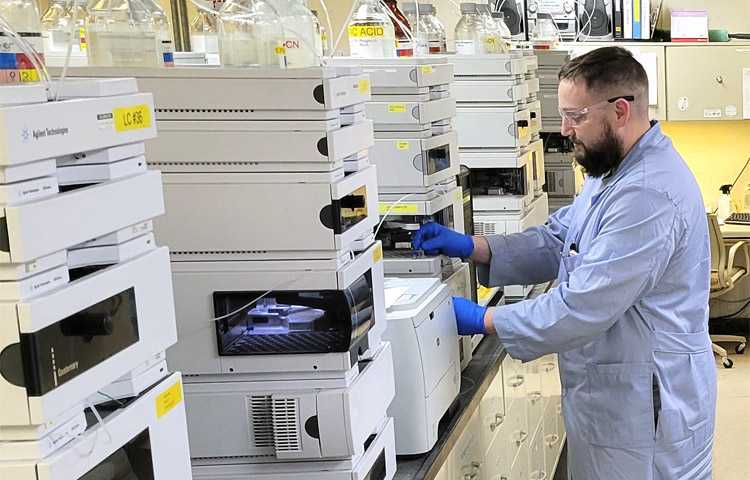
“Protease-resistant” is not a specification until it carries an enzyme, a concentration, a temperature and a time window. Without those four parameters, the phrase describes an intention rather than a measured property, and no formulation team can compare one peptide against another on the strength of it.
Услуги The published numbers show why the distinction matters. Free liraglutide recovery reached 1.9% после 30 minutes in simulated gastric fluid and 9.2% после 30 minutes in simulated intestinal fluid, with complete degradation after one hour in SIF (gastrointestinal stability of therapeutic peptides, 2024 review context and 2026 SNEDDS study). In the same body of work, только 3 из 17 therapeutic peptides remained after 30 minutes in human intestinal fluid, with many degrading within 2 к 10 минуты. В практическом плане, most therapeutic peptides are degraded within minutes in intestinal fluid, so a colloid carrier is being asked to change a timescale, not to remove a risk.
Синтез пептидов Three readouts turn peptide enzymatic protection into something a program can specify: intact-peptide recovery at defined timepoints, degradation half-life under the stated enzyme and temperature, and fragment appearance as the degradation products accumulate.
Для чаевых: Every stability claim should carry four parameters: the enzyme or fluid, its concentration, the temperature, and the time window.
The failure mode is a cyclized or D-amino-acid-substituted analog that survives the assay but loses the conformational Синтетические пептиды epitope the program needed. Protection that changes the molecule’s shape is not protection the program can use.
Упражняться 5: Write the Analytical Package as Acceptance Criteria Before the First Lot
The characterization plan is a purchasing document. Write it before you place the order, agree it with the supplier, and make each lot release against it. A package assembled after synthesis tells you what arrived; a package agreed beforehand tells the supplier what will be rejected.
For a peptide mucosal delivery program, the method list is settled enough to specify now. Encapsulation efficiency is measured from the supernatant after particle separation. Drug loading is expressed as encapsulated peptide relative to particle dry mass, not to total formulation mass. Release is run by sample-and-separate, dialysis, or continuous flow, with quantification by HPLC. Size comes from dynamic light scattering with morphology confirmed by SEM, TEM, or AFM. Zeta potential comes from electrophoretic light scattering. Mucus diffusivity is measured by particle tracking in mucus, not in buffer. Enzymatic stability is reported as intact-peptide recovery with fragment appearance.
|
Атрибут |
Method and threshold or reporting convention |
|---|---|
|
Пептидная идентичность |
Mass confirmation by MS |
|
Чистота пептидов |
ОФ-ВЭЖХ; ~≥95% is an industry norm, not an EMA-mandated figure |
|
Peptide-related impurities |
Ph. Евро. пороги: report >0.1%, идентифицировать >0.5%, qualify >1.0% |
|
Противоион Производство пептидов |
Identity and content Магазин stated |
|
Остаточная ТЖК |
Reported as a process-related impurity |
|
Бактериальные эндотоксины |
Limit set by route and dose, where appropriate |
|
Encapsulation efficiency |
From supernatant after particle separation |
|
Drug loading О |
Encapsulated peptide relative to particle dry mass |
|
Release kinetics |
Sample-and-separate, dialysis, or continuous flow, quantified by HPLC |
|
Particle size |
ДЛС, with morphology confirmed by SEM, TEM, or AFM |
|
Surface charge |
Zeta potential by electrophoretic light scattering |
|
Mucus diffusivity |
Particle tracking in mucus |
|
Enzymatic stability |
Intact-peptide recovery and fragment appearance |
The regulatory frame is already written down. the EMA specification expectations for synthetic peptides require a justified active-substance specification covering peptide-related impurities, идентичность и содержание противоиона, residual TFA as a process-related impurity, and bacterial endotoxins where appropriate.
A peptide supplier’s certificate of analysis and QC package should carry identity, чистота по ВЭЖХ, mass confirmation by MS, противоион, эндотоксин, бесплодие, and lot-to-lot consistency data. Изменения МОЛ provides custom synthesis with MS, ВЭЖХ, чистота, содержание, и тестирование на эндотоксины, which covers the drug-substance side of that list. The delivery-formulation attributes in the table remain the research team’s to specify and measure.
Упражняться 6: Separate Promising Concepts From Validated Performance
Every number in a peptide mucosal delivery program carries an evidence stage, and the stage has to travel with the number. A permeability result measured across a Caco-2 monolayer is an in vitro result. It is not a clinical projection, and presenting it as one is the failure mode this practice exists to prevent.
The framing is not new. Duncan and Gaspar described the long-standing promise-versus-performance gap in nanomedicine в Молекулярная фармацевтика в 2011: preclinical promise sat far from clinical translation, the truth “lies firmly between” hype and alarm, and after roughly 50 years of design work only a few dozen nanomedicines had reached routine clinical use, with regulatory mechanisms part of that picture. Treat it as a historical baseline rather than a current count, but the tiering logic holds.
What validation costs is clearest in absorption data. А 2026 review reports that most peptides have inherent oral bioavailability below 1%, and that formulation efforts rarely lift it past low single digits in large animals and humans (Navigating the complexity of oral peptide delivery, 2026). Oral octreotide reaches about 0.7% in humans. Luna18 reached 21–47% preclinically, and MEDI7219 about 6% in dogs as an enteric tablet. Note how far the preclinical figure sits from the clinical one.
Предупреждение: Label every result with its evidence stage. In vitro, ex vivo, animal, клинический. The label travels with the number, into every deck, memo, and specification it appears in.
Where the Field Is Moving

With those evidence stages labelled, the near-term movement in peptide mucosal delivery is not new carrier chemistry. It is analytical and regulatory rigor, and the specifications a formulation team will eventually have to meet are already being written for adjacent routes.
Nasal and pulmonary products show what that looks like. The FDA’s guidance on nasal spray and inhalation products expects droplet size distribution to be controlled with three to four cut-off values reported as D10, D50, D90 and span, measured in the fully developed plume at two distances at least 3 cm apart, обычно 2 к 7 cm. Spray pattern criteria specify both shape and size, for example an ellipsoid of relative uniform density with a longest-to-shortest axis ratio around 1.00 к 1.30, and plume geometry requires angle and width at a single delay time. Nasal deposition generally targets droplets above roughly 10 µm to avoid lung deposition, often cited around 50 мкм. These are the CMC expectations for nasal spray products, and the underlying guidance dates to 2002, with the figures reaching most teams through FDA product-specific guidance pages and a 2014 analytical review. Treat them as directional, not current.
For the peptide itself, the EMA guideline on synthetic peptides (2025-12-04) is the more current anchor.
Часто задаваемые вопросы
Can I choose a mucosal route before the sequence is fixed?
Нет, and treating the route as independent of the sequence is the most common sequencing error in early feasibility work. Net charge, изоэлектрическая точка, and hydrophobicity are sequence properties that determine whether a peptide partitions into a soft colloid at all, so the carrier decision is downstream of them. Fix the sequence, then screen carriers against it.
How much encapsulation efficiency is enough for an early feasibility study?
Универсального порога не существует, and published ranges vary with peptide, перевозчик, and method. Treat encapsulation efficiency as a comparative screen across candidate colloids under one fixed protocol rather than as a pass/fail gate, and set the target from the range your own assay reproduces.
Should a PEGylated or lipidated analog go to the formulation group first?
It depends on which liability you are solving. PEGylation mainly addresses circulation and enzymatic exposure; lipidation mainly addresses membrane interaction and partitioning. Send the analog that matches the failure mode you measured, not the one with the larger literature footprint.
What belongs in a lot-to-lot consistency package at research stage?
Как минимум: the specification, the analytical method behind each attribute, and results across at least three lots. Чистота по ВЭЖХ, идентификация методом масс-спектрометрии, and endotoxin testing belong in the package from the first lot, because retrofitting them later invalidates earlier comparability.
How do I read a preclinical bioavailability number?
Read it as a measurement under one model, one dose, and one formulation, not as a projection. Oral peptide bioavailability rarely exceeds low single digits, and even that figure is model-dependent. Report the model, маршрут, dose, and time window alongside the number, and check the specification expectations in the EMA guideline on synthetic peptides before treating any value as a target.
Заключение
The sequence and modification decision precedes and constrains the colloid decision. That is the single most important takeaway for anyone planning peptide mucosal delivery work: choose the peptide, its net charge, its hydrophobicity and its stability profile first, then select the carrier that fits those properties. Reversing the order is what produces the long-standing promise-versus-performance gap in nanomedicine, where a formulation performs well in concept and fails at loading, release or enzymatic stability.
The six practices form one decision sequence. Match charge and hydrophobicity to the colloid before ordering. Set loading targets against published ranges. Specify release kinetics in simulated mucosal fluid. Treat enzymatic protection as a measured half-life. Write the analytical package as acceptance criteria before the first lot. Separate promising concepts from validated performance.
What is changing is not the carrier chemistry but the bar around it. Analytical and regulatory expectations for characterisation, method detail and lot-to-lot consistency keep rising, so documentation quality now shapes which programs stay viable.
If you are ready to move, request a specification or analytical package, or start a feasibility assessment with your supplier. Consult a qualified professional before making medical or formulation decisions. This article is educational and contains no commercial recommendation.