Por qué un átomo reconfigura la biología
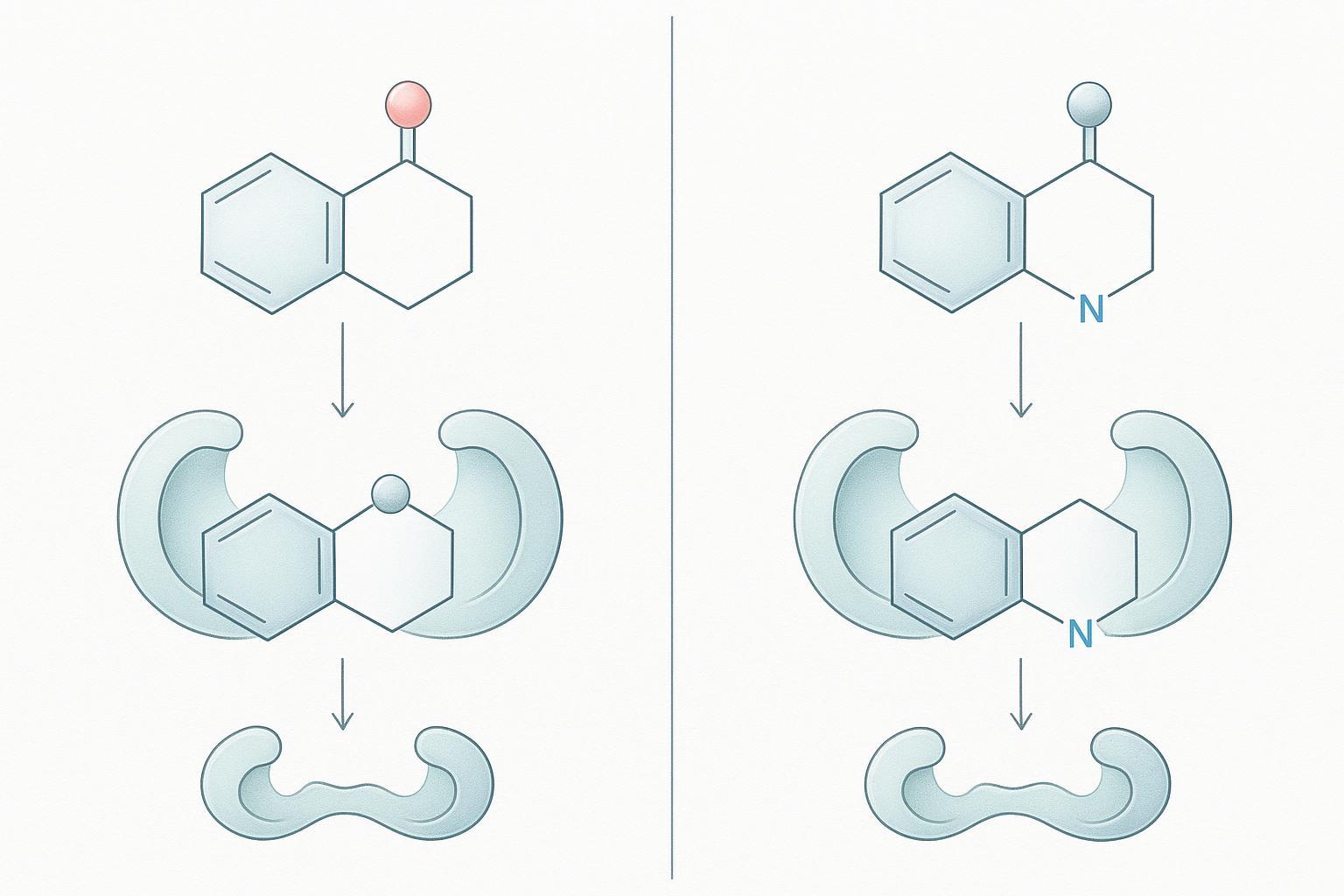
Esa redirección no es un cambio sutil de grado. En 2026 trabajo de edición esquelética, una edición de oxígeno a nitrógeno convirtió el anillo de furano de limonina en pirrol, produciendo el analógico 15N-LIMO. En un ensayo de unión térmica más estudios celulares, la limonina se unía preferentemente a quinasas, mientras que el análogo editado se unía a un conjunto de proteínas diferente, incluida la nicotinamida nucleótido transhidrogenasa. (NNT). Ambos compuestos eran antifibróticos., pero a través de diferentes mecanismos: La limonina inhibe las vías de señalización., mientras que 15N-LIMO actuó sobre el redox mitocondrial y redujo las ROS. 15N-LIMO también fue menos citotóxico. el proyecto, liderado por Yoonsu Park en KAIST con Ho Jeong Kwon en Yonsei, Se describe como un dramático recableado del compromiso con el objetivo. (do&EN, 2026-09-15).

Aquí importan dos límites. Los informes accesibles no proporcionan un valor de potencia único para el cambio, entonces no se reclama ninguno. Y la limonina es una pequeña molécula similar a un producto natural de los cítricos., no es un péptido o depsipéptido, lo que hace que la transferencia a estructuras similares a péptidos sea un argumento por analogía en lugar de un resultado peptídico (do&EN, 2026-09-15). un relacionado 2026 avance, Expansión diastereoselectiva del anillo de tetrahidrofuranos a pirrolidinas., muestra la misma lógica de oxígeno a nitrógeno aplicada al nivel del anillo (Artículo de comunicaciones de la naturaleza, 2026-02-02).
La implicación para la caracterización de péptidos modificados es directa.: si un átomo puede cambiar lo que une una molécula, un porcentaje de pureza no puede sustituir la identidad.
La visión convencional: pureza como la puerta
Síntesis de péptidos Si un átomo puede cambiar lo que une una molécula, la pregunta es qué mide realmente la puerta de liberación. La puerta principal para una molécula similar a un péptido es un conjunto de umbrales de impurezas., y los dos principales reguladores todavía lo plantean de esa manera. El julio de la FDA 2026 Las directrices preliminares revisadas para productos peptídicos genéricos mantienen los informes familiares., niveles de identificación y calificación en 0.10%, 0.50% y 1.0%, y el proyecto reduce el umbral de presentación de informes a 0.05% para productos dosificados arriba 10 mg por día. La directriz de péptidos sintéticos de la EMA que entró en vigor en junio 2026 establece informes arriba 0.1%, identificación arriba 0.5% y calificación superior 1.0%, y controla esos límites contra el Ph. euros. monografía general “Sustancias para uso farmacéutico” en lugar de ICH Q3A, que no se aplica a los péptidos sintéticos.
Péptidos sintéticos src=”https://molchanges.com/wp-content/uploads/2026/09/pub_20260925_050922_934_21bf4c59c3ab42f2ab0ac9a6e982f6ba.png”>
|
Estructura |
Servicios Informes |
Identificación |
Calificación |
Base |
|---|---|---|---|---|
|
FDA (Julio 2026 borrador) |
0.10% (0.05% arriba 10 mg/día) |
0.50% |
1.0% |
Orientación específica del producto |
|
EMA (eficaz 2026-06-01) |
>0.1% |
>0.5% |
>1.0% |
Ph. euros. “Sustancias de uso farmacéutico” |
Ese marco se convirtió en el predeterminado porque es auditable., comparable entre lotes, y mucho más barato que el trabajo ortogonal. Tenga en cuenta que la página de inicio de la FDA nombra los umbrales de impurezas sin imprimir los números., por lo que las cifras de la FDA anteriores son de fuente secundaria.
Por qué la pureza del HPLC pasa mientras que la identidad es incorrecta

La razón por la que esos umbrales no pueden incluir la pregunta de identidad es que un número de pureza de HPLC informa homogeneidad cromatográfica., no identidad química. Un único pico te dice sólo una cosa: el material eluyó como una banda en esas condiciones. No te dice cual es esa banda.
Tres modos de falla explotan esa brecha. Primero, péptidos estructuralmente diferentes pueden compartir una retención casi idéntica y aparecer como un pico, por lo que los isómeros de secuencia aumentan la pureza aparente sin siquiera separarse; como lo expresa una referencia estándar de análisis de péptidos, un área de pico no es una identidad (Análisis por HPLC y purificación de péptidos., sin fecha, recuperado 2026-06-14). Segundo, La racemización en etapa de acoplamiento a través de un intermediario plano de oxazolona permite que la amina entrante ataque cualquiera de las caras del residuo activado., invertir la estereoquímica D/L en una sola posición; His y Cys son los clásicos residuos sensibles., y porque los epímeros son isobáricos con respecto al objetivo, la masa por sí sola no puede resolverlos (Directriz de la EMA sobre el desarrollo y fabricación de péptidos sintéticos, eficaz 2026-06-01). Tercero, secuencias de truncamiento y eliminación de acoplamiento incompleto coeluyen o emergen solo como hombros, mientras que la oxidación en Met, Trp o Cys y la desamidación en Asn o Gln cambian la retención tan sutilmente que se esconden dentro del pico principal. (Análisis por HPLC y purificación de péptidos., sin fecha, recuperado 2026-06-14).
La magnitud no es hipotética.. Se informó la comparación de un proveedor de pureza UV y MS en el mismo lote de Eledoisin 94.7% por detección óptica contra 74.8% por espectrometría de masas, porque los péptidos coeluyentes aparecen sólo en la traza de MS (Waters application note, 2018-08-01). Waters sells LC-HRMS, so read that number as a vendor making its own case, not as a neutral benchmark.
⚠️ Advertencia: A passing purity specification is not evidence of peptide structural confirmation. It is evidence that your detector saw one peak.
All three modes share one property: they are invisible to a detector that only counts peak area.
Lo que realmente muestran los datos sobre la caracterización de péptidos modificados
Because those failure modes are invisible to peak-area detection, the reframe is simple: the useful question is not “how pure is it” but “which method answers which question.” Once you ask it that way, the answer set is orthogonal by construction, and no single release test can cover it.
A 2025 study on four cyclic nonapeptides found that RP-HPLC and HILIC resolve different impurity populations from the same samples, so each separation sees a fraction the other misses (Revista de cromatografía A, 2025). That is the practical case for pairing methods rather than ranking them.
Detection limits are real but narrow. One LC-HRMS workflow reported an API-Proline impurity at 0.08% relative abundance with 2.4% RSD, a single-peptide, instrument-specific result rather than a general floor (Waters application note, 2018).
The mechanism explains why the O→N case resists a purity-only read. An amide nitrogen supplies a backbone N–H hydrogen-bond donor and a strong carbonyl acceptor; swap it for oxygen and the ester cannot donate that hydrogen bond and its acceptor carbonyl is weaker (Peptide-Bond Isosteres review, 2011). A specific intra- or intermolecular hydrogen bond is lost, the backbone becomes more flexible with a lower rotational barrier, and the cis/trans ensemble shifts. The target then sees a different population of conformers, not a different mass.
Direction matters too. Amide→ester removes a donor and adds flexibility; ester→amide restores the N–H donor and a stronger acceptor, tightening conformational bias (Amide Bond Bioisosteres review, 2020).
So a mass-confirmed, high-purity sample can still present the wrong conformer population. Structural confirmation and peptide bioactivity interpretation are separate questions from purity, and the EMA expects orthogonal methods for identity, including higher-order structure where relevant (EMA guideline explainer, 2026). Yo Q2(R2) supports this by letting a second well-characterized orthogonal procedure carry the specificity argument when impurity standards are unavailable (Yo Q2(R2), 2023).
Conclusión clave: Purity and mass confirmation do not establish which conformer population your sample presents. That is a structural question, answered by orthogonal methods, not by a higher purity number.
El mejor enfoque: un paquete de caracterización integrado
If conformer population is a structural question, the package has to be built to answer it. Treat synthesis route, impurity map, estructura, and bioactivity as one linked package rather than four checkpoints. The core principle: every claim must be anchored to a named standard or documented practice, and every method’s limits must be stated before its result is used.
Five rules make that work.
-
Define the question before the method. Pureza, identidad, conformación, and function are different questions. Choosing the instrument first guarantees you answer the wrong one.
-
Require orthogonality, not redundancy. Two methods that separate by the same mechanism confirm each other’s blind spots. If reversed-phase HPLC and a second reversed-phase gradient both miss a co-eluting variant, running both adds cost, not confidence.
-
Treat the impurity map as a structural hypothesis. The EMA’s explicit impurity taxonomy names truncated, supresión, inserción, racemization-derived stereoisomer, oxidación, and deamidation products as distinct categories, each with its own analytical consequence. A plain-language walkthrough of what the guideline asks for is useful for translating that taxonomy into a testing plan.
-
Connect structure to function with a bioassay that distinguishes mechanism. A potency readout that cannot separate receptor affinity from downstream signaling will not tell you whether a single-atom change altered binding or altered signaling.
-
State limitations up front. Chiral methods consume more material and time; ion mobility resolution depends on the variant’s collision cross-section. Naming those limits before the result is used is what makes the result defensible.
For the package as a whole, Yo Q2(R2) validation expectations set the bar for demonstrating that each method performs as claimed, and the FDA’s Comercio Julio 2026 revised draft guidances for generic peptide products show regulators moving toward the same structural-identity expectations.
Para propina: Write the impurity map as a set of structural hypotheses, not a list of peak areas. Each named species implies a synthesis or handling step you can then test directly.
A co-eluting isobaric variant sitting under the main peak is the case that exposes a purity-only workflow. MS detects the mass difference first; chiral analysis then resolves which stereoisomer is present. MOL Changes supports that kind of sequence, and the same logic can be used to decide which orthogonal method answers the question the first one raised.
|
Project scenario |
Recommended characterization scope |
|---|---|
|
Modified or conjugated peptide |
Impurity map against the EMA taxonomy, MS/MS connectivity, bioassay with mechanism resolution |
|
Cyclic or disulfide-rich scaffold |
Disulfide pairing assignment, conformational check, orthogonal separation |
|
Lot-to-lot comparability |
Same method set across lots, with defined acceptance criteria per attribute |
|
Potency shift with unchanged purity |
Chiral or isobaric resolution first, then structural confirmation before re-testing potency |
Cómo aplicar esto

Putting the package together starts with writing down the question your data must answer and the decision it feeds. If the release decision is “does this batch match the intended molecule,” a purity percentage is not an answer. This takes an hour and usually exposes the gap immediately.
Then audit the current package for redundancy. Two methods that separate on the same principle, reversed-phase and another reversed-phase gradient, answer one question twice. The EMA guideline on synthetic peptides is useful here: its impurity categories let you rank failure modes by risk for your specific scaffold, so you add the orthogonal method that covers the highest-risk one rather than the easiest one to run. Expect this step to cost instrument time and material. Acerca de
Build the impurity map into a structural hypothesis, then test it against the bioassay. That feedback loop is where peptide bioactivity interpretation stops being a number and becomes a mechanism. Validate each method for the role it plays under ICH Q2(R2), and document its blind spots next to the result.
Track one thing: whether identity, stereochemistry, conformation and bioactivity each have at least one method behind them.
Advertencias
The strongest limitation is that the O→N evidence comes from a natural-product-like small molecule, not a peptide, so the mechanism transfer is analogical rather than demonstrated, and the strength of that analogy varies by scaffold. The natural-product scope of the original finding is the reason to treat it as a warning about single-atom change peptide biology, not as a peptide-specific result.
por un corto, unmodified peptide made by a mature route, the conventional purity gate may be sufficient, and the added orthogonal work may not change a release decision. The mechanistic basis for the conformational shift and the directionality of the amide–ester swap support the argument, but no peptide dataset in the accessible literature confirms that a shifted ensemble reliably produces a different biological outcome. That is the weakest link in this position.
The claim here is narrow: purity is necessary but not sufficient. It is not an argument for reducing purity testing.
But doesn’t the conventional purity gate work for well-behaved peptides?
Sí, for a short unmodified peptide on a low-risk scaffold, a purity-only release specification is often defensible, and nothing here argues for replacing it wholesale. The objection fails only when a passing purity figure is read as a statement about identity. A peak area measures how much material elutes as one band under one set of conditions; it does not establish connectivity, and a peak area is not an identity (PMC). That distinction is exactly what the guideline’s orthogonal identity expectation formalizes: purity and structural confirmation are separate questions, answered by separate methods (ChemVerificar).
So the practical rule is proportional, not absolute. Keep the reduced package where the scaffold and the decision stakes justify it, but document the blind spots in the specification itself, so nobody downstream treats a clean chromatogram as proof of peptide structural confirmation.
¿Qué pasa si ya hemos validado una especificación de lanzamiento de solo pureza??
Keep the validated specification as your release gate. You do not have to reopen a filed method or renegotiate a specification to strengthen characterization. Add orthogonal work as a characterization-layer activity that sits alongside release testing rather than replacing it. Producción de péptidos
The EMA’s guideline on synthetic peptides is explicit that co-eluting impurities must not be left as unresolved single peaks where they can be separated or otherwise justified. That single sentence is your prioritization rule: start with the failure mode most likely for the scaffold in front of you, not with a wholesale method rewrite. A scaffold prone to deamidation gets an orthogonal separation; one prone to sequence variants gets fragmentation-based confirmation.
Regulators are moving the same direction. Analysis of FDA expectations and trade reporting concludes that manufacturers relying solely on HPLC-UV will need to upgrade. Treat that as a documentation roadmap, not a verdict on work already done.
¿Cómo se concilia esto con los umbrales de la FDA y la EMA??
The thresholds define what you must report, identify, and qualify. They do not define what you must structurally confirm. That gap is where a purity-only release specification quietly stops short of the guidance it claims to satisfy.
El julio de la FDA 2026 revised draft guidances for generic peptide products keep the impurity reporting, identificación, and qualification framework that has governed peptide submissions, and the FDA landing page names impurity thresholds without printing the numbers, so any specific figure should be checked against the current guidance text rather than a summary. La directriz de péptidos sintéticos de la EMA que entró en vigor en junio 2026 sets its expectations on the same foundation, and the guideline itself ties impurity control to the active substance’s defined structure. Neither document asks a chromatographic purity value to stand in for structural identity. They assume you already know what the molecule is. Peptide impurity profiling answers the reporting question; it does not answer the identity question, and the two are not interchangeable in a filing.
Conclusión
Purity is necessary but not sufficient, because a single oxygen-to-nitrogen edit can change what a molecule binds: a single oxygen-to-nitrogen edit rewired a natural product’s protein targets entirely, which is why modified peptide characterization has to answer identity, conectividad, conformación, and bioactivity questions rather than report one number. The broader shift is a change in how packages get assembled. Instead of running a default method list and hoping the gaps do not matter, teams should build the package from the questions the molecule raises, and state openly what each method cannot see. A field where every reported purity figure travels with its method and its blind spots would waste less material, fewer retests, and fewer late surprises.
Próximos pasos. If you are specifying a characterization package for a modified or peptide-like molecule and want the method set mapped to your actual structural risks, talk to our analytical team about an integrated characterization package covering impurity profiling, confirmación estructural, and bioactivity interpretation.
Divulgación: MOL Changes provides analytical and synthesis services for modified peptides and related molecules, so we have a commercial interest in how these packages are specified.