修饰肽表征: 为什么一个原子很重要

修饰肽表征: 为什么一个原子很重要

为什么一个原子重塑生物学

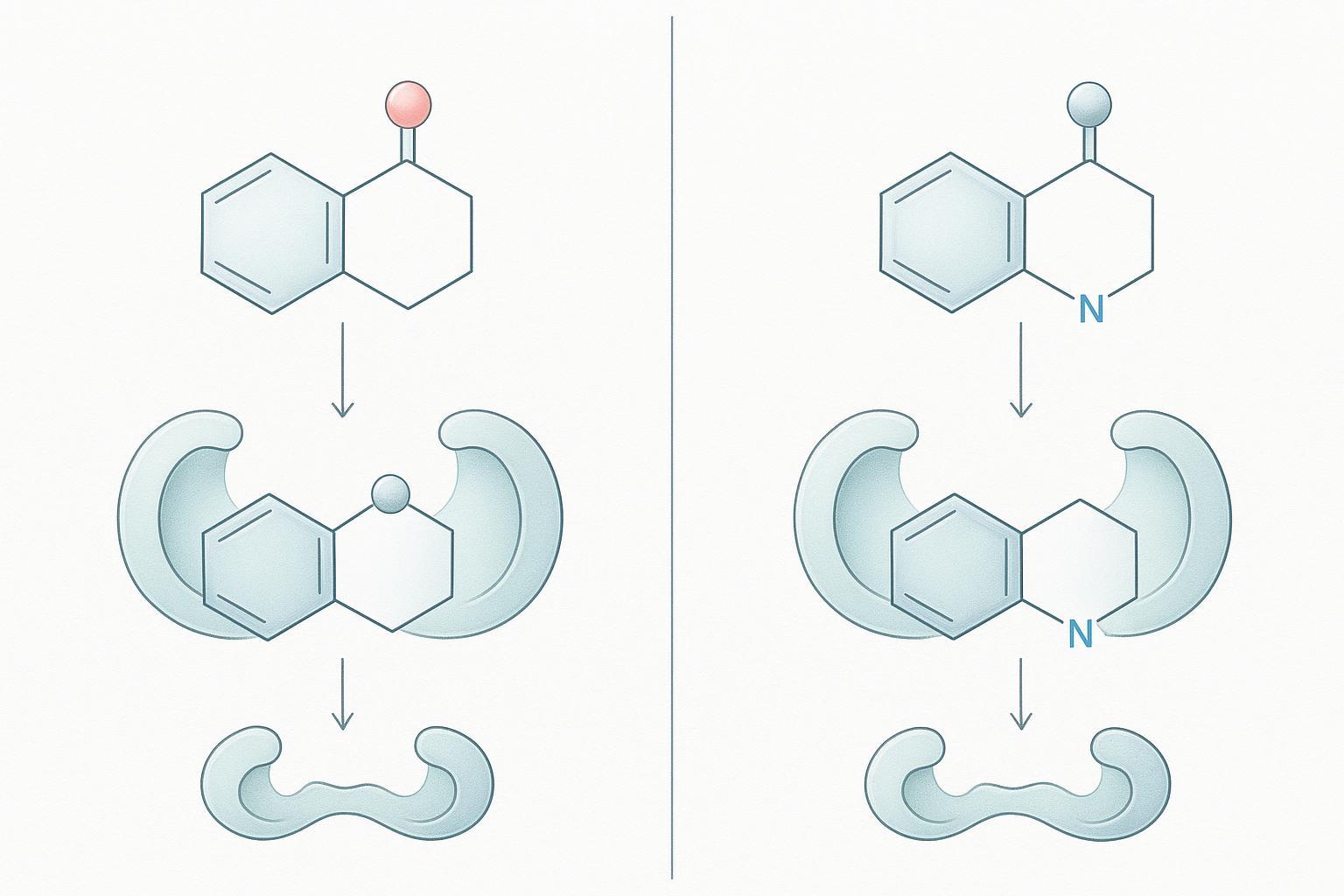
同一支架的拆分示意图,其中一个呋喃氧被吡咯氮取代, 两个不同的目标绑定结果显示为 s

这种重定向并不是程度上的微妙转变. 在 2026 骨架编辑工作, 氧氮编辑将柠檬苦素的呋喃环转化为吡咯, 生产模拟 15N-LIMO. 在热结合测定和细胞研究中, 柠檬苦素优先结合激酶,而编辑后的类似物结合不同的蛋白质组,包括烟酰胺核苷酸转氢酶 (神经网络). 两种化合物均具有抗纤维化作用, 但通过不同的机制: 柠檬苦素抑制信号通路, 而15N-LIMO作用于线粒体氧化还原并减少ROS. 15N-LIMO 的细胞毒性也较小. 项目, 由韩国科学技术院的 Yoonsu Park 和延世大学的 Ho Jeong Kwon 领导, 被描述为目标参与的戏剧性重新布线 (C&在, 2026-09-15).

修饰肽表征: 为什么一个原子很重要

这里有两个界限很重要. 易于访问的报告并未给出该转变的单一效力值, 所以没有人声称. 柠檬苦素是一种类似柑橘天然产物的小分子, 不是肽或缩肽, 这使得向类肽支架的转移成为类比论证,而不是肽结果 (C&在, 2026-09-15). 相关的 2026 进步, 四氢呋喃非对映选择性扩环为吡咯烷, 显示了在环级应用相同的氧-氮逻辑 (自然通讯项目, 2026-02-02).

修饰肽表征的意义是直接的: 如果一个原子可以改变分子的结合, 纯度百分比不能代表身份.

传统观点: 清净如门

多肽合成 如果一个原子可以改变分子的结合, 问题是释放门实际测量的是什么. 类肽分子的主流门是一组杂质阈值, 两个主要监管机构仍然如此. FDA 七月 2026 修订后的仿制药指南草案保留了熟悉的报告, 身份和资格等级 0.10%, 0.50% 和 1.0%, 草案将报告门槛降低至 0.05% 对于上述剂量的产品 10 毫克每天. 6月生效的EMA合成肽指南 2026 设置以上报告 0.1%, 上面的标识 0.5% 及以上资格 1.0%, 并控制这些对博士的限制. 欧元. 一般专论“药用物质”而不是 ICH Q3A, 不适用于合成肽.

修饰肽表征: 为什么一个原子很重要合成肽 src=”https://molchanges.com/wp-content/uploads/2026/09/pub_20260925_050922_934_21bf4c59c3ab42f2ab0ac9a6e982f6ba.png”>

框架

服务 报告

鉴别

资质

基础

美国FDA (七月 2026 草稿)

0.10% (0.05% 多于 10 毫克/天)

0.50%

1.0%

针对产品的指导

EMA (有效的 2026-06-01)

>0.1%

>0.5%

>1.0%

博士学位. 欧元. “药用物质”

该框架成为默认框架,因为它是可审计的, 批次间具有可比性, 并且比正交工作便宜得多. 请注意,FDA 登陆页列出了杂质阈值,但没有打印数字, 所以上面的 FDA 数据是二次来源的.

为什么 HPLC 纯度合格但鉴定错误
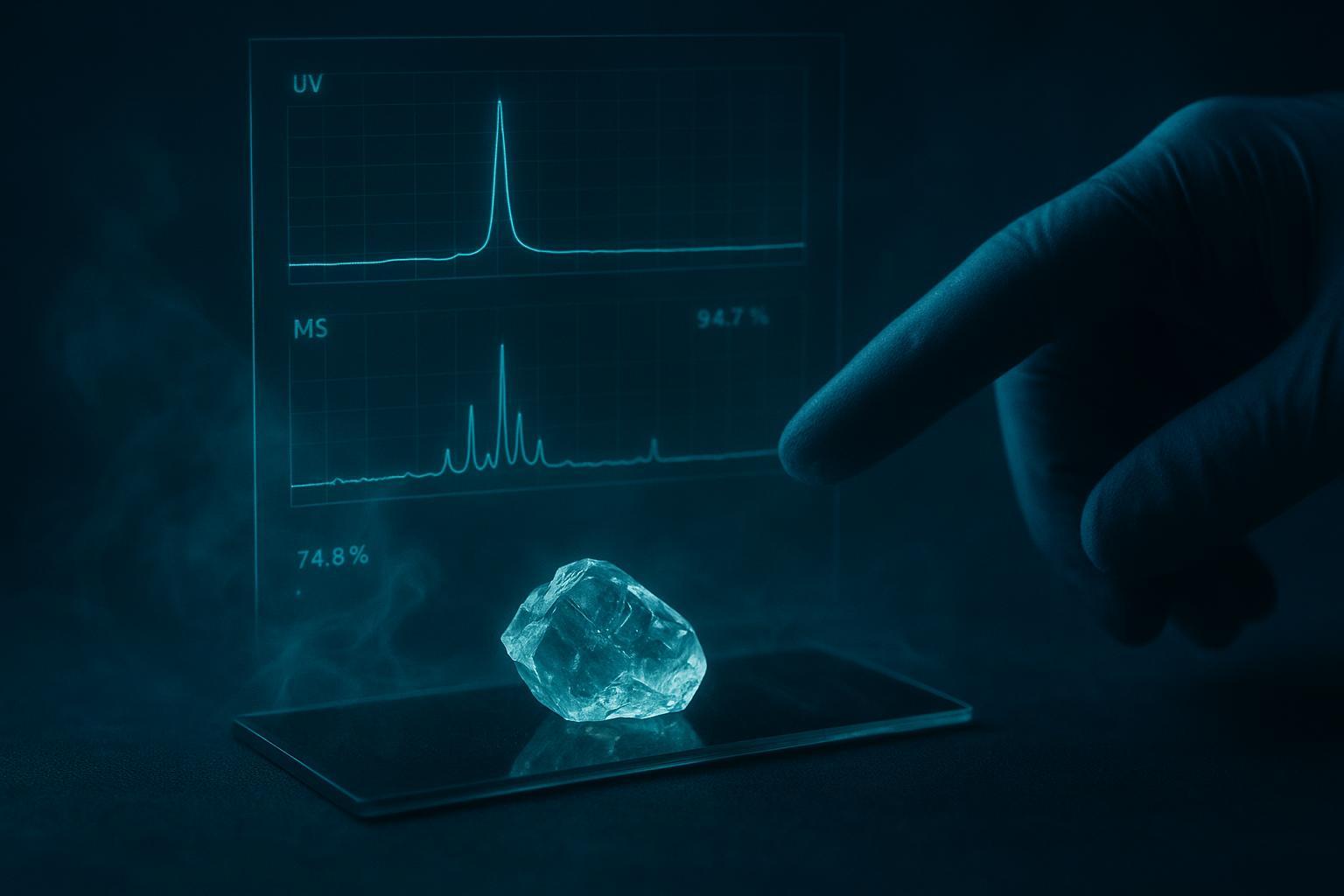
同一批次 Eledoisin 的重叠 UV 迹线和 MS 迹线, UV 迹线显示一个干净的主峰,MS 迹线分离了共洗脱组分

这些阈值不能解决同一性问题的原因是 HPLC 纯度值报告色谱同质性, 不是化学同一性. 单个峰面积只能告诉您一件事: 在这些条件下,材料作为一条带洗脱. 它不会告诉你那个乐队是什么.

三种故障模式利用了这一差距. 第一的, 结构不同的肽可以具有几乎相同的保留并显示为一个峰, 因此序列异构体无需分离即可提高表观纯度; 正如标准肽分析参考文献所说, 峰面积不是一个恒等式 (肽的 HPLC 分析和纯化, 未注明日期, 检索到的 2026-06-14). 第二, coupling-stage racemization via a planar oxazolone intermediate lets the incoming amine attack either face of the activated residue, inverting D/L stereochemistry at a single position; His and Cys are the classic sensitive residues, and because epimers are isobaric with the target, mass alone cannot resolve them (EMA 关于合成肽开发和制造的指南, 有效的 2026-06-01). 第三, truncation and deletion sequences from incomplete coupling co-elute or surface only as shoulders, while oxidation at Met, Trp or Cys and deamidation at Asn or Gln shift retention so subtly that they hide inside the main peak (肽的 HPLC 分析和纯化, 未注明日期, 检索到的 2026-06-14).

The magnitude is not hypothetical. One vendor’s own comparison of UV and MS purity on the same Eledoisin lot reported 94.7% by optical detection against 74.8% by mass spectrometry, because co-eluting peptides appear only in the MS trace (Waters application note, 2018-08-01). Waters sells LC-HRMS, so read that number as a vendor making its own case, not as a neutral benchmark.

⚠️警告: A passing purity specification is not evidence of peptide structural confirmation. It is evidence that your detector saw one peak.

All three modes share one property: they are invisible to a detector that only counts peak area.

数据实际上显示了有关修饰肽表征的内容

Because those failure modes are invisible to peak-area detection, the reframe is simple: the useful question is not “how pure is it” but “which method answers which question.” Once you ask it that way, the answer set is orthogonal by construction, and no single release test can cover it.

一个 2025 study on four cyclic nonapeptides found that RP-HPLC and HILIC resolve different impurity populations from the same samples, so each separation sees a fraction the other misses (色谱杂志A, 2025). That is the practical case for pairing methods rather than ranking them.

Detection limits are real but narrow. One LC-HRMS workflow reported an API-Proline impurity at 0.08% relative abundance with 2.4% 相对标准差, a single-peptide, instrument-specific result rather than a general floor (Waters application note, 2018).

The mechanism explains why the O→N case resists a purity-only read. An amide nitrogen supplies a backbone N–H hydrogen-bond donor and a strong carbonyl acceptor; swap it for oxygen and the ester cannot donate that hydrogen bond and its acceptor carbonyl is weaker (Peptide-Bond Isosteres review, 2011). A specific intra- or intermolecular hydrogen bond is lost, the backbone becomes more flexible with a lower rotational barrier, and the cis/trans ensemble shifts. The target then sees a different population of conformers, not a different mass.

Direction matters too. Amide→ester removes a donor and adds flexibility; ester→amide restores the N–H donor and a stronger acceptor, tightening conformational bias (Amide Bond Bioisosteres review, 2020).

So a mass-confirmed, high-purity sample can still present the wrong conformer population. Structural confirmation and peptide bioactivity interpretation are separate questions from purity, and the EMA expects orthogonal methods for identity, including higher-order structure where relevant (EMA guideline explainer, 2026). 我Q2(R2) supports this by letting a second well-characterized orthogonal procedure carry the specificity argument when impurity standards are unavailable (我Q2(R2), 2023).

要点: Purity and mass confirmation do not establish which conformer population your sample presents. That is a structural question, answered by orthogonal methods, not by a higher purity number.

更好的方法: 集成的表征包

If conformer population is a structural question, the package has to be built to answer it. Treat synthesis route, impurity map, 结构, and bioactivity as one linked package rather than four checkpoints. The core principle: every claim must be anchored to a named standard or documented practice, and every method’s limits must be stated before its result is used.

Five rules make that work.

  1. Define the question before the method. 纯度, 身份, 构象, and function are different questions. Choosing the instrument first guarantees you answer the wrong one.

  2. Require orthogonality, not redundancy. Two methods that separate by the same mechanism confirm each other’s blind spots. If reversed-phase HPLC and a second reversed-phase gradient both miss a co-eluting variant, running both adds cost, not confidence.

  3. Treat the impurity map as a structural hypothesis. The EMA’s explicit impurity taxonomy names truncated, 删除, 插入, racemization-derived stereoisomer, 氧化, and deamidation products as distinct categories, each with its own analytical consequence. A plain-language walkthrough of what the guideline asks for is useful for translating that taxonomy into a testing plan.

  4. Connect structure to function with a bioassay that distinguishes mechanism. A potency readout that cannot separate receptor affinity from downstream signaling will not tell you whether a single-atom change altered binding or altered signaling.

  5. State limitations up front. Chiral methods consume more material and time; ion mobility resolution depends on the variant’s collision cross-section. Naming those limits before the result is used is what makes the result defensible.

For the package as a whole, 我Q2(R2) validation expectations set the bar for demonstrating that each method performs as claimed, 和 FDA 的 店铺 七月 2026 revised draft guidances for generic peptide products show regulators moving toward the same structural-identity expectations.

对于小费: Write the impurity map as a set of structural hypotheses, not a list of peak areas. Each named species implies a synthesis or handling step you can then test directly.

A co-eluting isobaric variant sitting under the main peak is the case that exposes a purity-only workflow. MS detects the mass difference first; chiral analysis then resolves which stereoisomer is present. MOL Changes supports that kind of sequence, and the same logic can be used to decide which orthogonal method answers the question the first one raised.

Project scenario

Recommended characterization scope

Modified or conjugated peptide

Impurity map against the EMA taxonomy, MS/MS connectivity, bioassay with mechanism resolution

Cyclic or disulfide-rich scaffold

Disulfide pairing assignment, conformational check, orthogonal separation

Lot-to-lot comparability

Same method set across lots, with defined acceptance criteria per attribute

Potency shift with unchanged purity

Chiral or isobaric resolution first, then structural confirmation before re-testing potency

如何应用这个

a five-step flow from question definition through redundancy audit, orthogonal method addition, impurity-map hypothesis testing, and limitation docume

Putting the package together starts with writing down the question your data must answer and the decision it feeds. If the release decision is “does this batch match the intended molecule,” a purity percentage is not an answer. This takes an hour and usually exposes the gap immediately.

Then audit the current package for redundancy. Two methods that separate on the same principle, reversed-phase and another reversed-phase gradient, answer one question twice. The EMA guideline on synthetic peptides is useful here: its impurity categories let you rank failure modes by risk for your specific scaffold, so you add the orthogonal method that covers the highest-risk one rather than the easiest one to run. Expect this step to cost instrument time and material. 关于

Build the impurity map into a structural hypothesis, then test it against the bioassay. That feedback loop is where peptide bioactivity interpretation stops being a number and becomes a mechanism. Validate each method for the role it plays under ICH Q2(R2), and document its blind spots next to the result.

Track one thing: whether identity, stereochemistry, conformation and bioactivity each have at least one method behind them.

注意事项

The strongest limitation is that the O→N evidence comes from a natural-product-like small molecule, 不是肽, so the mechanism transfer is analogical rather than demonstrated, and the strength of that analogy varies by scaffold. The natural-product scope of the original finding is the reason to treat it as a warning about single-atom change peptide biology, not as a peptide-specific result.

对于一个短暂的, unmodified peptide made by a mature route, the conventional purity gate may be sufficient, and the added orthogonal work may not change a release decision. The mechanistic basis for the conformational shift and the directionality of the amide–ester swap support the argument, but no peptide dataset in the accessible literature confirms that a shifted ensemble reliably produces a different biological outcome. That is the weakest link in this position.

The claim here is narrow: purity is necessary but not sufficient. It is not an argument for reducing purity testing.

But doesn’t the conventional purity gate work for well-behaved peptides?

是的, for a short unmodified peptide on a low-risk scaffold, a purity-only release specification is often defensible, and nothing here argues for replacing it wholesale. The objection fails only when a passing purity figure is read as a statement about identity. A peak area measures how much material elutes as one band under one set of conditions; it does not establish connectivity, and a peak area is not an identity (PMC). That distinction is exactly what the guideline’s orthogonal identity expectation formalizes: purity and structural confirmation are separate questions, answered by separate methods (化学验证).

So the practical rule is proportional, not absolute. Keep the reduced package where the scaffold and the decision stakes justify it, but document the blind spots in the specification itself, so nobody downstream treats a clean chromatogram as proof of peptide structural confirmation.

如果我们已经验证了仅纯度释放规范怎么办?

Keep the validated specification as your release gate. You do not have to reopen a filed method or renegotiate a specification to strengthen characterization. Add orthogonal work as a characterization-layer activity that sits alongside release testing rather than replacing it. 多肽生产

The EMA’s guideline on synthetic peptides is explicit that co-eluting impurities must not be left as unresolved single peaks where they can be separated or otherwise justified. That single sentence is your prioritization rule: start with the failure mode most likely for the scaffold in front of you, not with a wholesale method rewrite. A scaffold prone to deamidation gets an orthogonal separation; one prone to sequence variants gets fragmentation-based confirmation.

Regulators are moving the same direction. Analysis of FDA expectations and trade reporting concludes that manufacturers relying solely on HPLC-UV will need to upgrade. Treat that as a documentation roadmap, not a verdict on work already done.

如何使这一点与 FDA 和 EMA 阈值保持一致?

The thresholds define what you must report, 确认, 并有资格. They do not define what you must structurally confirm. That gap is where a purity-only release specification quietly stops short of the guidance it claims to satisfy.

FDA 七月 2026 revised draft guidances for generic peptide products keep the impurity reporting, 鉴别, and qualification framework that has governed peptide submissions, and the FDA landing page names impurity thresholds without printing the numbers, so any specific figure should be checked against the current guidance text rather than a summary. 6月生效的EMA合成肽指南 2026 sets its expectations on the same foundation, and the guideline itself ties impurity control to the active substance’s defined structure. Neither document asks a chromatographic purity value to stand in for structural identity. They assume you already know what the molecule is. Peptide impurity profiling answers the reporting question; it does not answer the identity question, and the two are not interchangeable in a filing.

结论

Purity is necessary but not sufficient, because a single oxygen-to-nitrogen edit can change what a molecule binds: a single oxygen-to-nitrogen edit rewired a natural product’s protein targets entirely, which is why modified peptide characterization has to answer identity, 连接性, 构象, and bioactivity questions rather than report one number. The broader shift is a change in how packages get assembled. Instead of running a default method list and hoping the gaps do not matter, teams should build the package from the questions the molecule raises, and state openly what each method cannot see. A field where every reported purity figure travels with its method and its blind spots would waste less material, fewer retests, and fewer late surprises.

后续步骤. If you are specifying a characterization package for a modified or peptide-like molecule and want the method set mapped to your actual structural risks, talk to our analytical team about an integrated characterization package covering impurity profiling, structural confirmation, and bioactivity interpretation.

披露: MOL Changes provides analytical and synthesis services for modified peptides and related molecules, so we have a commercial interest in how these packages are specified.

管理员头像

Zejun Peng

首席技术官; 多肽合成专家 核心专长: 复合肽合成, 非天然氨基酸修饰, 以及环肽和钉合肽的构建.

传:彭泽君在有机化学和多肽合成方面拥有丰富的经验. 精通固相多肽合成的组合应用 (统计软件) 和液相肽合成 (LPPS), 尤其擅长克服“极难合成的序列” (比如超长链肽, 高疏水性序列, 和多个二硫键折叠). 在他的带领下, 团队在多项专项改造中成功攻克技术瓶颈 (例如N-甲基化, 聚乙二醇化, 和荧光标记), 保持合成成功率超过 98%.

事实已核实 & 编辑指南
审阅者: 主题专家
分享这篇文章
家 搜索 Whatsapp 服务 产品