He aha te mea i tupu me te aha te mea nui mo te kitenga Peptide kua rite AI
Kei runga 2026-09-16, Ko te panui a GenScript mo te whakaaetanga TuneLab I whakapumautia e te kamupene inaianei ka tukuna e te kamupene nga tikanga maaku-taiwhanga pai ake i roto i te panui: whakapuaki pūmua, te purenga me te tohu o nga raupapa kua whakaritea, mahia i raro i te paerewa, kawa kua tuhia katoatia. Āta pānuihia te whānuitanga. Kaore he paerewa raraunga peptide, karekau he whakatakotoranga ka taea te panui miihini, kaore hoki he tuku peptide-motuhake e whakaingoatia ki nga waahi katoa.
Ko taua aputa te korero. Ray Chen, Perehitini o GenScript Life Science Group, i hanga te take i roto i te korero a GenScript mo te hononga: "Ko te kitenga o te raau taero AI-whakahohea ka tere haere i te mea ka taea e te umanga te whakaputa taunakitanga koiora pono."
Ko TuneLab ake ehara i te mea hou. Ko te panui whakarewatanga a Lilly mo TuneLab rā ki 2025-09-09, i whakahaeretia e Eli Lilly ehara i te kamupene motuhake, me te tukunga tuatahi e kapi ana i te tuku tarukino, te haumaru me nga tauira preclinical. Ko te tauine kei muri ko te take e aro nui ana nga kaiwhakarato: nga raraunga rangatira i whiwhi i te utu nui ake $1 piriona, ka tangohia mai i nga rau mano o nga ngota ngota ahurei, mo te tauine o nga raraunga kei muri i a TuneLab. Ko te urunga ka haere ma te hoahoa ako-a-TuneLab, ka taea e nga hangarau koiora te tarai i nga tauira a Lilly me te kore e whakaatu tika i o raatau ake raraunga rangatira, a Lilly ranei..
Kei te whakauruhia ano te papaaho ki roto i nga roopu rorohiko rorohiko e whakamahia ana, mā te whakauru Schrödinger LiveDesign panuitia 2026-01-09 me te whakaurunga TuneLab a CDD Vault i panuitia 2026-05-20.

No reira, tirohia tenei hei tohu mo te hanga taunakitanga, ehara i te whakatakotoranga. Kaore he korero i roto i te panui e korero ana ki a koe he aha nga kitenga peptide kua rite AI mo o rekoata. Ka taka taua taumaha ki runga i te taiwhanga.
Maa Raraunga: Nga Pou e wha o AI-Ready Peptide Discovery
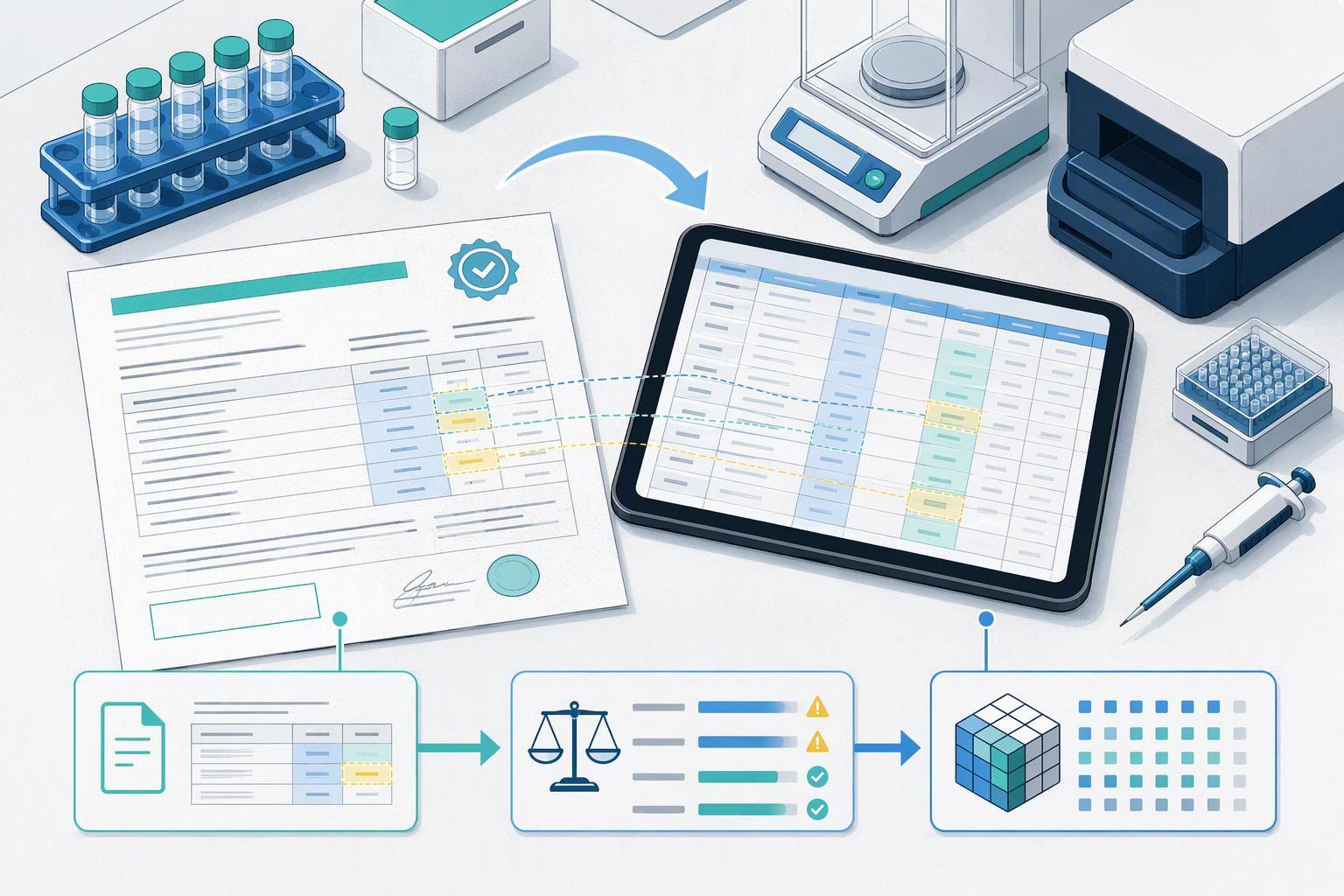
Ko te kitenga peptide kua reri AI te tikanga ka taea te panui i to putanga whakamatautau, i hanumihia ka whakamahia ano e tetahi tauira karekau he tangata e tuhi ano. Ko nga raraunga ka taea e te miihini te kawe i ona waeine, tauira tuakiri me te putanga tikanga i roto i nga mara hanganga hei utu mo te PDF, te wharangi pukatuhi ranei. Ko te huringa hoahoa-hanga-whakamatautau-ako ko te kohanga o aua tauira: raupapa hoahoa, whakahiato me te whakamatautau, whangaia nga hua ki muri, hoahoa ano.
E wha nga pou e mau ana i taua koropiko ki runga: nga raraunga whakamatautau pai ake, reproducible synthesis records, nga whakatakotoranga kua reri-whakamatautau me nga huingararaunga tātari. He iti ake te pae i te whakaaro o te nuinga o nga kapa. He aratohu kohikohi raraunga a Cradle mo te hoahoa pūmua ka whakatakoto i te hoahoa pūmua generative-ML ki roto i nga taiwhanga katoa ka taea te whakamatautau i nga wa katoa 96 nga rereke raupapa pūmua mo ia taonga, me te kii ko etahi tatini o nga raupapa kua whiriwhiria ma te mohio ka taea te ahu whakamua nui. I whakaputaina he aratohu mahi tino pai mo te miihini pūmua a ML E ai ki nga korero he iti ake te pupuri i nga huingararaunga ML hangahanga pūmua 1,000 wā, ko te take ka whakamahia e te whakamanatanga te 10-whakawhitinga whakamanatanga, kaua ki te wehewehenga kotahi.
Ko nga huingararaunga iti ka whiua nga rekoata pohehe. Ko te tātaritanga a GEN he aha i kore ai te mahi a AI ki te rapu raau taero e kii ana ko nga tauira i whangaihia he koretake, kāore i oti, Ko nga raraunga rangirua, he ngoikore ranei te whakahōputu ka ako i te haruru me te tohu, te whakaputa matapae maia engari iti ake te pono. He mea noa te tauira rahunga: nga waeine kua tuhia hei mg/mL i te oma kotahi me te µg/µL i te waa e whai ake nei, nga ingoa tauira kupu-kore utu e kore e taea e tetahi ki te hono tahi, kei te ngaro nga tautohu puranga, me te kore putanga o te tikanga whakamatautau, te waehere tātaritanga ranei. Any one of these stops a dataset from merging across runs.
The upstream cause is fragmentation, not carelessness. LabKey’s overview of practical assay data management describes assay data that lives in silos, on shared drives, in lab notebooks, or embedded in emails, with instrument heterogeneity across vendors and file types and no consistent format. Peptide data quality for AI models is therefore a records problem before it is a modelling problem.
Taketake Matua: A campaign that tests around 96 variants per property is already in generative-design territory. What disqualifies the dataset is inconsistent units, free-text sample names, missing batch IDs and unversioned methods, not the sample count.
Reproducible Synthesis Records and Assay-Reri Formats
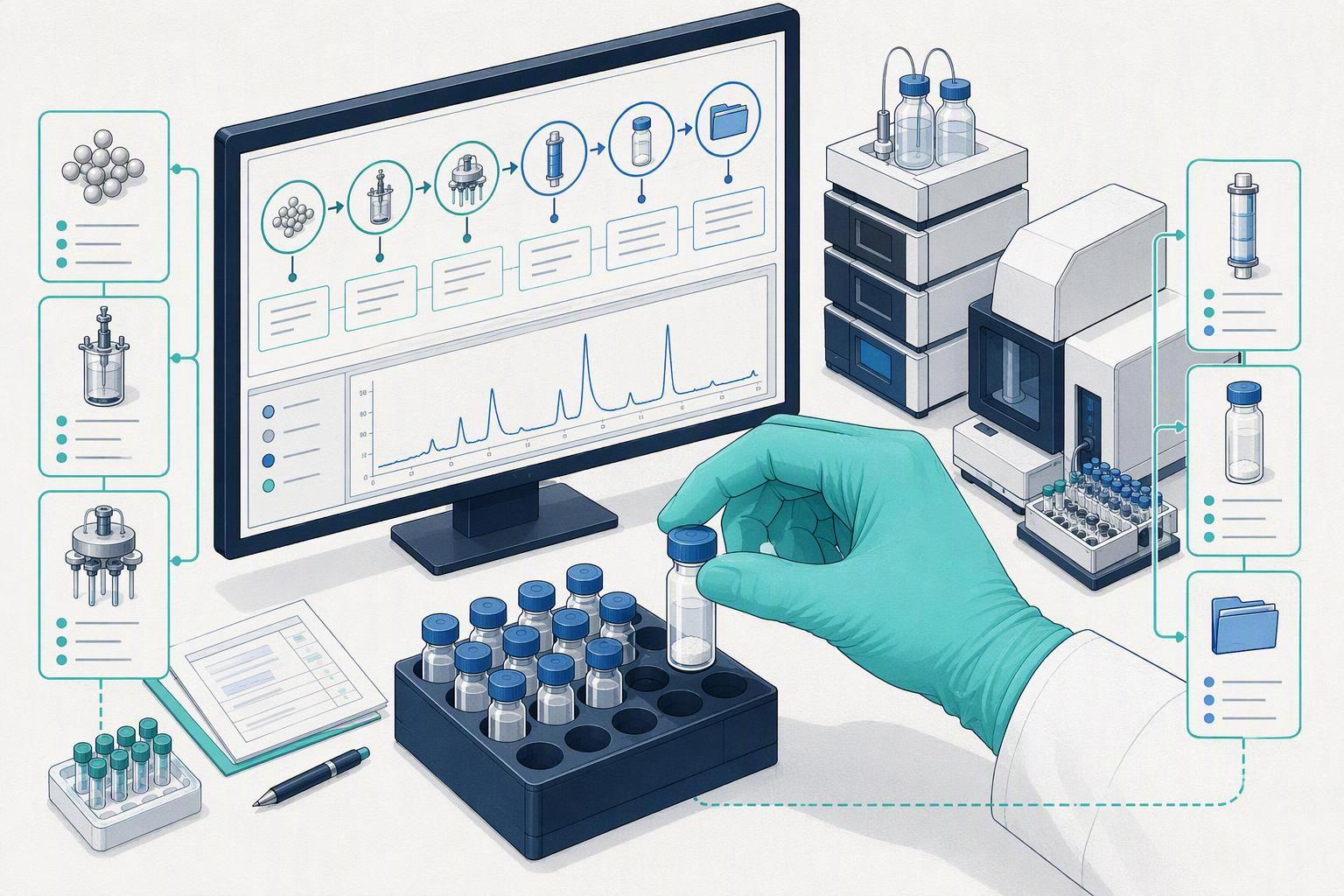
A certificate of analysis is not a reproducible peptide synthesis record. The unit of reproducibility is the lot file: te Ko te SPPS tuatahi a American Peptide Society describes a batch record detailed enough for a third party to recreate the run, covering resin type and loading, per-cycle deprotection and coupling with reagents and equivalents, wash steps and equipment. The standard manual Fmoc cycle it documents prescribes 20% piperidine/DMF deprotection (5 meneti, then 15 meneti) a 3 × 1 mL DMF washes per cycle. MOL Changes’ stage-by-stage chain-of-custody framework extends that into nine stages, from raw material sourcing and incoming qualification through synthesis lot records, isotope labelling traceability, analytical release and complete lot-file assembly, citing ICH Q7 for starting-material characterization and flagging a supplier who cannot name the resin lot or amino-acid source.
Assay-ready peptide data formats carry a parallel requirement. LabKey’s overview of practical assay data management identifies what recurs across CSV, JSON, AnIML and SDRF: stable identifiers for samples, files and runs; controlled vocabularies or ontologies; explicit units and datatypes; links between raw data, processed data and metadata; and open, long-lived formats. Identity confirmation by mass spectrometry is not purity determination by HPLC, and neither settles counterion or content questions such as TFA counterion exchange. ahau Q2(R2), whakaputaina 30 Noema 2023, requires an analytical procedure to be shown fit for its intended purpose under a predefined validation protocol, with the reportable range confirmed to include upper and lower specification or reporting limits, and extends those principles to mass spectrometry and other spectrometric data.
|
What a standard supplier package contains |
What a computational team needs |
|---|---|
|
CoA plus summary analytics |
Lot-linked records with stable identifiers |
|
Final purity and identity values |
Per-cycle synthesis detail and versioning |
|
Peptide 1 Static PDF or printed report |
Cyclic Peptide Synthesis Machine-readable tables with explicit units |
|
Certificate as the deliverable |
Provenance from raw Ratonga Peptide material to release |
No documentation standard removes the need Peptide 2 for orthogonal confirmation of hits.
He aha te tikanga o tenei mo nga Kaituku, Nga Roopu Tatau me nga Kaihoko
The announcement lands differently depending on where you sit. For the synthesizing supplier, documentation completeness becomes a differentiator rather than an afterthought. GenScript’s AIDD service page advertises sequence-to-data in as fast as 4 calendar days, 4000+ designs per day, 20M+ AI-ready data points generated per year, i raro $10 per data point, a 3500+ global partner organizations. Read it closely, ahakoa, and it names no peptides at all; its listed modalities are VHHs, miniproteins, IgG, bispecifics, enzymes and de novo proteins. Peptide chemistry is not yet the demonstrated centre of that pipeline, which is the opening for suppliers who can show it. Calcitonin Synthesis
For the computational team, the binding constraint is dataset size and metadata sufficiency. Published best-practice guidance on ML-assisted protein engineering treats 10-fold cross-validation as the norm on sub-1,000-instance datasets, which tells you how thin the training material usually is. TuneLab’s federated-learning design matters here: biotechs tap into Lilly’s models without directly exposing proprietary data. The non-obvious implication is that the Schrödinger LiveDesign integration means most teams will meet these models inside software they already run. The models are not the variable you control. The data you feed them is.
For the buyer or QC lead, “documented” already has a definition. The ten ALCOA+ data-integrity principles require records to be attributable, kitea, o naianei, taketake, tika, oti, riterite, mau tonu me te waatea, and the ICH Q2(R2) analytical validation guideline requires an analytical procedure to be shown fit for its intended purpose under a predefined validation protocol, with the revision extending those principles to mass spectrometry. A documentation-complete peptide delivery, in those terms, means a lot file where the sample identifier ties back to the batch, the assay version and units travel with the result, and the controls and error metrics are stated rather than implied. MOL Changes is one supplier whose analytical package is built around that chain, though no independent audit of its AI-specific data formats was found.
Four questions to ask of your own records today: Can a model read this table? Can a third party recreate this batch? Does this assay output carry identifiers and units? Can this dataset be merged with last quarter’s? Peptide 3
Me aha Inaianei me te Pikitia Nui
Start with the export, not the platform. Three actions, in order of urgency.
-
This week: audit one recent campaign’s assay export against your machine-readable field list and write down what is missing. Most teams find the gaps in an afternoon.
-
This month: add batch identifiers, wae, assay version and analysis-code version to the export template, and start versioning the assay method itself.
-
This quarter: request the full lot file, including resin lot and amino-acid source, before committing to a campaign. A supplier who cannot name the resin lot or the amino-acid source is a red flag.
Two things not to do. Do not rebuild a data platform before fixing the export format, and do not treat a CoA as a training-ready dataset.
The cautionary context is worth keeping in view. In a manual FAIR reusability audit of archived datasets, 45.9% of assessed open datasets were rated reusable, meaning 54.1% were not. In the energy-domain dataset audit, 82% of datasets had missing data in at least one key dimension and 27% were missing more than half. Figures of this type vary by source and domain, and they are cited here as an illustration of metadata loss rates, not as peptide benchmarks.
That is the bigger picture for AI-ready peptide discovery: evidence generation, not model capability, is becoming the rate-limiting step. Documentation standards are turning into a procurement criterion, and the labs that version their records now will be the ones whose data is still usable in three years.
Te taahiraa o muri: review the chain-of-custody documentation framework and use its nine-stage checklist to score your current lot files.
Whakaaturanga: MOL Changes publishes this blog as a peptide vendor.
Pātai Auau
Ka hipokina e te hononga GenScript–TuneLab nga peptides?
Kao. GenScript’s own announcement of the TuneLab agreement scopes the service to protein expression, te purenga me te tohu o nga raupapa kua whakaritea. Peptide synthesis is not named in that scope, so peptide teams should read the announcement as a signal about where AI-assisted discovery is heading rather than as a service they can buy today.
What does “AI-ready” data actually mean in practice?
It means five concrete properties: stable identifiers for every entity, controlled vocabularies instead of free-text fields, explicit units and datatypes, linked raw, processed and metadata files, and open long-lived formats rather than vendor-locked exports. LabKey’s overview of practical assay data management sets out these requirements for assay data. A file that satisfies them can be parsed by a model without a human rewriting column headers first. That is the whole test.
Kia pehea te nui o te huinga raraunga tātari peptide i mua i te awhina ako miihini?
Smaller than most teams assume, but not trivially small. Cradle’s data-collection guidance for protein design puts generative design at practical from around 96 variants per property. Typical protein-engineering datasets, he rereke, hold fewer than 1,000 instances and are validated with 10-fold cross-validation, as published best-practice guidance on ML-assisted protein engineering describes. The binding constraint is usually consistency across those instances, not their count.
Me tono ahau ki tetahi kaiwhakarato?
Ask for the full lot file, not the CoA alone. MOL Changes’ stage-by-stage chain-of-custody framework treats a supplier who cannot name the resin lot or the amino-acid source as a red flag, and asks for machine-readable analytical data alongside the certificate. If the assay-ready peptide data formats you receive cannot be loaded without manual transcription, the AI-ready peptide discovery pipeline stops at your inbox.
Whakamutunga
The GenScript-TuneLab partnership is a signal about how peptide evidence gets generated, not a peptide data standard. No independent test data published after 2024 was found that would let anyone treat the announcement as a settled specification, so the practical work stays where it always was: in the record your lab already produces.
That record has four requirements you can act on now. Clean data means fields a model can parse without manual repair. Reproducible peptide synthesis records mean lot-level traceability back to resin and amino acid sources. Assay-ready peptide data formats mean results that survive transfer between instruments and collaborators. Peptide analytical datasets for computational design mean the underlying measurements stay attached to the sequences they describe.
The next logical step is small and unglamorous: take one completed campaign, export it as it stands today, and check it field by field against a machine-readable specification. Whatever fails that audit is your AI-ready peptide discovery roadmap, and it will be more specific than any announcement.