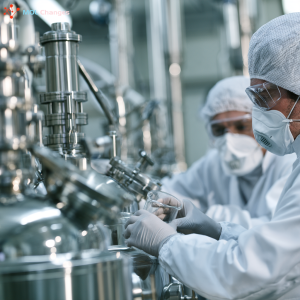
Por que o gargalo passou do modelo para a bancada
Um cocientista de IA é um sistema multiagente que gera e classifica hipóteses de pesquisa; a interface da bancada é tudo entre um candidato classificado e um frasco de material caracterizado. A capacidade do modelo ultrapassou essa interface, e a lacuna é onde os ganhos estão sendo perdidos.
As validações relatadas pelo próprio Google são a ilustração mais clara. Seu cocientista multiagente Gemini propôs candidatos de reaproveitamento de leucemia mieloide aguda que inibiam a viabilidade do KG-1 em concentrações clinicamente relevantes, alvos epigenéticos que mostraram atividade em organoides hepáticos humanos (p < 0.01), e um mecanismo cf-PICI/fago-cauda para resistência antimicrobiana (Pesquisa do Google, 2025-02-19). Leia as letras miúdas: o sistema produziu hipóteses, não materiais. Cada uma dessas reivindicações tornou-se uma reivindicação somente após o trabalho de laboratório úmido, e quando os primeiros resultados co-cientistas revisados por pares apareceram na Nature, a cobertura foi explícita que as validações de laboratório, não o modelo, carregar o peso probatório (Espectro IEEE, 2026).

O padrão se repete em todo o campo. Uma avaliação de seis estruturas de descoberta de agentes descobriu que nenhuma delas suportava totalmente qualquer uma delas. 15 classes de tarefas do mundo real, e tarefas específicas de peptídeos tiveram cobertura zero, com sistemas tendenciosos para representações de moléculas pequenas (revisar cobertura, 2026-02-13).
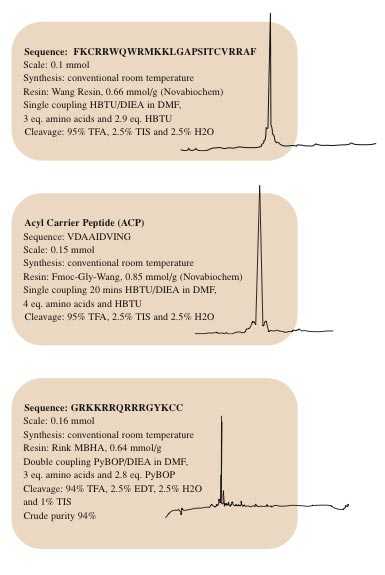
A camada física não é um erro de arredondamento. O mesmo 16-mer, seis resinas, uma propagação quíntupla em pureza bruta: estrela do bar[75–90] variou de 20% para 52% sem etiqueta solubilizante e 41% para 72% com uma ArgTag (Estudo de resina SPPS, 2025-11-21). A eficiência por etapa é composta da mesma maneira: 99% sobre 30 resíduos dá aproximadamente 74% rendimento global, 98% dá sobre 55%, e 95% dá sobre 21% (explicador de fabricação, 2026-07-24). Esse último conjunto é uma ilustração aritmética, dados de campanha não medidos, e números deste tipo variam de acordo com a fonte.

Principal vantagem: Um modelo que classifica bem os candidatos ainda entrega à bancada uma molécula cuja viabilidade de síntese, compatibilidade de modificação e confirmação analítica estão indecisas. A viabilidade da síntese de peptídeos projetada por IA é a restrição que define o que o loop pode realmente fornecer.
Síntese de Peptídeos em seis resinas de síntese, além de PS-2CTC em escala piloto, duas séries por resina (sem ArgTag / com ArgTag). Valores sem/com: 20/41, rastreamento/24, 45/72, 52/58, 51/64, 34/64, 27/50. Fonte: PMC12645436, 2025.]
A viabilidade de síntese é um filtro de design, Não é uma verificação post-hoc
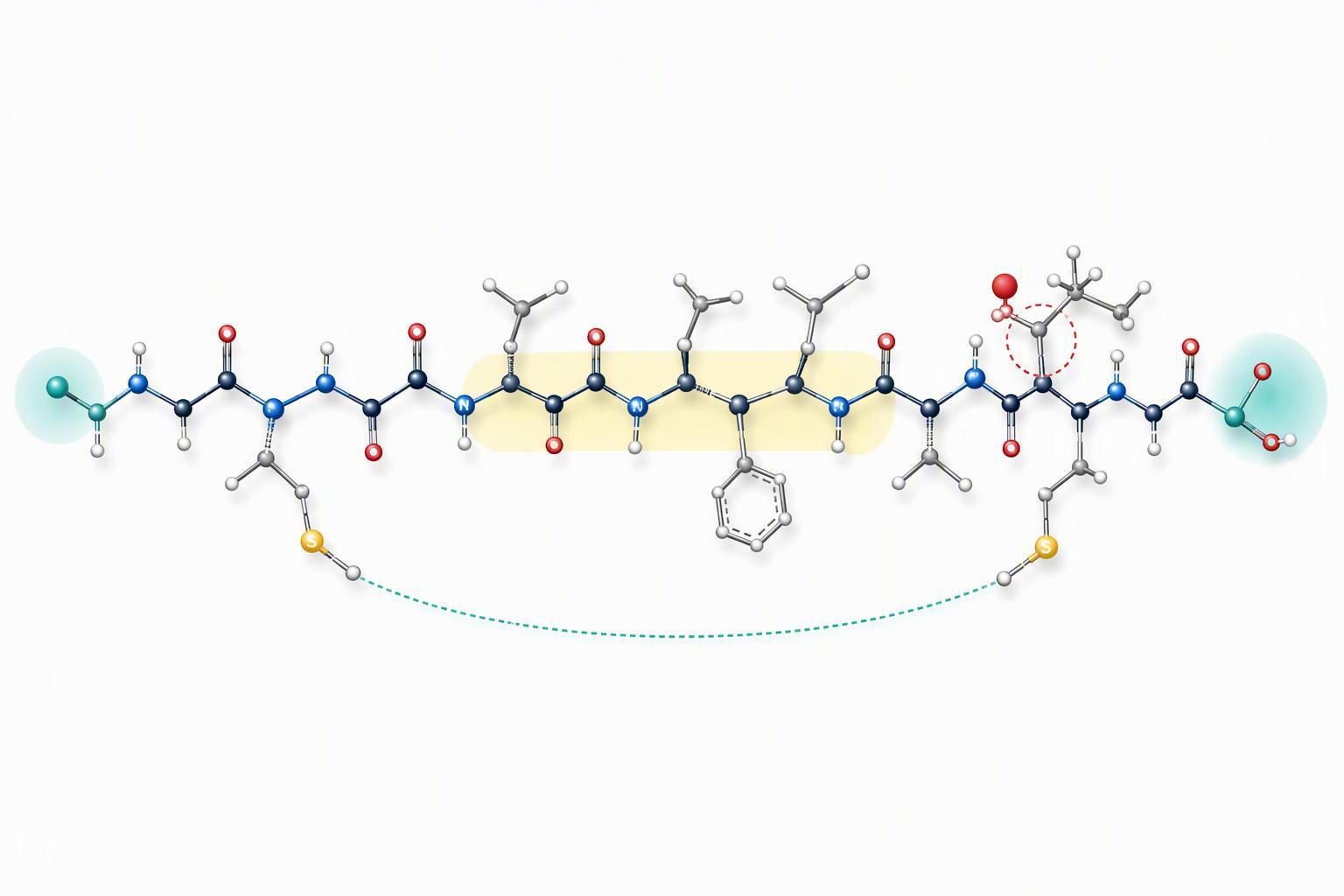
A viabilidade da síntese de peptídeos projetada por IA precisa identificar um candidato antes que alguém faça um pedido, não explicar a falha depois. Trate isso como um filtro de design: uma tela em nível de sequência executada na saída do modelo, no mesmo loop que a função de pontuação.
O teto prático para o qual a maioria dos químicos de síntese trabalha é curto. Acima aproximadamente 15 aminoácidos, produto bruto de fase sólida carrega um grande número de subprodutos de baixo nível, e esses subprodutos muitas vezes excedem o peptídeo alvo no produto bruto (Revisão prática do SPPS, 2025). Acima de 35–40 resíduos, O SPPS gradual deixa de ser o caminho certo e a condensação convergente ou a ligação química nativa assume o controle (mesma avaliação, 2025).
A aritmética explica por que. No 95% por passo, uma cadeia de 30 resíduos retorna cerca de um quinto da teoria; sobre 100 resíduos, um 1% perda por etapa deixa cerca de um oitavo da teoria (Explicador de síntese de peptídeos, 2026). Ambas as figuras são ilustração aritmética, dados de campanha não medidos.
As pontuações de sintetizabilidade ajudam aqui, com limites. SAscore was validated against chemist judgments at r² = 0.89 on forty molecules, a small set (RSC Chemical Science, 2025), and the literature frames such scores as early-warning proxies, not proof of manufacturability (Synthesizability filtering study, 2026).
Principal vantagem: Separate sequence-intrinsic feasibility problems (propensão de agregação, hydrophobic stretch, multi-disulfide topology, sterically hindered coupling) from route-dependent ones (protection strategy, escolha de resina, cleavage and purification conditions). The first is a design constraint; the second is a process choice.
As restrições de modificação pertencem à etapa de geração
Peptide modification constraints are a generation-time input, not a purification-time surprise. The intended chemistry and the real synthesis route have to be checked against each other before a model commits to a candidate, because a structure-only score cannot see the route. The models are still fitting patterns, not physics: peer-reviewed reviews of multi-agent peptide-design frameworks report that these systems are limited by sparse high-quality experimental data, weak handling of flexible and disordered peptides, and reliance on statistical patterns rather than physical chemistry (Briefings in Bioinformatics, 2024; Comunicações Químicas, 2026).
That gap is where a compatibility check earns its place. A candidate carrying lipidation, cyclization or a fluorescent tag should be run against a modification menu that covers the intended chemistry before an order is placed, not after a failed Peptídeos Sintéticos muito. In practice this is a short exchange: sequence in, intended modification named, route and feasibility read back. Where the menu stops, a capable CDMO or specialist supplier is the honest answer, and the arbiter is still the experiment.
Uma leitura não é confirmação
Orthogonal analytical confirmation of peptides means using methods whose physical basis for separating or identifying a molecule is genuinely independent, not two runs of the same principle. A single reverse-phase HPLC trace tells you the lot elutes as one peak; it does not tell you what that peak is. The FDA’s own list of deficiencies in comparative peptide filings expects orthogonal chromatographic methods with different separation principles alongside UHPLC-HRMS/MS to confirm peak identity (FDA comparative-peptide-analysis guidance, 2022-09-20). Eu Q2(R2) sets the validation characteristics per procedure type and allows specificity to be demonstrated against a second, well-characterized procedure, including an orthogonal one (Eu Q2(R2), 2023-11-30). Q6B sets specifications from manufacturing-consistency lots, which is why acceptance criteria belong to the lot, not to the assay (Eu Q6B).
|
Impurity level |
Serviços Action required |
|---|---|
|
≥0.10% |
Report |
|
≥0.5% |
Identify |
|
≥1.0% |
Qualify |
|
>0.5% new impurity vs. reference product |
Not acc Comprar eptable |
Thresholds per the FDA guidance (2022-09-20) e o EMA synthetic-peptide guideline (2025-12-04).
The recurring bench pattern: a candidate ranks well in silico, synthesizes as a low-recovery crude, purifies poorly, and yields a lot whose single-method readout looks acceptable while the orthogonal method disagrees.
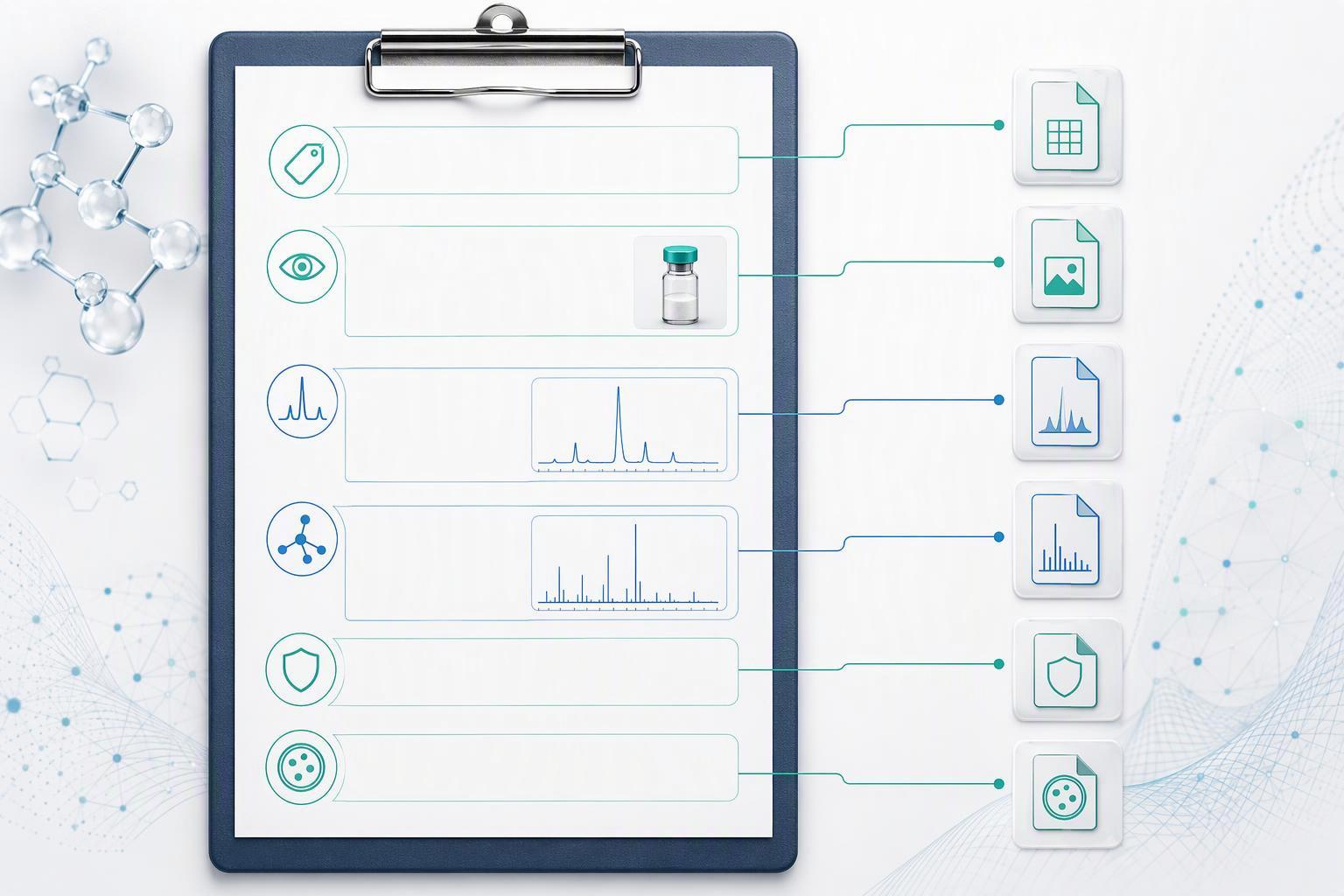
Identity and purity documentation should be traceable to raw data files per lot, and a CoA without the underlying chromatogram and mass spectrum is not verifiable. Produção de Peptídeos
A comparabilidade de lote é uma entrada do projeto
Peptide batch-to-batch comparability is the ability to show that two lots of the same sequence meet the same specification, and it is decided long before QC opens a vial. A specification is not a purity number; it is tests, procedures and criteria, and the same thresholds apply lot to lot (FDA guidance on endotoxin limits). Route and resin choices are comparability variables: in a 2025 SPPS study, one sequence gave 27% crude purity on high-loading PS-2CTC resin at 0.75 mmol/g, rising to 50% no 0.69 mmol/g with the tag, while apolar PSAM-RAM gave roughly 20% and MBHA-RAM only trace product (same SPPS resin study). By-products fall into deletions, terminations and chemical modifications, and their profile shifts with the route.
No published 2025–2026 dataset gives a numeric lot-to-lot purity distribution for complex modified peptides versus simple linear peptides. What the record does fix is the release layer: sterility takes 14 days in two media at two temperatures before a sterility result exists, with no growth in either medium required (FDA Pharmaceutical Microbiology Manual), and endotoxin is judged against the 5 EU/kg parenteral limit, calculated as K/M (FDA guidance on endotoxin limits). A per-lot documentation set records lot number, appearance, purity by HPLC with chromatogram, identity by MS with spectrum, and endotoxin and sterility results, each traceable to its raw data file.
A taxa de loop é definida por recuperação analítica, Não velocidade de inferência
The design-test-learn cycle for peptide discovery, the loop where a candidate is designed, synthesized, tested and fed back into the next round, is gated by calendar time on the bench, not by inference speed. In AI-driven small-molecule discovery, a design-make-test-analyze iteration commonly runs 4 para 8 semanas, while peptide service quotes put standard synthesis at 1 para 3 weeks and modified or longer peptides at 2 para 6 semanas, with primary assay turnaround of 3 para 5 dias, 5 days with ADME, and under 10 days with in vivo PK (BioIndustry Association, recuperado 2026-09-12). Those are vendor and service-level statements, not a controlled benchmark. AstraZeneca’s under-5-day design-to-test-data target and sub-2-hour prototype cycle show what the same loop looks like when the wet-lab steps are engineered for speed (IRBM, recuperado 2026-09-11).
The calendar time a synthesis request actually consumes follows the same shape: standard peptides of 2 para 30 amino acids at above 80% purity typically arrive in 10 para 15 dias úteis, express orders in 5 para 7 dias, and complex or multiply modified sequences in 3 para 4 semanas. Shortening the loop means buying back those weeks, not shaving milliseconds off a model run.
Mas os modelos serão projetados em torno da química - já não é??
Partly, and the concession matters. SAscore-class synthesizability filters are standard practice, and the 2025–2026 literature treats accessibility scores as useful early-warning proxies. But the same literature is explicit that they are proxies, not proof of manufacturability, with the physical experiment remaining the arbiter. The proxy is also thinner than its reputation: SAscore was validated on forty molecules, and it is structure-only rather than route-based. On the model side, a review of six agentic frameworks found zero peptide-task coverage across six frameworks, with a bias toward small-molecule representations, and the underlying scoring is largely fitting patterns, not physics. Better filters raise the hit rate. They do not remove feasibility, modification compatibility, orthogonal confirmation and comparability as design inputs.
Próximas etapas: Trate a interface como a superfície de design
AI-designed peptide synthesis feasibility, modification compatibility, orthogonal confirmation and batch comparability are design inputs, not downstream checks, and the loop rate is set by analytical turnaround rather than inference speed. The starting sequence is short. Screen candidates against sequence-intrinsic feasibility rules before you order anything. Check the intended modification against the route that will actually run it. Require orthogonal confirmation with per-lot raw-data traceability. Specify comparability criteria in the order itself, not in a follow-up email after the first lot arrives.
MOL Changes is a specialized peptide R&D organization integrating organic chemistry and biology, offering custom synthesis from sequence design to large-scale production, with production in Class 100 ultra-sterile cleanroom environments and QC by MS, HPLC, AAA, endotoxina, contraíon, optical rotation and UV content. MOL Changes has a commercial interest in peptide quality standards. Development-stage material characterization is not a clinical claim, and formulation or dosing decisions belong with qualified professionals.
Send a sequence for a feasibility read. You get a route assessment and a realistic timeline before you commit to an order, which is the cheapest way to find out whether a candidate can exist in a vial. Sobre
Perguntas frequentes
Don’t synthesizability filters already solve this?
Partly, and that is the honest answer. Filters are useful proxies, not certificates. A 40-molecule validation set showed that predicted synthesizability and bench outcomes diverge often enough that a filter can rank candidates but cannot clear one. Treat a passing score as permission to try, never as evidence the molecule exists.
Nosso programa já está comprometido com candidatos que reprovam na viabilidade. Agora o que?
Re-sequence the route before you re-design the molecule. By-product accumulation becomes the dominant constraint above roughly 15 resíduos, and the route itself changes above 35 para 40 resíduos, where convergent ligation starts to pay. Many “infeasible” sequences are feasible on a different assembly strategy.
Won’t models simply get better and design around chemistry?
Capability is improving; coverage is not. Six major evaluation frameworks contained zero peptide coverage, so the frameworks were not evaluated on peptides. Better models help, but peptide modification constraints are physical, not informational, and no benchmark currently measures them.
A comparabilidade de lotes é importante em escala de pesquisa, ou apenas na fabricação?
It matters as soon as two lots feed one experiment. Comparability is a specification question: define impurity thresholds and the analytical methods that measure them before you compare results across lots, not after a replicate disagrees.