Etapa 1: Separe os testes de identidade dos dados de pureza
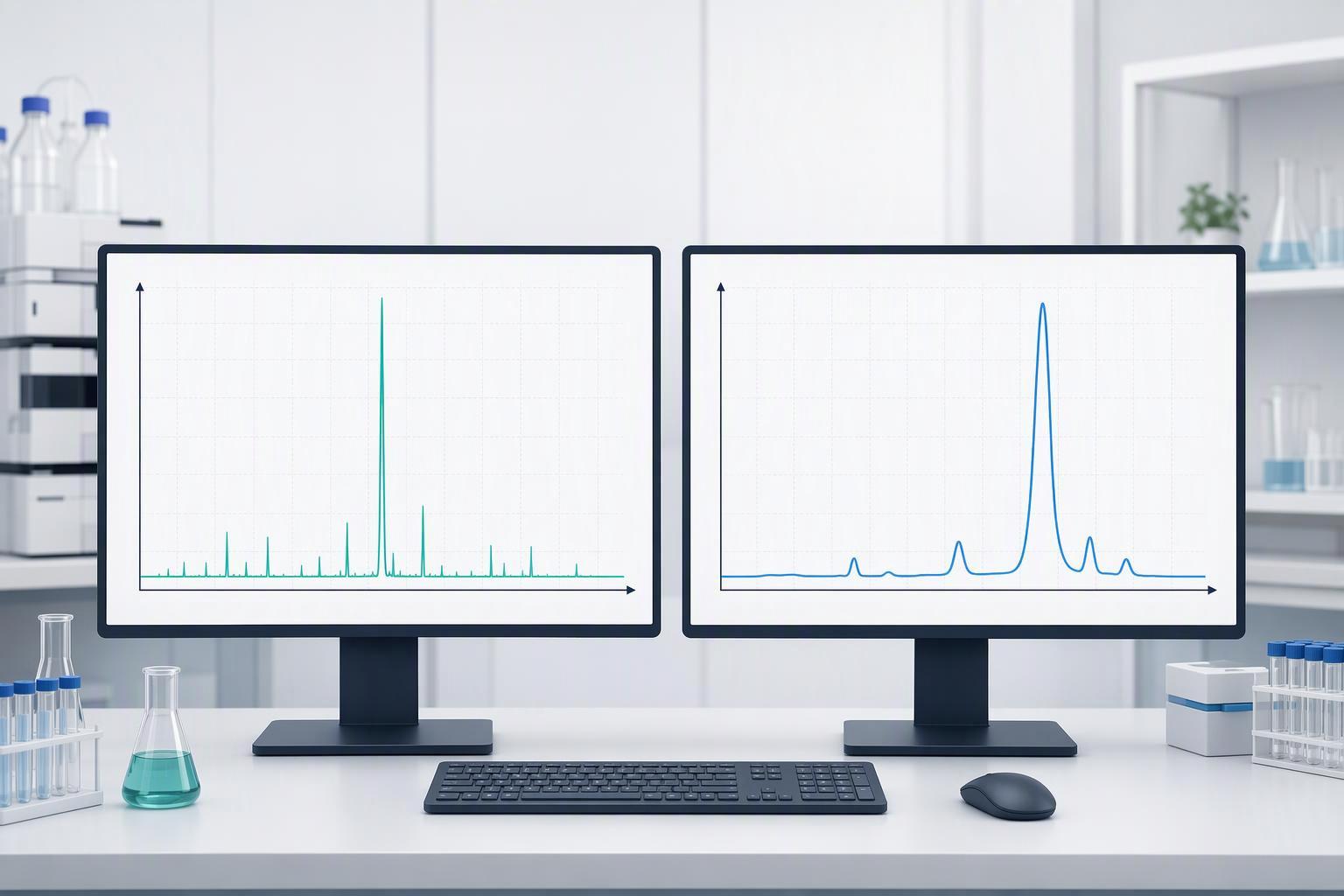
Identidade e pureza são questões analíticas separadas, e um fornecedor que respondeu apenas uma delas não respondeu nenhuma. A identidade pergunta qual é o material: requer específico, confirmação ortogonal, como espectrometria de massa, LC-MS/MS, análise de aminoácidos, RMN, mapeamento de peptídeos, ou retenção de HPLC em relação a um padrão de referência (Trabalho padrão de referência da USP, 2023). A espectrometria de massa separa as moléculas pela razão massa-carga e relata um peso molecular; LC-MS/MS adiciona uma etapa de fragmentação que lê informações de sequência. Pureza é uma medida totalmente diferente: quantifica o peptídeo alvo em relação a impurezas e substâncias relacionadas, e não diz nada sobre se o alvo é a molécula certa.
Essa lacuna é o modo de falha que vale a pena nomear. Um composto pode ler 99% puro por HPLC e ainda ser o peptídeo errado, porque um valor de alta pureza não é evidência de identidade. Em testes de pureza BPC-157, um cromatograma limpo confirma que uma espécie domina a amostra, não que a espécie seja BPC-157.

A pureza é calculada a partir da área de pico integrada: área de pico alvo dividida pela área total de pico integrada, multiplicado por 100. A convenção assume HPLC de fase reversa em uma coluna C18 com detecção UV em 220 nm, o comprimento de onda onde as ligações peptídicas absorvem (Documentação de qualidade do peptídeo GenScript).
O que verificar: o pacote de documentação contém um método de identidade (EM, LC-MS/MS, ou equivalente) relatado separadamente do método de pureza, ou apresenta uma única porcentagem de pureza como toda a história analítica?
Comprar =”https://molchanges.com/wp-content/uploads/2026/10/pub_20261002_013927_165_11203be2c7974a76b7f4d56fce8c9749.png”>
Etapa 2: Leia uma reivindicação de pureza para seu método, Muito, Laboratório, e data
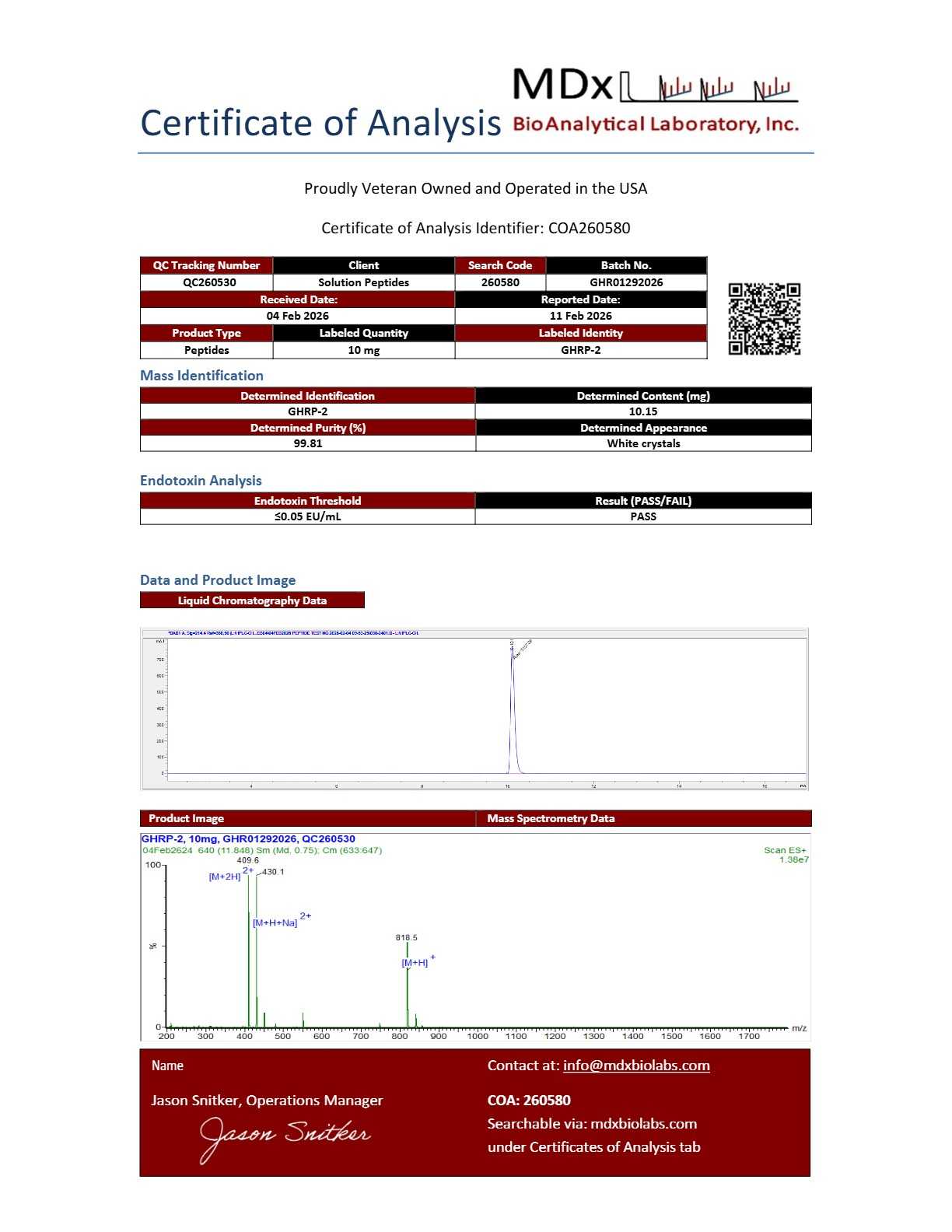
Porque identidade e pureza são questões separadas, uma porcentagem de pureza só se torna evidência quando o método, número do lote, laboratório de testes, e data de análise viajam com ele. Esses campos são o núcleo da maioria dos requisitos de certificados de análise de peptídeos.
Síntese de Peptídeos Comece com o método. Um resultado defensável de HPLC-UV de fase reversa nomeia seu comprimento de onda de detecção, coluna, e gradiente, e declara o padrão contra o qual foi validado. O método publicado por um laboratório contratado usa um C18 5 µm, 4.6 × 250 coluna de mm com gradiente água/acetonitrila contendo 0.1% TFA ou ácido fórmico, lê principalmente em 214 nm com um 280 canal secundário nm, relata impurezas até 0.1% da área total do pico, e é validado para ICH Q2(R1) e USP <621> (Teste de laboratório ACS, recuperado 2026-01-01). Esse é um método HPLC documentado, não apenas uma porcentagem. Se um CoA disser “≥98% (HPLC)”e para por aí, você não pode dizer se o número veio de um método validado ou de uma única injeção em um sistema não calibrado.
A segunda distinção é mais importante do que a maioria dos compradores espera: um valor percentual de área UV não é o conteúdo líquido de peptídeos por peso. USP atribui pureza de peptídeos por balanço de massa, medindo todas as classes de impurezas detectáveis, incluindo impurezas relacionadas a peptídeos, contra-íon, água, solventes residuais, e resíduos não combustíveis, e subtraindo o total de 100% (Trabalho padrão de referência da USP, 2023). Porque a pureza percentual da área UV não mede contra-íons, TFA ou sais de acetato, teor de água, ou solventes residuais, uma alta porcentagem de área pode coexistir com um conteúdo líquido de peptídeo em peso substancialmente menor.
Em seguida, verifique o lote e a data em relação ao seu próprio pedido. Um valor de pureza pertence a um lote testado em uma data, não para uma linha de produtos. Quando você escala de miligramas para gramas, solicite o CoA do Peptídeos Sintéticos muito que você está realmente recebendo, e compare sua data de análise com a data de envio. Um CoA datado dezoito meses antes do envio descreve um lote de material diferente daquele na caixa.
Como é o fracasso: um CoA com uma porcentagem de pureza, nenhuma linha de método, sem data de análise específica do lote, e sem cromatograma. Você não tem como saber se o valor foi medido, estimado, ou copiado de um lote anterior.
Etapa 3: Solicite o Pacote de Documentação e Confira no ALCOA+
Depois de saber quais campos uma declaração de pureza precisa, o próximo passo é solicitar o pacote completo, porque um CoA não é um documento único. É um pacote, e o pacote é o que você inspeciona.
Solicite esses campos antes de avaliar qualquer outra coisa: número do lote, data de fabricação, data de análise, laboratório de testes, método analítico, cromatograma ou referência de rastreamento, resultado de identidade de espectrometria de massa, condições de armazenamento, e uma declaração explícita do que foi não testado. That last field is the one most suppliers omit, and its absence tells you more than its presence would. These are the core peptide certificate of analysis requirements a qualification reviewer works through.
Judge the package against the ALCOA+ data-integrity attributes, which require records to be attributable, legível, contemporâneo, original and accurate, plus complete, consistente, enduring and available. The five original attributes trace to FDA CGMP guidance finalized in December 2018; MHRA’s GxP data-integrity guidance, Revision 1 (Marchar 2018), added the remaining four. Contemporaneous is the test that catches most weak packages: an analysis date reconstructed months after synthesis fails it.
A lot-specific package from MOL Changes illustrates the inspectable form: an analytical report tied to a named lot, with traceable quality data for research and industrial use. MOL Changes operates Class 100 ultra-sterile cleanroom production with in-house HPLC, MS and sterility testing, and manufactures custom and catalog peptides from milligrams to kilograms.
⚠️ Aviso: a CoA is produced by a party with an interest in the result; independent third-party testing is what raises its evidentiary weight.
Etapa 4: Aplicar controles de uso pretendido como critério de qualificação
Documentation tells you what was tested; intended-use controls tell you what the supplier believes the product is for. Research use only peptide labelling is not boilerplate, and treating it as boilerplate is how buyers end up qualifying a consumer-facing seller. RUO designates a product manufactured and sold for laboratory research, whether that is in vitro studies, animal testing, química analítica, or preclinical investigation. Such products are not made under pharmaceutical GMP, have not undergone the testing required for human use, and carry no regulatory approval (Peptide Journal, 2025).
The label alone decides nothing. Under the FD&Ato C, intended use, not the disclaimer, governs: a peptide marketed or intended for the diagnosis, cura, tratamento, or prevention of disease in humans is a drug under federal law regardless of what the label says. FDA weighs labeling and packaging, advertising and marketing, and the totality of evidence (Peptide Journal, 2025).
So read the whole storefront, not the product page. A supplier that publishes dosing guidance, human-use testimonials, or before-and-after claims has told you its intended market, whatever its footer says. A supplier whose materials stay on analytical and laboratory ground has separated research-grade from consumer-facing product.
Nothing in this guide is medical or dosing guidance, and no product referenced here is offered for human use.
Etapa 5: Teste se o fornecedor se comunica de forma transparente
Transparency is the criterion most suppliers fail, because it costs them something to pass. A supplier that communicates well will tell you what its documentation does not prove, name the laboratory that ran the tests, and publish dated lot records instead of a single undated purity figure.
Three pass/fail signals carry most of the weight in research-grade peptide supplier verification:
-
States the limits of its own documents. A passing supplier says plainly that a certificate of analysis (CoA) confirms identity and measured purity for one lot, and does not establish sterility, níveis de endotoxina, or suitability for any clinical use. A failing supplier lets the CoA imply more than it shows.
-
Names the testing laboratory. A passing supplier identifies the lab and whether it is in-house or independent. A failing supplier writes “third-party tested” with no lab named, which is a claim, not a record.
-
Publishes dated lot records. A passing supplier shows lot numbers with analysis dates you can match to your shipment. A failing supplier shows one purity number with no lot and no date.
Para dica: ask for two CoAs from different lots of the same peptide and compare the impurity profiles, not just the headline purity figure.
A useful category observation: across the supplier pages reviewed for this guide, none taught readers how to read a CoA, what a passing versus failing result looks like, or how to spot a forged or duplicated CoA. The top-ranking supplier page also carried no page-level publish or update date. Treat an undated page as a signal in itself, and ask the supplier directly when the record was last updated.
Etapa 6: Coloque os cinco critérios em um fluxo de trabalho de qualificação de fornecedores

Run the five criteria as a sequence, not a checklist you sample from. Identity confirmation comes first, because a purity figure for the wrong molecule is meaningless. Purity review follows, then the documentation package, then intended-use controls, then transparency. A supplier that fails any stage is rejected at that stage; you do not carry it forward to see whether the rest looks better.
The reason to run your own sequence rather than accept a supplier’s self-reported pass rate is that the published failure figures are narrower than they appear. Third-party testing programs have published tens of thousands of results, incluindo 9,997 peptide vials submitted for analysis, of which BPC-157 accounted for 756 tests across 110 vendors (peptidesbeat.com report on the Finnrick dataset, dataset updated 2026-09-03). The widely repeated claim that roughly one in three samples fail basic expectations comes from that same single dataset, self-reported and not peer-reviewed, and the proportion has held stable over 12 para 14 months of reporting on the gray-market peptide boom. One dataset, echoed across outlets, is not independent corroboration.
That is the case for peptide supplier due diligence as a buyer-side control. Research-grade peptide supplier verification is something you perform against artifacts you inspect, and no documentation package substitutes for it. Produção de Peptídeos
Erros comuns a evitar
Accepting a high purity figure as proof of identity. UM 98% HPLC result says the main peak dominates the chromatogram; it does not say the peak is the right molecule. Identity comes from mass spectrometry, where the observed molecular weight matches the designed construct. Suppliers blur the two because a single purity number is easier to market than a two-part analytical story. Ask for both, and check that the identity method names the expected mass.
Treating a UV area-percent number as net peptide content by weight. UV detection at 214 nm responds to the peptide backbone, so the percentage reflects relative peak area, not how much peptide sits in the vial. Residual counterions, water and salts are invisible to the detector but very present on the balance. This is the most common gap in peptide certificate of analysis requirements: um valor percentual de área UV não é o conteúdo líquido de peptídeos por peso, and a supplier who presents it as such has either misunderstood the assay or is counting on you to.
Listing assays without showing what a pass or fail looks like. Across the supplier pages reviewed for this guide, chromatograms and spectra appear as decoration rather than as results with stated acceptance criteria. A specification you cannot compare against a reported value is not a specification.
Leaving pages undated. An undated CoA or specification page cannot be tied to a lot, a method revision or a testing laboratory, which undermines the traceability the document exists to provide.
Principal vantagem: a purity figure without a method, muito, laboratory and date is a claim, not a measurement.
Perguntas frequentes
Como posso diferenciar um CoA forjado ou duplicado de um genuíno?
Check that the lot number on the certificate matches the lot on the vial label and packing slip, then look for a chromatogram or spectrum specific to that lot rather than a figure reused across products. A document that names no testing laboratory and no analysis date, or whose chromatogram reappears under a second lot number, is unverified. Requesting the raw data file behind the report is the strongest check available. Sobre
Can I verify a supplier’s claim that a third party tested its peptides?
Partly. You can confirm the named laboratory exists, offers the cited method, and issues reports in that format. What the document cannot show is that the sample submitted came from the lot you received. That gap is not hypothetical: reporting on the gray-market peptide boom found that about a third of the thousands of products analysed failed basic quality checks, a proportion broadly unchanged over the 12 para 14 months of data gathering. Independent testing of a retained sample from your own receipt is the only way to close it.
O que devo fazer se um CoA reportar pureza sem cromatograma ou correspondência de lote?
Ask for the missing artifacts before evaluating the number. A purity figure without a method, a lot identifier, and a supporting chromatogram cannot be traced to anything, so it functions as a marketing statement rather than analytical evidence. Note also what a purity figure is not: the FDA’s peptide dossier guidance sets at least one peptide-related impurity threshold of 0.10% of drug substance for impurity characterization, a characterization requirement and not an identity proof. Meeting your peptide certificate of analysis requirements means holding identity, pureza, and lot traceability as separate records, not one headline percentage.
Does a research-use-only label change a supplier’s legal position?
It shifts the framing rather than settling the question. A research-use-only label states the product’s intended application, and regulators assess the supplier’s conduct against that intent. As one legal analysis of the gray area puts it, intended use, not the disclaimer, governs. Na prática, research use only peptide labelling is a qualification signal: a supplier that consistently separates research-grade material from consumer-facing product, and publishes no dosing or human-use guidance, is easier to qualify than one whose marketing contradicts its own label. This is not legal advice; consult counsel for your jurisdiction.
Conclusão
The five criteria are one habit: separate identity from purity, read every purity claim for its method, muito, lab and date, check the documentation package against ALCOA+, treat intended-use controls as a qualification gate, and watch how the supplier answers an awkward question. Peptide supplier due diligence is not a one-time audit but the practice of preferring a supplier whose artifacts can be inspected over one whose claims can only be believed. A lot-specific CoA that names the testing laboratory, the analytical method and the analysis date gives you something to file, compare across batches and hand to a colleague; a purity percentage with none of that context gives you nothing to check.
If you want to run the framework against a real package, request a sample CoA package or talk to a technical specialist. Both are low-commitment steps that let you test the documentation before any purchasing decision.
Disclosure: MOL Changes has a commercial interest in peptide quality standards and supplies research-grade peptides with lot-specific analytical documentation. Nothing in this guide is medical or dosing guidance, and all products discussed are for research use only.
Reviewed by the MOL Changes technical team. Consult a qualified professional before making decisions about research materials.