Regelbilden förändrades enligt ett daterat schema, och varje steg dokumenteras. Den juli 23, 2026, de FDA:s mötessida för Pharmacy Compounding Advisory Committee listade BPC-157 (fri bas) och BPC-157-acetat för granskning mot användningen av ulcerös kolit, med informationsmaterial som föreslår ämnena inte läggas till i 503A Bulks List. Utskottet röstade 8–6 med en nedlagd röst för att rekommendera att de ändå skulle läggas till, som McDermotts läsning om PCAC-resultatet uppgifter.
Den omröstningen legaliserar inte sammansättning. FDA sa till mötet att det "sällan avviker" från PCAC:s rekommendationer, men det sista tillägget kräver regler för meddelanden och kommentarer som kan hamna i 2027 eller sträcker sig över flera år. Tills dess, BPC-157 sitter utanför kategori 1 och av den slutliga 503A Bulks List.
Verkställigheten väntade inte på regelgivningen. Fem CDER-varningsbrev daterade i augusti 24, 2026 gick till online-peptidförsäljare, och alla fem hävdade "endast forskningsanvändning" medan deras webbplatser hade doseringsinformation, injektionsinstruktioner och dosräknare. I juni 2026, Alabama Medical Board hindrade separat läkare från att blanda, administrering eller dispensering av forskningsklassade peptider till patienter.
Varför märkning endast för forskning inte är en förvaltningsstrategi
Research-use-only är ett uttalande om avsedd användning, inte en juridisk sköld. FDA kan fortfarande hitta ett icke godkänt nytt läkemedel där en leverantörs webbplats som helhet visar mänsklig användning, under avsnitt 201(g)(1) och sektioner 301(d) och 505(a) av FD&C Act, som Arent Fox Schiff förklarar i sin september 18, 2026 analys av augusti 24, 2026 varningsbrev. Dessa brev var ren ogodkänd-ny-drogtillämpning, och samma analys tillämpar en nettovisningsstandard: säkrat marknadsföringsspråk kan fortfarande göra en produkt felmärkt om den övergripande marknadsföringsbilden innebär mänsklig användning.
Den distinktionen är hela forskningsanvändningen endast kontra terapeutiska påståenden. En etikett styr inte vad den omgivande sidan, produktfotografering, doseringsspråk, eller kundrekommendationer kommunicerar.
Felläget är förutsägbart. En leverantör stämplar RUO på flaskan, publicerar sedan en sida som läser som en konsumentproduktlista, och etiketten slutar göra något arbete. Styrning innebär att kontrollera etiketten, granska anspråk före publicering, kontrollera vilka kanaler som bär produkten, och ta in rapporter om biverkningar snarare än att kassera dem.
Vad ett batchspecifikt analyscertifikat bevisar och vad det inte gör
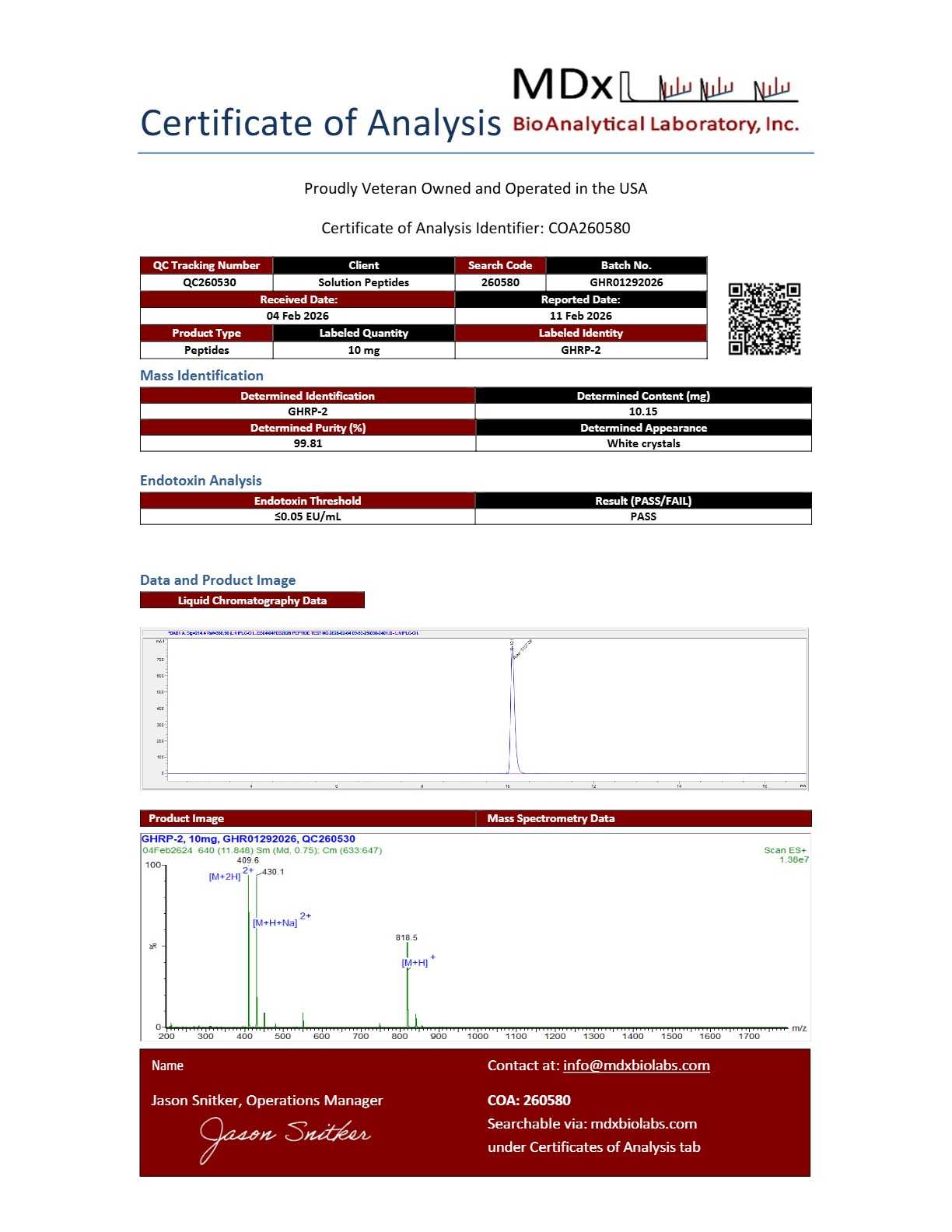
Ett batchspecifikt analyscertifikat för forskningspeptider är det minsta dokument som en leverantör bör kunna ta fram, och det är det dokument som oftast misstas för kvalitetsbevis. Det bevisar att någon testat ett namngivet parti och registrerat ett resultat. Det bevisar inte vem som gjorde testet, vilken metod de använde, eller om materialet i flaskan matchar materialet på etiketten.
De 2024 multifaktor kvalitets- och säkerhetsanalys av semaglutidprodukter från illegala onlineapotek, publiceras i Journal of Medical Internet Research, testade tre flaskor köpta från online-säljare. Uppmätt semaglutidhalt överskred den märkta mängden med +28.56%, +38.69% och +33.58%, mot +5.05% för en referens Ozempic 1 mg penna (JMIR, 2024). The same three lyophilized samples were devoid of viable microorganisms at the time of testing, which shows how narrow a single passing result is: a clean microbial count says nothing about how much active material the vial contains.
Scope matters here. Three vials, one compound, purchased from online sellers, tested in 2024. The finding is not generalizable to every gray-market product, and it does not describe supplier-issued CoAs in general. It shows what a label figure and the physical material can separately be.
Gränserna för HPLC-renhetstestning för peptider
A 98% eller 99% HPLC purity figure measures one method under one set of conditions. It is not a statement about what else is in the vial. De documented limits of single-method HPLC purity determinationare structural rather than incidental: co-eluting impurities can hide under the main peptide peak, and UV detection near 214 till 220 nm misses species that absorb weakly or not at all, including sugars, glycols, lipider, salts and buffer residues (PMC, “HPLC Analysis and Purification of Peptides”; the article is undated, retrieved for this review).
The number is also method-dependent. Kolumnkemi, lutning, mobil fas, detekteringsvåglängd, flow rate and integration parameters all shape the result, so two laboratories can report different purities for the same lot without either being wrong.
That is why a purity percentage establishes neither identity nor safety. Orthogonal mass-spectrometric confirmation is what ties the peak to the intended sequence, and it says nothing about residual trifluoroacetate counterion content, kvarvarande lösningsmedel, water content or bioburden. Those are separate measurements, reported separately, or not reported at all.
Endotoxin och sterilitetsdokumentation: Två olika frågor
A supplier that reports “sterility tested” has answered one question and left another open. Endotoxin and sterility documentation for research peptides are two separate records, and a lot can pass one while failing the other. USP <85> bacterial endotoxins testing, usually run as a Limulus amebocyte lysate (LAL) analysera, is quantitative for endotoxin only, reported in endotoxin units (EU) or EU/mg, and it does not detect viable microbes. USP <71> sterility testing is growth-based instead: the standard’s described method uses membrane filtration or direct inoculation into two media, fluid thioglycollate and soybean-casein digest, incubated for not less than 14 dagar, with the primary USP <71> document as the authority to check rather than a lab summary.
That distinction matters because a clean endotoxin figure is not a clean lot. In the three BPC-157 vials tested by researchers and published in JMIR, endotoxin ranged from 2.1645 till 8.9511 EU/mg, which is a quantitative endotoxin result, not a sterility result.
Key Takeaway: LAL versus USP <71>
| Metod | Detects | Cannot detect | | LAL (USP <85>) | Endotoxin, quantitatively, in EU or EU/mg | Viable bacteria, fungi, or any non-endotoxin contaminant | | Sterilitet (USP <71>) | Viable microorganisms that grow under the test conditions | Endotoxin, and any organism that does not grow in the two media used |
A lot-matched result requires both tests run on the same lot number, with the lot number printed on each report.
Ett ramverk för kvalitet och styrning av peptidleverantörer
A peptide supplier quality and governance framework is a set of auditable evidence requests, not a certificate you file once. Each dimension below works the same way: you request a specific record, it proves one bounded thing, and past that boundary it proves nothing. Run the six dimensions as a checklist before qualification and at every re-qualification.
Audit report or questionnaire response, ISO 9001 omfattning, site and contact details
The quality system behind the batch exists and can be inspected
Nothing about the specific lot’s analytical results
The peptide supplier quality and governance framework only holds if the records stay attached to the material. One caution on the first row: a batch-specific certificate of analysis for research peptides is only as strong as its lot linkage. A CoA without the shipped lot number is a marketing document, not a release record. Anpassade peptidsyntesföretag
Dokumentationsförväntningar i praktiken
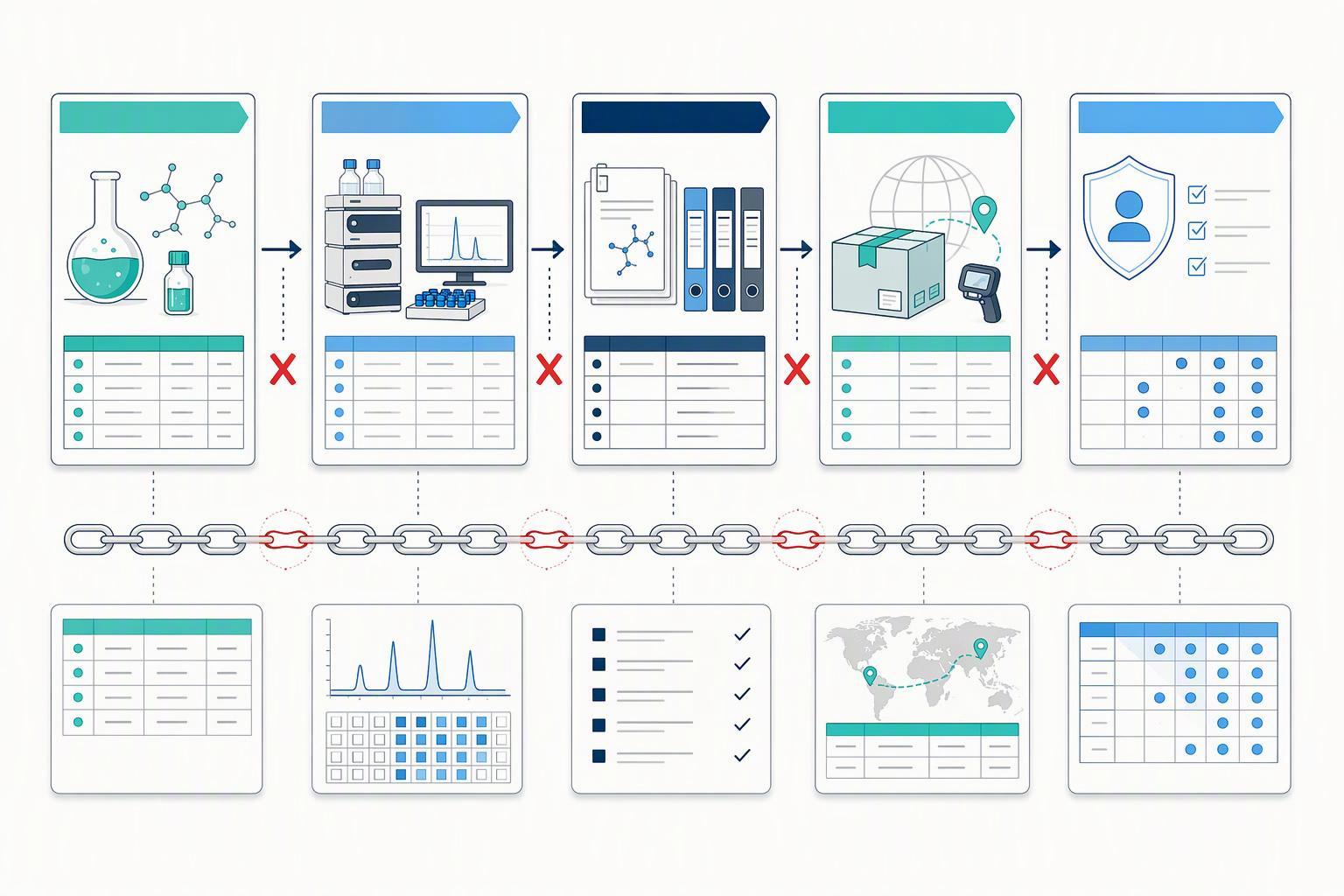
A lot-matched release package is a set of documents that all carry the same lot number and all describe the same physical material. In practice it usually contains four things: a batch-specific certificate of analysis, the chromatogram that produced the purity figure, the mass spectrum that confirms identity, and any endotoxin or sterility result claimed for that lot. The chain breaks when one of those documents is generic rather than lot-specific.
Three failures show up repeatedly. A supplier reuses a single CoA across multiple lots, so the purity figure describes a reference batch rather than the vial in hand. A chromatogram is supplied without its integration table, which means the reader cannot see how the purity percentage was calculated or which peaks were excluded. Endotoxin testing is claimed on the CoA but the supporting report is not lot-matched, leaving no way to connect the result to the material shipped.
MOL Changes operates Class 100 ultra-sterile cleanroom production with per-lot analytical release documentation including batch chromatogram and MS. Two gaps remain unresolved in the material available for this article: the specific cleanroom and environmental-monitoring evidence behind that production claim, and the exact wording of the brand’s research-use-only label. Neither should be inferred. Ask for both directly, and treat a supplier who cannot produce them as a supplier whose documentation chain has not been demonstrated.
Komma igång: Kvalificera en leverantör före den första beställningen
Start with one request: a lot-matched release package for a specific catalog number. Ask for the certificate of analysis, chromatogram and spectrum tied to the lot number printed on the vial you would actually receive. If the CoA references a different lot, or a “representative” lot, you have learned something useful before spending anything.
Then check that identity confirmation is orthogonal to the purity method. A mass spectrometry result and an HPLC purity figure answer different questions; two readings of the same chromatogram answer one. Where a supplier cannot show a second, independent method, treat identity as unconfirmed.
Tredje, get change-control and deviation handling in writing before scale-up. Ask how you will be notified if a synthesis route, kolumn, or testing laboratory changes, and who signs off on a deviation. A supplier who answers this in a document is easier to qualify than one who answers it in a call.
För tips:Run these three checks on a small first order. The documentation package costs the supplier little and tells you more than any capability page.
To work through the full framework with your own catalog numbers, request a documentation package or talk to an expert. This article is published by a peptide supplier, so treat the criteria here as a buyer’s checklist rather than neutral advice.
Vanliga frågor
Vad ska ett batchspecifikt analyscertifikat för forskningspeptider innehålla?
It should tie one document to one lot number and report methods, not just results. Åtminstone: peptide sequence and lot number, the purity method (typically HPLC-UV or HPLC-CAD), the identity method (masspektrometri), the quantity method (amino acid analysis or UV content), and the acceptance criteria each result was judged against. A purity figure with no method, no lot and no specification is a number, inte dokumentation.
Skyddar forskningsanvändning endast märkning en leverantör?
Inga. RUO is a distribution control, inte en juridisk sköld. It tells the buyer the material is not intended for human or veterinary use, but it does not protect a supplier from responsibility for misleading therapeutic claims or marketing that implies clinical benefit. A supplier that stamps RUO on the vial while implying therapeutic use elsewhere has created a contradiction, not protection.
Vad säger inte HPLC-renhetstestning dig?
An HPLC purity figure tells you the proportion of the main peak by the detector’s response, and nothing about what the remaining percentage is. It does not identify residual counterions such as trifluoroacetate, kvarvarande lösningsmedel, vattenhalt, or the impurity peaks themselves. Independently tested research peptides have measured as low as 7.70% purity against 99% label claims, which shows how far a headline number can sit from the underlying reality.
Testar endotoxin och sterilitet samma sak?
Inga, and treating them as interchangeable is a common documentation error. Endotoxin testing measures lipopolysaccharide, typically by the LAL method in USP <85>. Sterility testing looks for viable microbial contamination, typically by membrane filtration or direct inoculation under USP <71>. A product can pass one and fail the other.
Hur skiljer man en legitim forskningsleverantör från en tvivelaktig?
A legitimate research supplier answers specific questions with specific documents. Ask for the batch-specific certificate of analysis with lot number and methods, the chromatogram and mass spectrum for that lot, the endotoxin and sterility methods by name, and the facility’s quality certification. A supplier that responds with a generic brochure, a purity percentage with no method, or a refusal to name the testing laboratory is telling you what its documentation is worth.
Slutsats
The single most important thing to carry away is that documentation is a chain the buyer has to test, not a document the supplier hands over. A certificate of analysis, a chromatogram, an endotoxin result and a sterility statement each answer a narrower question than the folder they arrive in suggests, and the gaps between them are where risk accumulates. The peptide supplier quality and governance framework in this guide exists to make those gaps visible before an order is placed, not after a batch is in hand.
The enforcement record is moving quickly. The August 2026 warning letter set reflects the state of regulatory attention at that moment and may be superseded as further actions are published, so treat it as a dated snapshot rather than a settled position. Re-check the primary sources directly when a qualification decision depends on them.
The next step is small and concrete: pick one supplier already on your list, request the batch-specific records for a single lot, and trace each claim back to the method that produced it.
Chief Technology Officer; Expert på peptidsyntesKärnexpertis: Komplex peptidsyntes, icke-naturliga aminosyramodifieringar, och konstruktionen av cykliska peptider och häftade peptider.
Biografi:Zejun Peng har lång erfarenhet av organisk kemi och peptidsyntes. Han är skicklig i den kombinerade tillämpningen av peptidsyntes i fast fas (SPSS) och vätskefas peptidsyntes (LPPS), och är särskilt skicklig på att övervinna "extremt svåra att syntetisera sekvenser" (såsom ultralångkedjiga peptider, mycket hydrofoba sekvenser, och multipel disulfidbindningsveckning). Under hans ledning, teamet har framgångsrikt övervunnit tekniska flaskhalsar i flera specialiserade modifieringar (såsom N-metylering, PEGylering, och fluorescerande märkning), bibehålla en syntesframgångsfrekvens på över 98%.
Hej där! 👋 Välkommen till MOL Changes. Hur kan vi hjälpa dig idag? Fråga gärna om vår peptidsyntes, CRO-tjänster, or any product inquiries — just type your message below and we'll continue the conversation on WhatsApp.