
Vad ”minsta anslutna datapaket för ett peptidprojekt” innebär i praktiken

Peptidsyntes Definitionen: det minsta anslutna datapaketet för ett peptidprojekt är den minsta uppsättningen korsreferensposter som låter ett andra labb reproducera resultatet och en granskare försvara beslutet.
Ansluten är inte detsamma som komplett. Ett komplett paket rymmer varje dokument; en ansluten gör att varje dokument pekar på de andra, så många skivor namnger dess kromatogram, kromatogrammet namnger dess metod, och metoden namnger standarden den kördes mot. MOL Changes drar reproducerbarhetstestet vid återkörbarhet: om paketet svarar på dina frågor men inte kan köras om av ett andra labb enbart från det skriftliga dokumentet, det dokumenterar ett resultat snarare än en process. Det är felläget som den här guiden är byggd för att förhindra.
Hur kopplade register ser ut i praktiken framgår av ett fungerat exempel på ett komplett bevispaket: syntesväg med föroreningsmotiv, frisläppnings- och stabilitetsdata för samma parti, en metodöverföringsrapport som innehåller acceptanskriterier tillsammans med faktiska resultat, och ett certifikat vars rådata fortfarande går att hämta.
Fem anspråk sitter i den strukturen och får aldrig ersätta varandra: renhet, identitet, innehåll, stabilitet, och analyslämplighet. Resten av den här guiden tar dem en i taget.
De fem påståenden som ett paket måste hålla separat
Renhet, identitet, innehåll, stabilitet och analyslämplighet är fem olika påståenden, och var och en behöver sina egna bevis. Att sammanblanda dem är det vanligaste granskningsfelet, och det börjar vanligtvis med att läsa ett renhetsnummer som en fullständig karaktärisering.
En publicerad metodrekommendation för peptidhantering sätter konventionen: en renad forskningspeptid är typiskt specificerad vid större än 95% kemisk renhet, stöds av preparativ RP-HPLC-rening och tre distinkta QC-steg, analytisk RP-HPLC för procentuell renhet, MALDI/ESI-MS eller MS/MS för massa- och sekvensbekräftelse, och aminosyraanalys för koncentrations- och sammansättningsnoggrannhet (Rekommendationer för generationen, kvantifiering, lagring och hantering av peptider). Separationen är inte en huspreferens. I Q2(R2), gäller i juni 2024, namnanalys/styrka, renhet, föroreningar och identitet som distinkta analytiska syften, var och en med sina egna valideringsförväntningar, och USP-peptidreferensstandarder och föroreningsstandarder behandla processrelaterade och nedbrytande föroreningar som separata kategorier snarare än en renhetssiffra.
Skillnaden mellan peptidrenhet vs identitet är den som granskarna testar först, eftersom de två mäts med olika instrument och svarar på olika frågor.
|
Cl Syntetiska peptider syfte |
Beviskrav |
Vad det inte bevisar |
|---|---|---|
|
Renhet |
Analytisk RP-HPLC area procent |
Kan inte skilja sameluerande trunkering från oxidation utan ortogonala bevis |
|
Identitet |
Massbekräftelse mot teoretisk massa |
Fastställer inte renhet eller innehåll |
|
Innehåll / nettopeptid |
Aminosyraanalys, motjon och vatten stod för |
Ytprocent är inte ett innehållsvärde |
|
Stabilitet |
Tidpunktsdata under angivna förhållanden |
Säger ingenting om identitet eller innehåll vid release |
|
Analysens lämplighet |
Metodspecifik kvalifikation |
Överförs inte till ett annat analysformat |
Begränsningen är viktigare än tabellen. En renhetsareaprocent är inte ett innehåll eller ett netto-peptidvärde, eftersom counterion, vatten och kvarvarande lösningsmedelsmassa tas inte med i kromatogrammet. Mycket kan läsa 97% ren och fortfarande leverera väsentligt mindre peptid än vad märkningen antyder.
Sekvensposter och ändringshistorik
Sekvensposten är paketets primära nyckel. Varannan rekord (kromatogram, masspektrum, stabilitetsprotokoll, analysresultat) är endast tolkbar mot en specifik version av den, så det måste vara versionskontrollerat innan någon av dessa poster betyder något.
En granskare behöver sex fält för att använda den: sekvensversion, N- och C-terminalkommentar, modifieringsplats och kemi, motjonsform, och parti-ID. Modifieringsfältet väger mest, eftersom en modifierad rest är där ett paket oftast förlorar spårbarhet. A due-diligence playbook for peptide CRO selection treats the prior batch record or CoA for a sequence carrying the same modification, plus the analytical method used to confirm modification position, as part of the documentation demand list, not an optional extra.
Where a modification has no ready-made analytical route, reference standards do the work. USP supplies peptide API Reference Standards, related impurity Reference Standards and Analytical Reference Materials, plus system-suitability standards such as the Oxytocin Identification Reference Standard and Goserelin System Suitability Mixture, usable to develop and validate methods and to control drug substance and product batches (USP Biologics, Peptide Standards). Peptidproduktion
The failure mode is a sequence edit with no immutable version trail. It is the most common cause of a non-reproducible experiment: the lot is real, the data is real, and nobody can prove which molecule was made.
Renhet och identitetsregister: vad kromatogrammet och masspektrumet faktiskt bevisar
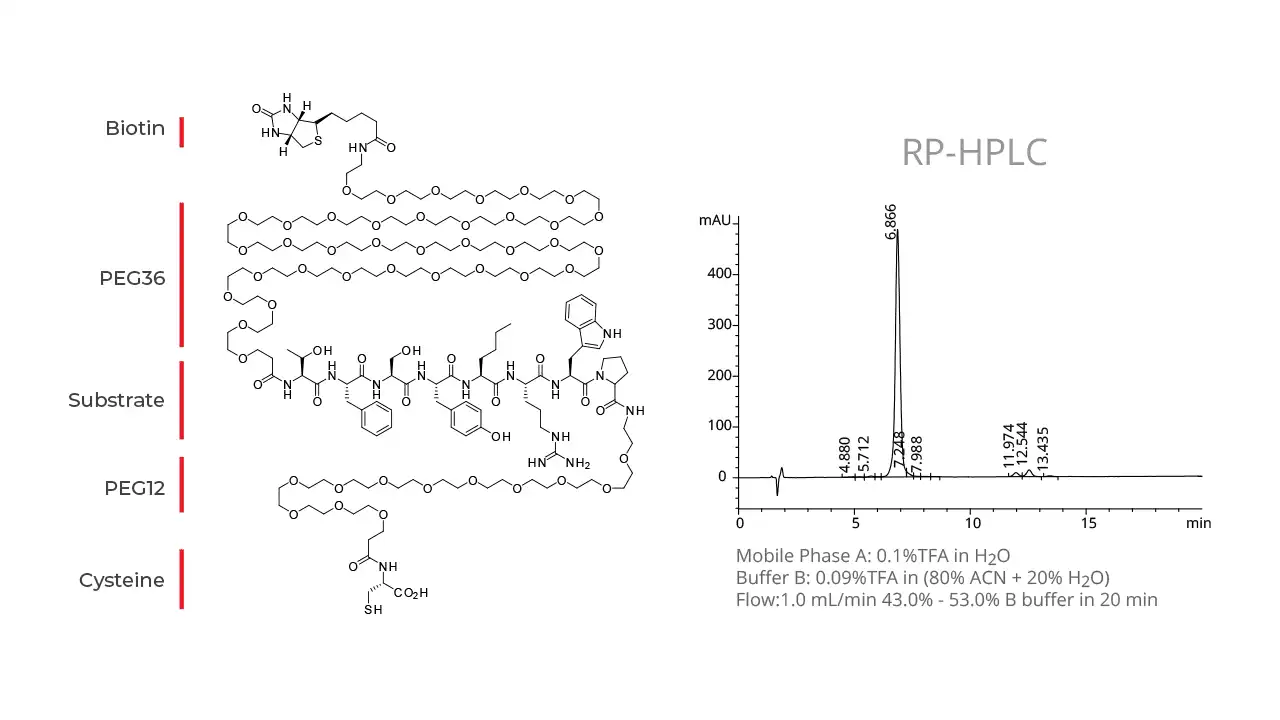
RP-HPLC establishes relative purity; ESI-MS establishes identity. Neither one establishes the other, and a package that treats them as interchangeable leaves the reviewer unable to answer either question.
The distinction is not editorial. I Q2(R2), gäller i juni 2024, replaced Q2(R1) and treats assay/potency, renhet, impurities and identity as separate analytical purposes, each with its own validation expectation. The ICH Q2(R2) validation guidance as issued by FDA in March 2024 carries the same structure. So the reviewer’s first question is not “is there an HPLC trace” but “which purpose does this method serve, and was it validated for that purpose.”
For the chromatogram, the fields that matter are column and dimensions, lutning, detekteringsvåglängd, referensstandard, and method ID. A leading shoulder at 0.6 RRT is only interpretable against those parameters: without the gradient, the retention time means nothing.
An analysis of peptide CRO sourcing practice states that buyers should expect HPLC and mass-spec data as standard rather than as an upcharge, and should be able to request raw QC data rather than a summary.
Two limits belong here. A summary table is not the chromatogram. And a mass spectrum confirms mass, not sequence position: a deletion and a substitution can return the same nominal mass, so MS alone cannot tell you where a sequence differs.
Innehåll, motjon och massbalans
Innehåll, or net peptide, is a mass-balance value: it states how much of the weighed powder is actually peptide, after counterion, water and residual solvent are subtracted. It is the claim most often missing from a package that otherwise looks complete, and an HPLC area percent cannot stand in for it. Area percent measures the share of UV-absorbing peak area at one wavelength; it says nothing about the mass of material that peak represents.
A reviewer reading a purity-only certificate does the arithmetic anyway. If a lot is reported at 95% purity by area and the net peptide content is 70%, then a 10 mg weigh-out delivers roughly 7 mg peptid, and every downstream molar calculation inherits that gap. Counterion is usually the largest single term: acetate and trifluoroacetate both add mass that is not peptide.
Amino acid analysis is the reference approach for concentration and composition accuracy, because it quantifies peptide mass directly rather than inferring it from a chromatographic response (Journal of Pharmaceutical Analysis, 2016).
Key Takeaway: Purity by area percent and content by mass balance answer different questions. A package that reports only the first leaves the reviewer to guess the second.
Where a package reports content but not the method behind it, the number is not verifiable, and the section of the certificate that should carry it stays empty.
Stabilitetsrekord: design, förhållanden och tidpunkter
A stability result table is only interpretable when the protocol that produced it travels in the same package. Without the protocol, a receiving lab cannot tell whether the study applies to its own storage and handling conditions.
The required contents of a stability protocol are set out in Health Canada’s guidance on stability, avsnitt 52 till 62 (2025-09-04). A peptide stability data package should carry, as applicable: product identification and master-document references; container and closure system type and size, plus total container count; lot or batch code with manufacture date and proposed expiry; sample size and test intervals per parameter; storage conditions with tolerances and how those tolerances are maintained; sample orientation reflecting worst case; specifications with acceptance criteria per parameter; the method of data evaluation, including statistical analysis or trending; and the report format.
These fields sit inside a framework rather than replacing it. De current Q1A(R2) stability framework dates to November 2003, och the Q5C expectations for peptide-like products (juli 1996) state that products whose active components are typically proteins or polypeptides are particularly sensitive to temperature, oxidation, ljus, ionic content and shear, so stringent storage conditions are usually necessary. Q5C does not supersede Q1A(R2); the two apply together. The field list above is a general stability-protocol requirement, not a peptide-specific or FDA-specific one.
Analysens lämplighet och de register som gör ett resultat överförbart
Assay suitability belongs to the method in the matrix, not to the peptide. A lot that reads clean by RP-HPLC can still fail a cell-based potency assay, because the assay measures what the peptide does in a buffer, a cell line and a plate, and those conditions are part of the result. The records that make a potency number transferable are therefore the format, the matrix, the controls and the acceptance criteria, not just the value.
For conjugate-type programs the bar is higher. ChemExpress sets out the analytical demands for peptide drug conjugate programs as LC-MS/MS for structural confirmation, SEC-MALS for aggregation, HPLC-UV/MS for drug-to-peptide ratio and free payload, peptide mapping for modification sites, and bioassays for potency, with methods validated per ICH guidelines. The same source states that without conjugation-site, drug-to-peptide ratio and aggregation characterization, “you cannot file an IND.”
Where a discovery-stage package may stop short: if the program is not yet filing, a documented method with matrix and controls can be enough, provided the record says which of those characterizations are still open.
Uppgifter, revisionsspår och vad som gör ett paket försvarbart
A package is defensible when its electronic records meet the same integrity expectations as paper ones, och del 11 states those expectations directly. 21 CFR 11.10(e) and the audit-trail requirement calls for secure, datorgenererade, time-stamped audit trails that independently record the date and time of operator entries and actions creating, modifiering, or deleting electronic records, with changes never obscuring previously recorded information and trails retained at least as long as the subject records. 21 CFR 11.10(a) adds validation of systems for accuracy, pålitlighet, konsekvent avsedd prestanda, och förmågan att urskilja ogiltiga eller ändrade register, medan 11.100(a) och 11.300(a) require each electronic signature to be unique to one individual and never reused or reassigned.
The failure mode is an electronic record that cannot show what changed, när, and by whom. A revised peptide certificate of analysis without a retained prior version is exactly that gap.
|
ALCOA attribute |
Record artifact that demonstrates it |
|---|---|
|
Tillskrivbar |
Named analyst and unique credential on each entry |
|
Legible |
Time-stamped audit trail readable across revisions |
|
Samtida |
Entry timestamp matching the action |
|
Original |
Tjänster Retained first capture, not a later transcription |
|
Accurate |
Validated system able to flag altered records |
Two limits matter. FDA’s stated scope and application of Part 11 says the agency will narrowly interpret the rule, and where computers merely generate paper printouts meeting all record requirements, the paper record is the regulated record. Del 11 also does not reach every electronic file a CRO holds.
Korsreferensgenomgången: en lott, fem humle

A minimum connected data package for a peptide project is only as strong as the links between its records, so the practical test is whether one lot number can be followed through five hops without a dead end.
Take a lot released by MOL Changes. The lot number on the certificate of analysis points to the RP-HPLC chromatogram, which names the method ID it was run under. That method ID points to the stability protocol the same lot entered, and the protocol points to the assay record that used it. Each hop is checkable. None of them, på egen hand, tells you the material is fit for your experiment.
The solubility record shows where the chain stops being about release. It is run to find optimal solvent conditions, can be customized to the solvents your experiment uses, with water as the first choice, and it answers a formulation question rather than a release question. A reviewer can conclude the lot dissolves under the tested conditions. They cannot conclude it will dissolve in a different buffer, at a different concentration, or after freeze-thaw.
Checklista för granskare och nästa steg
Use this as a reusable filter for any supplier, not just the one you are evaluating now. It condenses the peptide CRO documentation requirements into the questions a reviewer actually asks before accepting a package.
-
Is the certificate of analysis batch-specific, or a generic template?
-
Does the supplier state its chromatography data system’s audit-trail policy?
-
Will they release a representative batch record for a comparable sequence length and hydrophobicity, including the impurity profile?
-
Is there a scale-up or Handla jämförbarhetsrapport?
-
Is the method-transfer record complete?
-
Do you receive the actual chromatogram and mass spectrum, or only a summary table?
-
For a modified sequence, is there a prior batch record carrying the same modification? Om
-
Do the records follow MHRA ALCOA principles, and does the supplier hold an ISO 13485 eller ISO 9001 certificate?
A due-diligence playbook for peptide CRO selection turns on one decision rule: if any of these seven records is missing and the supplier will not commit to a date for it, treat the package as unverified and price the risk into your timeline. The checklist is reusable across suppliers, which is what makes switching less costly than it looks.
MOL Changes ships a full certificate of analysis with chromatograms, downloadable from each product page and retrievable via a peptide-specific QR code, and it has a commercial interest in peptide quality standards. If you want to test the checklist against a live package, request a sample data package or talk to an analytical expert.
[CTA: Request a sample data package]
Vanliga frågor
Vad måste ett peptidintyg för analys innehålla?
A usable peptide certificate of analysis identifies the lot, names the method behind each result, and reports purity, identitet, and content as separate values rather than one headline figure. A reviewer needs the lot number, method identifiers, the chromatogram and mass spectrum, and the specification each value is judged against. A package reduced to one purity percentage leaves the receiving lab unable to confirm what was measured.
Kan renhetsprocent jämföras mellan leverantörer?
Only when the chromatographic method is comparable, because a purity figure is a property of the method as much as of the peptide. Two vendors reporting 98% may be running different columns, gradients, och detekteringsvåglängder, and a method that resolves fewer impurities reports a higher number for the same material. Treat a percentage without its method parameters as unverifiable rather than comparable.
Hur mycket stabilitetsdata behöver ett peptidprogram i upptäcktsstadiet?
Enough to cover the interval and conditions the material will actually meet, and no more. Early discovery work rarely justifies a full ICH Q1A(R2) bracketed study, but it does justify knowing whether the peptide survives the buffer, temperatur, and handling it meets during the assay. Where sterility is part of the specification, the USP <71> sterility test sets a concrete floor: media are incubated for not less than 14 dagar, with fluid thioglycollate medium at 32.5 ± 2.5 °C and soybean-casein digest medium at 22.5 ± 2.5 °C, and no evidence of microbial growth means the product complies.
Kan du begära råkromatogram och masspektra?
Ja, and for any lot you intend to rely on, you should. A summary purity figure is a conclusion; the chromatogram shows peak shape, baslinje, and whether a leading shoulder was integrated into the main peak or excluded from it. Some vendors publish full chromatograms as standard practice, others provide them on request. Either way, the request belongs in the documentation requirements you set before the first order, not after a batch fails.
Hur länge ska ett peptiddatapaket bevaras?
Retain it for as long as any result derived from that lot may need defending, which in practice means the life of the program plus the retention period your quality system requires. Stability conclusions, assay qualifications, and any submission citing the material all trace back to the original records, so a package that cannot be retrieved later is effectively a package that never existed. Confirm the retention commitment as part of your peptide CRO documentation requirements rather than assuming it.
Slutsats
The minimum connected data package for a peptide project is defined by re-runnability, not by volume: if a receiving lab cannot repeat your result from the records alone, the package is incomplete no matter how many pages it runs to. That test sorts the five claims cleanly. Renhet, identitet, innehåll, stability and assay suitability each need their own record, and each record carries a stated limit on what it does not prove. The cross-reference chain holds them together, from lot number through chromatogram and method ID to the stability protocol, so a reviewer can follow one hop at a time instead of reconstructing your project from memory.
The standards layer underneath is stable. I Q2(R2) governs how the analytical procedures are validated, I Q1A(R2) and Q5C set the stability expectations, USP monographs fix the compendial tests, och 21 CFR del 11 covers the audit trail. Vendor practice is not stable, and that gap is where packages fail review.
So the next step is concrete. Take the last certificate of analysis your current supplier sent you, pick one lot, and try to walk the five hops without emailing anyone. Where the chain breaks, that is the question to put to your supplier in writing.