Den konventionella utsikten: Skala är det säkra valet
Under större delen av det senaste decenniet, det vanliga svaret på urvalskriterier för peptidleverantörer har varit enkelt: ranka kapaciteten först. Tier-1 CDMO och de upphandlingsböcker som byggts runt dem behandlar produktionsskala, reaktorvolym och plats räknas som de primära avrisksignalerna, på resonemanget att endast en stor tillverkare kan garantera utbudet när efterfrågan ökar.
Den utsikten fick sin plats. Kapacitetsbrist under GLP-1-eran var verklig, och de leverantörer som satte kapital tidigt löste verkligen ett försörjningsproblem. CordenPharmas peptidexpansion för cirka 900 miljoner euro, tillkännagavs i juli 2024, lagt till storskaliga tillverkningståg i Colorado plus en europeisk greenfield-anläggning. Bachems byggnad K, dess stora fabrik i Bubendorf, förankrad CHF 332.6 miljoner av FY2025-investeringar och slutförde det angivna skiftet från CDMO till CMO mot industriell skala, högvolymutgång.

Skala var aldrig fel svar. Det är helt enkelt inte längre den enda.
Varför Scale slutade vara differentiatorn
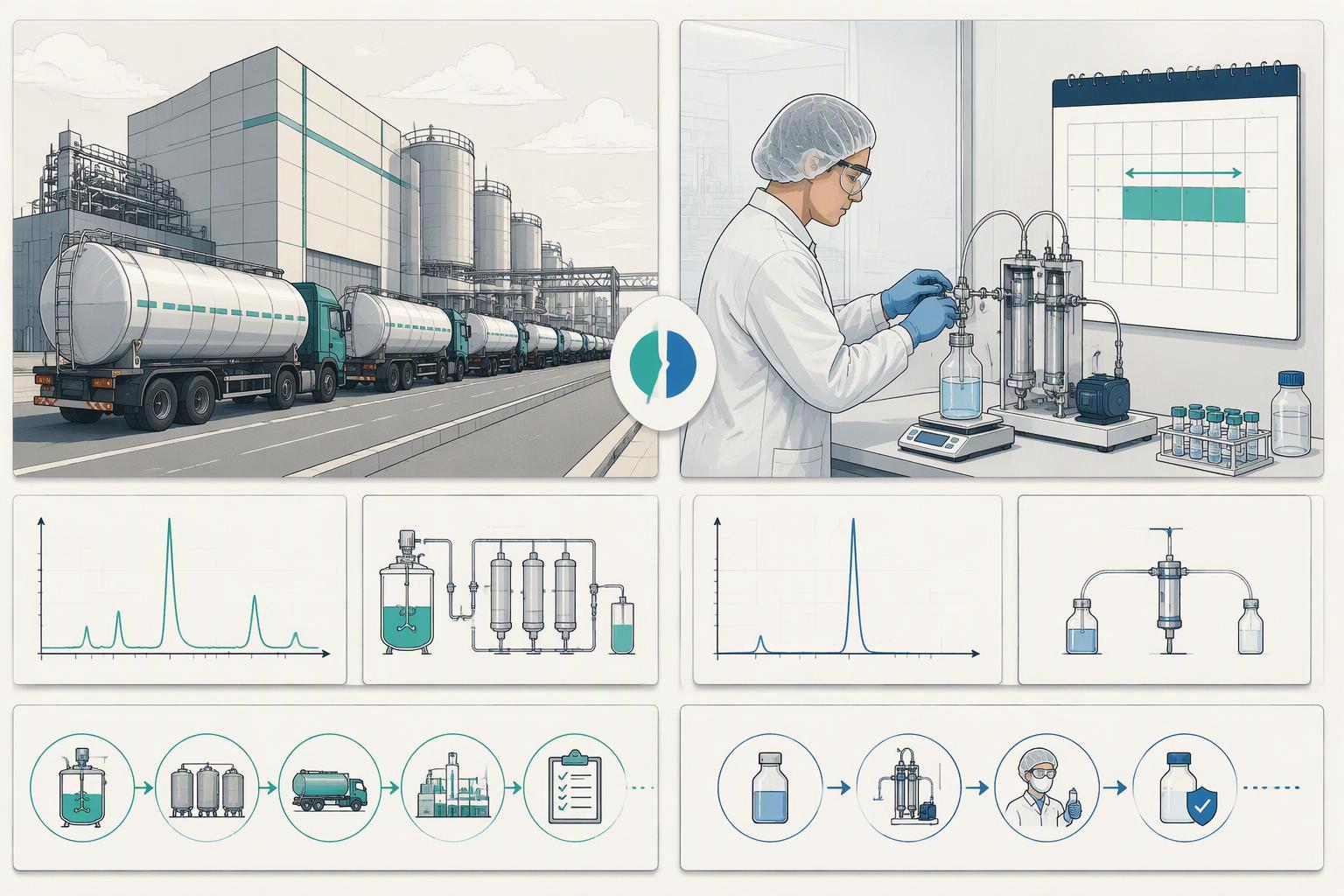
Kapacitet har slutat separera leverantörer eftersom alla köper samma kapacitet samtidigt. När flera CDMOs beställer storskaliga peptidfabriker i samma fönster, begränsningen som används för att sortera fältet blir en delad kostnadsbas snarare än en delad fördel. Tre problem följer av att behandla skalan som det säkra valet.

Den första är att kapacitetsbyggande är kapitaldyrt och utspädande innan det ökar. Bachems EBIT-marginal sjönk till 22.0% under FY2024 från 22.4%, vilket bolaget hänförde till ”ökade av- och nedskrivningar på nyinvesteringar” i sin FY2024 resultatrelease. Mönstret upprepades under första halvan av 2026, när bolaget uppgav att "upptrappningskostnader för Byggnad K påverkade rörelseresultatet som förväntat" i den senaste delårsrapporten. Ny kapacitet kostar marginal innan den tjänar någon.
Det andra problemet är att tillväxten kom, det kom från användning och blandning snarare än från skalan i sig. Bachems kommersiella API-tillväxt under första halvan av 2025 drevs främst av ett bra operativt utförande i vårt nätverk som ledde till ett optimerat utnyttjande av befintliga anläggningar,” enligt Bachems H1 2025 resultat. Fyller befintliga växter bättre, inte äger fler av dem, flyttade numret.
Det tredje problemet är att breddargumentet är tunnare än vad rubriktillväxten antyder. GenScripts intäkter för FY2025 ökade 61.4%, men GenScripts FY2025-resultat hänföra det främst till licensintäkter, främst LaNova underlicensiering, medan ProBios 309.1% tillväxten snedvrids av engångsposter och avgiften för tjänsten ökade 21%. Rubrikprocenterna här mäter affärens timing, inte serviceförmåga.
När alla seriösa spelare köper samma kapacitet, urvalskriterier för peptidleverantörer ändras till vad kapacitet inte kan köpa: lyhördhet, specialiserade modifieringar, analytisk transparens, och tekniskt samarbete.
Vad data faktiskt visar om urvalskriterier för peptidleverantörer
Läs de avslöjade siffrorna igen och bilden inverteras. GenScript H1 2026 delresultat beräknade totala intäkterna till ungefär 404,2 miljoner USD, upp 27.3% år för år på jämförbar basis; resultatrapporten för FY2025 959,5 miljoner USD och 66,000+ aktiva Life Science Group-kunder. Det är siffror för servicelinjebredden. Ingen av GenScript-resultatsidorna som läses för denna jämförelse avslöjar en peptidspecifik intäktslinje, kapacitetssiffra eller vändningsmått, och den sidan av jämförelsen vilar på tunnare offentliggörande än Bachem-sidan. Frånvaron är fyndet.
Bachems H1 2025 resultat visar en nettoomsättning på CHF 313.0 miljon, upp 30.2%, och en EBITDA-marginal på 29.1%, upp från 23.1% ett år tidigare. Tillväxten av den formen kom från ett bättre utnyttjande av anläggningar som Bachem redan driver, inte från ny kapacitet.
Fyra kriterier väger istället vikten: lyhördhet, specialiserade peptidmodifieringar, peptidanalytiska datatransparens, och peptid CDMO tekniskt samarbete. Bevisen bakom var och en är kvalitativ där marknadsdata är tunna.
|
Kriterium |
Vad köparen inspekterar |
Kelaterande peptider Svagt svar |
Starkt svar |
|---|---|---|---|
|
Lyhördhet |
Metodöverföring och pilot-batch-schemaläggning |
Anpassade peptider Flermånaders slotköer, höga MOQs |
Namngiven transferfönster, Klicka på Kemipeptider pilot-till-kilogram väg |
|
Specialiserade modifieringar |
Modifieringsportfölj och sekvenskomplexitet hanteras |
Enbart kataloglista |
Specifika modifieringstyper med prejudikat |
|
Analytisk transparens |
CoA fields and method documentation |
Purity percentage alone |
Metod, kolumn, and lot-to-lot comparability data |
|
Technical collaboration |
Scale-up handoff and transfer support |
Handoff at purchase order |
Documented transfer plan across mg to kg |
Kriterium 1 och 2: Lyhördhet och specialiserade modifieringar
These two criteria are measured in elapsed time and chemistry classes, not in tonnes. Responsiveness means method-transfer and pilot-batch lead time; specialized modifications means whether a supplier can hold a non-standard chemistry through scale-up.
On responsiveness, the structural contrast is utilization. Bachems H1 2025 results describe growth as coming from utilization of existing facilities rather than new capacity, which is the pattern buyers meet as slot scheduling and high MOQs on early-stage pilot batches. GenScript’s FY2025 results disclose no turnaround benchmark on the pages reviewed, so published lead times remain a qualitative range: roughly two to three weeks for standard sequences and three to six weeks for complex ones, figures that appear mainly in commercially motivated sources and should be treated as a range, not a market statistic.
För custom peptide synthesis capabilities, evaluate by chemistry class rather than service bullets. PEGylering, cyklisering, glycopeptides and isotope labeling each carry different failure modes, and the question is whether the supplier holds the modification through scale-up. Four sequence properties predict difficulty: hydrophobicity and aggregation tendency, kedjelängd, modifiering på flera platser, and disulfide topology. Each maps to a capability, not a catalog entry.
För tips: Run the buyer-side evaluation sequence in order: difficult-sequence feasibility check, then
specialized peptide modificationscapability check, then analytical package review, then the scale-up and tech-transfer conversation.
Kriterium 3: Analytisk transparens är det svåraste påståendet att förfalska
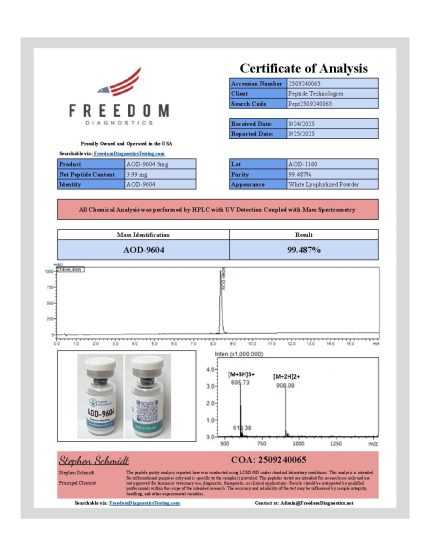
Analytical transparency is the one criterion a buyer can verify before committing, which makes it the highest-signal screen in the framework. A batch certificate of analysis is not proof on its own. What matters is whether it carries the fields a filing needs: an HPLC chromatogram with the method and column conditions, an MS spectrum confirming the expected mass, a purity figure tied to a defined method, and a stated endotoxin result.
Endotoxin thresholds tighten with the assay, and the default specification rarely matches the application. One testing-vendor resource reports that levels below 1.0 EU/mg are generally acceptable for immortalized cell lines, nedan 0.05 EU/mg for primary immune cells, och 0.1 till 0.5 EU/mg for in vivo rodent studies, with USP 〈85〉 injectable limits set at 5 EU/kg/hr on a different unit basis (Creative Proteomics endotoxin and sterility testing resource, odaterad). That is a single vendor source, and the USP 〈85〉 figure should be re-verified against the chapter itself before it anchors a specification.
The honest limitation: USP’s 〈1503〉 chapter on synthetic peptide quality attributes and the ICH Q6B framework for justified specifications could not be read in full text in this pass, so the documentation argument here rests on supplier-side and secondary material rather than the standards themselves.
Kriterium 4: Tekniskt samarbete och uppskalningshandoff
Technical collaboration is what decides whether responsiveness, modifications and analytical transparency survive the jump from pilot to commercial batch. A supplier can look strong at milligram scale and still fail the handoff: purity drifts, batch-to-batch comparability weakens, and the receiving team inherits a method it cannot reproduce. Peptide CDMO technical collaboration is therefore a selection criterion, not a courtesy.
MOL Ändringar, as one example inside this framework, describes the two sourcing extremes it positions against: “choosing either a single tier-1 contract development and manufacturing organization (CDMO) eller enbart förlita sig på en låg kostnad, overifierad katalogleverantör. Both extremes introduce systemic risk.” The same page states Peptidkemi that a warm second source, kept alive through minor annual order allocations, cuts emergency supplier transition timelines from 12 months to under 3 veckor. Treat that as the brand’s stated service model, not an independent benchmark; the operational case for a warm second source rests on the buyer’s own continuity planning.
The cheap alternative fails in a predictable place. Suppliers promising rapid turnaround often lack cleanroom sterility controls, robust analytisk instrumentering, eller parti-till-parti-batchjämförbarhet, which is exactly the documentation a commercial batch needs. Peptidsyntesföretag
Hur man tillämpar ramverket
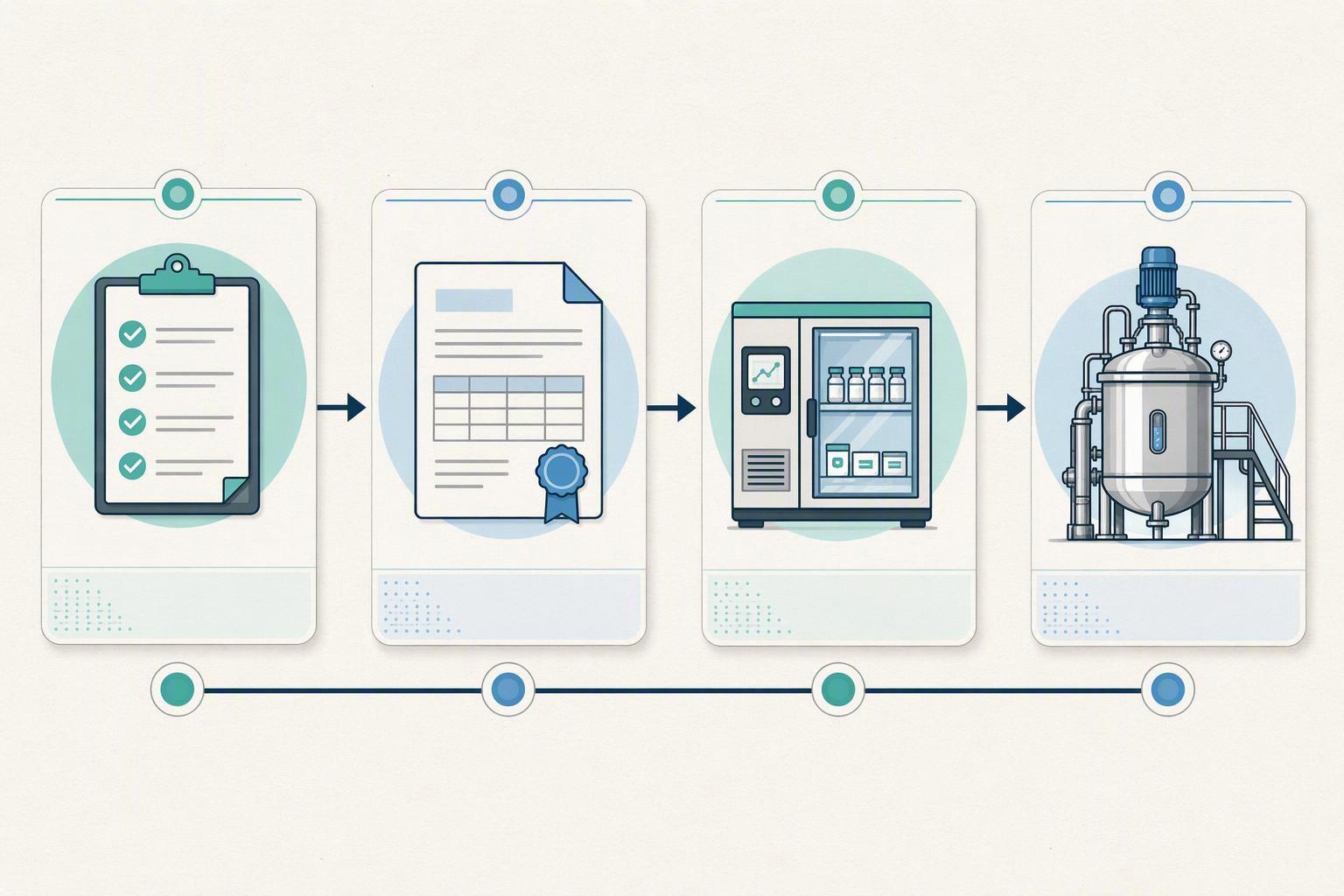
Start by sending a supplier the sequence that actually gives you trouble, not a catalog peptide. A trial synthesis on your real difficult sequence is the fastest way to see whether the responsiveness claim holds, and it takes days rather than a full evaluation cycle. Isotopmärkta peptider
-
Send the difficult sequence for a trial synthesis. Days. This is the quickest filter you have.
-
Request the modification list with named chemistries. Ask which of them survive scale-up, not just which appear in a brochure. Quick win.
-
Request a real batch CoA and read the method fields, not only the purity number. Quick win.
-
Open a tech-transfer conversation covering the mg to kg path and the documentation handoff. Longer-term.
-
Qualify a warm second source with a minor annual allocation. Longer-term, and the step most buyers skip until an emergency forces it.
Scoring sheet: carry the four criteria (lyhördhet, specialiserade modifieringar, analytisk transparens, technical collaboration) into the supplier call as a one-page grid, and score each answer against the artifact you were shown.
Measure the framework by method-transfer elapsed time, batch-to-batch comparability, and whether the analytical package clears your filing review without follow-up queries. Those three signals are the operational lever behind Bachem’s H1 2025 resultat, where utilization, not catalog breadth, moved the margin line. Expect the first three steps to change your shortlist within one evaluation cycle.
Varningar: Där den konventionella utsikten fortfarande håller
For a late-stage commercial program with fixed, multi-year demand, tier-1 scale and a regulatory track record genuinely reduce risk, and the four criteria above do not replace that. Slot scheduling and minimum order quantities bite hardest at development and early-clinical scale, which is where this framework applies most strongly.
Two limits are worth naming. The GenScript side of this comparison rests on thinner public disclosure than the Bachem side, so part of the asymmetry may reflect disclosure practice rather than capability. And Bachem’s margin compression is self-declared as planned and transitory, a fairer framing than margin pressure alone; the company’s stated 2026 ambition of more than CHF 1 billion in sales and over 30% EBITDA-marginal, as of the H1 2025 släppa, is not the profile of a supplier losing ground.
The claim is not that scale is worthless. It is that scale has stopped being sufficient on its own.
Vanliga frågor
But doesn’t a tier-1 CDMO’s scale protect us if demand spikes?
Scale protects the supplier’s throughput, not your queue position. The company’s stated 2026 ambition at large CDMOs is to fill capacity with programs already holding reserved slots, so a spike is exactly when an unreserved buyer waits longest. The protection you want is a warm second source with a reserved slot, not a bigger primary.
Tänk om vi redan har kvalificerat en stor leverantör och det är dyrt att byta?
You do not have to switch. Qualify a second source alongside the incumbent, which is what the operational case for a warm second source describes: minor annual allocations keep the relationship and the documentation current, so an emergency transition is a phone call rather than a fresh qualification. The incumbent keeps the volume; the second source keeps you covered.
Hur svarar du på argumentet att boutiqueleverantörer inte kan stödja kommersiella volymer?
That argument conflates a boutique’s catalog business with its custom peptide synthesis capabilities. GenScript’s FY2025 results show how license-driven growth qualification works at scale, and the same qualification logic applies downward: what matters is whether the supplier can document method transfer, lot comparability and scale-up continuity, not whether its name is large. Ask for the transfer record, not the headcount.
Isn’t analytical transparency just a matter of asking for the CoA?
Inga. A CoA is a summary; peptide analytical data transparency is whether the underlying method, the lot it was run on and the specification it was judged against travel with the number. Endotoxin thresholds tighten with the assay, so a certificate that reports a value without the method and limit tells you little. Ask which assay, which lot, which specification, and whether peptide CDMO technical collaboration extends to reviewing the data with you.
Slutsats: Vad köpare bör fråga efter i 2026
Scale is now table stakes in peptide supplier selection criteria, and the four criteria that actually separate suppliers are responsiveness, specialiserade modifieringar, analytical transparency and technical collaboration. Bachems H1 2026 results make the point: net sales rose 4.3% till CHF 326.4 million while the EBITDA margin fell 3.7 percentage points to 25.4% (Bachems H1 2026 resultat, juli 2026). Capacity growth no longer guarantees pricing power or service quality.
So ask for artifacts, inte försäkringar. Request a representative CoA with the analytical method behind each specification, a written list of modifications the supplier has actually delivered, and a named technical contact who owns the scale-up handoff. Where suppliers publish nothing comparable, treat the gap as a finding: GenScript’s FY2025 results show how little peptide-specific disclosure reaches buyers who need to compare (GenScripts FY2025-resultat). The market improves when the CoA, the modification list and the transfer path become the comparison surface.
If you are evaluating suppliers now, request a representative CoA package and a technical consultation before you commit to a slot.
This article is published by MOL Changes, which offers custom peptide synthesis and analytical documentation services. Consider that interest when weighing the framework above.