Sửa đổi peptide
Peptide FRET
What is FRET peptide?
FRET peptide labelling has a donor molecule and an acceptor (bursting agent) molecule. In most cases, the donor and acceptor pairs are two different dyes. If the acceptor is a non-fluorescent dye (bursting agent), the transferred energy from the fluorescent donor is converted into molecular vibrations. When FRET is terminated (by separating the donor and acceptor), an increase in donor fluorescence can be detected. When both donor and acceptor dyes are fluorescent, the transferred energy is emitted as longer wavelength light, allowing changes in the donor and acceptor fluorescence intensity ratio to be measured. For efficient FRET bursting, the fluorophore and bursting agent molecules must be in close proximity to each other (~10-100 Å) and the absorption spectrum of the bursting agent must overlap with the emission spectrum of the fluorophore. Careful comparison of the fluorescence spectrum of the donor and the absorption spectrum of the bursting agent is required when designing donor-bursting agent FRET systems.

FRET peptides science
Key benefits of FRET peptides:
·Real-time monitoring of enzymatic reactions and protein activity.
·Extremely high detection sensitivity due to unique proximity-based energy transfer.
·Versatility for in vitro and in vivo applications, providing insight into complex biological processes.
|
Fluorophore
|
Quencher
|
Donor Ex/Em
|
|---|---|---|
|
Abz |
Dnp 2,4-dinitrophenyl |
320 nm/420 nm |
|
Abz |
Dnp 2,4-dinitrophenyl |
320 nm/420 nm |
|
Maca |
Dnp 2,4-dinitrophenyl |
325 nm/392 nm |
|
Trp |
Dnp 2,4-dinitrophenyl |
280 nm/360 nm |
|
FAM |
Dabcyl4-([4'-dimethylamino)phenyl]azo)benzoyl |
492 nm/517 nm |
|
Lucifer Yellow |
Dabsyl4(Dimethylamino)azobenzene-4'-sulfonyl |
430nm/520nm |
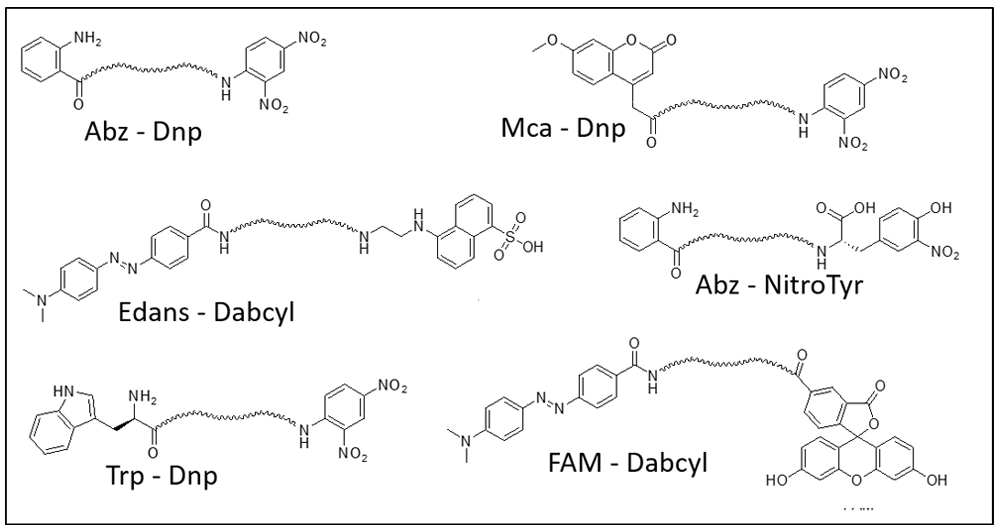
Trích dẫn nổi bật
Ultrasensitive tumour-penetrating nanosensors of protease activity
The ability to identify cancer lesions with endogenous biomarkers is currently limited to tumours ~1 cm in diameter. We recently reported an exogenously administered tumour-penetrating nanosensor that sheds, in response to tumour-specific proteases, peptide fragments that can then be detected in the urine. Đây, we report the optimization, informed by a pharmacokinetic mathematical model, of the surface presentation of the peptide substrates to both enhance on-target protease cleavage and minimize off-target cleavage, and of the functionalization of the nanosensors with tumour-penetrating ligands that engage active trafficking pathways to increase activation in the tumour microenvironment. The resulting nanosensor discriminated sub-5 mm lesions in human epithelial tumours and detected nodules with median diameters smaller than 2 mm in an orthotopic model of ovarian cancer. We also demonstrate enhanced receptor-dependent specificity of signal generation in the urine in an immunocompetent model of colorectal liver metastases, and in situ activation of the nanosensors in human tumour microarrays when re-engineered as fluorogenic zymography probes.
Dịch vụ biến đổi peptide liên quan
glycosyl hóa peptit
glycosyl hóa peptit
Quá trình glycosyl hóa peptide là một biến đổi cộng hóa trị có khả năng cải thiện các tính chất hóa lý của peptide
Đọc thêmPhosphoryl hóa peptit
Phosphoryl hóa peptit
Phosphoral hóa có thể xảy ra trên Serine (S, trở thành), Threonine (T, thứ ba) và Tyrosine (Y, Tyr) chuỗi bên bằng cách hình thành liên kết phosphoester
Đọc thêmPeptide cố định
Peptide cố định
Giới thiệu hai axit amin không tự nhiên có chứa α-methyl, Nhóm α-alkenyl trong quá trình tổng hợp pha rắn chuỗi peptide.
Đọc thêmPeptide tuần hoàn
Peptide tuần hoàn
Chu trình peptide tăng cường sự ổn định về hình dạng của peptide (so với các chất tương tự tuyến tính của chúng) và là một chiến lược phổ biến trong phát triển peptide.
Đọc thêmbiến đổi peptit
Có nhiều kinh nghiệm trong việc sửa đổi peptide, cung cấp nhiều con đường khả thi cho nghiên cứu peptide.
