ペプチド修飾

クリックケミストリーペプチド

Click reactions are key steps in peptide chemistry for peptide synthesis and chemoselective modification

What is Click Chemistry Peptides?

Click peptides are peptides synthesised using click chemistry. This technology is characterised by high yield, good selectivity, carbon hetero bond binding, wide applicability and easy operation. Click reaction is a key step in peptide chemistry for peptide synthesis and chemoselective modification. Click reactions have a wide range of applications, including ligation, cyclisation, biocoupling and radiolabelling.

The most common functional groups in click chemistry are azides and alkynes. Azide-alkyne cycloaddition reactions are the most common click reactions. Click chemistry has a wide range of applications in chemical synthesis, materials science, chemical biology and drug development.

Peptide click chemistry is also used for biomolecular labelling, highly selective covalent attachment to target sites, and biocoupling in proteomics studies. With the development of peptide drugs in the scientific and clinical fields, click peptides are being prepared at lower cost and with higher stability.

Click Chemistry Peptides typology

CuAAC and copper-free click chemistry

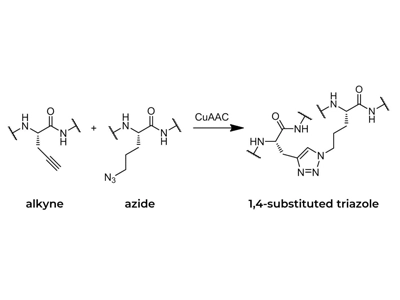
CuAAC (copper-catalysed azide-alkyne cycloaddition) click reactions proceed by clicking on alkyne-modified peptides and azide-modified molecules starting from the triazole bond. Copper-free click chemistry is an alternative technique to click chemistry that has a lower activation energy barrier and does not require the cytotoxic leap of a metal catalyst.

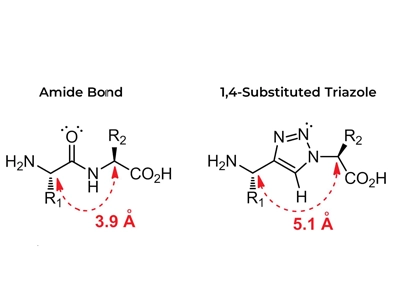
The CuAAC reaction involves the formation of rigid five-membered heterocyclic 1,2,3-triazoles under mild conditions. As far as functionality is concerned, azides are easy to introduce, stable under aqueous and oxidising conditions and highly reactive. Such triazoles are electronic equivalents of peptide bonds and have similar planarity to the amide portion, but are not susceptible to hydrolytic breakage.

Properties such as high stability, similarity to amide bonds, and potential biological activity make the triazole bond not only a benign and easily synthesised linker, but also an important component of click chemistry.

BCN Linker

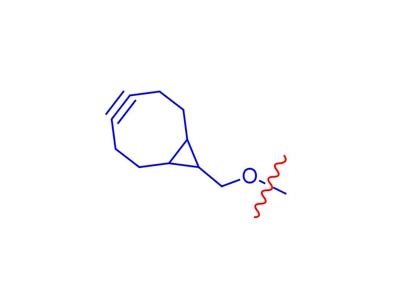
BCN groups can react with azide-labelled biomolecules without the need for a copper catalyst.BCN linkers can be attached to a variety of functional groups such as amine groups, amino groups, aminooxy groups, acid groups, NHS ester groups and so on.

DBCO Linker

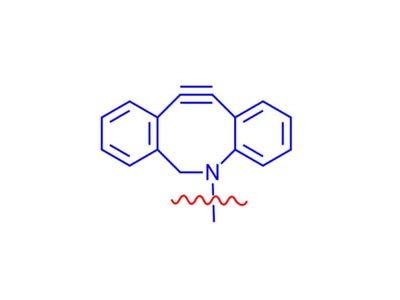
DBCO linkers can react with azide-modified biomolecules without the need for toxic Cu catalysts, making DBCO reagents ideal for use in living cells and organisms.

Cyclopropene Linker

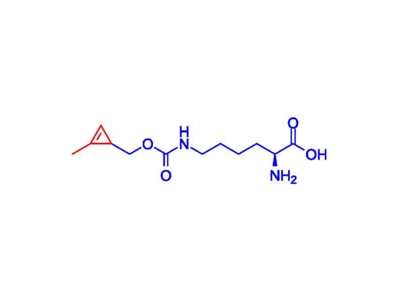
Cyclopropene is the smallest unsaturated carbocyclic compound with high addition, cycloaddition, and ring opening reactivity.

TCO Linker

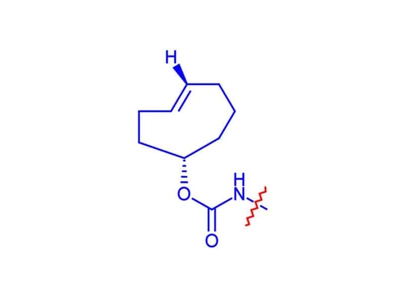
TCO linkers are biological orthogonal agents of tetrazines. The cycloaddition reaction between tetrazine and trans-cyclooctene (TCO) is widely used in bioconjugation, molecular imaging and cellular diagnostics.

Tetrazine Linkers

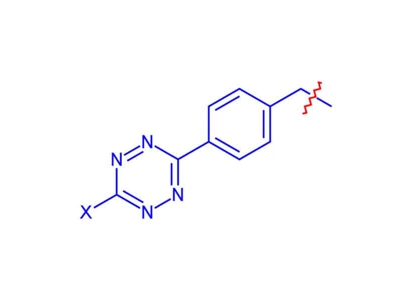
The tetrazine linker is a bioorthogonal ligand for TCO and cyclopropene. Tetrazine linkers are chemoselective and react specifically with trans-cyclooctene (TCO). They are ideal tools for biocoupling, cell engineering and site/target specific coupling studies.

注目の引用文献

Modification of DNA Nanostructures with Functional Peptides Through Copper-Free Click Chemistry

The provided protocol outlines a method for synthesizing a peptide-modified three-arm DNA nanostructure. The protocol details the functionalization of three partially complementary amino-modified single-stranded DNA molecules with azide-modified peptide, denoted "PeB," using copper-free click chemistry. This PeB peptide, derived from the neutralizing antibody HC19, effectively targets the influenza A virus. Subsequently, the peptide-functionalized DNA structures are assembled into a three-arm DNA structure, enabling multivalent presentation of the peptides to enhance binding and inhibit viral particles. While this protocol specifically describes the synthesis of simple trivalent DNA-peptide structures, the general approach can be scaled to decorate more complex DNA nanostructures such as those formed from tile- or origami-based architectures.

関連するペプチド修飾サービス

ペプチドのグリコシル化

ペプチドのグリコシル化

ペプチドのグリコシル化は、ペプチドの物理化学的特性を改善できる可能性がある共有結合修飾です。

続きを読む

ペプチドのリン酸化

ペプチドのリン酸化

セリンではリン酸化が起こる可能性があります (S, であること), スレオニン (T, Thr) とチロシン (Y, ティール) リン酸エステル結合形成による側鎖

続きを読む

ステープルペプチド

ステープルペプチド

α-メチルを含む2種類の非天然アミノ酸の導入, ペプチド鎖の固相合成中のα-アルケニル基.

続きを読む

環状ペプチド

環状ペプチド

ペプチドの環化によりペプチドの立体構造の安定性が向上します (線形類似体と比較して) これはペプチド開発における一般的な戦略です.

続きを読む

ペプチド修飾

ペプチド修飾の豊富な経験, ペプチド研究に複数の実行可能な手段を提供.

検索 ワッツアップ サービス 製品