Evalueer samen records en modellen
De normen die de rest van dit argument zullen dragen, worden hier één keer genoemd: ik Q2(R2) voor analytische validatie, Ik Q1A(R2) en ICH Q5C voor stabiliteit, USP <71> En <85> voor steriliteit en endotoxine, MHRA’s ALCOA- en ALCOA+-definities voor gegevensintegriteit, En 21 CFR-onderdeel 11 voor elektronische dossiers. Elk wordt aangehaald waar het wel werkt.
Wat de ontwerpstap aan de bank moet overhandigen
Het werkelijke resultaat van de ontwerpstap is een op haalbaarheid gefilterde overdracht, geen opeenvolging. Een hydrofoob 30-meer dat aggregeert tijdens het samenstellen van de ketting is geen ontwerpsucces dat de synthese niet heeft kunnen uitvoeren; het is een ontwerpuitvoer dat de beperkingen waaronder de synthese opereert, heeft weggelaten. Verliezen door koppeling en ontscherming per stap nemen toe in de loop van de cycli, en het harsbelastings- en zwelgedrag veranderen de uitkomst, Daarom moet de overdracht voldoen aan de voorwaarden waaraan de reeks zal voldoen.

Geen enkele bron in dit overzicht meet de omvang van de variabiliteit van batch tot batch op de schaal van milligram tot kilogram. Het mechanisme is gedocumenteerd; het nummer niet. Die kloof is van belang voor de lezer, omdat het betekent dat een ontwerpbeslissing niet kan worden gerechtvaardigd door een veronderstelde rentecurve.
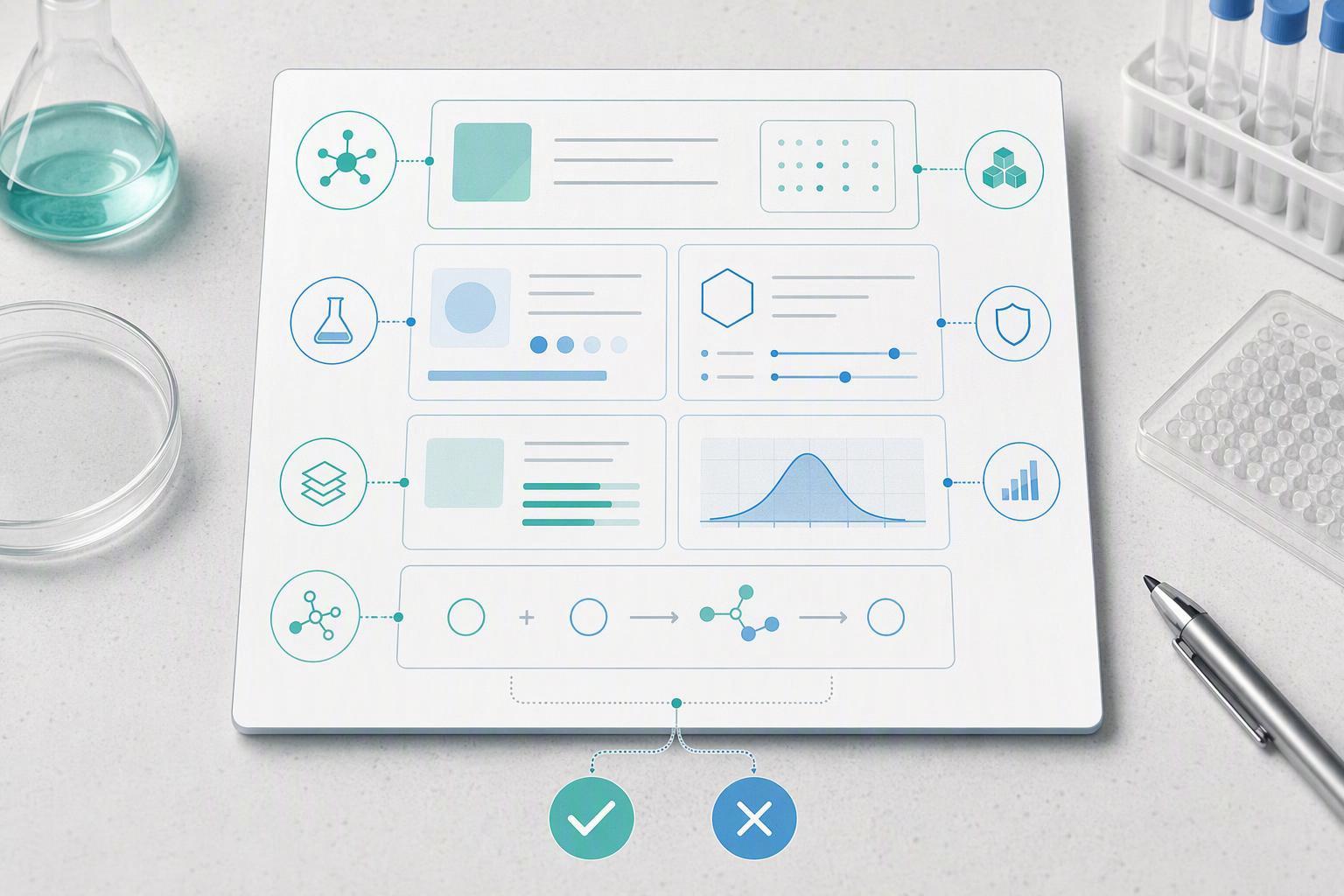
Het overdrachtsartefact moet op zichzelf beoordeeld kunnen worden. Het bevat de reeks met een versie-ID, de wijzigingen en beide uiteinden, haalbaarheidsvlaggen voor hydrofobiciteit en aggregatierisico, het cysteïne- en disulfideplan, de beoogde schaal, en de zuiveringsroute. Een recensent die deze velden niet kan zien, kan niet zeggen of een mislukt lot een scheikundig probleem of een ontwerpprobleem was.
Controlelijst voor ontwerpoverdracht
Volgorde met versie-ID
Wijzigingen en N-/C-termini gespecificeerd
Hydrofobiciteit en aggregatievlaggen
Cysteïne- en disulfideplan
Beoogde schaal (mg tot kg)
Lialh4-synthese Zuiveringsroute
Wat de synthese moet vastleggen, Niet alleen presteren
Syntheseomstandigheden zijn gegevens, en de plaat wordt gemaakt tijdens de synthese of helemaal niet. 21 CFR-onderdeel 11 definieert een elektronisch document als elke combinatie van tekst, afbeeldingen, gegevens, geluid, picturaal, of andere informatierepresentatie in digitale vorm gecreëerd, gewijzigd, onderhouden, gearchiveerd, opgehaald, of gedistribueerd door een computersysteem, en het vereist veiligheid, computergegenereerd, tijdsgestempelde audittrails die onafhankelijk de datum en tijd van invoer en acties van operators registreren, met recordwijzigingen die eerder opgenomen informatie niet verdoezelen, minstens zo lang bewaard als de documenten zelf (21 CFR-onderdeel 11, eCFR, huidig).
De MHRA-richtlijnen bieden de woordenschat waaraan deze documenten moeten voldoen. ALCOA is toerekenbaar, leesbaar, gelijktijdig, origineel en accuraat; de “+” voegt compleet toe, consistent, duurzaam en beschikbaar, en de richtlijnen stellen duidelijk dat er geen verschil in verwachtingen is, ongeacht welk acroniem wordt gebruikt, omdat data governance-maatregelen ervoor moeten zorgen dat de data compleet zijn, consistent, duurzaam en beschikbaar gedurende de hele levenscyclus van de gegevens (MHRA, GXP-richtlijnen voor gegevensintegriteit, Maart 2018). De levenscyclus loopt van generatie en registratie tot en met verwerking, gebruik, behoud, archiveren en terugvinden, tot vernietiging.
De praktische consequentie is dat een syntheserecord een veldset is, geen verhaal. Kavelidentiteit, hars en linker, geschiedenis van koppeling en ontbescherming, zuiveringsmethode en gradiënt, en tegenionformulier moeten elk aan een persoon en een tijdstempel kunnen worden toegeschreven en jaren later beschikbaar zijn voor opvraging. Een voorbeeld van een recordgenererende fase die de zuiverheid bijhoudt, inhoud, endotoxine, pH en steriliteit per partij over een bereik van milligram tot kilogram is de synthese- en karakteriseringsservice die wordt beschreven op molchanges.com; het gaat niet om de leverancier, maar om de veldset, omdat de kwaliteit van analytische peptidegegevens slechts zo goed is als de velden die het proces vastlegde terwijl het liep.
Karakterisering: Vijf nummers die niet uitwisselbaar zijn

Characterization in a closed-loop peptide design workflow rests on five attributes that cannot be collapsed into one purity number: identiteit, chromatografische zuiverheid, netto peptidegehalte, stabiliteit, and sterility and endotoxin. ik Q2(R2) defines specificity and selectivity as terms describing the extent to which other substances interfere with the determination of an analyte, with specificity describing the ultimate Liraglutide Synthesis state of measuring a desired analyte unequivocally (ik Q2(R2), adopted 1 November 2023, EU effective 14 juni 2024). Specificity can be verified by showing that a measured result is comparable to that of a second, well-characterized procedure that ideally applies a different measurement principle.
Identity is established with orthogonal techniques, not by the purity number. Peptide reference-standard work uses HPLC retention time, NMR, LC-MS/MS monoisotopic mass with sequence fragmentation, amino acid analysis for leucine and isoleucine discrimination, and chiral GC-MS for D-amino acids (Reference Standards to Support Quality of Synthetic Peptide Drugs, PMC, 2023-03-22). In one bivalirudin standard, ongeveer 50% of total phenylalanine content was the D-form, and the paper is explicit that this percentage does not represent enantiomeric purity, only the presence of the D-enantiomer.
Chromatographic purity and net content are separate specification attributes. Purity testing establishes and conducts suitable tests for product- and process-related impurities, while quantification procedures establish methods for quantifying peptide content, and both must be validated under ICH Q2(R2) (Regelgevingsrichtlijnen voor de analyse van therapeutische peptiden, PMC, 2025-02-08). Tegenion, bound water and residual salts can account for 15 naar 25% of total peptide mass without lowering the chromatographic purity number, and a worked vial example gives roughly 78% netto peptide, 12% tegenreactie, 6% gebonden water en 4% restzouten (Amerikaanse peptiden, 2026). That page sells peptides and testing, so read the range as an order-of-magnitude illustration; the defensible anchor is the method set, amino acid analysis for content, Karl Fischer for water, en USP <503> En <503.1> for acetic acid and TFA.
Stability has its own scope problem. Q5C applies to well-characterized proteins and polypeptides, their derivatives and products of which they are components, isolated from tissues, body fluids, cell cultures, or produced using rDNA technology, and it requires a stability-indicating profile covering identity, purity and potency because there is no single stability-indicating assay (ICH Q5C, 1995, huidig). It does not by itself settle applicability to chemically synthesized peptides. Q1A(R2) asks for data from at least three primary batches, a minimum of 12 months of long-term data at submission, and long-term conditions of 25 ± 2 °C / 60% RV ± 5% RH or 30 ± 2 °C / 65% RV ± 5% RH (Ik Q1A(R2), huidig). Sterility and endotoxin answer different questions: a sample can be free of viable organisms yet carry endotoxin, because sterilization removes organisms without removing lipopolysaccharide. The endotoxin limit is K/M, waar K is 5 USP-EU/kg for any route other than intrathecal, and method suitability requires recovery within 50% naar 200% (USP <85>, current harmonised chapter; Sievers, ongedateerd).
Het tegenargument: Meer sequenties verslaan betere records
The strongest counterargument is that more sequences beat better records, and the evidence does not support it as stated. The antimicrobial peptide field is the natural test case, because it has generated sequence volume at scale: over 5,000 antimicrobial peptides have been identified, yet fewer than 50 have been approved by FDA or are under clinical investigation (Machine learning for antimicrobial peptide identification and design, PMC, 2024-02-26). The two numbers come from different counting bases, database enumeration versus regulatory status, so they are not a success rate, but the gap is the point.
The same review documents why volume alone does not close it. Unlabelled sequences have often been used as negatives, for example UniProt entries lacking antimicrobial keywords, and false negatives may mislead models trained on them; mitigations include filtering unlabelled samples highly similar to positives, clustering and subsampling, label smoothing, and positive-unlabelled learning. The review also notes that studies differ in input representation, positive and negative classification, and evaluation, making it difficult to conclude which features and models performed best.
Peptide Manufacturers There is a real version of the counterargument, and it deserves stating. More sequences help when the additional sequences are accompanied by the metadata that records how they were generated, because that metadata is what lets a downstream user understand the biases and limitations of a model. Volume without provenance is the failure mode, not volume itself.
Implicaties: Wat verandert er als de recordlaag betrouwbaar is?
A trustworthy record layer changes what a design iteration can claim. When a characterization result is attributable, contemporaneous and complete, it becomes a legitimate input to the next design cycle rather than a verdict on the last one. The ML-for-AMPs review’s call for standardized datasets, consistent train-validation-test splits and benchmarking maps onto the same requirement ICH Q2(R2) already formalizes for analytical procedures: the experimental design of a validation study should reflect the number of replicates used in routine analysis to generate a reportable result, and the study should be documented in a protocol and a report (ik Q2(R2), 2023/2025).
Repeatability is where that becomes concrete. Vraag 2(R2) requires repeatability to be assessed using a minimum of 9 determinations covering the reportable range, Bijvoorbeeld 3 concentrations with 3 replicates each, or a minimum of 6 bepalingen op 100% of the test concentration. A laboratory that cannot produce those replicates on demand has a record problem, not a statistics problem.
The limitation of this argument is worth stating in one sentence: no source found in this review measures how many designed peptide sequences reach a characterized, releasable lot in AI-assisted programs, so the claim here is about where the constraint sits, not about a measured failure rate. What the standards do establish is that purity, inhoud, identiteit, stabiliteit, sterility and endotoxin are separate attributes with separate acceptance criteria, and a loop that treats them as one number is feeding itself a distorted input.
Volgende stappen: Een beslissingsregel die een beoordelaar kan toepassen
A reviewer can apply a five-question test to any analytical data package before accepting it as a design input. The questions are formatted to be copied into a review checklist.
Reviewer checklist
Is identity established by an appropriate identity strategy, adding Penetratin orthogonal techniques when needed, not by the purity number alone?
Are chromatographic purity and net peptide content reported as separate values, with the content method named?
Does the stability package state its scope, and does it name the batches, duration and conditions?
Are sterility and endotoxin reported as separate results, with the endotoxin limit basis stated?
Does the record carry a time-stamped audit trail whose changes do not obscure earlier values? Groothandel in peptiden
These questions are a proposed review framework. The applicable legal and analytical requirements depend on the activity, ontwikkelingsfase, dosage form and record system; not every research lot requires compendial sterility testing, a particular stability submission package or Part 11 controles.
The medium-commitment next step is a conversation with a technical expert about the analytical data package behind a specific lot: which fields were captured during synthesis, which methods produced each reported number, and what the record would look like under audit. That conversation is where a partnering review either finds the record layer or finds its absence. N To C Peptide Synthesis
Veelgestelde vragen
Heeft een 99% Het HPLC-zuiverheidsresultaat betekent dat het peptide zelf in orde is?
A high HPLC area percentage does not establish identity, target content or assay suitability. Water, counterion and other components vary by lot. Use measured results and a clear calculation basis; purity and content are different purposes even if a validated platform supports both.
We hebben onze pijpleiding al op een lekkende splitsing aangelegd. Moeten we opnieuw beginnen?
Re-evaluate the model with a leakage-aware split and preserve the earlier score as a labeled historical result. Use the new baseline for fair model comparisons. Performance may change, but a lower numerical score is not guaranteed merely by changing the split.
Regelt ICH Q5C de stabiliteitstests voor chemisch gesynthetiseerde peptiden??
Niet op zichzelf. Q5C’s scope covers well-characterised polypeptides and proteins derived from biological sources or rDNA technology, and it asks for a stability-indicating profile rather than a single assay (ICH Q5C, 1995, huidig). Q5C does not itself settle chemically synthesised peptide stability, so a synthetic-peptide stability package has to state its own justification for the conditions, timepoints and assays it uses.
Isn’t ALCOA just paperwork?
Nee. The MHRA guidance states expectations do not differ between ALCOA and ALCOA+, and the underlying requirement is a complete, consistent, enduring and available record across the data lifecycle (MHRA, GXP-richtlijnen voor gegevensintegriteit, Maart 2018). In practice that means the raw chromatogram, the integration parameters and the analyst who set them have to survive retention, archiveren en terugvinden, not just the review meeting.
Kan een hogere ROC-AUC het vertrouwen in een door AI ontworpen peptide rechtvaardigen??
Not by itself. Under random train/test splitting, peptide ML datasets commonly reach ROC-AUC above 0.9 and models become almost indistinguishable, while leakage-aware splitting scores significantly lower (Zhang et al., ICLR 2026, 2026). Read the score against the split strategy and the provenance of the negatives before it informs a design decision.
Waarom kan een monster de steriliteitstest doorstaan en toch niet voldoen aan de eisen voor endotoxine??
Because the two tests answer different questions. Sterile filtration removes or kills organisms without removing lipopolysaccharide, so a sample can be free of viable organisms and still carry endotoxin, and the reverse is possible too. The endotoxin limit is K/M, met K bij 5 USP-EU/kg for routes other than intrathecal, and method suitability requires recovery within 50% naar 200% (USP <85>, current harmonised chapter). Treating one passing result as evidence for the other is where peptide analytical data quality breaks down.
Conclusie
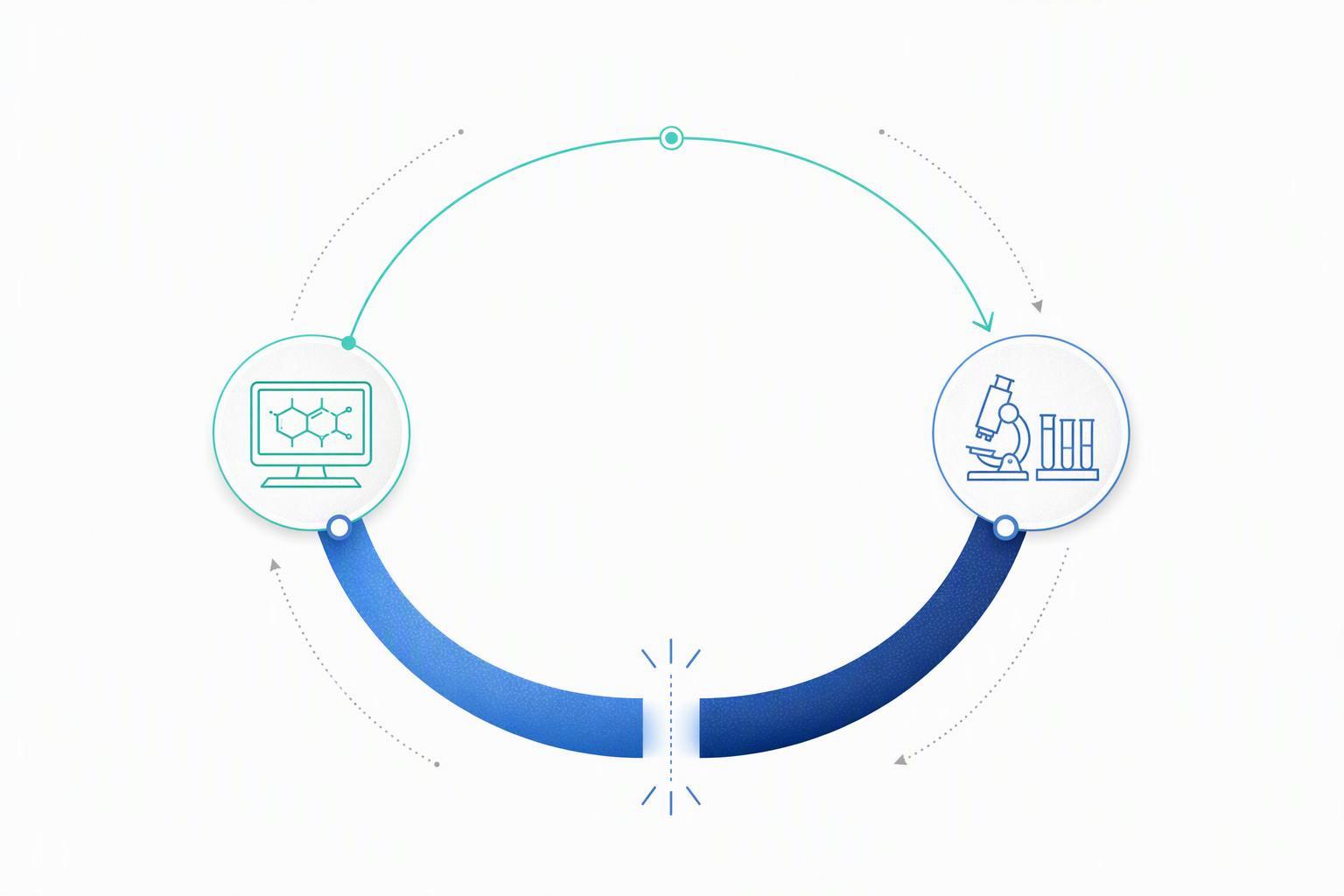
A useful design loop needs credible prediction and credible measurements. Complete records improve interpretation, while model performance, material behavior and biological validity still require independent evaluation.
Audit model validity together with the experimental package. Check independent or leakage-aware evaluation, synthesis success and failure records, identiteit, assay controls and the traceability of feedback used for the next design cycle.
The next step is a technical review of one lot’s analytical data package, with the five questions above as the agenda. That is a medium-commitment conversation, and it is the one that determines whether the loop can close.