Wat een platform-HPLC-methode voor GLP-1-onzuiverheidsanalyse feitelijk meet – en wat deze niet doet

Een platform-gradiënt met omgekeerde fase scheidt peptiden voornamelijk door algehele hydrofobiciteit en toegankelijk niet-polair oppervlak, niet op basis van sequentie-identiteit, zodat een enkele residusubstitutie of positioneel isomeer de biologische activiteit substantieel kan veranderen en tegelijkertijd een retentieverandering kan veroorzaken die kleiner is dan de piekverbreding of de adsorptievariabiliteit (Waters’ primer voor de ontwikkeling van peptidemethoden). Wat de methode meet, is hoeveel peptidehoudend materiaal in een venster elueert. Wat het niet meet, is welk molecuul dat materiaal is.

Detectie vormt de grens. Detectie bij 214 nm reageert op de amidebindingen van de peptideskelet en daarom op vrijwel alle peptidebevattende soorten, inclusief sequentievarianten en afknottingen, waarbij de respons veel minder afhankelijk is van het aromatische gehalte dan 280 nm; 280 nm detecteert voornamelijk Trp, Tyr en Phe kunnen de onzuiverheden die deze niet hebben, onderschatten (Waters’ primer voor de ontwikkeling van peptidemethoden). A 280 De nm-only-methode heeft daarom een detectieblinde vlek die a 214 nm-methode niet.
De vier claims die een peptidemethode moet dragen
Zuiverheid, identiteit, inhoud en stabiliteit zijn vier afzonderlijke claims, en één niet-gevalideerd chromatografisch piekgebiedresultaat bevestigt niet alle vier. Zuiverheid is een relatieve maatstaf voor hoeveel van het geïntegreerde gebied tot de hoofdpiek behoort, en het zegt op zichzelf niets over identiteit: een monster kan lezen 99% zuiver door HPLC en nog steeds het verkeerde molecuul zijn. Identiteit wordt door de massa tot stand gebracht, peptide in kaart brengen, aminozuuranalyse of NMR, en de EMA-richtlijn voor synthetische peptiden beveelt ten minste twee orthogonale methoden aan voor identificatie bij vrijlating, waarbij de aanvrager verantwoordelijk is voor het tonen van de combinatie, bevestigt op ondubbelzinnige wijze de volgorde.
Inhoud is de hoeveelheid van het aanwezige peptide, normaal uitgedrukt tegen een referentiestandaard en gecorrigeerd voor tegenionen, water en zout. Stabiliteit is net zo goed een eigenschap van de methode als van het molecuul: Ik Q1A(R2) vereist stabiliteitsstudies waarbij gebruik wordt gemaakt van gevalideerde stabiliteitsindicatieprocedures en waarbij de kenmerken worden onderzocht die tijdens opslag kunnen veranderen, met stresstests om afbraakproducten en -routes te identificeren (Ik Q1A(R2)). Een zuiverheidsmethode waarvan nooit is aangetoond dat deze een soort met gedwongen afbraak oplost, is geen methode die de stabiliteit aangeeft, wat het resultaat van de systeemgeschiktheid ook zegt.
Waarom structureel vergelijkbare GLP-1-peptiden en hun onzuiverheden een generieke omgekeerde-fasegradiënt verslaan
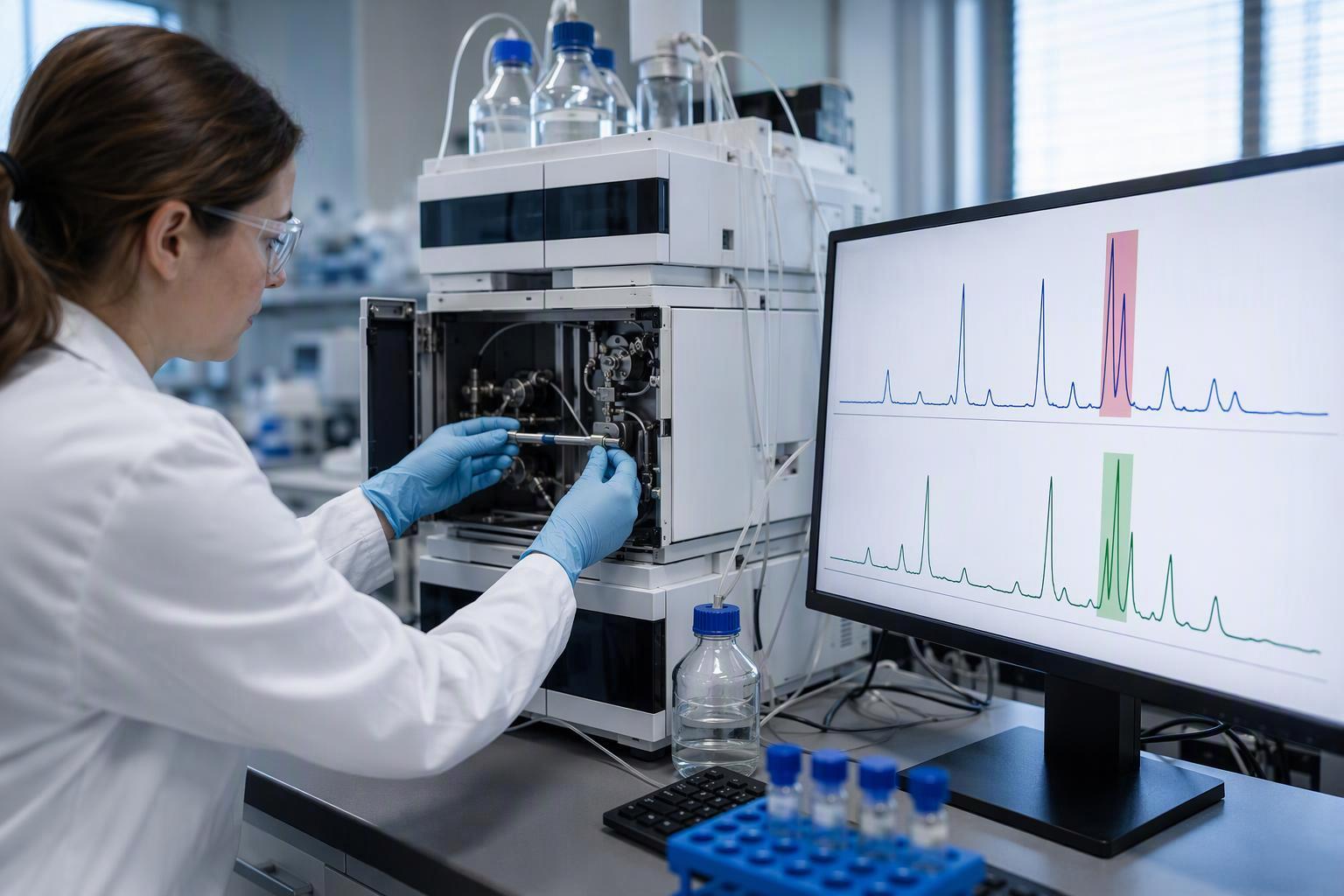
Structurele gelijkenis tussen GLP-1-peptiden vertaalt zich niet noodzakelijkerwijs in vergelijkbaar chromatografisch gedrag, daarom kan een platformmethode verbindingsspecifieke optimalisatie vereisen (Het argument van Thermo Fisher dat structurele gelijkenis geen chromatografisch gedrag voorspelt). Dezelfde bron meldt dat de samenstelling van de mobiele fase een grotere invloed had op de scheiding van onzuiverheden dan de chemie van de stationaire fase, en dat TFA-bevattende mobiele fasen vaak een betere piekvorm en resolutie gaven dan mierenzuur.
Kolomchemie verandert het antwoord, zelfs als de gradiënt dat niet doet. Op één enkele methode en gradiënt, CORTECS Premier C18+ en ACQUITY Premier Peptide CSH C18 isoleerden de meest unieke liraglutidevarianten, terwijl CORTECS Premier C18+ en ACQUITY Premier CSH Phenyl-Hexyl de meest unieke semaglutidevarianten isoleerden; de Peptide CSH C18 scheidde liraglutide beter dan semaglutide en de Phenyl-Hexyl-kolom deed het omgekeerde (Waters’ kolomselectievergelijking voor liraglutide en semaglutide). Er bestaat niet één beste column, alleen een beste kolom voor een genoemde analyt.
De onzuiverheidsklassen die de selectiviteit tenietdoen
Onzuiverheidsklassen verschillen in de mate waarin ze het molecuul veranderen en in de vraag of die verandering zichtbaar is bij een omgekeerde fasegradiënt.. De onderstaande massaverschuivingen komen uit een peptidetestdocument van derden en beschrijven de chemie, geen compendiale limiet.
|
Onzuiverheid klasse |
Massale verschuiving |
Waarom omgekeerde fase-strijd |
|---|---|---|
|
Oxidatie (Ontmoet, Trp, Cys) |
+16 En |
Kleine polariteitsverandering; vaak dichtbij of onder de ouder geëlueerd |
|
Dubbele oxidatie |
+32 En |
Tweede oxidatiegebeurtenis, cumulatieve retentieverschuiving |
|
Deamidatie (Asn → Asp, Gln → Glu) |
Hobt-koppeling +1 En |
Bijna-isobaar met ouder; het klassieke geval van co-elutie |
|
N-terminale cyclisatie (Gln → pyroGlu) |
-17 Ja |
Leveranciers van peptiden Verlies van een geladen N-terminus verandert de retentie op subtiele wijze |
|
Verwijdering Van Peptiden reeks |
Afhankelijk van het ontbrekende residu en de wijziging |
Ontbrekend residu; kan meer of minder hydrofoob zijn dan de ouder |
|
Resterende beschermende groep (tBu, Pbf, Trt) |
Bereken de netto behouden groep op basis van de molecuulformule |
Hydrofoob label door onvolledige verwijdering van de bescherming |
Selectiviteit is niet de enige faalwijze. Peptide-HPLC-methoden falen ook door adsorptie en niet-specifieke binding aan silica, resterende silanolen, metalen oppervlakken, frits, slangen, flesjes en filters; door aggregatie en precipitatie, aangedreven door de pH, ionische sterkte, temperatuur, oplosmiddel, concentratie of vries-dooi; via secundaire stationaire fase-interacties die staartvorming veroorzaken, splitsing of niet-oplossing; door metaalgemedieerde adsorptie, vooral van Asp- en Glu-bevattende soorten; door overdracht en geheugeneffecten; en door degradatie op de kolom (de beoordeling van faalwijzen voor peptide-HPLC). Een methode kan elke selectiviteitscontrole doorstaan en toch analyt aan het systeem verliezen.
Temperatuur en mobiele fase zijn geen eenrichtingshefbomen
Het verhogen van de kolomtemperatuur is de reflexfix, en het is niet betrouwbaar. Verhoging van de kolomtemperatuur vanaf 30 °C tot 60 °C loste twee tirzepatide-onzuiverheden op die samen bij de lagere temperatuur elueerden, maar op semaglutide met een Hypersil GOLD C4-kolom en TFA-bevattende mobiele fasen verhoogde dezelfde temperatuur de resolutie, en werden twee onzuiverheden gelijktijdig geëlueerd (Thermo Fisher's RPLC-UV-optimalisatiestudie voor semaglutide en tirzepatide). De richting van het effect hangt af van de combinatie van kolom en mobiele fase, niet op basis van een algemene regel.
Het Waters-temperatuuronderzoek laat hetzelfde niet-monotone gedrag binnen één methode zien: kolomtemperatuurveranderingen van ±5 °C veroorzaakten selectiviteitsverschillen die de resolutie van onzuiverheidssoorten voor liraglutide beïnvloedden, tirzepatide en semaglutide, met de beste resolutie tussen één kritisch paar (pieken 9 En 10) bij 55 °C en die twee soorten die samen elueren bij 65 °C (A Hobt-synthese Waters onderzoek naar temperatuurafhankelijkheid bij GLP-1-scheidingen). Een verandering van vijf graden bracht een cruciaal paar van opgelost naar co-eluerend, dat is de marge die een overdracht tussen laboratoria moet hebben om te overleven.
Waar het percentage UV-oppervlakte niet langer een verdedigbaar zuiverheidsgetal is
Gebiedsnormalisatie is een operationele zuiverheidsmaatregel. Om het om te zetten in een massa- of molfractie zijn passende aannames over de responsfactor vereist, detectiedekking en integratie. Verschillende residusamenstellingen of labels kunnen verschillend reageren, en niet-gedetecteerde of co-eluerende soorten vereisen verdere beoordeling.
De detectiegolflengte bepaalt welke onzuiverheden überhaupt in de berekening worden opgenomen. Omdat 280 nm detecteert voornamelijk Trp, Tyr en Phe, een onzuiverheid waarbij deze residuen ontbreken, kan op die golflengte ondervertegenwoordigd of onzichtbaar zijn, terwijl 214 nm reageert op vrijwel alle peptidebevattende soorten (Waters’ primer voor de ontwikkeling van peptidemethoden). Lees tegen de EMA-eis dat methoden geschikt moeten zijn voor de 0.1% rapportagedrempel, A 280 De nm-only-methode brengt een detectiekloof met zich mee voor niet-aromatische peptidegerelateerde onzuiverheden die de richtlijn niet excuseert.
Het gevolg van co-elutie
De EMA-richtlijn behandelt onzuiverheden die samen als één piek worden waargenomen en de mogelijke behoefte aan onafhankelijke methoden. Pas de relevante kwalificatiebeoordeling toe op het gemeten gecombineerde niveau; interpreteer de niet 1.0% drempel als toestemming om individuele identiteiten over het hoofd te zien of als een wijziging in de rapportagedrempel.
De praktijkcasus is goed gedocumenteerd. Een peptide kan lezen 98% zuiver door HPLC terwijl a +16 Da satellietpiek, gedeeltelijke oxidatie, gelijktijdig eluerend met de hoofdpiek, stays invisible to UV and plainly visible by mass. The LC-UV/MS work on thermally stressed exenatide found seven peaks with significantly elevated peak area, with the mass detector assigning a +16 Da oxidation difference at a −1.3 min retention-time shift and a non-enzymatic cleavage fragment at 3,254.1 En (LC-UV/MS impurity profiling of stressed exenatide). The UV trace alone would have reported a purity number that the mass data contradicts.
Hoe u een platformmethode kunt kwalificeren als geschikt voor het doel voor een nieuwe reeks voordat u erop vertrouwt
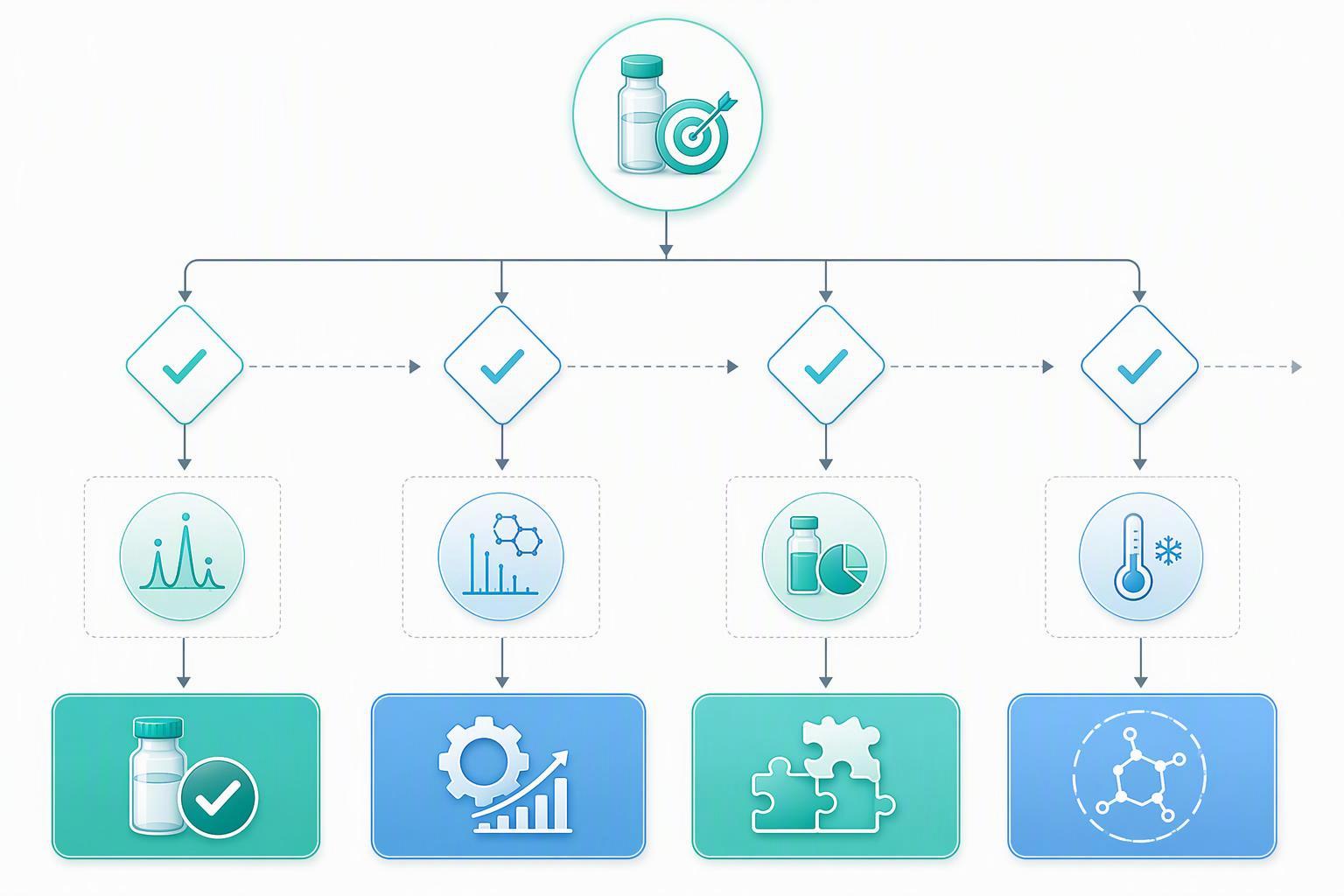
Qualification starts from the intended purpose, not from the method. ICH Q14 defines the analytical target profile as a prospective summary of the performance characteristics describing the intended purpose and the anticipated performance criteria of an analytical measurement, and states that the ATP drives the choice of analytical technology and is maintained over the lifecycle to ensure the procedure remains fit for the intended purpose (ICH Q14’s analytical target profile). Write the ATP for the new sequence first, then test the platform method against it.
The three-tier evidence expectation follows from that. Screening and characterization tolerate flexibility and incomplete robustness data if limitations are recorded; early clinical or development testing requires qualification with defined sample preparation, appropriate specificity, preliminary precision and accuracy, a usable range and basic system suitability; uitgave, stability and filing-supporting testing require predefined acceptance criteria, validated or qualified performance, robustness across analysts, days and equipment, controlled reference standards and evidence the method is stability-indicating where required (the phase-appropriate analytical control strategy). The tier you are in sets the evidence, and moving up a tier is the decision, not the method’s reputation.
De poortcriteria
Work through these in order, and stop at the first failure.
-
Intended purpose is written. The ATP names the attributes to be measured, the performance characteristics and the associated criteria, per ICH Q14. Groothandel peptiden
-
Detection is adequate for the reporting threshold. The method must be suitable to meet the Ph. Eur. 0.1% reporting threshold for synthetic peptides, volgens de EMA-richtlijn voor synthetische peptiden. A 280 nm-only method fails this gate for non-aromatic species.
-
Specificity is demonstrated by one of the three ICH Q2(R2) routes. Absence of interference, comparison against an orthogonal procedure, or the underlying scientific principles of the procedure; selectivity can be demonstrated even when the procedure is not specific (ik Q2(R2)).
-
Response factors are addressed for any impurity whose response differs from the reference material, per ICH Q2(R2).
-
Stability-indicating capability is shown through forced degradation, per ICH Q1A(R2).
-
System suitability is set by the procedure, not assumed from the chapter. USP <621> requires demonstrating that the complete analytical system performs adequately before and throughout analysis, with criteria set by the monograph or analytical procedure; the harmonised chapter adds a peak symmetry requirement of 0.8 naar 1.8 and calculates resolution from peak width at half height (USP <621> geschiktheid van het systeem). Passing system suitability is a necessary condition, not fitness for purpose.
De methode uitdagen met gestresste en verrijkte monsters
Forced degradation and spiking are what turn a gate checklist into evidence. The AQbD exenatide study screened four parameters (kolomchemie, organic modifier, acidic modifier, gradient time), detected and partially resolved 19 proces- and product-related impurity peaks, and produced a final MODR-verification chromatogram with 20 peaks at integrated area of 0.05% of groter, against an optimization target of USP resolution of at least 1.5 for a majority of identified product-related impurities (the AQbD exenatide method-development study). Those 20 peaks are detected peaks, not limits, and the gap between 19 at screening and 20 at verification is the value of challenging the method rather than trusting it. Kaiser Test For Peptides
Wanneer optimalisatie voldoende is, en wat je precies verandert
Optimize when plausible changes can meet the analytical target profile. Parameter changes can alter selectivity as well as retention and efficiency. Add an orthogonal procedure or redesign the method when the resulting evidence remains inadequate.
Wat te veranderen, in volgorde
Choose a structured optimization plan for the actual critical pairs. Mobile phase, stationary phase, gradient and temperature interact; one vendor comparison does not establish a mandatory order of changes or a universal gradient slope.
Wanneer u orthogonale technieken of verbindingsspecifieke methodeontwikkeling nodig heeft
Orthogonal techniques are needed when the method cannot separate all peptide-related impurities, which the EMA-richtlijn voor synthetische peptiden anticipates by stating that additional independent methods may be needed and that co-eluting impurities fall under the 1.0% qualification threshold unless justified. This is not a theoretical provision. The same exenatide study shows a deamidation pair where RPLC needed a shallow 0.5% organic per minute gradient over 114 minutes for only partial resolution with peak fronting, BEH Amide HILIC co-eluted them even at 150 mm, and BEH HILIC achieved partial resolution at 1% organic per minute in 45 notulen, halving analysis time and doubling throughput at the same 100 mm column length (Waters’ RPLC/HILIC orthogonal profiling study of exenatide).
De orthogonale modus kiezen
The choice follows from what the primary mode cannot see. HILIC is the documented complement for variants that reversed phase cannot baseline-resolve, and the mode matters within HILIC: BEH Amide and BEH HILIC behaved differently on the same deamidation pair. Mass detection is the complement for identity and for co-eluting species, since a mass detector can read the characteristic mass shift of an impurity that stays under the main UV peak. The limit of mass detection is that HRMS cannot by itself distinguish isomeric and isobaric impurities, because racemization produces D-amino acid impurities with the same mass as the parent drug, and TFA used as the ion-pairing agent suppresses peptide ionization in the mass spectrometer (the LCGC interview on GLP-1 analytical challenges). An orthogonal method that shares the same blind spot is not orthogonal.
Wanneer verbindingsspecifieke ontwikkeling het eerlijke antwoord is
Compound-specific development is the honest answer when the ATP cannot be met by any combination of platform parameters and orthogonal modes without redesigning the method around the analyte. The evidence points that way for the class as a whole: the Thermo Fisher study concluded that method optimization must be compound-specific and that a universal platform method cannot be directly applied to different GLP-1 receptor agonists, with chromatographic conditions tailored to each analyte (Thermo Fisher's RPLC-UV-optimalisatiestudie voor semaglutide en tirzepatide). The regulatory framework accommodates this through ICH Q14, which allows a minimal (traditional) approach or elements of an enhanced approach, with the enhanced approach using prior knowledge and risk assessment to identify influential parameters and establish a MODR through univariate or multivariate studies (Ik Q14). Platform knowledge is the starting point; the ATP decides how far it carries.
Wat het overdrachts- en administratiepakket moet bevatten, zodat een claim op vergelijkbaarheid de beoordeling overleeft
Method transfer for peptides fails on details that small-molecule transfers tolerate. Differences in system dwell volume are a frequent, underappreciated source of transfer failure because peptide separations rely on very shallow gradients, and column temperature and flow rate are more consequential for peptides than for small molecules because large molecules diffuse more slowly (LCGC’s practitioner discussion of GLP-1 method transfer). A shallow gradient amplifies every volume difference between instruments.
The record has to let an independent reviewer reconstruct what each laboratory did. That means method identity and version; column manufacturer, scheikunde, afmetingen, deeltjes- en poriegrootte, serial or lot number, conditioning history, injection count, storage and replacement criteria; instrument and detector IDs with software and firmware versions; measured or qualified dwell volume with the measurement method and any compensation applied; column-oven and autosampler setpoints with actual recorded temperatures and equilibration time; and mobile-phase preparation details including solvent and reagent grades, supplier and lot numbers, water source, pH and adjustment reagent, preparation date and time, preparer and verifier, filtration and degassing, storage container and expiry or hold time (FDA’s comparability and method-transfer expectations).
De data-integriteitslaag
The record is only defensible if the underlying data meet ALCOA expectations. MHRA defines ALCOA as attributable, leesbaar, gelijktijdig, origineel en accuraat, with the plus referring to complete, consistent, duurzaam en beschikbaar, and states that raw data must permit full reconstruction of the activities and that where data were captured in a dynamic state and generated electronically, paper copies cannot be considered raw data (MHRA’s ALCOA expectations for chromatographic raw data). For chromatography this is specific: a printed chromatogram loses the ability to reprocess the data and expand the baseline, which is exactly the capability a reviewer needs when a co-elution question arises.
Waar een verbonden datapakket helpt
The practical failure at handoff is not a missing document but a missing connection between documents. When the method version, the column lot, the dwell volume measurement and the integration decisions live in separate files, a reviewer cannot reconstruct the run without asking the originating laboratory, and the comparability claim stalls on correspondence rather than on science. A connected data package that keeps the method record, the instrument record and the raw chromatographic data linked to the same sample and run identifiers removes that reconstruction step. That is the narrow, practical role such a package plays here: it makes the reviewer’s reconstruction possible without a round of questions.
Veelgemaakte fouten die van een methodevraag een archiveringsvraag maken
The first mistake is treating system suitability as fitness for purpose. USP <621> requires the complete analytical system to perform adequately, with criteria set by the procedure, and it does not impose a universal resolution value (USP <621> geschiktheid van het systeem). Passing suitability says the system is behaving today, not that the method answers the intended question.
The second is reading a UV purity number as an identity or a completeness claim. A resolved peak is not an identified peak, en een 98% area percent is not evidence that the remaining 2% is benign. The third is assuming a resolved peak is a single species: co-eluting impurities observed as one peak take the 1.0% qualification threshold unless otherwise justified (EMA-richtlijn voor synthetische peptiden). The fourth is assuming a successful in-house transfer means the method is transferable, when dwell volume and shallow gradients move selectivity between instruments (LCGC’s practitioner discussion of GLP-1 method transfer).
Veelgestelde vragen
Betekent het slagen voor de geschiktheid van het systeem dat de platformmethode geschikt is voor het beoogde doel??
Nee. USP <621> requires demonstrating that the complete analytical system performs adequately before and throughout analysis, and it sets no universal resolution value; criteria come from the monograph or the analytical procedure (USP <621> geschiktheid van het systeem). Fitness for purpose is a separate question, answered against the analytical target profile defined in ICH Q14 (Ik Q14).
Kan het percentage UV-oppervlak dienen als zuiverheidsgetal voor een vrijgavespecificatie??
It can serve as a purity measure, but not as an unqualified one. Area normalization assumes comparable response per mole, en ik Q2(R2) directs that relative response factors be calculated where an analyte’s response differs from the reference material (ik Q2(R2)). Detection wavelength also sets which species enter the calculation, sinds 280 nm detecteert voornamelijk Trp, Tyr en Phe (Waters’ primer voor de ontwikkeling van peptidemethoden).
Hoe weet ik of ik moet optimaliseren of orthogonaal moet gaan??
Optimize when the problem is parameter range and the critical pair responds to mobile phase, kolomchemie, temperature or gradient slope. Go orthogonal when the pair does not respond to any of those, as with the exenatide proline-insertion variant that RPLC could not baseline-resolve after extensive optimization while HILIC reached Rs = 2.94 (Waters’ RPLC/HILIC orthogonal profiling study of exenatide).
Wat zorgt ervoor dat de overdracht van een peptidemethode tussen laboratoria mislukt??
Dwell volume differences are a frequent and underappreciated cause, because peptide separations rely on very shallow gradients, and column temperature and flow rate matter more for peptides than for small molecules (LCGC’s practitioner discussion of GLP-1 method transfer). The transfer record must therefore carry the measured dwell volume and the measurement method, along with column lot, conditioning history and mobile-phase preparation details (FDA’s comparability and method-transfer expectations).
Conclusie
The decision comes down to one question asked in the right order: what does the intended purpose require, and does the platform method meet it? Write the analytical target profile first, per ICH Q14, then test the method against the EMA 0.1% rapportagedrempel, de ICH Q2(R2) routes to demonstrating specificity, and forced-degradation evidence of stability-indicating capability. If the method clears those gates, use it as-is and record the limitations. If it fails on parameter range, optimize in the order that matters: mobiele fase, kolomchemie, temperatuur, then gradient slope. If it fails on selectivity, add an orthogonal mode that does not share the same blind spot. If the ATP cannot be met without rebuilding the method around the analyte, commit to compound-specific development, which is what the class-level evidence supports.
The transfer package is where the decision is tested by someone else. Carry the dwell volume measurement, the column lot and conditioning history, the mobile-phase preparation record and the raw electronic data, because MHRA’s reconstruction requirement is what a reviewer will apply. The next step is to take the ATP for the sequence in front of you and run it against the six gate criteria; if you want a second pair of eyes on that assessment, talk to an expert before the method goes into a filing.