Kader voor kwaliteit en bestuur van peptideleveranciers
Inhoudsopgave
Wat het handhavingsrapport van de BPC-157 feitelijk laat zien
Het regelgevingsbeeld veranderde volgens een gedateerd schema, en elke stap wordt gedocumenteerd. Op juli 23, 2026, de Vergaderpagina van het Pharmacy Compounding Advisory Committee van de FDA vermeld BPC-157 (vrije basis) en BPC-157-acetaat ter beoordeling tegen het gebruik van colitis ulcerosa, met briefingmateriaal waarin de stoffen worden voorgesteld niet worden toegevoegd aan de 503A Bulklijst. De commissie stemde met 8–6 stemmen, bij één onthouding, om aan te bevelen ze toch toe te voegen, als McDermott's lezing over de PCAC-uitkomst records.
Die stemming legaliseert compounding niet. De FDA vertelde tijdens de bijeenkomst dat het “zelden afwijkt” van de PCAC-aanbevelingen, maar voor de laatste toevoeging is regelgeving met kennisgeving en commentaar nodig die zou kunnen binnendringen 2027 of zich over meerdere jaren uitstrekken. Tot dan, BPC-157 bevindt zich buiten categorie 1 en uit de definitieve 503A Bulks-lijst.
De handhaving wachtte niet op de regelgeving. Vijf CDER-waarschuwingsbrieven uit augustus 24, 2026 ging naar online peptideverkopers, en alle vijf beweerden “alleen voor onderzoeksgebruik”, terwijl hun sites doseringsinformatie bevatten, injectie-instructies en dosiscalculators. In juni 2026, de Alabama Medical Board verbood artsen afzonderlijk van bereiding, het toedienen of verstrekken van peptiden van onderzoekskwaliteit aan patiënten.
Waarom labeling voor alleen onderzoek geen bestuursstrategie is
Alleen voor onderzoeksgebruik is een verklaring van het beoogde gebruik, geen juridisch schild. De FDA kan nog steeds een niet-goedgekeurd nieuw medicijn vinden waarvan de website van een leverancier als geheel menselijk gebruik laat zien, onder Sectie 201(G)(1) en Secties 301(D) En 505(A) van hetFD&C Wet, als Arent Fox Schiff legt het uit in zijn september 18, 2026 analyse van augustus 24, 2026 waarschuwingsbrieven. Die brieven waren pure, niet-goedgekeurde handhaving van nieuwe medicijnen, en dezelfde analyse past een netto-vertoningsnorm toe: Afgedekte marketingtaal kan er nog steeds voor zorgen dat een product een verkeerd merk krijgt als het algemene marketingbeeld menselijk gebruik impliceert.
Dat onderscheid betreft het geheel van alleen onderzoeksgebruik versus therapeutische claims. Een label bepaalt niet wat de omringende pagina is, productfotografie, dosering taal, of getuigenissen van klanten communiceren.
De faalwijze is voorspelbaar. Een leverancier stempelt RUO op de flacon, publiceert vervolgens een pagina die leest als een vermelding van een consumentenproduct, en het label stopt met werken. Governance betekent controle over het label, het beoordelen van claims vóór publicatie, controleren welke kanalen het product vervoeren, en het opnemen van meldingen van bijwerkingen in plaats van deze weg te gooien.
Wat een batchspecifiek analysecertificaat wel en niet bewijst
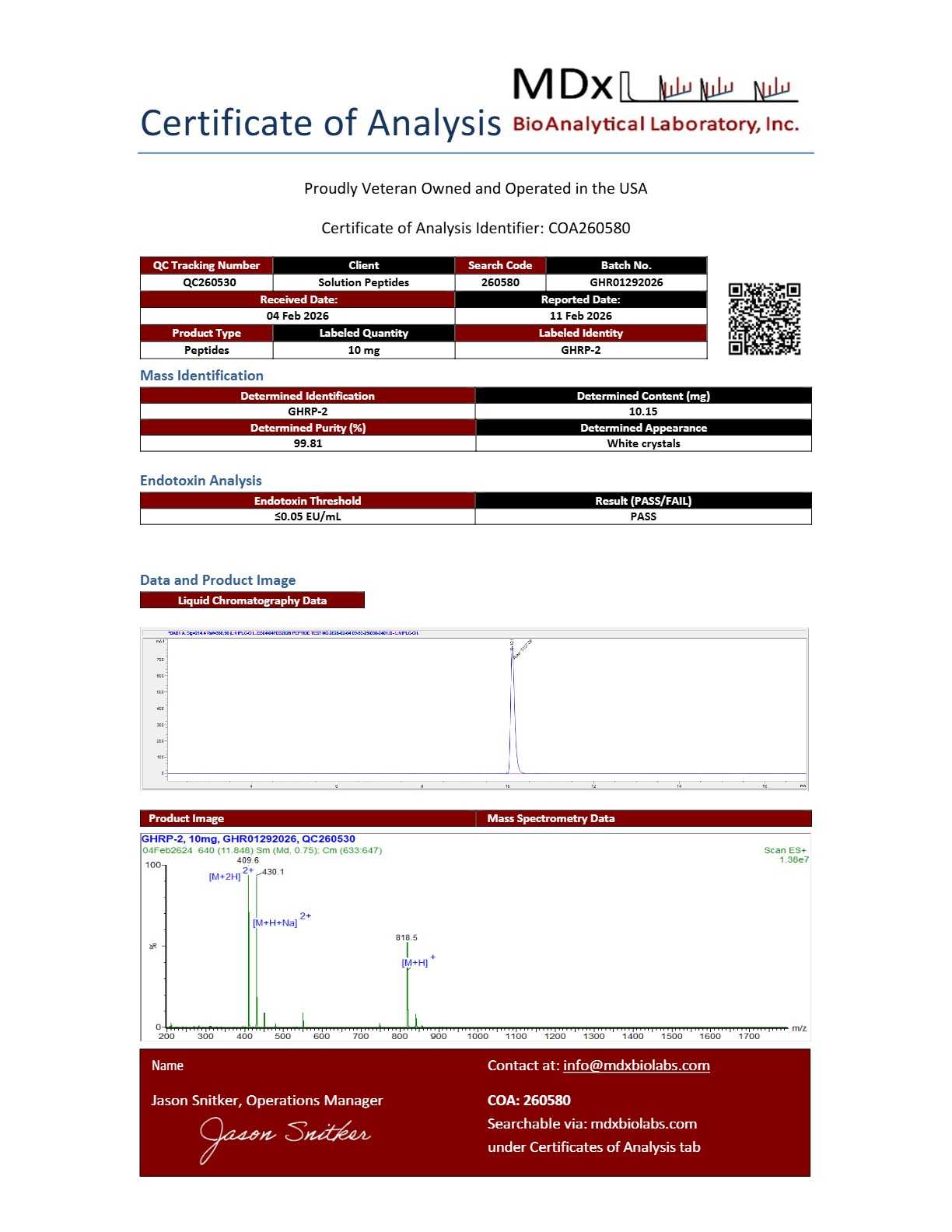
Een batchspecifiek analysecertificaat voor onderzoekspeptiden is het minimale document dat een leverancier moet kunnen overleggen, en het is het document dat het vaakst wordt aangezien voor een bewijs van kwaliteit. Het bewijst dat iemand een met name genoemde partij heeft getest en een resultaat heeft geregistreerd. Het bewijst niet wie de tests heeft uitgevoerd, welke methode ze gebruikten, of het materiaal in de injectieflacon overeenkomt met het materiaal op het etiket.
De 2024 multifactoriële kwaliteits- en veiligheidsanalyse van semaglutide-producten van illegale online apotheken, gepubliceerd in de Tijdschrift voor medisch internetonderzoek, testte drie flesjes gekocht bij online verkopers. Het gemeten semaglutidegehalte overschreed de aangegeven hoeveelheid met +28.56%, +38.69% En +33.58%, tegen +5.05% voor een referentie Ozempic 1 mg-pen (JMIR, 2024). The same three lyophilized samples were devoid of viable microorganisms at the time of testing, which shows how narrow a single passing result is: a clean microbial count says nothing about how much active material the vial contains.
Scope matters here. Three vials, one compound, purchased from online sellers, tested in 2024. The finding is not generalizable to every gray-market product, and it does not describe supplier-issued CoAs in general. It shows what a label figure and the physical material can separately be.
De grenzen van HPLC-zuiverheidstests voor peptiden
A 98% of 99% HPLC purity figure measures one method under one set of conditions. It is not a statement about what else is in the vial. De documented limits of single-method HPLC purity determinationare structural rather than incidental: co-eluting impurities can hide under the main peptide peak, and UV detection near 214 naar 220 nm misses species that absorb weakly or not at all, including sugars, glycols, lipiden, salts and buffer residues (PMC, “HPLC Analysis and Purification of Peptides”; the article is undated, retrieved for this review).
The number is also method-dependent. Kolomchemie, gradiënt, mobiele fase, detectie golflengte, flow rate and integration parameters all shape the result, so two laboratories can report different purities for the same lot without either being wrong.
That is why a purity percentage establishes neither identity nor safety. Orthogonal mass-spectrometric confirmation is what ties the peak to the intended sequence, and it says nothing about residual trifluoroacetate counterion content, resterende oplosmiddelen, water content or bioburden. Those are separate measurements, reported separately, or not reported at all.
Endotoxine- en steriliteitsdocumentatie: Twee verschillende vragen
A supplier that reports “sterility tested” has answered one question and left another open. Endotoxin and sterility documentation for research peptides are two separate records, and a lot can pass one while failing the other. USP <85> testen van bacteriële endotoxinen, usually run as a Limulus amebocyte lysate (LAL) testen, is quantitative for endotoxin only, reported in endotoxin units (EU) or EU/mg, and it does not detect viable microbes. USP <71> sterility testing is growth-based instead: the standard’s described method uses membrane filtration or direct inoculation into two media, fluid thioglycollate and soybean-casein digest, incubated for not less than 14 dagen, with the primary USP <71> document as the authority to check rather than a lab summary.
That distinction matters because a clean endotoxin figure is not a clean lot. In the three BPC-157 vials tested by researchers and published in JMIR, endotoxin ranged from 2.1645 naar 8.9511 EU/mg, which is a quantitative endotoxin result, not a sterility result.
Sleutel afhaalmaaltijd: LAL versus USP <71>
| Methode | Detects | Cannot detect | | LAL (USP <85>) | Endotoxine, quantitatively, in EU or EU/mg | Viable bacteria, fungi, or any non-endotoxin contaminant | | Steriliteit (USP <71>) | Viable microorganisms that grow under the test conditions | Endotoxine, and any organism that does not grow in the two media used |
A lot-matched result requires both tests run on the same lot number, with the lot number printed on each report.
Een raamwerk voor kwaliteit en bestuur van peptideleveranciers
A peptide supplier quality and governance framework is a set of auditable evidence requests, not a certificate you file once. Each dimension below works the same way: you request a specific record, it proves one bounded thing, and past that boundary it proves nothing. Run the six dimensions as a checklist before qualification and at every re-qualification.
The sequence is what the label claims, independent of retention time
Nothing about purity of species that co-elute
Endotoxine en steriliteit, lot-tied
LAL endotoxin result and sterility result naming the specific lot
Those two attributes wereDipeptide 2measured on that lot
Nothing about other bioburden or handling after the vial is opened
Tegenion, solvent and water content
Residual counterion, residual solvent and Karl Fischer water data where the synthesis route makes them relevant
The stated salt form and water content match the label
Nothing about stability over time
Change control and deviation records
Deviation/CAPA log and change-notification terms for the product
You learn about process changes instead of discovering themDipeptide
Nothing about changes the supplier does not classify as reportable
Kwalificatie van de leverancier Pna Synthesis bewijs
Audit report or questionnaire response, ISO 9001 domein, site and contact details
The quality system behind the batch exists and can be inspected
Nothing about the specific lot’s analytical results
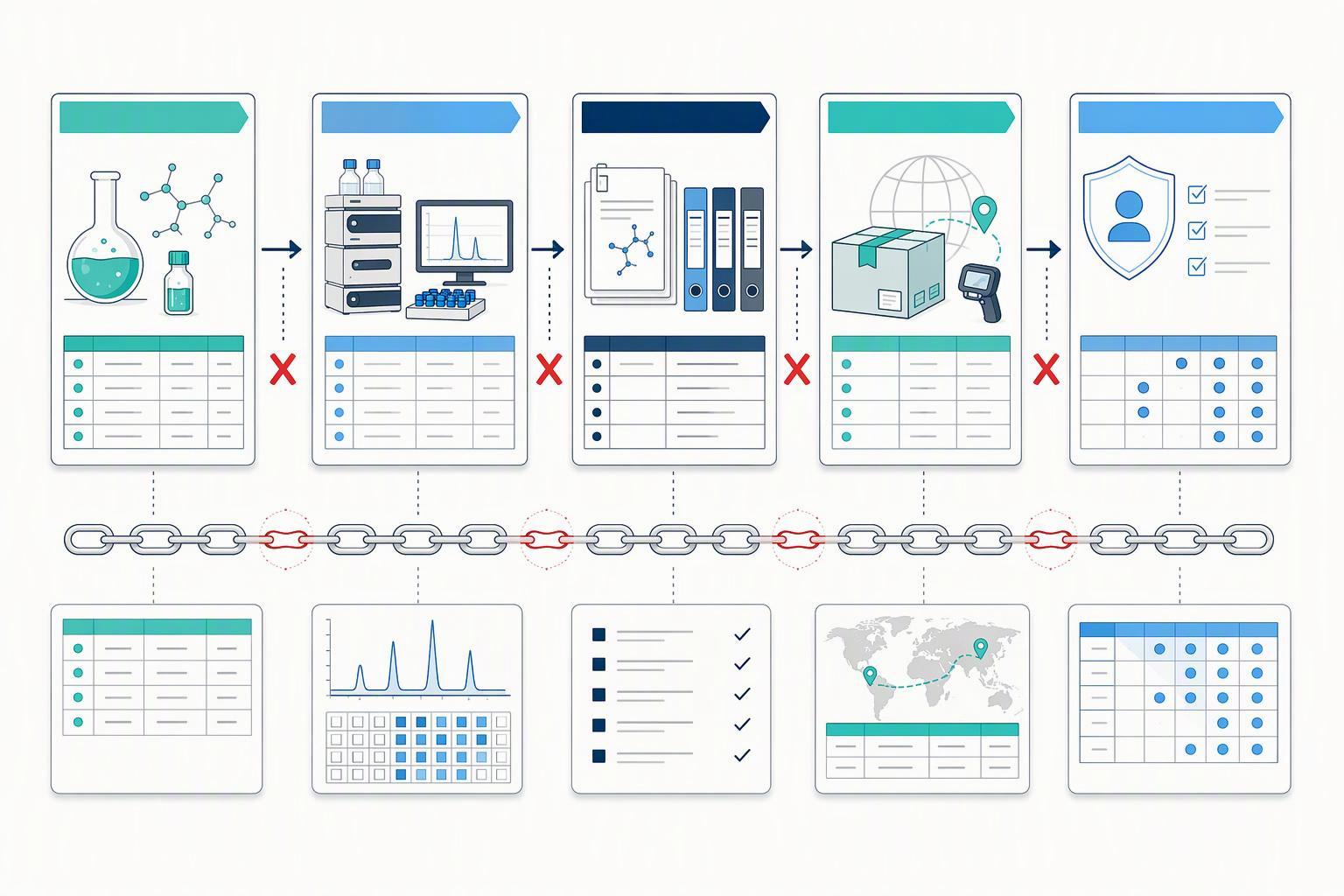
The peptide supplier quality and governance framework only holds if the records stay attached to the material. One caution on the first row: a batch-specific certificate of analysis for research peptides is only as strong as its lot linkage. A CoA without the shipped lot number is a marketing document, not a release record. Aangepaste peptidesynthesebedrijven
Documentatie Verwachtingen in de praktijk
A lot-matched release package is a set of documents that all carry the same lot number and all describe the same physical material. In practice it usually contains four things: a batch-specific certificate of analysis, the chromatogram that produced the purity figure, the mass spectrum that confirms identity, and any endotoxin or sterility result claimed for that lot. The chain breaks when one of those documents is generic rather than lot-specific.
Three failures show up repeatedly. A supplier reuses a single CoA across multiple lots, so the purity figure describes a reference batch rather than the vial in hand. A chromatogram is supplied without its integration table, which means the reader cannot see how the purity percentage was calculated or which peaks were excluded. Endotoxin testing is claimed on the CoA but the supporting report is not lot-matched, leaving no way to connect the result to the material shipped.
MOL Changes beheert Klasse 100 ultra-sterile cleanroom production with per-lot analytical release documentation including batch chromatogram and MS. Two gaps remain unresolved in the material available for this article: the specific cleanroom and environmental-monitoring evidence behind that production claim, and the exact wording of the brand’s research-use-only label. Neither should be inferred. Ask for both directly, and treat a supplier who cannot produce them as a supplier whose documentation chain has not been demonstrated.
Aan de slag: Een leverancier kwalificeren vóór de eerste bestelling
Start with one request: a lot-matched release package for a specific catalog number. Ask for the certificate of analysis, chromatogram and spectrum tied to the lot number printed on the vial you would actually receive. If the CoA references a different lot, or a “representative” lot, you have learned something useful before spending anything.
Then check that identity confirmation is orthogonal to the purity method. A mass spectrometry result and an HPLC purity figure answer different questions; two readings of the same chromatogram answer one. Where a supplier cannot show a second, independent method, treat identity as unconfirmed.
Derde, get change-control and deviation handling in writing before scale-up. Ask how you will be notified if a synthesis route, kolom, or testing laboratory changes, and who signs off on a deviation. A supplier who answers this in a document is easier to qualify than one who answers it in a call.
Voor Tip:Run these three checks on a small first order. The documentation package costs the supplier little and tells you more than any capability page.
To work through the full framework with your own catalog numbers, request a documentation package or talk to an expert. This article is published by a peptide supplier, so treat the criteria here as a buyer’s checklist rather than neutral advice.
Veelgestelde vragen
Wat moet er in een batchspecifiek analysecertificaat voor onderzoekspeptiden staan??
It should tie one document to one lot number and report methods, not just results. Minimaal: peptide sequence and lot number, the purity method (typically HPLC-UV or HPLC-CAD), the identity method (massaspectrometrie), the quantity method (amino acid analysis or UV content), and the acceptance criteria each result was judged against. A purity figure with no method, no lot and no specification is a number, niet documentatie.
Wordt bij onderzoek alleen gebruik gemaakt van etikettering, dan beschermt dit een leverancier?
Nee. RUO is a distribution control, geen juridisch schild. It tells the buyer the material is not intended for human or veterinary use, but it does not protect a supplier from responsibility for misleading therapeutic claims or marketing that implies clinical benefit. A supplier that stamps RUO on the vial while implying therapeutic use elsewhere has created a contradiction, not protection.
Wat vertelt HPLC-zuiverheidstests u niet??
An HPLC purity figure tells you the proportion of the main peak by the detector’s response, and nothing about what the remaining percentage is. It does not identify residual counterions such as trifluoroacetate, resterende oplosmiddelen, watergehalte, or the impurity peaks themselves. Independently tested research peptides have measured as low as 7.70% purity against 99% label claims, which shows how far a headline number can sit from the underlying reality.
Zijn endotoxine- en steriliteitstesten hetzelfde??
Nee, and treating them as interchangeable is a common documentation error. Endotoxin testing measures lipopolysaccharide, typically by the LAL method in USP <85>. Sterility testing looks for viable microbial contamination, typically by membrane filtration or direct inoculation under USP <71>. A product can pass one and fail the other.
Hoe onderscheid je een legitieme onderzoeksleverancier van een twijfelachtige??
A legitimate research supplier answers specific questions with specific documents. Ask for the batch-specific certificate of analysis with lot number and methods, the chromatogram and mass spectrum for that lot, the endotoxin and sterility methods by name, and the facility’s quality certification. A supplier that responds with a generic brochure, a purity percentage with no method, or a refusal to name the testing laboratory is telling you what its documentation is worth.
Conclusie
The single most important thing to carry away is that documentation is a chain the buyer has to test, not a document the supplier hands over. Een analysecertificaat, een chromatogram, an endotoxin result and a sterility statement each answer a narrower question than the folder they arrive in suggests, and the gaps between them are where risk accumulates. The peptide supplier quality and governance framework in this guide exists to make those gaps visible before an order is placed, not after a batch is in hand.
The enforcement record is moving quickly. The August 2026 warning letter set reflects the state of regulatory attention at that moment and may be superseded as further actions are published, so treat it as a dated snapshot rather than a settled position. Re-check the primary sources directly when a qualification decision depends on them.
The next step is small and concrete: pick one supplier already on your list, request the batch-specific records for a single lot, and trace each claim back to the method that produced it.
Hoofd Technologie; Expert op het gebied van peptidesyntheseKernexpertise: Complexe peptidesynthese, niet-natuurlijke aminozuurmodificaties, en de constructie van cyclische peptiden en geniete peptiden.
Biografie:Zejun Peng heeft uitgebreide ervaring in organische chemie en peptidesynthese. Hij is bedreven in de gecombineerde toepassing van vaste-fase-peptidesynthese (SPSS) en peptidesynthese in de vloeibare fase (LPPS), en is bijzonder bedreven in het overwinnen van “extreem moeilijk te synthetiseren sequenties” (zoals peptiden met ultralange keten, zeer hydrofobe sequenties, en meervoudige vouwing van disulfidebindingen). Onder zijn leiding, het team heeft met succes technische knelpunten overwonnen in verschillende gespecialiseerde aanpassingen (zoals N-methylering, PEGylatie, en fluorescerende etikettering), het handhaven van een succespercentage van de synthese van meer dan 98%.
Hallo daar! 👋 Welkom bij MOL Veranderingen. Hoe kunnen wij u vandaag helpen? Vraag gerust naar onze peptidesynthese, CRO-diensten, or any product inquiries — just type your message below and we'll continue the conversation on WhatsApp.