De conventionele visie: Automatisering is het antwoord op het zuiveringsknelpunt
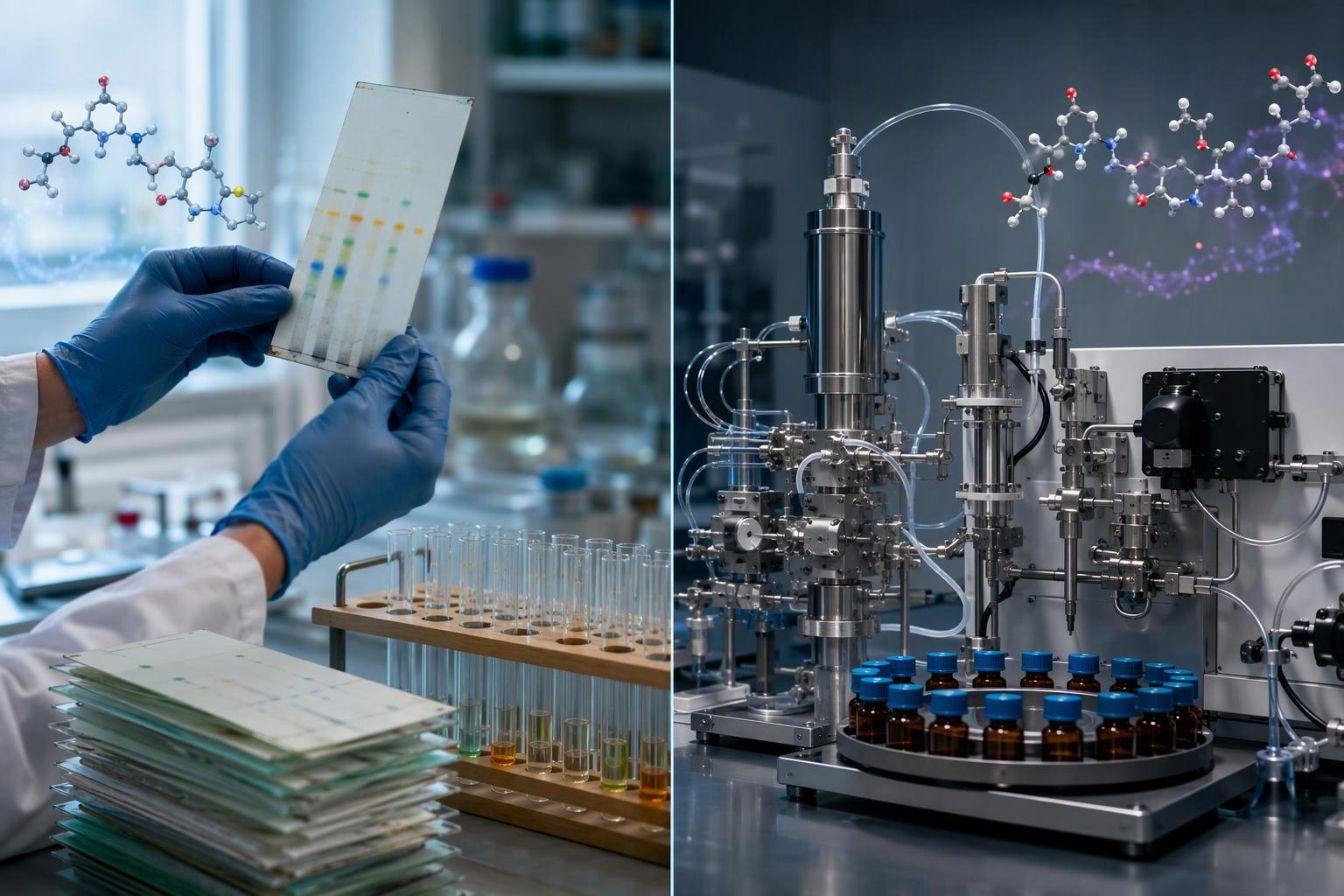
Het mainstream-standpunt is duidelijk: peptidesynthese in de vaste fase laat ruw materiaal achter in hetzelfde bereik van 50-80% ruwe zuiverheid, en bij zuivering moet de onzuiverheidslading worden verwijderd voordat iets stroomafwaarts verder kan gaan. Dat bereik is de eerlijke basis om zuivering het stroomafwaartse knelpunt te noemen, en dit is de reden waarom de arbeidsintensiteit van handmatig fractiewerk en de batch-tot-batch inconsistentie van gradiëntmethoden zoveel aandacht krijgen.

Waarom het uitzicht populair is, is gemakkelijk te begrijpen. Geautomatiseerde parallelle zuivering lost echt een echt syntheseprobleem met hoge doorvoer op, en de stroomafwaartse kosten van langzame zuivering zijn eerder reëel dan retorisch.
Waar het vandaan komt, is belangrijker dan wat er staat. De framing wordt voornamelijk gedragen door documentatie van het leveranciersplatform en verslaggeving over gebeurtenissen, die zuivering behandelen als één stap in een pijplijn in plaats van als een probleem met zijn eigen faalwijzen. Dat is ook de reden waarom de term robuustheid van de peptidezuiveringsmethode losjes in het veld wordt gebruikt, Er wordt aangenomen dat het platform een eigendom is in plaats van een eigendom dat de koper verifieert.
Waarom de standaard automatiseringspitch faalt
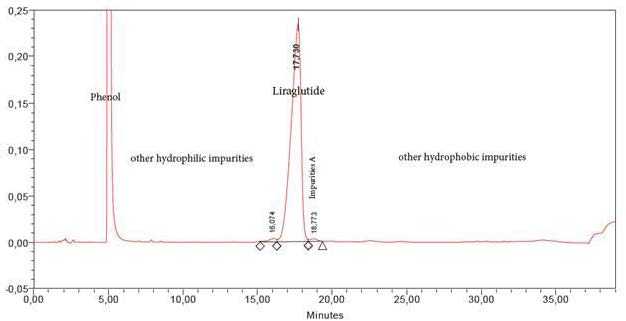
De meeste beweringen over AI bij de zuivering van peptiden worden op het verkeerde abstractieniveau gedaan. Ze beschrijven wat een platform in het algemeen kan doen, niet wat het bereikt voor een specifieke reeks, en de kloof tussen deze twee dingen is waar de budgetten voor methodeontwikkeling ten onder gaan.
Retentievoorspelling is het duidelijkste geval. DeepRT bereikte R² 0.996 op ongemodificeerde peptiden, maar had overdrachtsleren nodig om R² vast te houden 0.978 op post-translationeel gemodificeerde versies (DeepRT, PMC, opgehaald 2026-02-10). Hetzelfde patroon is te zien in DeepLC, waarbij transferleren een afzonderlijke aanpassing vereiste voor een pH-verschoven basis-pH-dataset en een atypische TMPP-gemodificeerde dataset (DeepLC-overdrachtsleren, PMC, opgehaald 2026-02-10). Het model wordt niet gratis overgedragen.
Herstel is ook geen platformeigenschap. In één studie, A 9.4 mm semi-preparatieve kolom gemiddeld 90.7% herstel tussen 0,75 en 200 mg, terwijl een 2.1 mm smalborige kolom gaf 82.1% bij 6 mg en een 1.0 mm microboring gaf 78.0% bij 3.0 mg (kolomformaat en herstel, PMC, 2006). Herstel varieert per kolomindeling en belasting, niet per platform.
⚠️Waarschuwing: Een claim op platformniveau is geen sequentiespecifiek prestatiebewijs. Vraag naar het chromatogram voor uw reeks, bij uw lading, op uw kolom.
De moeilijkste reeksen zijn die waarin autonomie het minste bewijs heeft. Een hydrofoob transmembraanfragment met 34 residuen gaf 4% opbrengst in DMF en 12% in 80% NMP/DMSO, zonder product onder één Fmoc-SPPS-voorwaarde (hydrofobe fragmentsynthese, PMC, 2006). De robuustheid van de peptidezuiveringsmethode is precies wat deze gevallen testen, en het is precies wat de toonhoogte weglaat. De toonhoogte beschrijft het gemakkelijke geval en generaliseert naar het moeilijke geval.
Wat de gegevens feitelijk laten zien over AI bij peptidezuivering
Spps-peptide De verdedigbare bijdrage van AI aan de zuivering van peptiden is beperkt, stroomopwaarts, en voorwaardelijk, niet van begin tot eind. Het zelfstandige werk zit in de methodeontwikkeling, niet in de fractiecollector.
Het duidelijkste voorbeeld is een sequentiebewust ANN-retentiemodel dat is getraind op ~345.000 peptiden uit 12,059 LC-MS/MS-analyses, die een gemiddelde elutietijdprecisie bereikte van ongeveer 1.5% en geplaatst 50% van peptiden binnen een foutmarge van ±1,52% (Verbeterd Peptideproductiebedrijven peptide-elutietijdvoorspelling, 2006). Veelzeggender voor aangepaste sequenties: het model scheidde isomere peptiden die m/z delen, alleen gebruik maken van volgorde. Dat is van belang omdat identificatie op basis van alleen massa isomeren niet kan oplossen, en het is precies de kloof die de ontwikkeling van methoden voor PEGylated tegenhoudt, fluorescerend, of geglycosyleerde doelwitten.
De tegenvoorbeelden laten zien waar de autonomieclaim ophoudt. De heterogeniteit van de PEG-lengte dwingt tot een keuze tussen zuiverheid en herstel: zuivering moet oligomeren scheiden die van elkaar verschillen 44 En, tegen de 57 Da van glycine, het kleinste aminozuurresidu (Impact van N-terminale PEGylatie op de synthese en zuivering van peptide-epitopen, 2024). Gerapporteerde zuiverheid bereikt 99.5% gemiddeld, maar alleen door zuiverheid gekocht met smalle piekafsnijding, die minder product verzamelt. Een geoptimaliseerde voorbereidende workflow met een overdraagbaarheidscorrectiemodel bereikte de bovenstaande initiële zuiverheden 90% met opbrengsten van meer dan 30% (Verbetering van analyse en overdraagbaarheid bij peptidezuivering, 2026). Dat is een overdraagbaarheidsresultaat, geen autonomieresultaat.
Sleutel afhaalmaaltijd: Behandel autonomie als een eigenschap per stap met een bewijspoort, geen platformeigenschap. Kies voor automatisering, niet automatiseerbaar, of heeft per sequentieklasse een menselijke poort nodig.
De betere aanpak: Op bewijs gebaseerde autonomie
Neurowetenschappelijk onderzoeksgebied Geef een zuiveringsstap alleen over aan een autonoom systeem als de leverancier batchspecifiek bewijs heeft geleverd voor die stap in uw sequentieklasse. Die ene voorwaarde scheidt ‘evidence-gated’ autonomie van het standaard automatiseringsveld, waarin u wordt gevraagd een platform te vertrouwen en vervolgens de uitvoer te verifiëren. Merrifield-synthese
Vier principes bepalen de aanpak:
-
Massagestuurde fractieverzameling levert het sterkste argument op. UV- en MS-triggers zijn dat wel complementair in plaats van overbodig: UV vangt slecht ioniserende verbindingen op, MS catches peptides with low UV extinction, and a combined trigger excluded impurities in a documented peptide case.
-
UV-only collection is not equivalent when coeluting impurities sit within 0.1 min of the target. In that multi-step case, MS triggering restored selectivity when UV separation was poor under standard conditions.
-
Orthogonal confirmation is a gate, not a final checkbox. FDA Q6A treats a single retention time as non-specific and accepts two different-principle procedures or a combined one, dat is the Q6A decision logic that makes orthogonality a gate.
-
Recovery and purity are optimized together. Aggressive pooling fragments the product into narrow cuts.
Voor Tip: Design the orthogonal gate into the workflow, not into final QC. A confirmation step that runs after pooling cannot recover a fraction that was already mis-pooled.
The proof point to demand is a documented transferability result, such as the correction model published in the 2026 peptide purification study: a vendor who can show how a method transfers between systems has shown you the evidence standard, not just the instrument.
Hoe u dit kunt toepassen: Wat u moet eisen voordat u een stap overdraagt
Start by asking for batch-specific chromatograms, not a platform capability deck. Everything below is a documentation request, not a technology question.
-
Classify your sequence against the known hard cases (one afternoon). Hydrofoob, cyclisch, disulfide-containing, PIN- or label-conjugated, and isobaric species each stress a different part of the method. Flag which criteria are at risk before you talk to anyone.
-
Demand batch-specific chromatograms and MS data (one to two weeks of correspondence). The method and time window must be stated. Representative traces are not evidence about your sequence.
-
Require a defined sterility and endotoxin testing scope, not an implied one. Ask which tests, on which samples, at which stage.
-
Require validation gates tied to the intended-purpose basis of Q2(R2) En the Q14 design space that makes “robust” a defined term. That framing treats robustness as a lifecycle property, not a claim.
-
Require at least two orthogonal methods, per de 0.10% impurity-identification threshold and the two-method rule, omdat identification by a single retention time is not specific.
Track recovery and purity as a pair. Test whether the design space survives a small deliberate parameter change. Expect evidence-gathering to dominate the first quarter.
Voorbehoud en waar de conventionele visie nog steeds geldt
The strongest limitation of this assessment is that it rests on published application notes and vendor documentation, and none of the sources gathered for it publishes a co-elution frequency for deletion and truncation impurities. The claim that orthogonal confirmation cannot resolve deletion co-elution is therefore a gap Tripeptide 1 in the evidence, not a finding. The sources state co-elution qualitatively, noting that deletion-related impurities can be chromatographically similar to the target and may partially co-elute, without quantifying how often (Journal of Pharmaceutical Investigation peptide quality review, 2026, opgehaald 2026-07-15).
Context matters too. For unmodified, well-behaved sequences in high-throughput screening, the conventional automated-parallel-purification pitch is largely correct, and the evidence gate is cheap to satisfy. Method development is a hybrid workflow, not model-only design: analytical scouting and rules of thumb narrow the space, then systematic optimization refines gradient, stroom, and modifier (preparative RP-HPLC peptide literature, 2025). Tripeptide 1
The AI-in-chromatography material is also recent and vendor-flavored, Dus 2026 capability may be framed here as moving from concept to closed-loop execution when it has in fact moved further. The argument is about the burden of proof, not whether autonomy works: a vendor who supplies batch-specific evidence has met the standard this article sets.
Openbaring: MOL Changes has a commercial interest in peptide quality standards and provides HPLC and MS purity testing.
Veelgestelde vragen
Is massagerichte fractieverzameling de kosten waard als UV-alleen werkt op eenvoudige sequenties??
On easy sequences, often not. UV and MS as complementary triggers earn their cost when coeluting impurities share the target’s chromophore, which is exactly where UV-only collection fails silently. The honest test is your own hard method, not a vendor’s easy one.
We hebben al een UV-platform gekocht. Beginnen we opnieuw?
Nee. Recovery data across column formats shows the collection hardware is rarely the limiting step; the trigger logic is. Adding a mass trigger to an existing UV platform is a smaller change than replacing it, and it preserves your validated fraction handling.
Applicatienotities van leveranciers laten sterke prestaties zien. Waarom neem je ze niet voor de nominale waarde??
Because a documented transferability correction model exists precisely because retention predictions drift between instruments and gradients. Ask for the batch-specific chromatograms and MS confirmation behind the note, on your sequence class, before you treat the number as yours.
Sluit transfer learning de kloof tussen gemodificeerde peptiden??
Gedeeltelijk. Transfer learning across modification classes improves retention prediction for sequences near the training set, but the evidence thins for heavy isotope labels, glycopeptides and cyclic peptides, where the modification changes the separation mechanism itself. Treat those as gate-and-verify, not hands-off.
Conclusie: De bewijsnorm is de bijdrage
The useful question about AI in peptide purification is not whether an algorithm can improve a separation, but which steps a vendor has proven on your sequence class, with your kind of modification, op jouw schaal. That reframing is the contribution, and it is the one thing this article asks you to carry into your next vendor conversation.
The shift it implies runs in two directions. Buyers should treat batch-specific chromatograms, MS data with a stated method and time window, a defined sterility scope, and explicit validation gates as the minimum evidence package before handing over a step. Vendors should publish that package instead of platform capability claims. The stakes are not abstract: at regulated kilogram scale, reaching above 95% purity generally requires multi-step preparative HPLC and controlled lyophilization, En yield loss accumulates across method transfer, overlap control, drying and hold times (KNAUER peptide purification scale-up application note, 2025). Autonomy that cannot show its evidence on your sequence will not absorb that loss for you.
An industry where autonomous purification claims are as auditable as the analytical methods they depend on is a realistic near-term goal, and it starts with what buyers agree to accept as proof.
If you are evaluating an autonomous or semi-autonomous purification step, talk to an expert about the analytical documentation that should accompany it.