Por que a visão convencional de pureza em primeiro lugar do design de peptídeos formadores de poros está incompleta

O critério de liberação principal para um peptídeo ativo na membrana é um único número: pureza da área de HPLC de fase reversa, geralmente igual ou superior 95%, além de um espectro de massa confirmando a massa intacta esperada. Esse padrão é genuinamente útil, e vale a pena ser preciso sobre o que ele estabelece. RP-HPLC relata pureza cromatográfica, significando a parcela de material absorvente de UV situado no pico principal, enquanto a espectrometria de massa relata massa intacta e, com MS/MS, suporte à fragmentação em nível de sequência (Capítulo de métodos PMC). Juntos eles respondem a uma pergunta real: o que foi feito, e quão puro é.
As próprias camadas são convenções e não requisitos. Os fornecedores geralmente citam ≥95% da área RP-HPLC como o piso de nível de pesquisa, ≥98% conforme pesquisa moderna e piso GMP, e ≥99% para material premium ou clínico (conjunto de referência de pureza de peptídeo, 2025). Estas são convenções de fornecedores relatadas, não é um mandato compendial.

A visão tornou-se dominante porque é barata, rápido, ortogonal, e suficiente para a maioria dos alvos não-membrana. Sua origem é a prática da química analítica, não biofísica, que é onde aparecem as primeiras limitações do teste de pureza de peptídeos: a pureza da área percentual não nomeia as impurezas que exclui.
⚠️ Aviso: a pureza da área percentual não quantifica sequências de exclusão, truncamentos, diastereômeros coeluentes, contra-íons (TFA, acetato, cloreto) ou conteúdo de água, então o conteúdo líquido de peptídeos pode diferir do peso do rótulo (guia de teste de pureza de peptídeos, 2026).

Síntese de Peptídeos Duas amostras de massa nominal igual podem, portanto, conter concentrações efetivas diferentes, e nenhum dos certificados informa se o peptídeo é inserido, oligomeriza, ou forma um poro estável em uma membrana.
O que 2026 A pesquisa sobre formação de poros realmente mostra
Essa reformulação começa com o 2026 Biologia Química da Natureza estudo de Deb e colegas, que trata o design de peptídeos formadores de poros como uma propriedade codificada por sequência, em vez de um resultado de purificação. A equipe correu 51 µs de dinâmica molecular imparcial de granulação grossa (martini 2.2 / GROMACS) através de aproximadamente 150 poros de barril transmembrana octaméricos pré-montados em POPC, validou as trajetórias com 2 Simulações de todos os átomos µs, então sintetizado 22 peptídeos e os testou por vazamento de calceína, eletrofisiologia de bicamada planar, AFM em tempo real, CD, e transporte de dextrano GUV (Sociedade Americana de Peptídeos, 2026-08-06).
Dois resultados são importantes para qualquer pessoa que edite uma sequência. Primeiro, a condutância chegou em etapas discretas: valores de poro único de 0.116, 0.251, 0.353, e 0.424 nS (Sociedade Americana de Peptídeos, 2026-08-06). Um poro de barril, onde os peptídeos alinham um canal fixo, e um poro toroidal, onde a própria bicamada lipídica se curva no revestimento, produzir diferentes assinaturas de condutância, então o padrão stepwise é uma leitura da arquitetura, não apenas de quanto peptídeo está ligado. Segundo, AFM em tempo real capturou os poros aproximadamente 6 nm de largura dentro 20 minutos de adição de peptídeo (Sociedade Americana de Peptídeos, 2026-08-06).
O gasoduto também destilou 52 modelos de sequência permitidos em quatro classes, classificado pela densidade de interação de uma varredura MD de 150 peptídeos (Sociedade Americana de Peptídeos, 2026-08-06). Leia esses números como condições de ensaio, não constantes: cada valor de condutância pertence a um modelo de bicamada específico, força iônica, e tensão, e nenhum deles é transferido diretamente para um sistema de membrana diferente.
Como as edições de sequência movem um peptídeo entre os fenótipos dos poros

A unidade que altera a sequência peptídica e a atividade da membrana é a substituição, não o peptídeo. Edições únicas e agrupadas podem mover um backbone entre três estados: sem atividade de membrana, vazamento transitório, e um poro estável.
A colocação aromática é a alavanca mais clara. Nos projetos de Deb et al., posições aromáticas ideais deslocadas dos resíduos 13 e 19 em um núcleo de 30 resíduos para 13, 15, 8 e 26 quando o núcleo foi encurtado para 22 resíduos, e a inclinação da hélice mudou de 50° para 30° em relação ao normal da membrana (Sociedade Americana de Peptídeos, 2026-08-06). A carga pode substituir essa ancoragem: quatro pontes salinas Arg-Asp por interface mantiveram a integridade dos poros mesmo com o empilhamento aromático removido (Sociedade Americana de Peptídeos, 2026-08-06). A eletrostática define a força motriz, uma vez que os peptídeos catiônicos mostraram aproximadamente 20 kJ mol⁻¹ maior afinidade para POPE aniônico:POPG do que bicamadas POPC zwitteriônicas (Sociedade Americana de Peptídeos, 2026-08-06).
A estereoquímica é um segundo eixo independente. Swapping every residue of DpPorA to its D-enantiomer changed unitary conductance from about 4 nS to 1.5 ± 0.3 nS at +100 mV in 1 M KCl (n = 75), and across 100 insertions the D-form split 75%/25% between the ~1.5 nS and ~4 nS states with PK⁺/PCl⁻ ≈ 7:1 (Ge et al., Nat Comum, 2022-09-14).
|
Recurso de sequência |
Expected membrane effect |
Assay that detects it |
|---|---|---|
|
Helicity |
Whether the peptide can span the bilayer as a continuous helix |
Circular dichroism in POPC vs POPE:POPG vesicles |
|
Momento hidrofóbico |
Depth and stability of membrane insertion |
Tryptophan fluorescence shift; vesicle leakage kinetics |
|
Charge placement |
Lipid-headgroup selectivity and salt-bridge stabilization |
Zeta potential; conductance in anionic vs zwitterionic bilayers |
|
Aromatic placement |
Interfacial anchoring and helix tilt |
Oriented circular dichroism; solid-state NMR tilt angles |
|
Geometry and tilt |
Which architecture forms: barrel-stave, toroidal or β-sheet |
Single-channel conductance; oriented CD; FTIR amide I |
Lisina, arginine and bulkier residues act as membrane-desorption gatekeepers, blocking deep insertion or bulk translocation (PMC, 2021-12-24).
Por que os testes de pureza não podem prever o comportamento da membrana
You have probably seen this already: two vials, same nominal mass, same certificate, and one of them simply does not behave the way the assay says it should. The certificate is not wrong. It is answering a narrower question than the one you are asking.
Reverse-phase HPLC and mass spectrometry establish identity and chromatographic purity. Neither establishes fold or secondary structure, estado oligomérico, aggregation state under native conditions, or membrane behaviour; those require separate biophysical or cell-based assays (PMC analytical review). Percent-area purity also carries a counterion and residual-water confound, so two samples of equal nominal mass can deliver different effective concentrations once dissolved. Different effective concentration means different apparent membrane activity, even when the sequence is identical.
Functional results are noisy for their own reasons. Minimum inhibitory concentration values commonly move by one to two dilution steps between laboratories, users and methods, and omitting controls, using the wrong inoculum (specified as 5 × 10⁵ CFU/mL) or deviating from growth conditions can distort results (MIC methods review, 2024). The reproducibility problem extends to prediction: in a 2026 benchmark of 48 published antimicrobial-peptide prediction methods, fewer than 25% were reproducible (BATTLE-AMP benchmark, bioRxiv, 2026). That is a preprint benchmark of methods, not of peptides, but it sets expectations for how much of a design decision can be settled on paper.
This is where custom peptide characterization ends and your own work begins.
Principal vantagem: analytical release testing is vendor-side; membrane-function testing is customer-side.
Uma estrutura melhor para o design de peptídeos formadores de poros
Design pore-forming peptides against a target pore architecture and a target assay, not against a purity specification. That single change in the design target reorganizes the whole project.
Five principles follow from the 2026 dados:
-
Choose the architecture first. Decide whether you want a barrel-stave, toroidal, or disordered-thinning pore before you touch the sequence, because each architecture implies a different set of sequence constraints.
-
Treat aromatic placement and salt bridges as the stability layer. They govern how long the assembly holds together in a membrane, not how strongly it binds.
-
Treat charge placement as the selectivity layer. Where the cationic residues sit relative to the hydrophobic face sets which membranes the peptide discriminates between.
-
Treat stereochemistry as a phenotype variable. A D-amino acid substitution is not a footnote; it can move a peptide between pore phenotypes.
-
Pre-commit to the functional readout before synthesis. Decide the assay, the lipid system, and the peptide-to-lipid ratios in advance, so the synthesis batch has something to be tested against.
The proof point is that this is workable at scale. UM 2026 design pipeline moved from a 150-peptide in-silico scan to 22 synthesized peptides, with calcein leakage and computed pore hydration correlating across the set. The lead peptide, KDFA2i + 9-NH₂, produced roughly 20% calcein release at a peptide-to-lipid ratio of 1:2,000, rising at higher ratios (Sociedade Americana de Peptídeos, 2026). Note what that number is: a functional result at a defined ratio in a defined system, which is exactly the kind of evidence a certificate of analysis cannot supply.
For teams without in-house synthesis, MOL Changes supports custom sequence design and modification work, which can be used to turn a chosen architecture into an orderable peptide while the functional testing stays in your own assay.
None of this is deterministic. Sequence-to-pore rules are probabilistic, and some well-designed peptides will still fail their first assay. The framework’s value is that it makes the failure informative rather than ambiguous.
Escolhendo ensaios funcionais que complementam os dados de pureza
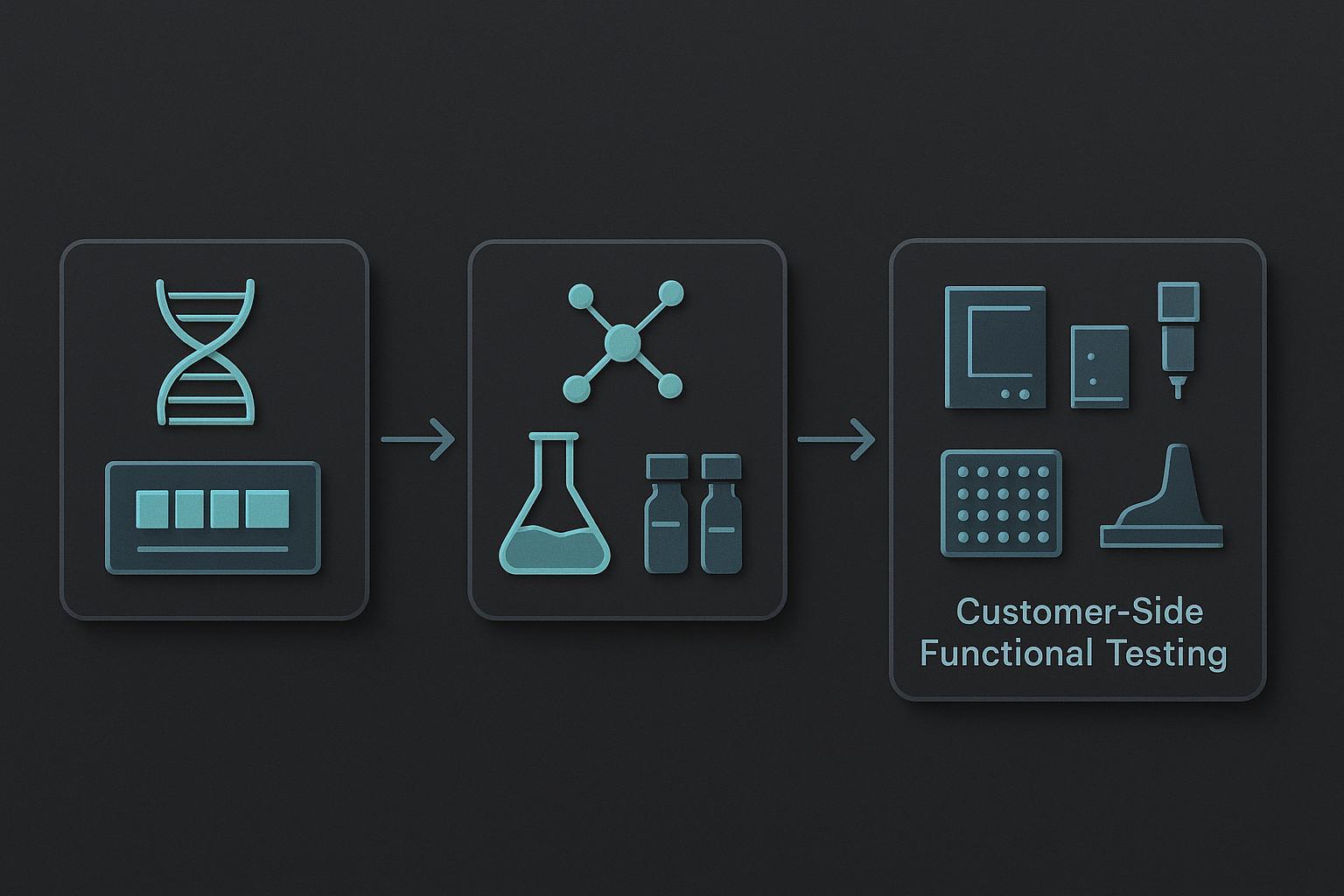
The first action step is to pick the assay that answers the question purity testing cannot: not “what is in this vial,” but “what does this peptide do to a membrane.” For Peptídeos Sintéticos functional assays for membrane-active peptides, that means matching the readout to the pore property under test rather than defaulting to whichever plate reader is free.
Calcein leakage measures dye release from lipid vesicles and reports bulk permeabilization. DiSC₃-5 depolarization tracks the loss of a membrane potential across a bacterial membrane, so it reports membrane disruption in a more physiological context. Planar bilayer single-channel recording measures current through one pore at a time, which is the only one of the three that resolves unitary conductance.
The three sit on very different sensitivity scales. Calcein leakage typically needs peptide concentrations in the 1 para 25 µM range against roughly 20 µM lipid with 75 mM intraliposomal calcein, while DiSC₃-5 depolarization effects cluster around 19 µM. Single-channel work reaches sub-micromolar to low-micromolar concentrations, with published detections at 0.3 µM, 0.8 para 4.1 µM, e 6.2 µM, resolving conductances from about 6 para 360 pS up to the nanosiemens range. A peptide that looks inert in a leakage assay may simply be below the detection floor of that readout.
|
Ensaio |
Pergunta que responde |
Required control |
Blind spot |
|---|---|---|---|
|
Calcein leakage |
Does the peptide permeabilize lipid bilayers in bulk? |
Vesicles without peptide; detergent for 100% liberar |
Averages away transient or rare pores |
|
DiSC₃-5 depolarization |
Does it collapse membrane potential? |
Protonophore control; peptide-free membrane |
Cannot separate pore formation from membrane solubilization |
|
Planar bilayer single-channel |
What is the unitary conductance and lifetime of one pore? |
Peptide-free bilayer; voltage-reversal runs |
Low throughput; one pore may not represent the population |
The blind spot in the first row is not hypothetical. A Wza-based D-peptide, DcWza, produced unitary conductance of 0.95 ± 0.1 nS at +200 mV in 1 M KCl across 50 events, yet vesicle permeabilization after one hour was 4.6 ± 2.5% against a control of 4.2 ± 2.1% (Ge et al., Comunicações da Natureza, 2022). Transient pores that eject rather than persist leave almost no trace in a bulk leakage readout. That is the case for running single-channel work alongside, not instead of, vesicle assays.
Implementation, in order:
-
Define the membrane model and lipid composition. Match the lipid mix to the biological membrane you care about. Quick win: a day of reading and a decision.
-
Select the readout. Bulk leakage for a first pass, depolarization for a physiological context, single-channel for mechanism. Longer-term: single-channel rigs take weeks to commission.
-
Fix the controls. Peptide-free vesicles, a positive disruptor, and a solvent-only blank. Quick win, but skipping it invalidates everything downstream.
-
Set the concentration range. Span at least two orders of magnitude around your expected threshold, and remember the detection floors above.
-
Pre-register the pass criterion. Write down what counts as active before you run the plate. This is the step most teams skip and most regret.
Measure leakage rate, unitary conductance, and selectivity ratio. A realistic timeline is two to four weeks for a validated vesicle assay and two to three months before single-channel data is publication-grade.
Advertências e onde a visão convencional ainda se mantém
The design rules are probabilistic, not deterministic, and some designed pores fail. That is the most important limitation to state plainly, because it is also the honest reason purity-first thinking persists: purity is measurable, repeatable, and cheap to certify, while membrane behavior is none of those things. Produção de Peptídeos
Context matters more than the argument does. For non-membrane targets, or for screening libraries where the readout is binding rather than permeabilization, RP-HPLC and MS purity genuinely is the right release criterion, and peptide purity testing limitations only become a problem when that certificate is asked to answer a question it was never designed to answer.
The weakest part of the case is the evidence base itself. Much of the 2026 design guidance derives from a single coarse-grained MD pipeline run in POPC, and the salt-bridge rescue was demonstrated in simulation before anyone synthesized the peptide. Neither result is wrong; both are narrower than a design rule implies.
Treat the framework as a hypothesis generator, não é uma especificação. It tells you which sequence edits are worth making and which assays are worth running, and it still expects some of those pores to fail.
But Doesn’t High Purity Guarantee Reproducible Membrane Activity?
Não. Purity constrains what is in the vial, not how that material assembles in a bilayer. A ≥98% specification is not meaningless, no entanto: it removes a large class of confounds, including truncated sequences, impurezas de exclusão, and scavenger by-products that would otherwise muddy any activity readout. What it cannot do is tell you whether the peptide inserts, oligomeriza, or forms the pore architecture your design assumed.
If a project is already locked into a purity-only release workflow, you do not need to rebuild the program. Add one orthogonal functional readout, such as a vesicle leakage assay or a planar bilayer conductance measurement, and use it to confirm that the released lot behaves as the design intended.
Treat activity reported from a peptide characterized only by HPLC and MS as provisional. Without visible assay conditions and controls, you cannot tell whether the observed effect came from the peptide, a residual counterion, or the buffer.
Conclusão: Do Certificado de Pureza à Evidência Funcional
Purity is necessary but not sufficient for pore-forming peptide design: a chromatogram can confirm what a molecule is, never what it does at a membrane.
The practical shift is in release criteria. For membrane-active peptides, analytical data should travel with at least one functional readout, and published activity numbers should arrive alongside the assay conditions and controls that produced them. That pairing is what makes a result reproducible in someone else’s hands rather than only in the lab that generated it.
None of this asks you to rebuild an existing program. Start by mapping the sequence features you already control onto the membrane behavior you actually need, then pick the assay that detects that behavior. A design workflow and characterization checklist can make that mapping explicit before the next lot is ordered.
The direction of travel is toward design rules that are probabilistic but usable: good enough to narrow a sequence space, honest enough to say when a designed pore will not behave as intended.