为什么成孔肽设计的传统纯度第一观点是不完整的
膜活性肽的主流释放标准是单个数字: 反相HPLC面积纯度, 通常等于或高于 95%, 加上确认预期完整质量的质谱. 这个标准确实有用, 值得精确说明它所建立的内容. RP-HPLC 报告色谱纯度, 表示位于主峰的紫外线吸收材料的比例, 而质谱法报告完整的质量和, 与 MS/MS, 序列级碎片支持 (PMC 方法章节). 他们一起回答一个真正的问题: 做了什么, 它有多纯净.
层本身是约定而不是要求. 供应商通常将 ≥95% RP-HPLC 面积称为研究级底板, ≥98%作为现代研究和GMP地板, 对于优质或临床材料≥99% (肽纯度参考集, 2025). 这些是报告的供应商惯例, 不是法定指令.

由于价格便宜,这种观点变得占主导地位, 快速地, 正交, 足以满足大多数非膜目标. 它的起源是分析化学实践, 不是生物物理学, 这是第一个肽纯度测试局限性出现的地方: 面积百分比纯度并未指出其排除的杂质.
⚠️警告: 面积百分比纯度不能量化缺失序列, 截断, 共洗脱非对映异构体, 抗衡离子 (三氟乙酸, 醋酸盐, 氯化物) 或含水量, 因此净肽含量可能与标签重量不同 (肽纯度测试指南, 2026).

多肽合成 因此,两个标称质量相同的样品可以携带不同的有效浓度, 并且两个证书都没有告诉您肽是否插入, 寡聚化, 或在膜中形成稳定的孔.
什么是 2026 孔隙形成研究实际上表明
重构始于 2026 自然化学生物学 Deb 和同事的研究, 它将成孔肽设计视为序列编码特性而不是纯化结果. 球队跑了 51 µs 的无偏粗粒度分子动力学 (马提尼 2.2 / 格罗玛斯) 大致穿过 150 POPC 中预组装的八聚体跨膜桶孔, 验证了轨迹 2 µs 全原子模拟, 然后合成 22 肽并通过钙黄绿素渗漏对其进行测试, 平面双层电生理学, 实时原子力显微镜, 光盘, 和 GUV 葡聚糖运输 (美国肽学会, 2026-08-06).
对于任何编辑序列的人来说,两个结果都很重要. 第一的, 电导以离散步骤到达: 单孔值 0.116, 0.251, 0.353, 和 0.424 纳秒 (美国肽学会, 2026-08-06). 桶状孔, 肽排列在固定通道中, 和一个环形孔, 脂质双层本身弯曲到内层, 产生不同的电导特征, 所以逐步的模式是建筑的读出, 不仅仅是有多少肽结合. 第二, 实时AFM大致捕捉毛孔 6 纳米宽内 20 肽添加分钟数 (美国肽学会, 2026-08-06).
管道还蒸馏 52 允许的序列模板分为四类, 按 150 肽 MD 扫描的相互作用密度排序 (美国肽学会, 2026-08-06). 读取这些数字作为测定条件, 不是常数: 每个电导值属于特定的双层模型, 离子强度, 和电压, 并且它们都不会直接转移到不同的膜系统.
序列编辑如何在孔表型之间移动肽

改变肽序列和膜活性的单位是取代, 不是肽. 单个和集群编辑可以在三种状态之间移动一个骨干网: 无膜活性, 瞬态泄漏, 和稳定的毛孔.
芳香放置是最明显的杠杆. 在 Deb 等人的设计中, 最佳芳香位置从残基转移 13 和 19 在 30 个残基的核心中 13, 15, 8 和 26 当核心缩短至 22 残留物, 螺旋倾斜度相对于膜法线从 50° 变为 30° (美国肽学会, 2026-08-06). 电荷可以替代锚定: 每个界面有四个 Arg-Asp 盐桥,即使去除芳香堆积,也能保持孔隙完整性 (美国肽学会, 2026-08-06). 静电设定驱动力, 因为阳离子肽大致显示 20 kJ mol⁻1 对阴离子 POPE 具有更大的亲和力:POPG 与两性离子 POPC 双层相比 (美国肽学会, 2026-08-06).
立体化学是独立的第二轴. 将 DpPorA 的每个残基交换为其 D-对映体,将单位电导从约 4 纳秒到 1.5 ± 0.3 纳秒在 +100 毫伏输入 1 氯化钾 (n = 75), 并跨越 100 插入D型分裂 75%/25% 介于 ~1.5 nS 和 ~4 nS 状态之间,PK⁺/PCl⁻ ≈ 7:1 (葛等人。, 纳特·共同, 2022-09-14).
|
序列特征 |
预期膜效应 |
检测它的测定 |
|---|---|---|
|
螺旋度 |
肽是否可以作为连续螺旋跨越双层 |
POPC 与 POPE 的圆二色性:POPG囊泡 |
|
疏水矩 |
膜插入的深度和稳定性 |
色氨酸荧光位移; 囊泡渗漏动力学 |
|
收费安排 |
脂质头基选择性和盐桥稳定性 |
Zeta电位; 阴离子与两性离子双层的电导 |
|
芳香放置 |
界面锚定和螺旋倾斜 |
定向圆二色性; 固态核磁共振倾斜角 |
|
几何和倾斜 |
有哪些架构形式: 桶板, 环形或β片层 |
单通道电导; 定向CD; FTIR 酰胺 I |
赖氨酸, 精氨酸和较大的残留物充当膜解吸看门人, 阻止深度插入或批量易位 (PMC, 2021-12-24).
为什么纯度测试无法预测膜行为
你可能已经看过这个: 两瓶, 相同的标称质量, 相同的证书, 其中之一根本没有按照化验所说的方式表现. 证书没有错. 它回答的问题比你问的问题要窄.
反相 HPLC 和质谱确定身份和色谱纯度. 既不建立折叠也不建立二级结构, 寡聚状态, 原生条件下的聚合状态, 或膜行为; 这些需要单独的生物物理或基于细胞的测定 (PMC 分析审查). 面积百分比纯度还带有抗衡离子和残留水混杂因素, 因此,两个标称质量相同的样品一旦溶解即可提供不同的有效浓度. 不同的有效浓度意味着不同的表观膜活性, 即使序列相同.
函数结果由于其自身原因而存在噪音. 实验室之间的最低抑菌浓度值通常会移动一到两个稀释步骤, 用户和方法, 并省略控制, 使用错误的接种物 (指定为 5 × 10⁵ 菌落形成单位/毫升) 或偏离生长条件可能会扭曲结果 (MIC 方法回顾, 2024). 再现性问题延伸到预测: 在一个 2026 的基准 48 已发表的抗菌肽预测方法, 少于 25% 是可重复的 (BATTLE-AMP 基准测试, 生物Rxiv, 2026). 这是方法的预印本基准, 不是肽, 但它设定了对于有多少设计决策可以在纸上解决的期望.
这是定制肽表征结束和您自己的工作开始的地方.
要点: 分析发布测试是供应商方的; 膜功能测试在客户端进行.
更好的成孔肽设计框架
针对目标孔结构和目标测定设计成孔肽, 不违反纯度规范. 设计目标的单一改变就重新组织了整个项目.
遵循以下五项原则 2026 数据:
-
首先选择架构. 决定是否需要桶板, 环形的, 或在接触序列之前无序变薄的毛孔, 因为每种架构都意味着一组不同的序列约束.
-
将芳烃放置和盐桥视为稳定层. 它们控制组件在膜中结合在一起的时间, 不是它的结合有多强.
-
将电荷放置视为选择性层. 阳离子残基相对于疏水面的位置设置了肽区分的膜.
-
将立体化学视为表型变量. D-氨基酸取代不是脚注; 它可以在孔表型之间移动肽.
-
综合前预先提交功能读数. 决定测定, 脂质系统, 以及预先确定肽与脂质的比例, 所以合成批次需要进行测试.
证据是这在规模上是可行的. 一个 2026 设计流程从 150 肽计算机扫描转变为 22 合成肽, 与整个集合相关的钙黄绿素泄漏和计算的孔隙水合作用. 先导肽, KDFA2i + 9-氨气, 粗略地产生 20% 钙黄绿素以肽与脂质的比例释放 1:2,000, 以更高的比率上升 (美国肽学会, 2026). 请注意该数字是什么: 在定义的系统中以定义的比例得到功能结果, 这正是分析证书无法提供的证据.
对于没有内部综合的团队, MOL Changes 支持定制序列设计和修改工作, which can be used to turn a chosen architecture into an orderable peptide while the functional testing stays in your own assay.
None of this is deterministic. Sequence-to-pore rules are probabilistic, and some well-designed peptides will still fail their first assay. The framework’s value is that it makes the failure informative rather than ambiguous.
选择补充纯度数据的功能测定
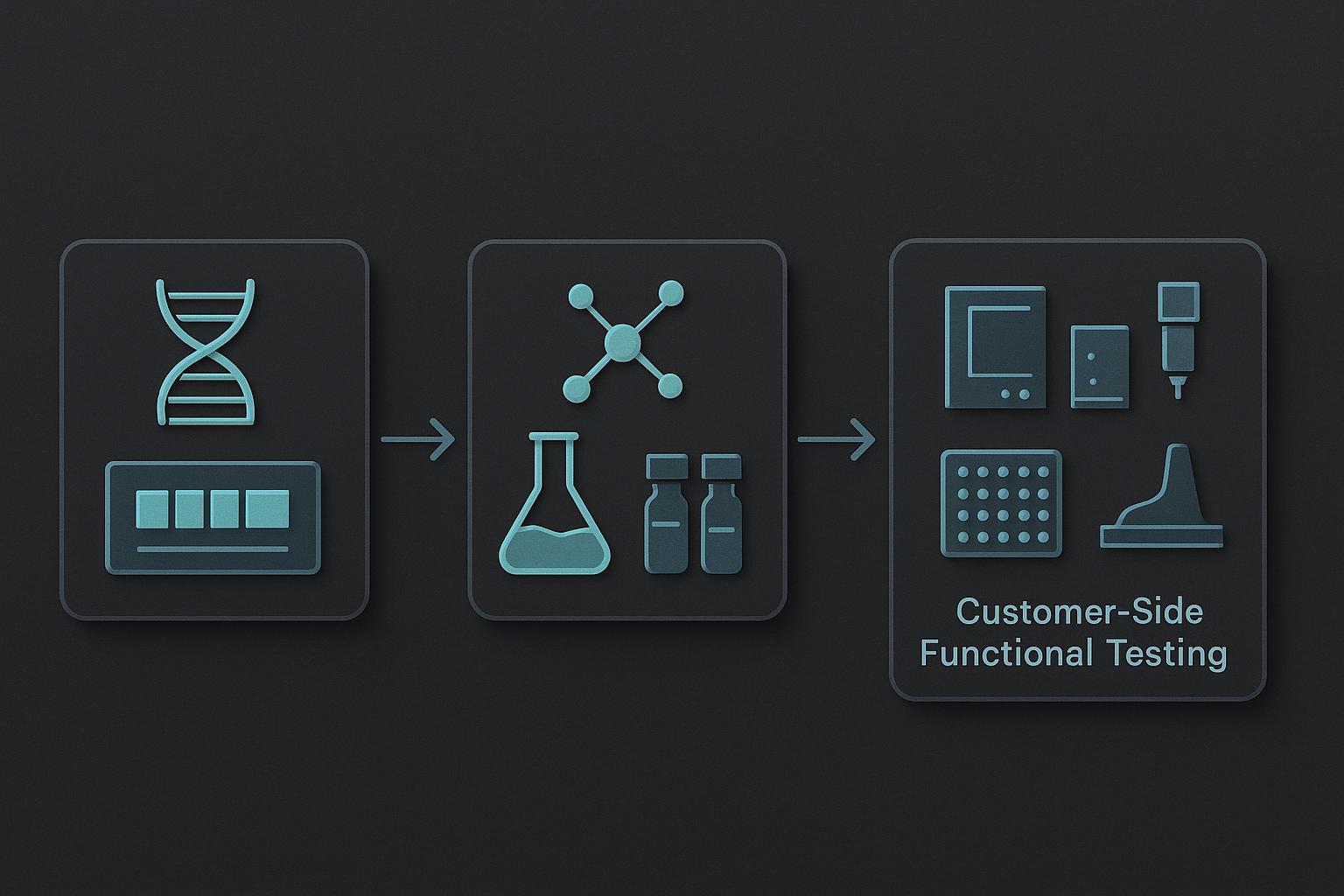
The first action step is to pick the assay that answers the question purity testing cannot: not “what is in this vial,” but “what does this peptide do to a membrane.” For 合成肽 functional assays for membrane-active peptides, that means matching the readout to the pore property under test rather than defaulting to whichever plate reader is free.
Calcein leakage measures dye release from lipid vesicles and reports bulk permeabilization. DiSC₃-5 depolarization tracks the loss of a membrane potential across a bacterial membrane, so it reports membrane disruption in a more physiological context. Planar bilayer single-channel recording measures current through one pore at a time, which is the only one of the three that resolves unitary conductance.
The three sit on very different sensitivity scales. Calcein leakage typically needs peptide concentrations in the 1 到 25 µM range against roughly 20 µM lipid with 75 mM intraliposomal calcein, while DiSC₃-5 depolarization effects cluster around 19 微米. Single-channel work reaches sub-micromolar to low-micromolar concentrations, with published detections at 0.3 微米, 0.8 到 4.1 微米, 和 6.2 微米, resolving conductances from about 6 到 360 pS up to the nanosiemens range. A peptide that looks inert in a leakage assay may simply be below the detection floor of that readout.
|
测定 |
提问它回答 |
Required control |
Blind spot |
|---|---|---|---|
|
Calcein leakage |
Does the peptide permeabilize lipid bilayers in bulk? |
Vesicles without peptide; detergent for 100% 发布 |
Averages away transient or rare pores |
|
DiSC₃-5 depolarization |
Does it collapse membrane potential? |
Protonophore control; peptide-free membrane |
Cannot separate pore formation from membrane solubilization |
|
Planar bilayer single-channel |
What is the unitary conductance and lifetime of one pore? |
Peptide-free bilayer; voltage-reversal runs |
Low throughput; one pore may not represent the population |
The blind spot in the first row is not hypothetical. A Wza-based D-peptide, DcWza, produced unitary conductance of 0.95 ± 0.1 纳秒在 +200 毫伏输入 1 M KCl across 50 events, yet vesicle permeabilization after one hour was 4.6 ± 2.5% against a control of 4.2 ± 2.1% (葛等人。, 自然通讯, 2022). Transient pores that eject rather than persist leave almost no trace in a bulk leakage readout. That is the case for running single-channel work alongside, not instead of, vesicle assays.
Implementation, 为了:
-
Define the membrane model and lipid composition. Match the lipid mix to the biological membrane you care about. Quick win: a day of reading and a decision.
-
Select the readout. Bulk leakage for a first pass, depolarization for a physiological context, single-channel for mechanism. Longer-term: single-channel rigs take weeks to commission.
-
Fix the controls. Peptide-free vesicles, a positive disruptor, and a solvent-only blank. Quick win, but skipping it invalidates everything downstream.
-
Set the concentration range. Span at least two orders of magnitude around your expected threshold, and remember the detection floors above.
-
Pre-register the pass criterion. Write down what counts as active before you run the plate. This is the step most teams skip and most regret.
Measure leakage rate, unitary conductance, and selectivity ratio. A realistic timeline is two to four weeks for a validated vesicle assay and two to three months before single-channel data is publication-grade.
注意事项以及传统观点仍然成立的地方
The design rules are probabilistic, not deterministic, and some designed pores fail. That is the most important limitation to state plainly, because it is also the honest reason purity-first thinking persists: purity is measurable, repeatable, and cheap to certify, while membrane behavior is none of those things. 多肽生产
Context matters more than the argument does. For non-membrane targets, or for screening libraries where the readout is binding rather than permeabilization, RP-HPLC and MS purity genuinely is the right release criterion, and peptide purity testing limitations only become a problem when that certificate is asked to answer a question it was never designed to answer.
The weakest part of the case is the evidence base itself. Much of the 2026 design guidance derives from a single coarse-grained MD pipeline run in POPC, and the salt-bridge rescue was demonstrated in simulation before anyone synthesized the peptide. Neither result is wrong; both are narrower than a design rule implies.
Treat the framework as a hypothesis generator, 不是规格. It tells you which sequence edits are worth making and which assays are worth running, and it still expects some of those pores to fail.
But Doesn’t High Purity Guarantee Reproducible Membrane Activity?
不. Purity constrains what is in the vial, not how that material assembles in a bilayer. A ≥98% specification is not meaningless, 尽管: it removes a large class of confounds, including truncated sequences, 缺失杂质, and scavenger by-products that would otherwise muddy any activity readout. What it cannot do is tell you whether the peptide inserts, 寡聚化, or forms the pore architecture your design assumed.
If a project is already locked into a purity-only release workflow, you do not need to rebuild the program. Add one orthogonal functional readout, such as a vesicle leakage assay or a planar bilayer conductance measurement, and use it to confirm that the released lot behaves as the design intended.
Treat activity reported from a peptide characterized only by HPLC and MS as provisional. Without visible assay conditions and controls, you cannot tell whether the observed effect came from the peptide, a residual counterion, or the buffer.
结论: 从纯度证书到功能证据
Purity is necessary but not sufficient for pore-forming peptide design: a chromatogram can confirm what a molecule is, never what it does at a membrane.
The practical shift is in release criteria. For membrane-active peptides, analytical data should travel with at least one functional readout, and published activity numbers should arrive alongside the assay conditions and controls that produced them. That pairing is what makes a result reproducible in someone else’s hands rather than only in the lab that generated it.
None of this asks you to rebuild an existing program. Start by mapping the sequence features you already control onto the membrane behavior you actually need, then pick the assay that detects that behavior. A design workflow and characterization checklist can make that mapping explicit before the next lot is ordered.
The direction of travel is toward design rules that are probabilistic but usable: good enough to narrow a sequence space, honest enough to say when a designed pore will not behave as intended.