Разработка рабочих процессов модификации пептида GLP‑1 и масштабирования для трансляционных программ
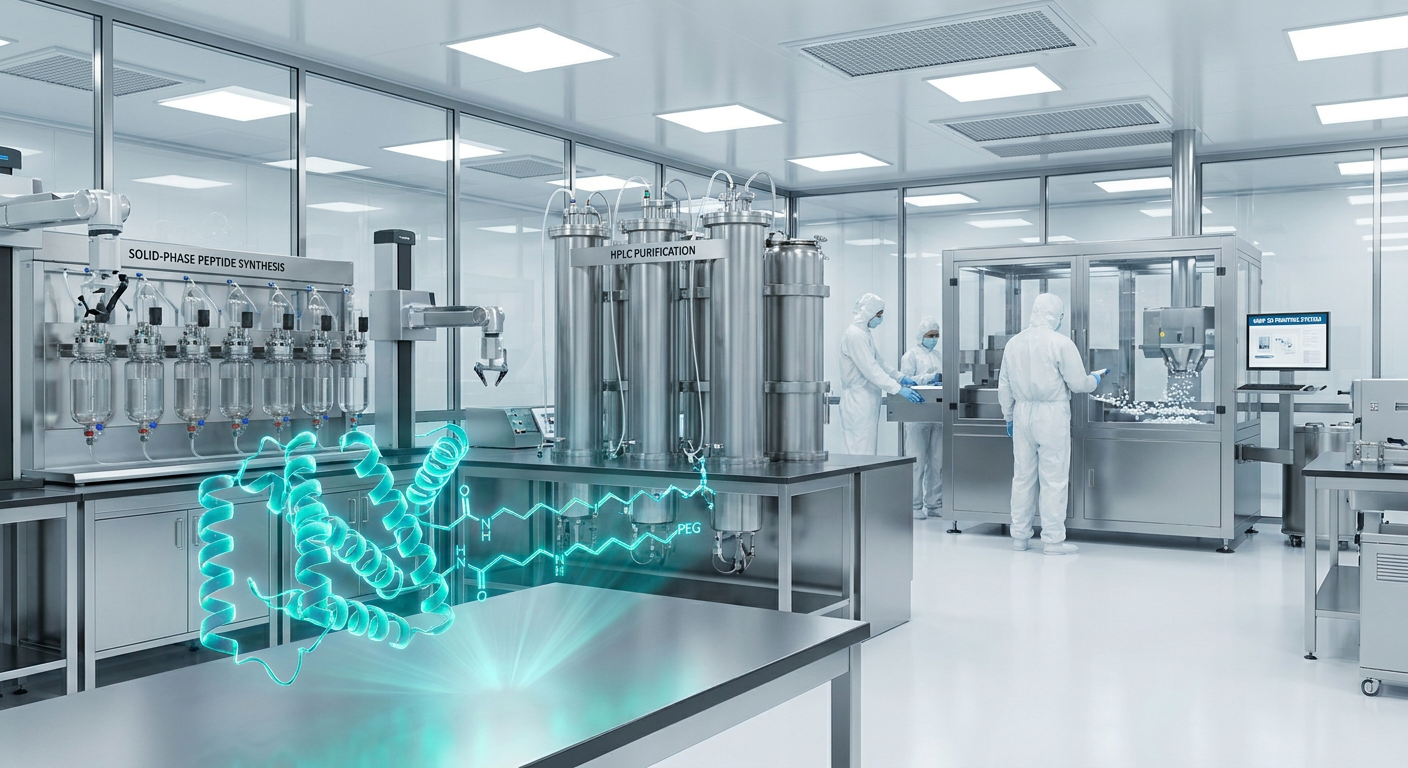
Исполнительный обзор: Трансляционная проблема в инкретиновой инженерии
Глюкагоноподобный пептид-1 (ГЛП-1) агонисты рецепторов и двойные/тройные коагонисты инкретинов (ГПП-1/ГИП/Глюкагон) представляют собой один из наиболее преобразующих терапевтических классов метаболических заболеваний., ожирение, и нейродегенеративные расстройства. Однако, трансляция последовательности GLP-1 дикого типа в коммерчески жизнеспособный кандидат на лекарственное средство представляет собой серьезные химические и биофизические узкие места.. Нативный ГПП-1 (7-36) амид проявляет живой период полувыведения из плазмы ($т_{1/2}$) менее чем 2 минут из-за быстрого протеолиза дипептидилпептидазой-4. (ДПП-IV) at the $\text{Ала}^8-\text{Глу}^9$ пептидная связь, в сочетании с почечным клиренсом ($NMWCO \approx 30-50\text{ кДа}$).
Для достижения клинического дозирования один раз в неделю или один раз в месяц, программы трансляции должны интегрировать сложные химические модификации, включая стерически затрудненные неприродные аминокислоты., ацилирование жирных кислот боковой цепи (липидирование), поли для конкретного объекта(этиленгликоль) (ПЭГилирование), и ручки для диагностической маркировки. Еще, ранний выбор, сделанный на этапе открытия твердофазного синтеза пептидов (СПСС) часто создают серьезные режимы сбоев во время масштабирования:
- Агрегация & Гелеобразование: Hydrophobic fatty acid side chains or polydisperse PEG polymers drive intermolecular $\beta$-sheet self-assembly during cleavage and purification.
- Диастереомерные примеси: Многоступенчатое сочетание сложных липофильных линкеров в растворе увеличивает рацемизацию в хиральных центрах..
- Аналитическая маскировка: Совместное элюирование близкородственных делеционных пептидов ($n-1, n-2$) и виды изобарной деградации боковой цепи ($D\text{-Асп}$, $\beta\text{-Асп}$) во время обращенно-фазовой высокоэффективной жидкостной хроматографии (ОФ-ВЭЖХ).
- Нелинейность процесса: Увеличение масштаба от миллиграммовых исследовательских количеств до многограммовых и килограммовых пилотных производств приводит к нелинейной хроматографической загрузке массы и сбоям в отводе тепла..
Эта структура описывает методологию комплексного проектирования, которая связывает варианты модификации последовательности на ранней стадии непосредственно с последующим масштабированием., аналитическая проверка, новые возможности производства, такие как 3D-печать, отвечающая требованиям GMP., и соответствие нормативным требованиям ICH.
Этап 1 — Модификация ранней последовательности & Химические вещества для продления периода полураспада
Разработка трансляционного терапевтического препарата GLP-1 требует многоуровневой стратегии химической модификации, чтобы одновременно блокировать ферментативное расщепление., медленный почечный клиренс, и сохранить кинетику связывания рецептора ($ЕС_{50}$).
[Native GLP-1 (7-36)] : H2N-His7-Ala8-Glu9-Gly10-Thr11-Phe12-Thr13-Ser14-Asp15-Val16...-Lys26...-Lys34-Gly37-OH
                                   |
                         (DPP-IV Cleavage Point)

[Engineered Analog]   : H2N-His7-[Aib8]-Glu9-Gly10-Thr11-Phe12-Thr13-Ser14-Asp15-Val16...-[Lys26(Spacer-FattyAcid)]...-[Arg34]-Gly37-NH2
                                   |                                                          |
                         (Protease Resistant)                                        (Albumin Binding Handle)
1. Ферментативная стабилизация: Сопротивление ДПП-IV
Substituting the native $\text{Ала}^8$ residue with $\alpha$-aminoisobutyric acid ($\текст{Аиб}^8$) or $D\text{-Ала}^8$ создает стерические препятствия вокруг $N$-концевого сайта каталитического расщепления, не нарушая альфа-спирального стыковки с внеклеточным доменом рецептора GLP-1..
Константа скорости деградации ($к_{кот}/К_м$) для DPP-IV ферментативное расщепление снижается в соответствии с кинетикой Михаэлиса-Ментен первого порядка.:
$$v = \frac{В_{Макс} [С]}{K_m \left(1 + \гидроразрыв{[я]}{К_и}\верно) + [С]}$$
Where substitution with $\text{Аиб}^8$ увеличивает локальный энергетический барьер активации ($\Delta G^\ddagger$), делая скорость расщепления незначительной ($к_{наблюдение} < 10^{-6}\текст{ с}^{-1}$).
2. Липидационная химия: С16 против. C18 Двухкислотная архитектура
Ковалентная конъюгация цепей жирных кислот способствует обратимому связыванию с сывороточным альбумином человека. (HSA, $K_d \sim 10-50\text{ }\mu\text{М}$), снижение почечной фильтрации и защита пептидного остова от неспецифических эндопептидаз.
По данным исследования, опубликованного в Переосмысление влияния пептидов на кинетику продления периода полувыведения липидов, переход от пальмитоилмонокислоты C16 (Лираглутидная архитектура, $т_{1/2} \sim 13\text{ час}$) to a C18 octadecanedioic acid diacid via a flexible $\gamma\text{-Глу-ОЭГ}_2$ проставка ($\gamma\text{-L-глутамил-(\бета-аланил-2,2'-(этилендиокси)бис(этиламин))}$, Семаглутидная архитектура) extends human plasma half-life to $\sim 165\text{ часы}$.
  Lys26 Side Chain ($\epsilon$-amine)
         |
    (NH-CO-CH2)
         |
    [$\gamma$-Glu Spacer]
         |
    [OEG Linker 1: 8-amino-3,6-dioxaoctanoic acid]
         |
    [OEG Linker 2: 8-amino-3,6-dioxaoctanoic acid]
         |
    [Octadecanedioic Acid: HOOC-(CH2)16-CO-]
3. Химия ПЭГилирования, специфичная для конкретного места
Для нековалентного или длительного системного накопления, монодисперсный или полидисперсный поли(этиленгликоль) (ПЭГ, 20–40 кДа) конъюгируется с помощью биоортогональных маркеров, специфичных для сайта:
- Тиол-малеимидное лигирование: Reaction of an engineered $Cys$ residue with Maleimide-PEG at $\text{рН } 6.5 – 7.2$.
- Оксимное лигирование: Reaction of an aminooxy-functionalized PEG with an $N$-terminal aldehyde or keto-amino acid at $\text{рН } 4.5 – 5.5$.
Как документировано в Химические исследования биоконъюгатов ACS по сайт-специфическому ПЭГилированию, ПЭГилирование резко расширяет гидродинамический радиус ($Р_х$), рассчитывается по закону масштабирования полимера:
$$Р_х = К_{ПЭГ} \cточка (М_в)^а$$
Where $M_w$ is the PEG molecular weight and $a \approx 0.55-0.60$ в водных буферах. В то время как ПЭГилирование эффективно предотвращает клубочковую фильтрацию, он может ослаблять энергию активации рецептора из-за стерического экранирования, требующие точной настройки длины линкера.
4. Диагностика & Аналитические маркировочные ручки
Ранние трансляционные исследования требуют количественного ADME., распределение тканей, и характеристика связывания клеток. Включение репортерных групп должно быть ортогональным, чтобы не мешать сродству GLP-1R.:
- Флуоресцентные метки: FITC или цианин5,5 (Cy5.5) конъюгированный посредством селективного ацилирования лизина или тиол-алкилирования.
- Изотопные метки: Униформа $^{13}\текст{С}/^{15}\текст{Н}$ меченные стабильными изотопами аминокислоты, включенные в основную гидрофобную последовательность для абсолютного количественного определения ЖХ-МС/МС (Режимы MRM/PRM) в доклинических плазменных матрицах.
ASCII-схема 1: Ортогональная защита & Сопряжение боковой цепи
To achieve site-specific acylation at $\text{Лис}^{26}$ while leaving $\text{Лис}^{34}$ (or $\alpha\text{-Нью-Хэмпшир}_2$) не отреагировавший, ортогональная схема защиты обязательна:
  Fmoc-Lys(Mtt)-OH or Fmoc-Lys(Alloc)-OH at Position 26
                          |
    [Assembly of Core Peptide Chain on Resin via SPPS]
                          |
  Selective De-protection of Mtt (1% TFA/DCM) or Alloc (Pd(PPh3)4/PhSiH3)
                          |
  Solid-Phase Coupling: Fmoc-OEG-OH -> Fmoc-OEG-OH -> Fmoc-Glu-OtBu -> Mono-tert-butyl octadecanedioate
                          |
  Global Deprotection & Resin Cleavage (TFA / TIS / H2O / EDT = 92.5 : 2.5 : 2.5 : 2.5)
Для команд, оценивающих сложные последовательности с несколькими модификациями, использование сложившейся специальная платформа для синтеза пептидов благодаря специальным возможностям ортогональной защиты обеспечивает высокую начальную чистоту сырой нефти перед дальнейшим масштабированием.
Этап 2 — Биоконъюгация на стадии решения & Реакционная инженерия
Матрица решений по устранению неполадок: Рацемизация & Контроль чрезмерного ацилирования
Во время масштабной биоконъюгации липофильных линкеров (например, C18 diacids with $\gamma\text{-Глу-ОЭГ}_2$ проставки), неоптимальные параметры реакции вызывают специфические профили примесей:
                  BIOCONJUGATION TROUBLESHOOTING FLOWCHART
                                     |
    +--------------------------------+--------------------------------+
    |                                                                 |
    v                                                                 v
[Symptom: Over-Acylation Impurity]               [Symptom: Racemization at Chiral Linker]
(Nα,Nε-bis-acylated product > 1.5%)             (D-Glu / D-Lys diastereomer species > 0.5%)
    |                                                                 |
    +---> Root Cause: pH > 8.8 (N-terminal            +---> Root Cause: Excess base / High Temp
    |     α-amine becomes unprotonated)            |     during activated ester coupling
    |                                              |
    +---> Action: Implement automated              +---> Action: Switch from HATU to Oxyma Pure/DIC;
          pH-stat titration at pH 8.2-8.5                 maintain reaction temperature at 18°C–20°C
| Режим отказа / Примесь | Первопричина | Аналитический сигнал | Стратегия смягчения последствий процесса |
|---|---|---|---|
| $N^\alpha,N^\epsilon$-Bis-Acylation | Reaction $\text{рН} > 8.8$ или избыток ацилирующего агента стоик. ($>1.5\текст{ экв.}$) | Пик УВЭЖХ, совместно элюируемый после основного пика ($+М_{липид}$ Сдвиг МВт на МС) | Tighten $\text{рН}$ контроль, чтобы $8.2-8.5$; предельная стоих. to $1.05-1.15\text{ экв.}$; используйте автоматическое титрование pH-stat |
| Диастереомерная рацемизация ($D\text{-Глу}$) | Увеличенное время реакции с сильной основой (например, ДИПЭА) в $>25^\circ\text{С}$ | Chiral LC-MS or Marfey’s method showing $D\text{-аминокислота} > 0.2%$ | Замените DIPEA на $N$-метилморфолин.; lower coupling temp to $18-20^\circ\text{С}$; принять Oxyma Pure / ДВС |
| Гидролиз эфиров липидов / Расщепление | Коэффициент водного буфера слишком высок ($>40%\текст{ ЧАС}_2текст{О}$) вызывая гидролиз сложного эфира | МС-пик, соответствующий предшественнику гидролизованной двухкислотной кислоты | Optimize solvent ratio to $\text{ДМФ/Вода } 80:20\текст{ v/v}$ или $текст{НМП/ДМСО}$; подавлять активность воды |
Хотя небольшие модификации могут быть реализованы на смоле., крупномасштабное производство часто диктует гибридный подход: синтез линейного пептидного остова на смоле, с последующим конъюгированием дорогостоящих липидных линкеров или полимеров ПЭГ в растворе после расщепления для минимизации отходов сырья..
+-----------------------------------------------------------------------------------+
|                        SOLUTION-PHASE BIOCONJUGATION PARAMETERS                   |
+--------------------------+--------------------------------------------------------+
| Parameter                | Optimal Process Window                                 |
+--------------------------+--------------------------------------------------------+
| Peptide Concentration    | 5.0 - 15.0 mM                                          |
| Acylating Agent Stoich.  | 1.05 - 1.25 equiv. relative to target Lys             |
| Solvent System           | DMF / Water (70:30 v/v) or NMP / DMSO mixtures         |
| Reaction pH              | 8.2 - 8.5 (controlled via N-methylmorpholine or TEA)   |
| Reaction Temperature     | 18°C - 22°C                                            |
| Coupling Reagents        | PyBOP / Oxyma Pure or HATU / HOAt                      |
+--------------------------+--------------------------------------------------------+
Хемоселективность & $pK_a$ Управление
Selective acylation of the $\epsilon\text{-амино-}$ group of $\text{Лис}^{26}$ ($pK_a \approx 10.5$) over the $N$-terminal $\alpha\text{-амино-}$ группа ($pK_a \approx 8.0$) требует точного поддержания pH буфера. Operating within a narrow window of $\text{рН } 8.2 – 8.5$ maintains the $\alpha\text{-амин}$ в преимущественно протонированном состоянии ($\текст{-Нью-Хэмпшир}_3^+$), while allowing sufficient unprotonated nucleophilic $\epsilon\text{-амин}$ ($\текст{-Нью-Хэмпшир}_2$) вступать в реакцию с активными NHS-эфирами или тетрафторфенилом (СФП) сложные эфиры.
Константа скорости реакции второго порядка ($к_{наблюдение}$) для селективной биоконъюгации регулируется:
$$\гидроразрыв{д[\текст{Сопряженный}]}{дт} = k_0 \cdot \left(\гидроразрыв{1}{1 + 10^{(pK_a – \text{рН})}}\верно) [\текст{Пептид}] [\текст{Ацилирующий агент}]$$
Проведение реакций биоконъюгации в специализированный комплекс биоконъюгации и модификации оснащен автоматическими контурами обратной связи pH-стата, устраняет побочные продукты чрезмерного ацилирования ($N\alpha,N\epsilon\text{-бис-ацилированный}$ разновидность).
Этап 3 — Масштабирование операций подразделения: Гибридный синтез SPPS в SPPS-LPPS
Масштабирование производства GLP-1 за счет количества лабораторных стендов (0.1–1,0 г) килограммовых пилотных партий вводит термодинамические и физико-технические ограничения..
       [LAB SCALE: Pure SPPS]                    [PILOT/COMMERCIAL SCALE: Hybrid SPPS-LPPS]
  0.1 - 100 g Batch Capacity                       1.0 kg - 100 kg Batch Capacity
  - High DMF/NMP consumption (>1000 L/kg)           - Slashes solvent consumption by 60%
  - Crude purity drops on long sequences            - Fragment purity >95% prior to condensation
  - Resin swelling & pressure drop limits           - Controlled solution-phase thermodynamics
1. Твердофазный против. Конденсация жидкофазных фрагментов
В линейном SPPS 30–40-мерных аналогов GLP-1 наблюдается экспоненциальное накопление примесей усечения. ($n-1, n-2$) из-за стерической агрегации на слое смолы. Как подробно описано в Анализ Центра знаний Bachem по масштабированию промышленного СЭС, общая добыча нефти упала ниже $20%$ в масштабе, если обрабатывать чисто линейно.
Чтобы преодолеть это, современные программы перевода принимают Гибридная конденсация фрагментов SPPS-LPPS, как подчеркивает Письмо PDA о гибридной конденсации фрагментов SPPS-LPPS.
Короткие защищенные пептидные фрагменты (например, Фрагмент А: остатки 7–14; Фрагмент Б: остатки 15–26; Фрагмент С: остатки 27–37) синтезируются отдельно на 2-хлортритилхлоридной смоле., расщепляется в мягких кислых условиях ($0.5-1.0%\текст{ ТФА}$ в DCM) для сохранения защитных групп боковой цепи, и впоследствии объединены на этапе решения:
 Fragment A (7-14)-OH + H-Fragment B (15-26)-OtBu
                          |  (Coupling: DIC / Oxyma Pure, DMF/DCM, 20°C)
                          v
           Protected Intermediate AB (7-26)-OtBu
                          |  (Deprotection)
                          v
      H-Intermediate AB (7-26)-OH + H-Fragment C (27-37)-NH2
                          |  (Coupling: PyBOP / HOAt)
                          v
            Full-Length Protected GLP-1 Analog
                          |  (Global Deprotection: TFA Cocktail)
                          v
                   Crude GLP-1 Conjugate
Эмпирический эталон масштабирования: В пилотных масштабных испытаниях (1.0партии –5,0 кг), принятие этого протокола конденсации SPPS-LPPS с 3 фрагментами последовательно обеспечивает получение результатов соединения фрагментов в фазе раствора $> 85%$ с защищенной чистотой фрагментов $> 92%$ до окончательной конденсации. Более того, elevating RP-HPLC column temperatures to $50^\circ\text{С} – 55^\circ\text{С}$ во время препаративной очистки C4 устраняется липофильный гистерезис противодавления., повышение выхода извлечения за счет $18-22%$ по сравнению с испытаниями при температуре окружающей среды.
2. Хроматографическое масштабирование & Нелинейность столбца
Очистка липидированных или ПЭГилированных пептидов GLP-1 основана на обращенно-фазовой ВЭЖХ. (ОФ-ВЭЖХ) использование неподвижных фаз кремнезема C4 или C18 ($100-300\текст{ \АА}$ размер пор, $10\текст{ }\mu\text{м}$ размер частиц).
Во время масштабирования, высота станины колонны ($л$) и линейная скорость ($ты$) должен оставаться постоянным при масштабировании диаметра колонки ($Д$) для сохранения хроматографического разрешения ($Р_с$):
$$\гидроразрыв{В_1}{В_2} = \left(\гидроразрыв{Д_1}{Д_2}\верно)^2$$
$$R_s = \frac{\кврт{Н}}{4} \левый(\гидроразрыв{\альфа – 1}{\альфа}\верно) \левый(\гидроразрыв{к'}{1 + к'}\верно)$$
                                  CHROMATOGRAPHIC RESOLUTION DYNAMICS
  Analytical (4.6 mm ID)        Preparative (50 mm ID)           Industrial (300-600 mm ID)
  [Peak A][Peak B]   -->        [ Peak A ][ Peak B ]   -->       [  Peak A  ][  Peak B  ]
  (Sharp separation)            (Slight peak broadening)         (Mass loading non-linearity)
Гидрофобные липидные цепи увеличивают время удерживания. ($к’$), требующие повышенных рабочих температур колонки ($45^\circ\text{С} – 60^\circ\text{С}$) и градиенты органических модификаторов (Isopropanol/Acetonitrile in $0.1%\text{ ТФА}$ or $20\text{ мм } \текст{Нью-Хэмпшир}_4\text{ОАк}$) для предотвращения загрязнения колонки и гистерезиса.
Этап 4 — Аналитическая характеристика высокого разрешения & Критерии выпуска
Успех трансляции требует строгой аналитической проверки для подтверждения химической идентичности., чистота, и свобода от иммуногенных побочных продуктов.
       ESI-HRMS MASS SPECTRUM (MOL Changes CoA Validation)
  100|                  [M+3H]3+ m/z = 1371.6842
     |                     |
   50|     [M+4H]4+        |         [M+2H]2+
     |   m/z = 1029.0151   |      m/z = 2057.0238
    0+-------------------------------------------------> m/z
Аналитические методы
- Сверхвысокоэффективная жидкостная хроматография (УВЭЖХ): Method optimized for resolving $D\text{-Глу}$, $D\text{-Ала}$, and $\beta\text{-Асп}$ изомеры перегруппировки.
- Масс-спектрометрия высокого разрешения с ионизацией электрораспылением (ESI-HRMS): Точное определение массы в пределах $< 5\текст{ ppm}$ предел погрешности для подтверждения точной моноизотопной молекулярной массы.
- Тандемное секвенирование МС/МС: Диссоциация, вызванная столкновением (CID) или диссоциация с переносом электрона (ЭТД) для проверки положений прикрепления липидов/ПЭГ, специфичных для сайта.
Комплексный сертификат анализа (Соглашение о намерениях) Технические характеристики
В таблице ниже приведены критерии высвобождения нормативного уровня, необходимые для конъюгатов трансляционного пептида GLP-1.:
| Атрибут качества | Аналитический метод испытаний | Критерии приемки | Научное обоснование |
|---|---|---|---|
| Химическая идентичность | ESI-HRMS / МАЛЬДИ-ТОФ МС | Матчи рассчитаны МВт ($\pm 0.05\text{ И}$) | Подтверждает последовательность и модификацию первичной аминокислоты |
| Химическая чистота | ОФ-ВЭЖХ / УВЭЖХ ($214\текст{ нм} / 280\текст{ нм}$) | $\ге 98.0%$ (Область %) | Минимизирует укороченные и окисленные пептидные примеси. |
| Одиночная примесь | ОФ-ВЭЖХ / ЖХ-МС | $\тот 0.5%$ | Строго ограничивает отдельные $n-1$ или диастереомерные виды. |
| Всего примесей | ОФ-ВЭЖХ | $\тот 2.0%$ | Соответствует нормативным пороговым значениям ICH Q3A. |
| Стереоизомерная чистота | Хиральный ГХ-МС / Метод Марфея | $\le 0.2\text{ D-аминокислота}%$ | Предотвращает потерю активации рецепторов и иммуногенности. |
| Остаточная ТЖК | Ионная хроматография (IC) | $\le 0.5%\text{ ж/б}$ (или обменять на ацетат/HCl) | Избыток TFA вызывает цитотоксичность в клеточных анализах |
| Остаточные растворители | Газовая хроматография (ГХ-HS) | ДМФ $< 880\текст{ ppm}$, НМП $< 530\текст{ ppm}$ | Соответствует классу ICH Q3C 2 пределы безопасности растворителей |
| Содержание эндотоксинов | LAL Кинетический хромогенный тест | $< 0.01\текст{ ЕС/мг}$ | Critical for $in\text{ виво}$ доклинические исследования на животных |
| Микробная стерильность | Мембранная фильтрация с прямой инокуляцией | Проходить (Нет роста в 14 дни) | Проверено через класс 100 обработка чистых помещений |
Обеспечение прозрачности, полностью отслеживаемый сертификат подлинности от партнера, предоставляющего определение характеристик КоА ВЭЖХ/МС высокого разрешения устраняет узкие места при проверке перед подачей IND.
Этап 5 — Новые возможности производства: 3D-печать, отвечающая требованиям GMP & Новые системы доставки
В то время как традиционные жидкие парентеральные препараты (подкожные инъекции) доминировать в современных методах лечения GLP-1, программы перевода используют передовые производственные платформы, в частности 3D-печать, отвечающая требованиям GMP и Микрофлюидная инкапсуляция- разблокировать удобные для пациентов пути перорального и депо-введения..
                  GMP-READY 3D PRINTING & FORMULATION PATHWAYS
                                       |
             +-------------------------+-------------------------+
             |                                                   |
             v                                                   v
   [Semi-Solid Extrusion (SSE)]                       [Subcutaneous Implants]
   - Multi-layer gastro-resistant oral tablets        - Biodegradable PLGA/PCL matrix
   - pH-responsive Eudragit L100-55 coatings          - Zero-order sustained release (1-3 months)
   - Protects peptide from stomach pepsin/acid       - Eliminates peak-to-trough plasma spikes
1. Полутвердая экструзия (СШЭ) 3D Печать для пероральной доставки
Пероральное введение пептидов GLP-1 серьезно затруднено из-за деградации желудочной кислоты. ($\текст{рН } 1.5 – 2.0$) и ферментативное переваривание пепсином и трипсином в тонком кишечнике..
Как подчеркивается в Природные исследования систем доставки пептидных лекарств, напечатанных на 3D-принтере, Полутвердая экструзия (СШЭ) 3D-печать позволяет изготавливать твердые лекарственные формы для перорального применения со сложной геометрией ядра-оболочки.:
- Основной: Липидированный аналог GLP-1, содержащий усилители проницаемости (например, Капрат натрия / ЗАКУСКА).
- Оболочка: 3D-печатная сеть кишечнорастворимых полимеров (Юдрагит L100 / ГПМЦ-АС) который остается нерастворимым при pH желудка, быстро растворяется только по достижении двенадцатиперстной кишки ($\текст{рН } > 6.0$).
$$\текст{Скорость растворения } \левый(\гидроразрыв{дМ}{дт}\верно) = \frac{A \cdot D \cdot (С_с – С_б)}{час}$$
3Параметры печати D (nozzle diameter $200-400\text{ }\mu\text{м}$, extrusion pressure $2.0-4.5\text{ бар}$, temperature $25^\circ\text{С} – 35^\circ\text{С}$) обеспечить точную настройку пространственной геометрии без термической деградации API конъюгированного пептида.
2. Микрофлюидная экструзия ядра-оболочки для подкожных депо
Для замены частых подкожных инъекций, Системы непрерывной 3D-микрофлюидной печати производят биоэродируемый полиэфир(молочно-гликолевая кислота) (ПЛГА) или Поликапролактон (ПКЛ) микроимплантаты.
Контролируя кинетику деградации полимера ($\текст{ТО:Джорджия}$ соотношение $50:50 \стрелка вправо 75:25$), профили высвобождения могут быть спроектированы таким образом, чтобы они демонстрировали диффузию нулевого порядка по 30 к 90 дни, поддержание постоянной терапевтической концентрации в плазме ($С_{SS}$) в терапевтическом окне ($С_{мин} < С_{SS} < С_{Макс}$).
Нормативная готовность & Соответствие качеству ICH
Трансляционные программы переходят от поздней стадии открытия к фазе 1 клинические испытания должны согласовывать производственные процессы с Международным советом по гармонизации. (я) руководящие принципы:
[ICH Q3A(R2)] : Control of Impurities in New Drug Substances (Threshold: > 0.05% ID, > 0.10% Qualification)
[ICH Q3B(R2)] : Control of Impurities in Finished Drug Products
[ICH Q3C(R8)] : Residual Solvent Control (DMF, NMP, DCM, Acetonitrile limits)
[ICH M7]     : Assessment and Control of DNA Reactive (Mutagenic) Impurities
Стерильная обработка в чистых помещениях
Потому что постсинтетическая терминальная стерилизация (автоклавирование или гамма-облучение) вызывает химическую деградацию боковых цепей липидов и ПЭГ, окончательное выделение пептидов и лиофилизация должны происходить в течение утвержденного срока. Сорт 100 ультрастерильное чистое помещение. Поддержание ISO 5 / Условия ламинарного потока класса А предотвращают пирогенное и микробное загрязнение во время наполнения лотков с порошком..
Трансляционная осуществимость & Дорожная карта реализации
Помогать ученым-биофармацевтикам на раннем этапе выбора последовательностей для расширения масштабов процесса., матрица решений ниже синтезирует ключевые компромиссы при модификации:
| Выбор модификации | Раннее пособие ($in\text{ }виво$) | Узкое место в масштабировании | Стратегия смягчения последствий |
|---|---|---|---|
| Замена Aib8 | Стерическая устойчивость к ДПП-IV | Низкая эффективность связывания из-за $N$-концевых стерических затруднений. | Используйте HATU/HOAt или двойное соединение при повышенной температуре. ($50^\circ\text{С}$) |
| C18 двухкислотная липидация | Увеличенный период полураспада ($>160\текст{ час}$), привязка HSA | Плохая растворимость, гелеобразование смолы, комплексная очистка ВЭЖХ | Биоконъюгация в растворе после расщепления; C4 RP-HPLC at $50^\circ\text{С}$ |
| ПЭГилирование (20-40 кДа) | Нулевой почечный клиренс | Полидисперсность, увеличение вязкости, пониженная биоактивность | Сайт-специфичное сочетание тиол-малеимид; строгий отбор монодисперсных ПЭГ |
| 3D Печатный оральный твердый продукт | Высокая комплаентность пациентов | Термическая чувствительность во время экструзии, низкая биодоступность при пероральном приеме | Низкотемпературная SSE-печать; совместный состав с усилителями проницаемости |
Партнерство для успеха перевода
Для перевода сложных кандидатов-инкретинов требуется интегрированный рабочий процесс, объединяющий химические процессы., аналитика, и соответствие нормативным требованиям. Изменения МОЛ (https://molchanges.com/) обеспечивает комплексное R&Платформа D, разработанная специально для инноваций в биофармацевтике:
- Обширный пакет модификаций: Над 300 модификации функциональных групп, включая специальные липидные дикислоты, ПЭГ-линкеры, изотопно-меченные аминокислоты, и флуоресцентные метки.
- Сорт 100 Инфраструктура чистых помещений: Современные стерильные производственные помещения, гарантирующие сверхнизкий уровень эндотоксинов. ($< 0.01\текст{ ЕС/мг}$) и микробная стерильность.
- Бесшовная масштабируемость: От миллиграммного исследовательского скрининга до пилотного синтеза мультиграммов/килограммов с гарантированной воспроизводимостью от партии к партии.
- Строгий контроль качества CoA: Полная ВЭЖХ, ESI-HRMS, и характеристика хиральной чистоты, сопровождающая каждый результат.
Приглашение на техническую оценку: Вы в настоящее время оптимизируете последовательность коагониста GLP-1 или инкретина для доклинической трансляции?? Свяжитесь с MOL Changes, чтобы запросить технико-экономическое обоснование биоконъюгации и оцените синтез вашей последовательности, липидирование, и масштабировать параметры вместе с нашей старшей командой химиков-технологов.
Ссылки
- Кнудсен, л. Б., & Лау, Дж. (2019). Открытие и разработка лираглутида и семаглутида. Границы эндокринологии, 10, 155. DOI: 10.3389/слот.2019.00155 | ПМИД: 31024456 | Обзор расширения Half-Life
- Prada Brichtova, Э., и др.. (2024). Влияние липидирования на структуру, Олигомеризация, и агрегация глюкагоноподобного пептида 1. Химия биоконъюгатов ACS, 35(4), 484-495. DOI: 10.1021/acs.bioconjchem.4c00012 | ЧВК: PMC10959496
- Центр знаний Бахема. (2024). Спрос на GLP-1: Что это значит для производителей промышленных пептидов. Технический документ Bachem Industrial
- Ассоциация парентеральных препаратов (КПК). (2025). Прорывные инновации, формирующие ландшафт GLP-1: Гибридный синтез SPPS-LPPS. Статья в письме КПК. Портал публикаций КПК
- Чжан, Ю., и др.. (2025). Проектирование доставки GLP-1: Структурные перспективы и подходы к разработке рецептур 3D-печати для оптимизированной терапии. Научные отчеты о природе, 10, 397. DOI: 10.1038/s41598-025-00397-4
- Международный совет по гармонизации (я). (2023). Я Q3A(Р2): Примеси в новых лекарственных веществах & я Q3C(Р8): Резюме по техническому обслуживанию для указаний по остаточным растворителям. Европейское агентство лекарственных средств (ЕМА) / Гармонизированные рекомендации FDA США.