Hur man bedömer överföringsberedskapen innan du skriver protokollet

USP <1224> definierar metodöverföring som ”den dokumenterade processen som kvalificerar ett laboratorium (den mottagande enheten) att använda ett analytiskt testförfarande som har sitt ursprung i ett annat laboratorium (den överförande enheten)," att säkerställa att enheten "har procedurkunskapen och förmågan att utföra det överförda analytiska förfarandet som avsett" (USP-NF, <1224> Överföring av analytiska procedurer). Läs den definitionen bokstavligt och beredskapsfrågan svarar sig själv: du skickar inte ett dokument, du kvalificerar en enhet. Så inventeringen kommer före protokollet.

Tjänster Regleringsgolvet är satt av I Q2(R2), som säger att när ett validerat förfarande flyttas till ett annat laboratorium, "en partiell eller fullständig förlängning av prestandaegenskaperna och/eller jämförande analys av representativa prover bör utföras,” med motivering krävs om inga överföringsexperiment körs alls. FDA 2015 vägledning för analytiska förfaranden skjuter upp överföringsdetaljen till USP <1224> istället för att upprepa det, kapitlet alltså, inte vägledningen, är din arbetstext.
|
Punkt |
Bevis att begära |
Peptidsyntes Godkänt skick |
|---|---|---|
|
Instrument och detektor |
Kvalifikationsrekord, våglängd eller massområde |
Matchar överföringsenhetens konfiguration |
|
Kolumn- och partihistorik |
Partinummer, åldras, lagringsförhållanden |
Ekvivalent selektivitet på en systemlämplighetskörning |
|
Programvara och integrationsregler |
Version, revisionsspår, integrationsparametrar |
Samma regler gällde för samma kromatogram |
|
Hänvisning Handla standard |
Certifikat, potens, upphörande, lagring |
Spårbar, på datum, tillräcklig mängd |
|
Erfarenhet av analytiker |
Träningsrekord, tidigare peptidanalyser |
Dokumenterad kompetens inom denna teknik |
Där någon rad misslyckas, domen är en av tre: överföra som skrivet, överlåtelse med förflyttningssanering, eller bygga om. Den domen är kärnan i peptid CDMO-partnerkvalificering, och det bör nås innan en enda protokollparagraf utarbetas.

Hur man skriver ett överföringsprotokoll för peptidmetoden som håller
Ett metodöverföringsprotokoll håller när det namnger överföringsmetoden, prestationskriterierna, och godkänt/underkänd-regeln innan det mottagande laboratoriet kör ett enda prov. USP <1224> erkänner fyra tillvägagångssätt: jämförande testning mot förutbestämda acceptanskriterier, samvalidering mellan två laboratorier, fullständig eller partiell validering, och ett överföringsavstående där den mottagande enheten har dokumenterad erfarenhet av ett mycket liknande förfarande. Vilken som gäller beror på metodkritikitet och komplexitet samt på den mottagande enhetens anläggningar och utrustning.
ICH Q14:s analytiska målprofil anger kriterierna innan överföringen påbörjas. ATP är den prospektiva sammanfattningen av den prestation ett förfarande måste leverera, och jämförande analys av representativa prover och referensmaterial mäts mot det (I Q14, Steg 4, 2023). Skriv in ATP i protokollet först, härled sedan trösklar från det.
Begränsning: Replikatantal och tröskelvärden nedan är bearbetade exempel kalibrerade till en angiven risknivå och avsedd användning. Rätta trösklar kommer från din egen riskbedömning. Siffror på konfidensnivå som cirkulerar i sekundära källor kunde inte verifieras mot ett primärt dokument, så denna artikel anger ekvivalens kvalitativt.
Justera acceptanskriterier över två peptidlaboratorier
Acceptance criteria have to be agreed and signed before the first comparative run, not negotiated afterwards against whatever the data show. The defensible anchor is the analytical target profile: the receiving laboratory Syntetiska peptider should be able to demonstrate that its method meets the same performance requirement the sending laboratory’s method was validated against, rather than reproducing the sending laboratory’s numbers exactly.
One band is worth carrying into that discussion, with its limits stated. Regulated bioanalysis conventionally accepts accuracy within ±15% of nominal, widening to ±20% at the lower limit of quantification, with precision at or below 15% CV and 20% CV at the LLOQ (FDA, Bioanalytical Method Validation Guidance for Industry, maj 2018). The ICH M10 text hosted by the FDA states the same precision limit (ICH M10, 2022). Treat this as a bioanalytical convention, not a universal peptide release criterion: the acceptance-criteria table itself sits in a PDF that could not be opened during research, so the worked thresholds above are the published convention rather than a verified extract of that table.
The practical point is that one threshold cannot govern five method types. Släppa, pågår, stabilitet, cleaning and identity methods answer different questions, and a single borrowed number applied across all of them is the most common way analytical method transfer acceptance criteria become indefensible at audit.
Peptidspecifika fellägen som allmän överföringsvägledning missar
Generic peptide method transfer guidance assumes the molecule survives the move intact. Four mechanisms specific to synthetic peptides break that assumption.
Resin and coupling chemistry differences shift the impurity profile. Two sites running the same sequence on different resins, or with different coupling reagents and activation conditions, produce different deletion and truncation populations. A gradient optimized for one impurity cluster will not resolve the other, so the receiving lab’s chromatogram looks worse even when the method performs correctly.
TFA counterion exchange distorts mass balance and purity readout. As Erckes et al. note in Towards a Consensus for the Analysis and Exchange of TFA Counterions (Läkemedel 18(8):1163, published August 2025), solid-phase synthesis depends on trifluoroacetic acid as both cleavage agent and ion-pairing reagent, so peptides are obtained as TFA salts, and the counterion introduces a weighting error through salt-form molecular-weight differences. The same lot can therefore report different counterion-related values at two labs.
Disulfide scrambling changes identity and purity simultaneously. For cysteine-containing peptides, a shift in pH, oxygen exposure or dwell time during transfer can redistribute disulfide connectivity. The main peak may persist while the impurity profile and the identity assay diverge.
Co-eluting hydrophobic impurities need an explicit integration rule. Without a written rule, two analysts integrate the same unresolved hump differently.
The measurable part is the assay itself. Erckes et al. report quantification limits of 1.52 µg/mL for HPLC-ELSD, 20.68 µg/mL for 19F-NMR and 713 µg/mL for FT-IR, and note that prior published methods often lack validation according to ICH guidelines and often report TFA− content without assessing the exchanged ion.
Key Takeaway: Counterion quantification limits differ by more than two orders of magnitude between techniques, so a counterion discrepancy between two labs may be a technique mismatch rather than a manufacturing defect.
Sponsorerna av dokumentation och tyst kunskap underskattar
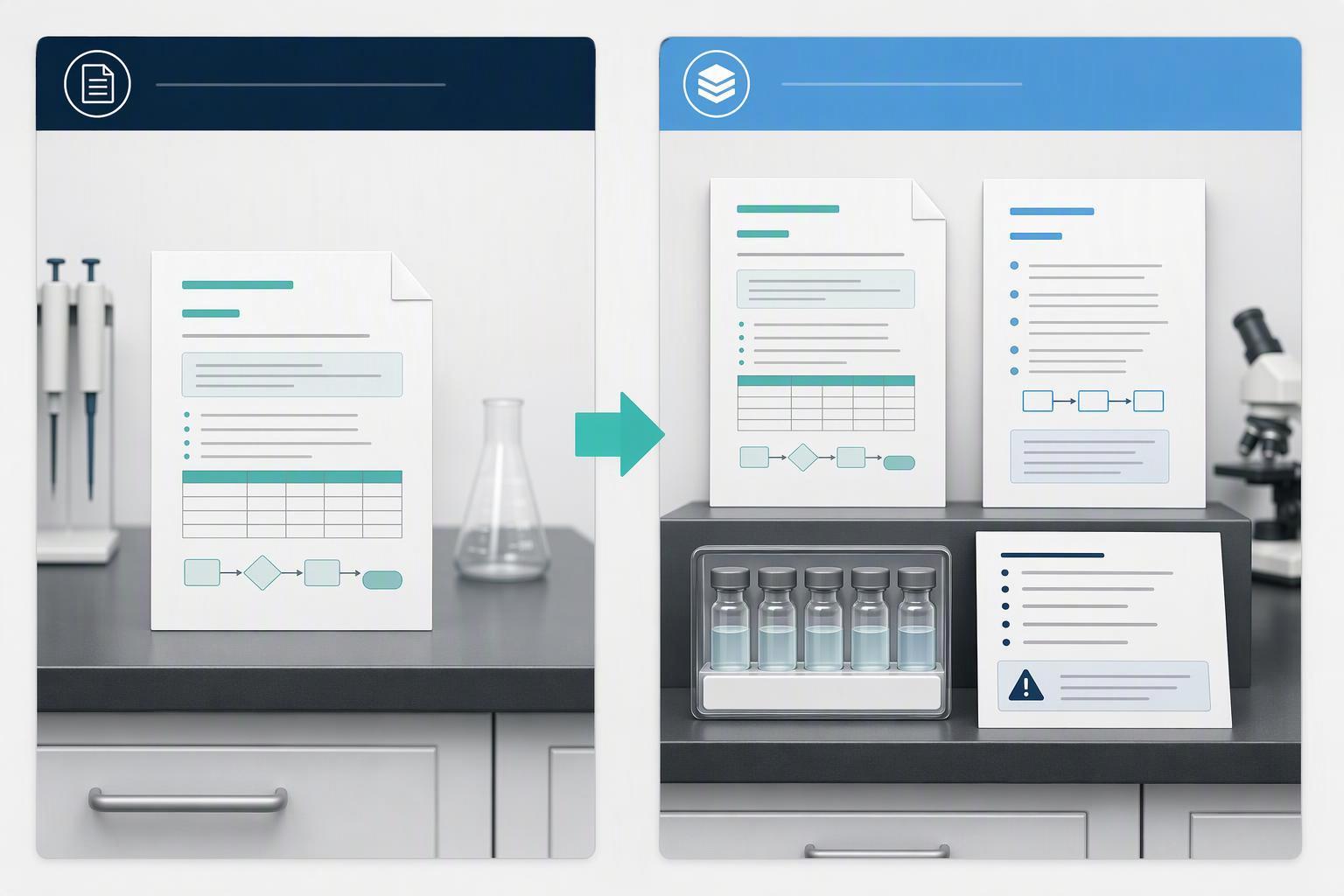
A method package can pass every completeness check and still fail in the receiving lab, because the artifacts that make a method transferable are rarely the ones written down. In peptide technology transfer, the gap is usually not the protocol itself but the reasoning behind it: why the integration rule for the hydrophobic impurity cluster was set where it was, which column lot behaved differently, which gradient adjustment was made and never recorded.
Three deliverables close most of that gap. Demand them before the protocol is signed:
Demand list: three artifacts a transfer-ready package must contain
A documented integration-rule set for the hydrophobic impurity cluster, including the decision logic, not just the final threshold Om
A reference-standard qualification record covering both the sending and receiving site
A written list of known failure modes, each paired with the sequence context that triggers it
The pattern behind these failures is well documented in biopharmaceutical manufacturing generally. BioPlan Associates’ Fifth Annual Report and Survey of Biopharmaceutical Manufacturing Capacity and Production found an average of one batch failure every 40.6 veckor, with nearly 60% of respondents reporting their most recent failure within the previous 3 till 12 månader (BioProcess International, 2008 survey). That figure covers manufacturing broadly rather than transfer specifically, so treat it as context for how often process knowledge gaps surface, not as a transfer failure rate.
The deeper constraint is talent. Experienced analytical staff hold much of this knowledge tacitly, and a package that never captures it transfers only the paperwork. Linking named personnel from the sending site to the receiving site for the duration of the comparison is the most reliable way to prevent that knowledge gap from opening.
Hur man undersöker ett jämförande resultat som är out-of-trend
Treat an out-of-trend comparative result as an analytical problem before you treat it as a manufacturing problem. The divergence itself does not tell you which it is; the investigation does. Branch on where the difference sits: metoden, the sample, the standard, or the analyst.
|
Observation |
Likely cause class |
Immediate action |
Stop condition |
|---|---|---|---|
|
Single replicate outside the acceptance interval, other replicates pass |
Analyst or instrument variability Peptidproduktion |
Repeat the injection sequence with a fresh preparation |
Repeat passes within the interval |
|
Systematic bias across all replicates, both labs |
Method or standard |
Widen the comparative set; check standard qualification and equivalence |
Bias persists after standard verification |
|
Divergence only in the impurity profile |
Sample handling or integration rules |
Re-examine integration parameters and sample prep |
Profile matches after rule alignment |
|
Divergence survives repeat, widened set, and rule alignment |
Method itself |
Invoke co-validation |
Co-validation fails; remediate the method |
The escalation options here are the ones the approach taxonomy names: repeat, widen the comparative set, co-validation, or remediation. Skipping transfer experiments is not among them, and it is not defensible. The justification requirement means you must be able to show why each experiment was performed or omitted, and “we did not run it” is not a justification.
Hur framgång ser ut och vad du ska göra härnäst
A peptide method transfer is complete when the comparative results fall inside the criteria you set before the first sample was run, at both sites, and the receiving unit can be described as qualified in the sense USP <1224> gives that word. Three artifacts should exist alongside those results: a signed reference-standard record held by both laboratories, a written list of the known failure modes for this molecule handed to the receiving team, and the comparative data set itself, traceable to the protocol version that produced it.
If any of those is missing, the transfer is not finished, whatever the results show. A passing data set with no signed standard record leaves the receiving lab unable to defend its next run.
The next step is a conversation about the specific gaps you have identified, not a general capability pitch. Bring your comparative data set, your criteria table and your failure-mode list to a discussion with an analytical team that works on peptide transfers routinely, and compare how they would have handled the two or three points where your results sat closest to the limit. That comparison is usually more useful than a broader vendor evaluation.
Avslöjande: MOL Changes works in peptide quality standards and analytical services, so we have a commercial interest in how this topic is understood. This article describes analytical and regulatory practice, inte medicinsk rådgivning. Decisions on filings should be confirmed with the relevant health authority and a qualified regulatory professional.
Vanliga frågor
Kan en överföring av en peptidmetod ske utan jämförande testning?
Not as a defensible equivalence claim. I Q2(R2) ties a procedure’s validity to documented evidence that it performs as intended in the receiving laboratory, and comparative testing is how that evidence is generated. A sponsor can argue exemption when the receiving lab already runs an identical procedure on identical equipment, but the argument has to be written down and justified in advance. Without that justification, a transfer report with no comparative data is an assertion, inte ett resultat.
Hur många replikat räcker?
Enough that the observed variability is the method’s, not sampling noise. Replicate counts should follow from the precision the procedure is expected to deliver and the size of the difference you need to detect, not from a default number copied out of a template. A procedure with tight intermediate precision needs fewer replicates to resolve the same difference than one with wide precision. State the basis for the count in the protocol so the receiving lab can defend it later.
What if the receiving lab’s column lot shifts retention of the hydrophobic impurity cluster?
Treat it as a method-robustness question before you treat it as a failure. Establish whether the shift falls within the selectivity the procedure was validated to tolerate. If it does, document the shift and the resolution achieved, and confirm the impurity cluster still integrates as a defined group. Om det inte gör det, the receiving lab’s column chemistry or lot is not equivalent to the transferring lab’s, and the fix belongs in the method or the column specification, not in the acceptance criteria.
Är ett överföringsavstående försvarbart för ett mycket liknande förfarande?
Sometimes, and the defensibility rests on the justification, not the similarity. A waiver is strongest when the procedure, utrustning, column chemistry, and analyst competency are demonstrably the same, and when the sponsor documents why comparative testing adds nothing. Similarity alone is not a justification. Sponsors weighing this against a full comparative transfer often fold it into peptide CDMO partner qualification discussions, because the receiving lab’s own qualification records are what make the waiver arguable.
Hur ska skillnader i motjonsavläsning mellan tekniker hanteras?
Compare like with like, and say which technique produced each number. Different analytical techniques can report a peptide’s counterion content on different bases, so a direct numerical comparison across techniques can show a difference that is an artifact of the readout rather than a real change in the material. In a comparability argument, either use the same technique on both sides or state the technique alongside each result and explain the basis of the comparison.
Slutsats
Running a peptide method transfer without breaking the project comes down to sequence. Assess readiness before writing anything, so the protocol is built on what the receiving lab can actually execute. Write acceptance criteria both laboratories have signed, with the replicate counts and thresholds stated as numbers. Treat the peptide-specific failure modes, resin and coupling chemistry differences, motjonbyte, disulfide scrambling, hydrophobic impurity integration, as the load-bearing content rather than an appendix. Then close the documentation and tacit-knowledge gap, because that is where transfers quietly break: the method is sound, the paperwork is complete, and the knowledge that made the original method work never left the sending bench.
The single next action is the readiness assessment. Run it before the protocol draft exists, not after the first comparative run fails. If the gap list comes back longer than the timeline allows, that is the moment to talk to an analytical team about what is transferable as written and what needs pre-transfer remediation.