
Vorhergehende zelluläre Mechanismen
Die Essenz des menschlichen Alterns ist die Alterung der Zellen, alternde Zellen werden für immer aus dem Zellzyklus ausgeschlossen, Sie werden jedoch nicht so direkt entfernt wie apoptotische Zellen, Seneszierende Zellen weisen im Allgemeinen eine große Anzahl beschädigter DNA auf, Dies kann der Grund sein, warum sie nicht entfernt werden, Daher bleibt eine große Anzahl alternder Zellen erhalten, und werden weiterhin abgelagert, was zur Alterung des Körpers und dem Auftreten damit verbundener Krankheiten führt. (Bevor seneszente Zellen dich töten, Du solltest zuerst zuschlagen)
Das p53-Gen hat die Funktion, Apoptose auszulösen, Sein Mechanismus besteht darin, dass das vom p53-Gen kodierte p53-Protein als Kontrollpunkt in der G1-Phase des Zellzyklus fungiert und dafür verantwortlich ist, zu überprüfen, ob die chromosomale DNA beschädigt ist; sobald die defekte DNA gefunden wird, es stimuliert die Expression von CIP, Dadurch wird verhindert, dass die Zellen in den Zellzyklus eintreten, und der Mechanismus der DNA-Reparatur wird in Gang gesetzt; wenn die Reparatur fehlschlägt, Das p53 löst den Apoptosemechanismus aus.
In seneszenten Zellen, Die FOXO4-Expression steigt und beeinflusst den Prozess der zellulären Seneszenz und Apoptose durch Interaktion mit Proteinen wie p53. Weil es an p53 angehängt ist, Es kann den Tod alternder Zellen verhindern.
Unterschied zwischen FOXO4 und FOXO4-Dri
Das kurze Peptid FOXO4 ist eine Aminosäure vom L-Typ.
Das kurze Peptid FOXO4-Dri ist eine Aminosäure vom D-Typ.
Warum FOXO4-Dri erscheint
FOXO4 ist ein geradkettiges Polypeptid, bestehend aus 46 Aminosäuren, Der überwiegende Teil der Sequenz besteht aus Aminosäuren vom D-Typ, weil er mit dem p53-Gen kombiniert wurde, Verhinderung der Expression des p53-Gens, Dies führt dazu, dass alternde Zellen nicht entfernt werden können.
In der ursprünglichen Idee, Wissenschaftler wollten die Genbearbeitung nutzen, um das Foxo4-Gen zu entfernen, aber das war zu aufwändig und anfällig für DNA-Schäden. daher, Wissenschaftler entwickelten eine Alternative, indem sie alle L-Typ-Aminosäuren im kurzen FOXO4-Peptid durch D-Typ-Aminosäuren ersetzten, welches die Konformation von FOXO4-Dri umkehrt und kompetitiv an p53 bindet, während verhindert wird, dass FOX04 an p53 bindet.
P53 aktiviert apoptotische Proteine und verursacht den Zelltod. Durch die Entfernung alter Zellen aus dem Gewebe, eine stärkere Geweberegeneration erreicht werden kann.
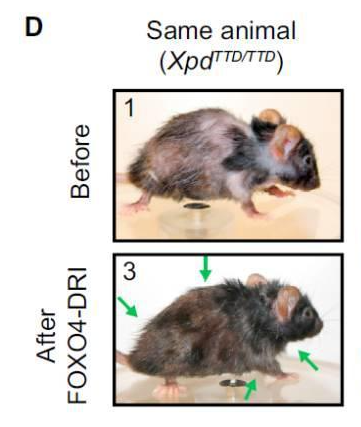
Anhang: Seneszente Mäuse, denen FOX04-dir injiziert wurde, zeigten eine deutliche Verbesserung der Nierenfunktion und das Haar begann, sich selbst zu reparieren.

Bingyan Gao
Profil: Bingyan Gao ist der „ultimative Pförtner“ für die Reinheit und Qualität von Peptiden. Er beherrscht den Umgang mit verschiedenen High-End-Analysegeräten und ist auf die Entwicklung maßgeschneiderter chromatographischer Trennmethoden für hochkomplexe modifizierte Peptide spezialisiert. Er hat ein strenges System zur Verunreinigungsprofilierung eingeführt, das nicht nur die Produktreinheit gewährleistet 99% oder höher, sondern identifiziert und beseitigt auch präzise Spurenverunreinigungen, die Immunogenität verursachen könnten. Mit einem tiefen Verständnis der regulatorischen Anforderungen der FDA und EMA für Peptidarzneimittel, Er stellt sicher, dass jede aus der Anlage freigegebene Charge von einem umfassenden und verbindlichen Analysezertifikat begleitet wird (Echtheitszertifikat).
- siRNA-Herstellungsmodell für die Peptidproduktion 2026年10月14日
- Therapeutische Peptidentdeckung: Catestatin und Orexin 2026年10月13日
- Metallgesteuerte 2D-Peptidkristalle: Design & Beweis 2026年10月12日
- Differenzierte Peptidmechanismen: Novo-Kallyope-Rennen 2026年10月11日
- Peptid-CMO-Auswahl: Eine 6-dimensionale Supply-Chain-Scorecard 2026年10月11日
Unser Faktencheck-Prozess
Wir legen bei unseren Inhalten Wert auf Genauigkeit und Integrität. So halten wir hohe Standards aufrecht:
- Expertenbewertung: Alle Artikel werden von Fachexperten überprüft.
- Quellenvalidierung: Informationen werden durch Glaubwürdigkeit untermauert, aktuelle Quellen.
- Transparenz: Wir zitieren Referenzen deutlich und legen mögliche Konflikte offen.
Unser Prüfungsausschuss
Unsere Inhalte werden von erfahrenen Fachleuten sorgfältig überprüft, um Genauigkeit und Relevanz sicherzustellen.
- Qualifizierte Experten: Jeder Artikel wird von Spezialisten mit fachspezifischem Wissen bewertet.
- Aktuelle Einblicke: Wir integrieren die neuesten Forschungsergebnisse, Trends, und Standards.
- Verpflichtung zur Qualität: Gutachter sorgen für Klarheit, Richtigkeit, und Vollständigkeit.
Achten Sie auf das von Experten geprüfte Label, um Inhalte zu lesen, denen Sie vertrauen können.