डिज़ाइन संक्षिप्त में ओरल पेप्टाइड डिलीवरी में क्या परिवर्तन होता है
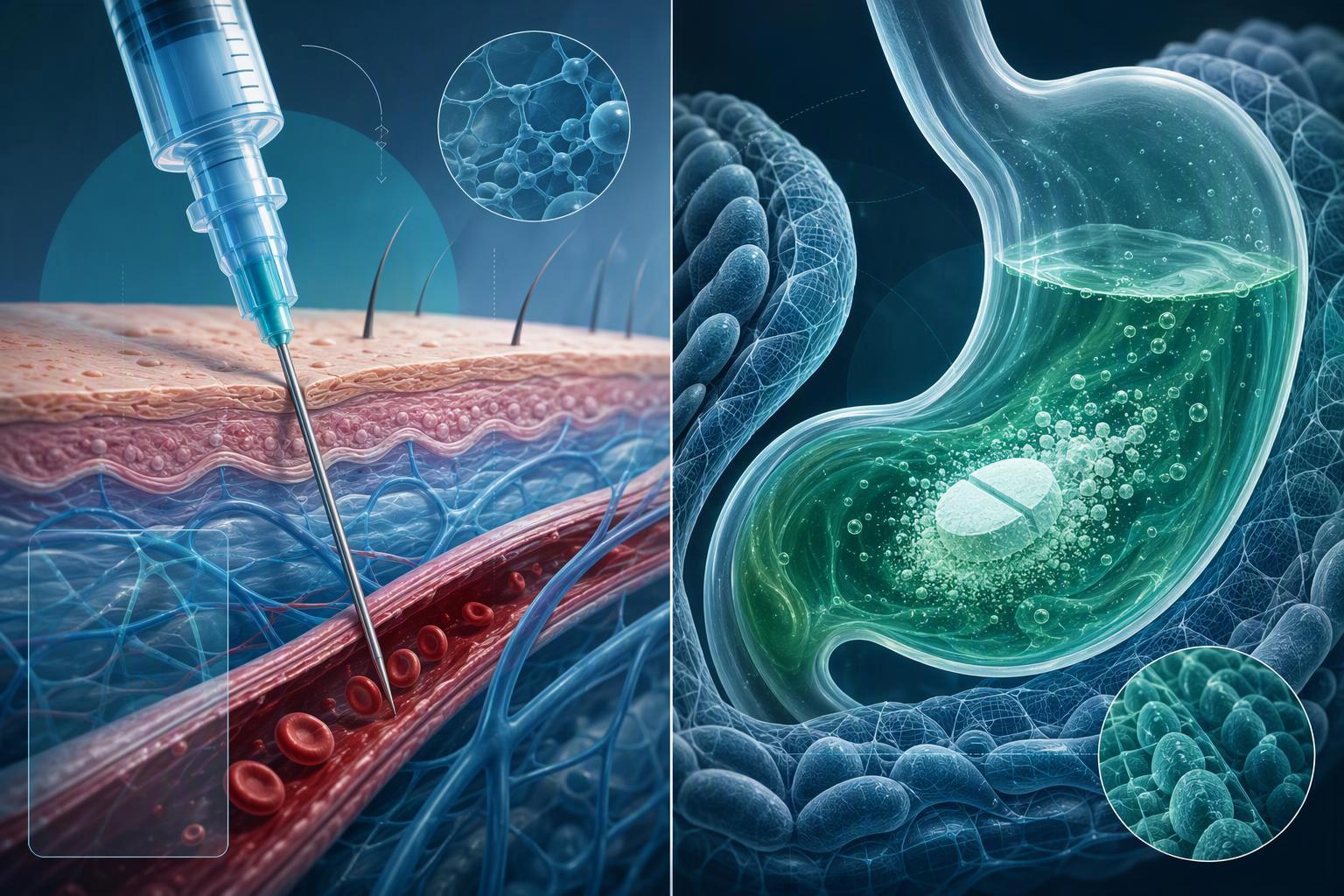
मौखिक पेप्टाइड वितरण डिज़ाइन उद्देश्य को ही बदल देता है. पहले शक्ति को अनुकूलित करने और बाद में तैयार करने के बजाय, अनुक्रम और वितरण रणनीति को शुरू से ही सह-डिज़ाइन करना होगा, क्योंकि अणु को अब अपने रिसेप्टर तक पहुंचने से पहले आंत में जीवित रहना होगा. ओरल पेप्टाइड खुराक की फार्माकोकाइनेटिक सीमाओं की फ्रंटियर्स समीक्षा, पर प्रकाशित 20 मार्च 2026, आवश्यकता को चार जीवित स्थितियों के रूप में तैयार करता है जिन्हें पेप्टाइड को एक ही बार में पूरा करना होगा: इसे गैस्ट्रिक एसिड और प्रोटीज़ का सामना करना होगा, एकत्रीकरण का विरोध करें, संशोधन के बाद शक्ति बनाए रखें, और 1% से कम अवशोषित खुराक की भरपाई करने के लिए आधा जीवन पर्याप्त लंबा रखता है.
यह इंजेक्शन से अलग ब्रीफ है. एक इंजेक्ट किया गया पेप्टाइड जठरांत्र संबंधी मार्ग को पूरी तरह से बायपास कर देता है, इसलिए शक्ति और आधा जीवन ही पूरी समस्या है. एक मौखिक उम्मीदवार के पास उन्हीं आवश्यकताओं के साथ-साथ एक डिलीवरी गौंटलेट भी होता है, और चारों स्थितियाँ एक दूसरे से प्रतिस्पर्धा करती हैं: प्रोटीज प्रतिरोध में सुधार करने वाले संशोधन अक्सर पारगम्यता के विरुद्ध काम करते हैं, और जो पारगम्यता में सुधार करते हैं उनमें अक्सर सामर्थ्य की कीमत चुकानी पड़ती है.

HRS-1596 के लिए नोवो नॉर्डिस्क और हेनग्रुई फार्मा लाइसेंस, पर घोषणा की गई 29 सितम्बर 2026, उस प्रकाश में पढ़ने लायक है. प्रकट की गई शर्तें हैं $300 करोड़ अग्रिम, तक $2.6 कुल संभावित मूल्य में अरब, शुद्ध बिक्री पर प्लस रॉयल्टी. संपत्ति एक बार साप्ताहिक मौखिक जीएलपी-1/जीआईपी दोहरी रिसेप्टर एगोनिस्ट है. जिसे लाइसेंस दिया जा रहा है वह न केवल एक अणु है बल्कि एक वितरण समस्या है जिसे चरण I कार्यक्रम को उचित ठहराने के लिए काफी हद तक हल किया जा चुका है.
⚠️ चेतावनी: HRS-1596 को एक बार साप्ताहिक मौखिक GLP-1/GIP दोहरे रिसेप्टर एगोनिस्ट के रूप में प्रकट किया गया है. यह आलेख अनुसंधान-चरण और नैदानिक-चरण पेप्टाइड विकास पर चर्चा करता है, चिकित्सीय सलाह नहीं. कोई भी चिकित्सीय निर्णय लेने से पहले किसी योग्य पेशेवर से परामर्श लें.
ओरल पेप्टाइड डिलीवरी कठिन क्यों है?: तीन बाधाएँ
एक मौखिक पेप्टाइड को रक्तप्रवाह तक पहुंचने से पहले तीन अलग-अलग बाधाओं से गुजरना पड़ता है: आंत के लुमेन में एंजाइमेटिक टूटना, उपकला कोशिका परत, और आंतों की दीवार पर बलगम की परत जम जाती है. हर एक अलग कारण से विफल होता है, और प्रत्येक एक अलग डिज़ाइन या फॉर्मूलेशन लीवर पर प्रतिक्रिया करता है, यही कारण है कि कोई भी एकल संशोधन पेप्टाइड को मौखिक रूप से उपलब्ध नहीं कराता है.
पहली बाधा रासायनिक है. पेट और छोटी आंत में पाचन प्रोटीज़ अवशोषण संभव होने से पहले ही पेप्टाइड रीढ़ को तोड़ देते हैं. की एक प्रारंभिक स्क्रीन 17 सिम्युलेटेड जीआई तरल पदार्थों में पेप्टाइड्स में एंजाइमेटिक गिरावट पाई गई, पीएच नहीं, सबसे ज्यादा नुकसान हुआ, साइक्लोस्पोरिन के साथ, ऑक्टेरोटाइड और डेस्मोप्रेसिन उल्लेखनीय अपवाद हैं (आण्विक फार्मास्यूटिक्स, 2015). यह एक परख सेट से एकल-अध्ययन परिणाम है, लेकिन यह डिजाइनरों को अकेले एंटरिक कोटिंग के बजाय रीढ़ की हड्डी के स्थिरीकरण की ओर इशारा करता है.
दूसरी और तीसरी बाधाएँ भौतिक हैं. ए 2022 पारगम्यता बढ़ाने वाली रणनीतियों की समीक्षा पारगम्यता को तीन-परत की समस्या के रूप में वर्णित करता है: ल्यूमिनल एंजाइम, इसके पैरासेल्यूलर के साथ उपकला अवरोध, ट्रांससेलुलर और वाहक-मध्यस्थ मार्ग, और बलगम की परत. वही समीक्षा बताती है कि क्यों पारगमन बढ़ाने वाले केवल क्षणिक लाभ प्रदान करते हैं: वे स्थानीय स्तर पर कार्य करते हैं, पेलोड-विशिष्ट हैं, और आवश्यक खुराक पर सुरक्षा और सहनशीलता सीमा में चला जाता है.
वह विभाजन पेप्टाइड्स की आंतों की पारगम्यता के लिए मायने रखता है. एंजाइम प्रतिरोध, उपकला परिवहन और बलगम प्रवेश प्रत्येक को अपने स्वयं के समाधान की आवश्यकता होती है, इसलिए मौखिक कार्यक्रमों का मूल्यांकन संयोजन के आधार पर किया जाता है, किसी एक संशोधन पर नहीं.
मौखिक प्रसव के लिए पेप्टाइड अनुक्रम डिज़ाइन
मौखिक डिलीवरी डिज़ाइन संक्षिप्त को बदल देती है: अनुक्रम और संशोधन विकल्पों को अब स्थिरता और आधा जीवन प्रदान करना चाहिए, अकेले सामर्थ्य नहीं. एक पेप्टाइड जो अपनी रिसेप्टर आत्मीयता खो देता है वह बेकार है, लेकिन जो आंत की दीवार तक पहुंचने से पहले ही नष्ट हो जाता है उसे कभी भी बंधने का मौका नहीं मिलता.
मौखिक पेप्टाइड्स के लिए मानक रासायनिक रणनीतियाँ चक्रीकरण हैं, डी-अमीनो एसिड प्रतिस्थापन, other non-natural residues including N-methylation, lipidation or acylation, PEGylation and glycosylation. More rigid structures are generally less vulnerable to protease attack, जैसा peer-reviewed reviews of cyclic peptides and oral delivery barriers describe. Cyclization buys conformational rigidity and some protease resistance; it does not by itself solve permeability.
Semaglutide shows how the two pillars combine. MOL Changes’ analysis of the oral GLP-1 development brief notes that the molecule pairs an Aib substitution at position 8, which blocks DPP-4 cleavage, with a Lys26 gamma-Glu-OEG2 spacer to a C18 di-acid for albumin binding: enzyme resistance plus half-life extension.
That second pillar carries a cost. Hydrophobic modifications that extend half-life, such as C18 di-acid acylation, lower aqueous solubility and raise aggregation tendency, व्यावहारिक सूत्रीकरण विंडो को संकीर्ण करना. Sequence decisions made at discovery therefore set the ceiling for everything downstream.
स्थिरता परीक्षण जो गैस्ट्रोइंटेस्टाइनल ट्रैक्ट को दर्शाता है
Oral peptide stability testing asks whether the peptide survives transit, not whether it survives storage. The developability assessment a peptide programme runs for an oral candidate is a GI-exposure programme: simulated gastric fluid and fasted-state simulated intestinal fluid, with and without enzymes, acid exposure, and precipitation risk as pH shifts from stomach to intestine (Bak et al., 2015). Injectable programmes target something else entirely, namely solution and shelf stability, एकत्रीकरण, ऑक्सीकरण, deamidation and container-closure compatibility.
The biorelevant stability toolkit at discovery stage is well defined. Simulated gastric fluid sits at roughly pH 1.2 पेप्सिन के साथ; fasted-state simulated intestinal fluid adds pancreatin; incubation runs at 37 समयबद्ध नमूने के साथ डिग्री सेल्सियस; reversed-phase HPLC tracks intact peptide while LC-MS identifies fragments. Enzyme-free controls separate pH-driven hydrolysis from proteolysis.
टिप के लिए: Run the enzyme-free control alongside every enzyme-containing sample. इसके बिना, a loss of intact peptide cannot be attributed to proteolysis rather than acid hydrolysis, and the mechanism you need for redesign stays hidden.
That distinction carries the practical consequence. A programme that runs only shelf-life stability will not see the failure mode that eliminates oral candidates, because degradation in the gut happens on a timescale and through chemistry that storage studies never probe.
आंतों की पारगम्यता और पारगमन वृद्धि की सीमाएँ
Permeation enhancers raise the intestinal permeability of peptides at the margin, but they do not remove the ceiling. ए 2026 review of oral peptide delivery complexity reports that most therapeutic peptides show oral bioavailability below 1%, describing this as the “low inherent oral bioavailability (<1%) observed for most compounds” (Oral peptide delivery complexity review, पीएमसी, 2026-03-24). That figure is the baseline every oral program is working against.
Oral semaglutide shows what the best-characterised enhancer can achieve. Its absolute bioavailability is approximately 0.4% को 1% under strict fasting conditions, and near zero when taken with food, per a 2026 Frontiers review of oral peptide pharmacokinetic boundaries reporting the FDA clinical pharmacology review (दवा वितरण में अग्रणी, 2026-03-20). The fasting requirement is not a labelling quirk; it is the mechanism showing through.
How SNAC actually helps semaglutide cross the membrane is more specific than a lipophilicity boost. Work published in प्रकृति संचार in October 2025 found that SNAC forms permeation-enhancer-filled fluid membrane defects, helps monomerise semaglutide in the water layer, then neutralises to insert into the bilayer, lowering aqueous free energy by about 1 kcal/mol versus a fixed protonation state. The effect is transient, local, and tied to that payload.
Higher numbers exist, and they are outliers rather than a template. The Luna18 preclinical outlier, a cyclic peptide from Chugai, reaches 21% को 47% oral bioavailability in preclinical models, and the MEDI7219 dog study, an AstraZeneca enteric-coated tablet, reached approximately 6% in dogs, about a five-fold increase over semaglutide formulated with SNAC (PMC complexity review, 2026-03-24). The review presents MEDI7219 as a cross-compound comparison, not a head-to-head trial, so treat the multiple as directional.
पेप्टाइड 1 Why formulation alone rarely clears the low single-digit ceiling comes down to the excipient toolkit. Formulation efforts have relied on a small set of well-characterised excipients, “rarely yielding bioavailability’s beyond the low single-digit range in large animals and humans”; what enabled efficacy at low single-digit bioavailability in oral semaglutide, MK-0616 and icotrokinra was structural modification (PMC complexity review, 2026-03-24). Enhancers also carry a dose-limiting constraint: they act by disrupting the membrane, so safety and tolerability at the doses needed for absorption set a practical ceiling that varies by payload.
फॉर्मूलेशन स्क्रीनिंग और डेवलपबिलिटी गेट
Formulation screening for an oral peptide is a staged elimination process, not an excipient search. The formulation screening funnel runs excipient compatibility and stability screening first, then function-based multi-excipient selection, enteric protection so release happens after the stomach, permeation-enhancer screening, and dose-loading feasibility, before any candidate reaches biorelevant release testing (PMC and Bak et al., 2015). Each stage exists to remove candidates cheaply, and constrained loading is a hard design limit: helper excipients compete with the peptide for space in the dosage form, so every added functional excipient takes room the dose needs.
Solid State Peptide Synthesis Potency and half-life are entry criteria for the oral route, not downstream properties. The potency gate for oral candidates is a low-nanomolar EC50, because low potency cannot achieve efficacy at a sub-1% absorbed dose (Frontiers, 2026). The half-life gate for once-daily oral dosing sets approximately 24 hours or more as the practical minimum when bioavailability sits below 1%; 12 को 24 hours stays viable only with twice-daily dosing or compensating potency and therapeutic window (Frontiers, 2026).
|
Technical area |
पास की शर्त |
Failure signal |
|---|---|---|
|
Sequence design |
Low-nanomolar EC50; modification strategy compatible with scale-up |
Potency requires a dose the dosage form cannot carry |
|
Peptide stability testing |
Intact peptide survives simulated gastric and intestinal conditions |
Rapid degradation before the absorptive surface |
|
Intestinal permeability of peptides |
Measurable flux with an enhancer strategy that tolerates chronic dosing |
Permeability gains that reverse at repeat exposure |
|
सूत्रीकरण |
Enteric protection plus dose loading that fits the capsule |
Excipient load crowds out the peptide |
|
विश्लेषणात्मक लक्षण वर्णन |
Assay distinguishes intact peptide from metabolites and degradants |
Release testing that cannot resolve the absorbed species |
व्यावहारिक परिणाम: a program that cannot clear the potency and half-life gates at discovery rarely recovers them Liberty Blue Peptide Synthesizer later, so both belong in the candidate-selection brief alongside peptide stability testing and the permeability plan.
मौखिक कार्यक्रमों के लिए विश्लेषणात्मक लक्षण वर्णन
Oral programs must add biorelevant-medium degradant profiling to standard release testing. An analytical package built for an injectable will not characterize the degradants an oral program actually produces.
That means three additions. पहला, sequence and modification integrity: confirming the backbone and any non-natural residues survived synthesis intact. दूसरा, degradation-product identification in simulated gastric and intestinal media, not just in buffer. तीसरा, counterion and salt-form characterization, since trifluoroacetate exchange affects both assay accuracy and tolerability. Endotoxin testing by LAL assay and a complete certificate of analysis belong in the same package, और आईएसओ 13485 या आईएसओ 9001 context tells you whether the supplier’s quality system can support it.
Methods must be validated against the validation characteristics Q2(आर2) प्रस्थान करना, published by the FDA in March 2024. Read those as expectations rather than thresholds: the guideline gives signal-to-noise guidance of roughly 3:1 for detection limit and at least 10:1 for quantitation limit, not peptide-specific cutoffs.
कुंजी ले जाएं: A validated peptide analytical characterization package should cover specificity and selectivity, शुद्धता, शुद्धता पेप्टाइड 2 including repeatability and intermediate precision, श्रेणी, response and linearity, detection and quantitation limits, and robustness.
This is where a research-grade supplier stops being enough. ए 95% purity floor is a conventional research-grade baseline, but it says nothing about which degradants are present or whether the method that measured it was validated for an oral matrix.
डिस्कवरी-स्टेज संश्लेषण की आवश्यकता बनाम विकास और स्केल-अप
Discovery and development optimise for different things. Discovery optimises for learning: many analogues, milligram to small research quantities, screening-grade purity acceptable, and turnaround valued over process optimisation. Development optimises for dependable manufacturing: fewer routes, locked and transferable processes, tight impurity control, lot-to-lot comparability, gram-to-kilogram supply, and full analytical and regulatory documentation. The change of optimisation target at scale-up, not the batch size alone, is what breaks programs, as the discovery-to-development framing in Bak et al.’s developability primer sets out (2015).
|
मांग |
खोज |
Development and scale-up |
|---|---|---|
|
पैमाना |
Milligram to small research quantities |
Gram to kilogram |
|
पवित्रता लक्ष्य |
Screening grade acceptable |
Tight impurity control, lot-to-lot comparability |
|
Process status Cem Peptide Synthesis |
Many analogues, routes still open |
Fewer routes, locked and transferable |
|
Analytical package पेप्टाइड 2 |
Identity and rough purity |
Full characterisation and regulatory documentation |
Peptide scale-up failure modes concentrate in incomplete coupling and deprotection, aggregation and poor resin swelling or mass transfer, thermal gradients, and purification bottlenecks. Small inefficiencies compound across every amino-acid addition, so yield and purity loss from milligram to kilogram scale is real but not reported as a percentage in any primary source, which is why it is described here rather than quantified.
कुंजी ले जाएं: Choose your synthesis partner by the stage you are entering, not the stage you are in. A route that tolerates screening-grade purity at milligram scale will not carry a program into gram-to-kilogram supply without process lock and full documentation.
MOL Changes runs custom peptide synthesis from milligram to kilogram scale, तक के क्रम के साथ 200 amino acids and support for 300-plus modifications, and purity from crude through 99 प्रतिशत. Quality-control methods available include HPLC, LC-एमएस, एंडोटॉक्सिन परीक्षण, and sterility testing in a Class 100 सफ़ाई कक्ष.
ओरल पेप्टाइड डिलीवरी के बारे में आम भ्रांतियाँ
Four beliefs cause most of the expensive failures in oral peptide programs: that a permeation enhancer solves absorption, that oral delivery is a formulation problem rather than a molecule problem, that a stable peptide is a shelf-stable peptide, and that scale-up is simply a bigger batch.
The first two are related. Enhancers act transiently and locally at the intestinal wall, so they widen a window rather than remove the barrier. What changed the outlook for oral peptides was structural modification, which is why formulation alone rarely clears the low single-digit bioavailability ceiling that oral programs run into. If your team is screening excipients before the sequence has been optimised for the gut, the screening is premature.
The third misconception confuses two different measurements. Resistance to gastrointestinal exposure and shelf-life stability are separate properties, and a peptide that survives twelve months on a shelf may still be degraded before it reaches an absorptive surface.
The fourth is a change of target, not of volume. Scale-up shifts what you are optimising for, so a route that works at milligram scale can fail on the parameters that matter later.
⚠️ चेतावनी: Oral bioavailability for peptides remains low and variable. No single modification or excipient resolves intestinal permeability. HRS-1596 is an early-stage candidate, and nothing here is an efficacy, सुरक्षा, or approval claim.
अक्सर पूछे जाने वाले प्रश्नों
पेप्टाइड को विकसित करने के लिए किस मौखिक जैवउपलब्धता की आवश्यकता है?
There is no single threshold, because the half-life and potency gates interact. A modelling analysis reported in Frontiers in Drug Delivery found that a peptide with a half-life of roughly 24 hours or longer can accumulate meaningfully even at sub-1% bioavailability, while the same analysis places the practical potency ceiling at low-nanomolar EC50. Oral viability is a property of the molecule’s pharmacokinetic profile, not of the delivery technology alone.
ओरल सेमाग्लूटाइड को खाली पेट क्यों लेना चाहिए??
Because absorption collapses when food is present. The fasting requirement for oral semaglutide reflects an absolute bioavailability of approximately 0.4-1% under strict fasting conditions, with no more than 4 oz of water, an empty stomach, and a 30-minute fast after dosing, and near-zero absorption with food, as recorded in the FDA clinical pharmacology review and reported in a Frontiers in Drug Delivery review. The instruction is the difference between a therapeutic dose and an ineffective one.
क्या पारगम्यता बढ़ाने वाले किसी भी पेप्टाइड को मौखिक रूप से उपलब्ध करा सकते हैं?
नहीं. Enhancers such as SNAC work by creating transient defects in the intestinal membrane that let the co-formulated peptide cross, and that mechanism is local, short-lived, and payload-specific. An enhancer that carries one peptide across the epithelium will not necessarily carry another, and raising the dose runs into gastrointestinal tolerability limits. Permeation enhancement widens the window for a candidate that already has the right potency and half-life; it does not make an arbitrary peptide absorbable.
एक मौखिक पेप्टाइड प्रोग्राम को किस स्थिरता परीक्षण की आवश्यकता होती है जो एक इंजेक्टेबल प्रोग्राम को नहीं होती है?
An oral program needs stability data generated in gastrointestinal-relevant media, not just in buffer. Injectable programs characterise the peptide in formulation buffer and plasma; oral candidates additionally have to survive gastric acid, pepsin, and intestinal proteases, so peptide stability testing has to model those conditions rather than assume them. That means proteolytic stability assays in simulated gastric and intestinal fluid, and release methods that reflect the intestinal environment the capsule actually encounters.
खोज-चरण और विकास-चरण की शुद्धता आवश्यकताएँ किस प्रकार भिन्न हैं??
Discovery work tolerates crude to 95% पवित्रता, because the question being asked is whether the sequence behaves, not whether it can be filed. Development and scale-up work moves toward 99% purity with a documented analytical package, since the same material has to support toxicology, नैदानिक आपूर्ति, और नियामक समीक्षा. A sequence that looks clean at research grade can reveal impurity and stability problems once the purity floor rises.
नोवो और हेंग्रुई सौदा वास्तव में क्या संकेत देता है?
It signals that large pharmaceutical companies are willing to pay for oral peptide delivery capability rather than build it. Hengrui’s announcement of the HRS-1596 licence disclosed a deal worth up to approximately $300 million for an oral GLP-1/GIP candidate, with Novo Nordisk taking the development forward. The signal for anyone running an oral program is the structure rather than the headline number: the licensor retained the discovery and early development work, and the partner bought the later-stage capability.
निष्कर्ष और अगले चरण
Oral peptide delivery moves five decisions earlier and makes them interdependent: अनुक्रम डिजाइन, स्थिरता परीक्षण, permeability strategy, formulation screening and analytical characterization. Change one and the others move with it, which is why the evaluation sequence matters more than any single modification. A candidate that survives fasted-state intestinal media but fails the developability gate is not a near-miss; it is a program that needed the permeability question answered before the synthesis scale changed.
That is also where the stage distinction earns its keep. Discovery work tolerates crude material and rapid iteration, while development and peptide scale-up demand documented purity, validated methods and batch-to-batch consistency. The handoff points between those stages, not the individual steps, are where programs lose time.
The HRS-1596 licence announced on 29 सितम्बर 2026 is one signal in a broader shift: delivery capability, not receptor potency alone, is becoming the differentiator. HRS-1596 is disclosed as phase I-ready for once-weekly oral dosing, and no efficacy or approval claim follows from that disclosure. Oral bioavailability remains low and variable, and no single modification or excipient resolves permeability on its own.
If you are scoping an oral candidate, the useful next step is a capability conversation: talk to an expert about which stage your sequence sits at and what the data package needs to show.
खुलासा: MOL Changes provides custom peptide synthesis services. This article discusses research-stage and clinical-stage peptide development and is not medical advice; consult a qualified professional before making medical decisions.