단계 1: Define the Replicate Unit Before You Read Any Number
맞춤형 펩타이드 공급업체 Spps Protein The first question is not “what is the RSD” but “what was replicated.” ICH Q2(R2) defines precision at three levels, and each level has its own replicate unit: repeatability is precision under the same operating conditions over a short interval, intermediate precision is within-laboratory variation across typical changes, and reproducibility is precision between laboratories established by an inter-laboratory trial (나는 Q2(R2), 채택됨 1 십일월 2023). A supplier who sends one RSD without naming the tier has sent you a number you cannot place.

Count what you were given against the published minimums. Repeatability should be assessed using either a minimum of 9 보고 범위를 포괄하는 결정, ~와 같은 3 농도 3 각각 복제, 또는 최소한 6 에서 결정 100% 시험 농도의 (나는 Q2(R2), §3.3.2.1). For intermediate precision, the factors to vary are different days, environmental conditions, analysts and equipment, as relevant, and the guideline explicitly encourages design of experiments rather than studying each factor in isolation (나는 Q2(R2), §3.3.2.2).
Reproducibility is the tier most often claimed and least often performed. 나는 Q2(R2) states that reproducibility is assessed by an inter-laboratory trial and that investigation of reproducibility is usually not required for regulatory submission, but should be considered where a procedure is standardized, included in a pharmacopoeia, or conducted at multiple sites (나는 Q2(R2), §3.3.2.3). The distinction is not academic. In an oxytocin study run across multiple countries, lab-to-lab %RSD reached 2.3% by HPLC assay, 4.73% by qNMR and 5.44% by amino acid analysis, while sample-to-sample %RSD within a laboratory was 0.7%, 1.85% 그리고 1.78% 각기 (Li et al., J Pharm Biomed Anal 166, 2019). The gap between those two sets of figures is the size of the uncertainty a single-laboratory purity number conceals.

The reason no threshold can be quoted from the guideline is deliberate. 나는 Q2(R2) sets no universal numeric precision limit; acceptance criteria must be predefined and justified from the procedure’s purpose, reportable range, product, analytical variability and regulatory specification (나는 Q2(R2)). A precision figure without its replicate unit is not an uncertainty statement, and a criterion without a stated basis is not an acceptance criterion.
단계 2: Ask What the Method Does to the Sample Before It Reaches the Detector
Some of the impurity a method reports may be created by the method itself. 에이 2024 Analytical Chemistry method paper states the premise plainly: elevating column temperature improves chromatographic separation of peptides, but high temperatures induce artificial modifications that compromise the quality of the peptide analysis, and in-column modifications can falsely elevate the levels of some critical quality attributes (Starovoit et al., Anal. 화학. 96(36), 2024). That is the frame for in-column degradation peptide analysis: the question is not whether the column is hot, but whether the method controls what heat does.
The paper also demonstrates what a control looks like. A short inline trap column held at near-ambient temperature upstream of the heated separation column increased peak capacity 1.4-fold within a 110-minute trastuzumab peptide mapping, delivered 10% more peptide identifications, and reduced temperature-related artifacts by 66% for N-terminal pyroGlu and 63% for oxidized Met compared with direct injection at 60 ℃ (Starovoit et al., Anal. 화학. 96(36), 2024). The reduction is the deliverable: a documented change that removes a defined fraction of measurement-created modification.
The mechanism behind the artifact is a residence-time effect, and the same physics governs retention. In reversed-phase peptide LC, the peptide’s hydrophobic region adsorbs to the bonded phase until solvent strength reaches the point at which it desorbs, and metal-ion impurities in the system cause peak tailing and resolution loss (Carr, ACE Guide to Reversed-Phase HPLC of Proteins and Peptides, undated technical guide). An impurity level reported without a degradation control has not been shown to be a sample property rather than an instrument property. Note the limit of the evidence: the paper reports artifact reductions, not a baseline in-column degradation rate, so no percentage loss per injection can be quoted from it.
단계 3: Design the Degradation Experiment You Are Asking For
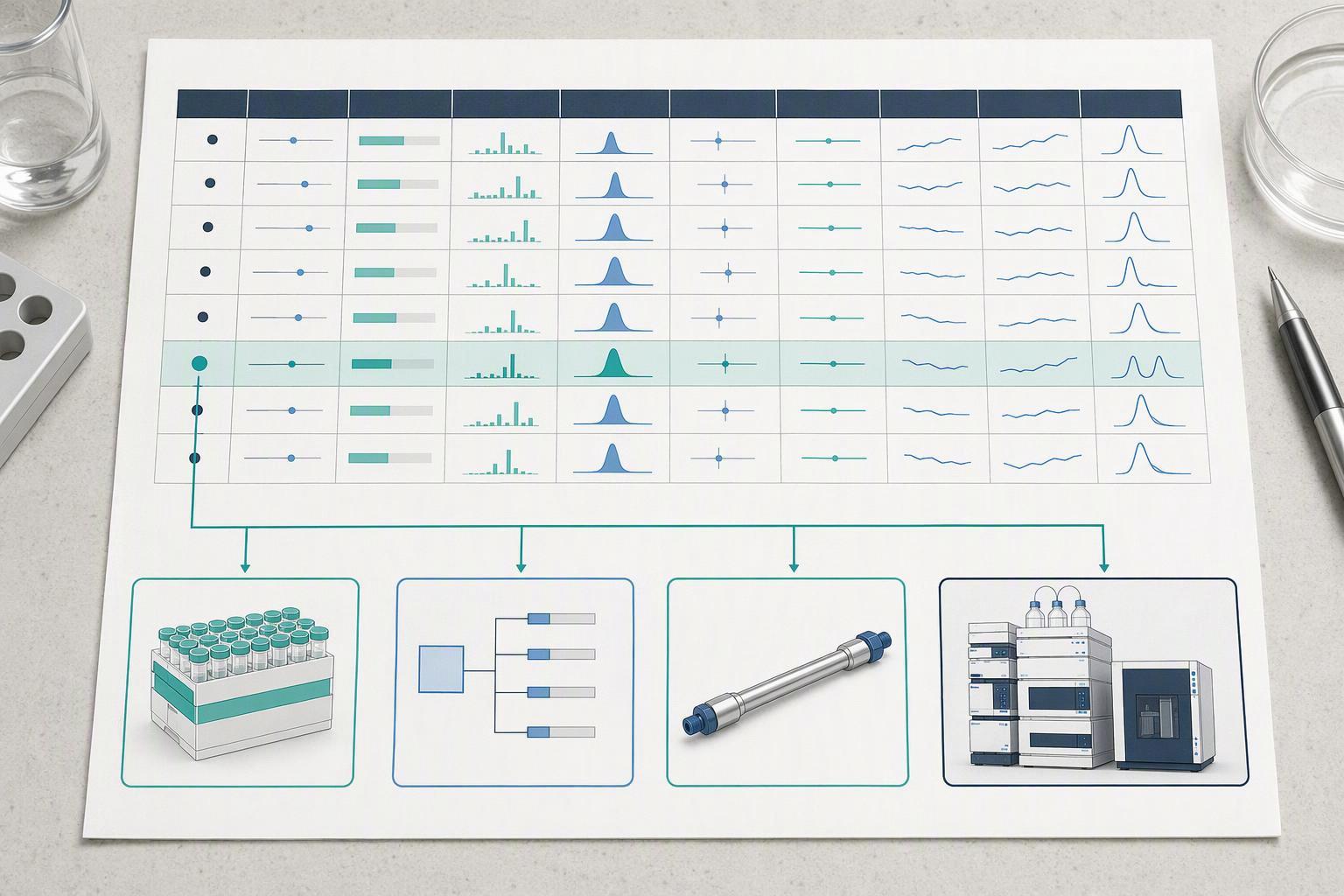
This is the step where you stop evaluating and start specifying. A workable replicate design exists in the literature: each library tested three times, each in triplicate with three technical repeats for 27 wells per condition, sampling at hours 0, 1, 4, 8, 24 그리고 48 in duplicate, with one aliquot measured immediately and the other frozen at −80 °C, and an internal standard whose peak area remained above 92% ~의 0 h peak at 48 시간 (Rozans, Moghaddam, Pashuck, J Biomed Mater Res A, preprint 2024, peer-reviewed version 2025). That structure is what makes a degradation claim traceable, because every reported value maps to a well, a timepoint and an aliquot.
Use the cited degradation experiment as an example, not a mandatory template. Select independent preparations, technical repeats, time points and internal-standard criteria based on the expected kinetics, precision and recovery. Distinguish an observed >92% signal from a prospectively justified acceptance threshold.
|
필드 |
Published example, not an acceptance criterion |
없는 경우 실패 모드 |
|---|---|---|
|
Replicate structure |
3 runs × 3 replicates × 3 technical repeats |
No basis for the stated RSD |
|
Timepoints |
0, 1, 4, 8, 24, 48 시간, 합성폴리펩타이드 공장 duplicate aliquots |
Degradation rate cannot be fitted Peptide S Manufacturer |
|
Aliquot handling |
One measured immediately, one frozen at −80 °C |
Storage loss indistinguishable from degradation |
|
Internal standard criterion |
Peak area >92% ~의 0 h at 48 시간 |
Loss of analyte cannot be separated from loss of signal |
|
Blanks and stressed samples |
Included at each timepoint |
Method-created peaks reported as sample impurities |
|
Fresh-column control |
Same lot, new column |
Column history confounded with sample |
|
Alternate column lot |
Second lot, Stapled Peptide Synthesis same method |
Lot effect invisible |
|
직교 확인 |
Second technique on a subset |
Single-method artifact unchallenged |
The oxytocin study shows why the exclusion criteria matter as much as the inclusion criteria. One laboratory’s amino acid analysis results were invalidated for inconsistent amino acid standard response, one laboratory’s HPLC results were excluded because it could not obtain stable Karl Fischer water content, and one HPLC value was excluded as an outlier, so the number of usable laboratories fell below the number that started (Li et al., J Pharm Biomed Anal 166, 2019). Ask for the exclusions and the reason for each.
The records side of the same request is governed by ALCOA+ and Part 11. MHRA’s guidance treats data integrity as a lifecycle outcome rather than a checklist: there is no difference in expectations regardless of which acronym is used, 데이터 거버넌스 조치를 통해 데이터의 완전성을 보장해야 하기 때문입니다., 일관된, 데이터 수명주기 전반에 걸쳐 지속적이고 사용 가능, and the audit trail is metadata recording creation, modification or deletion of GxP records (MHRA GxP 데이터 무결성 지침 및 정의, Revision 1, 3월 2018). 부분 11 보안이 필요합니다, 컴퓨터 생성, time-stamped audit trails that do not obscure previously recorded information, retained at least as long as the subject records and available for agency review, plus protection of records for ready retrieval and authority checks (21 CFR 부분 11, 현재 eCFR 텍스트). For CRO data package due diligence, request the per-injection table with lot, method ID, column and gradient traceability, 요약이 아니라. Synthetic Peptide Libraries
단계 4: Predefine System Suitability Instead of Accepting It After the Fact
Predefine system-suitability tests and acceptance criteria using the current applicable monograph, method and compendial edition. The cited USP 31/NF 26 text is historical; its replicate-injection example should not be presented as a universal current rule for peptide HPLC.
<figure class="blog-chart" style="max-width:640px;margin:1.5rem auto;font-size:12px;line-height:1.3;color:inherit"> <svg viewBox="0 0 560 380" style="max-width: 100%; height: auto; font-family: 'Inter', system-ui, sans-serif; color: #1e293b; --chart-muted: #64748비;" role="img" aria-labelledby="usp-621-repeatability-injection-counts-title usp-621-repeatability-injection-counts-desc"> <style> /* The renderer puts the chart in an iframe whose element background is black, and the iframe is a different shape to the chart, so the letterbox bands showed as black frames around it (prod 09-22). The document inside the iframe is transparent by default; painting it here covers the element background, and when the chart is inlined instead this matches nothing. Keep angle brackets out of this block: a style element inside an SVG is parsed as foreign content, so one stray bracket discards every rule in it. */ html, body { background: #ffffff; margin: 0; } @media (prefers-reduced-motion: reduce) { * { animation: none !important; 이행: none !important; } } </style> <rect x="0" y="0" width="560" height="380" rx="8" fill="#ffffff" /> <title id="usp-621-repeatability-injection-counts-title">USP <621> repeatability injection counts</title> <desc id="usp-621-repeatability-injection-counts-desc">USP <> repeatability injection counts, 인용된 출처에서 플롯한 대로. USP <621> repeatability injection counts. 롤리팝 데이터: 요구 사항 <= 2.0% 5; 요구 사항 > 2.0% 6.원천: USP 일반 장 <621> Chromatography .</desc> <text x="280.0" y="29" text-anchor="middle" font-size="18" font-weight="800" fill="currentColor">USP <621> repeatability injection counts</텍스트> <line x1="145" y1="298.0" x2="510" y2="298.0" stroke="currentColor" opacity="0.08" /> <line x1="145" y1="243.0" x2="510" y2="243.0" stroke="currentColor" opacity="0.08" /> <line x1="145" y1="188.0" x2="510" y2="188.0" stroke="currentColor" opacity="0.08" /> <line x1="145" y1="133.0" x2="510" y2="133.0" stroke="currentColor" opacity="0.08" /> <line x1="145" y1="78.0" x2="510" y2="78.0" stroke="currentColor" opacity="0.08" /> <text x="136.0" y="137.0" text-anchor="end" font-size="11" fill="currentColor" opacity="0.8"><tspan x="136.0" dy="0">요구 사항 <=</tspan><tspan x="136.0" dy="12">2.0%</tspan></텍스트> <line x1="145" y1="133.0" x2="449.2" y2="133.0" stroke="currentColor" opacity="0.15" stroke-width="1" /> <circle cx="449.2" cy="133.0" r="6" fill="#f97316" /> <text x="461.2" y="137.0" font-size="11" fill="currentColor">5</텍스트> <text x="136.0" y="247.0" text-anchor="end" font-size="11" fill="currentColor" opacity="0.8"><tspan x="136.0" dy="0">요구 사항 ></tspan><tspan x="136.0" dy="12">2.0%</tspan></텍스트> <line x1="145" y1="243.0" x2="510.0" y2="243.0" stroke="currentColor" opacity="0.15" stroke-width="1" /> <circle cx="510.0" cy="243.0" r="6" fill="#38bdf8" /> <text x="522.0" y="247.0" font-size="11" fill="currentColor">6</텍스트> <text x="280.0" y="366" text-anchor="middle" font-size="10" fill="var(--chart-muted, currentColor)">원천: USP 일반 장 <621> 크로마토그래피</텍스트> </svg> </figure>
The chapter also settles when results count. No sample analysis is acceptable unless the requirements of system suitability have been met, and sample analyses obtained while the system fails those requirements are unacceptable (USP <621>). The concept behind the tests is that the equipment, electronics, analytical operations and samples constitute an integral system evaluated as such (USP <621>). That is why a suitability failure is not a footnote to a data package; it invalidates the injections taken during it.
Two further points protect you from criteria that look authoritative but are not. 첫 번째, <621> imposes no universal numeric limit set: it defines the parameters, including resolution or peak-to-valley ratio, repeatability, symmetry or tailing factor, theoretical plates, retention factor and signal-to-noise where relevant, and the numerical limits come from the individual monograph or the validated procedure (USP <621>). Resolution ≥1.5, tailing ≤1.5 and RSD ≤2.0% circulate in vendor material as if they were universal requirements; they are not, and no primary pharmacopoeial source for peptide-specific numeric limits was found. 두번째, where more than one peak matters, column efficiency is a less reliable means to ensure resolution than direct measurement (USP <621>), so a plate count is weaker proof than a measured resolution. Ask the supplier to state the system suitability criteria for peptide HPLC in the method, with the source of each limit.
단계 5: Separate Degradation in the Vial, Autosampler, Mobile Phase and Injector From Degradation in the Column
A loss of intact peptide is not automatically a sample property. The in-column drivers are temperature and residence time, and both are controllable through method design (Starovoit et al., Anal. 화학. 96(36), 2024). Outside the column, retention behavior and metal-ion contamination produce tailing and resolution loss that can be mistaken for degradation (Carr, ACE Guide). Each candidate site needs its own discriminating control before you attribute a result to the molecule.
Robustness is where those controls belong, and it is a development activity. ICH Q14 defines robustness as a measure of the procedure’s capacity to meet expected performance criteria during normal use, tested by deliberate variations of analytical procedure parameters, and it should consider the duration of the analysis including the stability of sample preparations and reagents (나 Q14, 채택됨 1 십일월 2023). The same guideline states that for most procedures robustness evaluation is conducted during development and, if already done there, does not need to be repeated during validation (나 Q14, §5.1). A supplier who cannot produce development robustness data has either not done the work or is holding it back; either answer is useful to you.
System-to-system variation is measurable, and the published benchmark is old. A vendor application note on peptide mapping across three identical UPLC systems, one per day with six consecutive injections each, reported retention-time reproducibility within a system better than 0.3% RSD, inter-system standard deviation better than 0.20 minutes for the marker peaks, and peak-area %RSD better than 3.3% within a system and between 5.0% 그리고 6.3% across all runs (워터스 애플리케이션 노트 720003175, 칠월 2009). Treat it as a dated benchmark on a peptide-mapping method, and note that the vendor sells the systems tested. The scope limit matters more than the numbers: a single-laboratory, single-column package cannot establish laboratory-to-laboratory reproducibility, whatever its internal RSD.
단계 6: Require Uncertainty to Be Reported With Its Interval and Its Acceptance Criteria
A bare RSD is an incomplete report, and the guideline says so. Precision must be reported as the standard deviation, the relative standard deviation, and an appropriate 100(1-에이)% confidence interval or justified alternative statistical interval, and the observed interval should be compatible with the corresponding precision acceptance criteria unless otherwise justified (나는 Q2(R2), 단계 5 revision 2, §3.3.2.4). The same structure applies to accuracy: report mean percent recovery or the difference from the accepted true value with a confidence interval compatible with the accuracy acceptance criteria (나는 Q2(R2), §3.3.1.4).
The oxytocin study shows what an interval does that a point estimate cannot. The qNMR mean was 1.798 mg with a 95% confidence interval of 1.707 에게 1.888 mg, and the amino acid analysis mean was 1.73 mg with a 95% confidence interval of 1.580 에게 1.884 mg (Li et al., J Pharm Biomed Anal 166, 2019). The three methods converged on comparable central values, 1.807 mg by HPLC, 1.798 mg by qNMR and 1.73 mg by AAA, while differing substantially in precision, which is a worked example of orthogonal methods agreeing in central value and disagreeing in uncertainty.
Read the interval against a criterion, and read the criterion against its basis. Because ICH Q2(R2) sets no universal numeric precision limit, the acceptance criterion must be predefined and justified from the procedure’s purpose, reportable range, product, analytical variability and regulatory specification, and the validation protocol should state the intended purpose, the performance characteristics, the experimental design and the criteria (나는 Q2(R2)). An interval with no criterion beside it cannot be judged, and a criterion with no stated basis cannot be defended in a filing. 증거가 멈추는 곳: no source in this evidence base supplies a peptide-specific numeric acceptance criterion, so the criterion has to come from your specification and the supplier’s method, not from a guideline.
단계 7: Check That the Records Are Connected and Audit-Ready
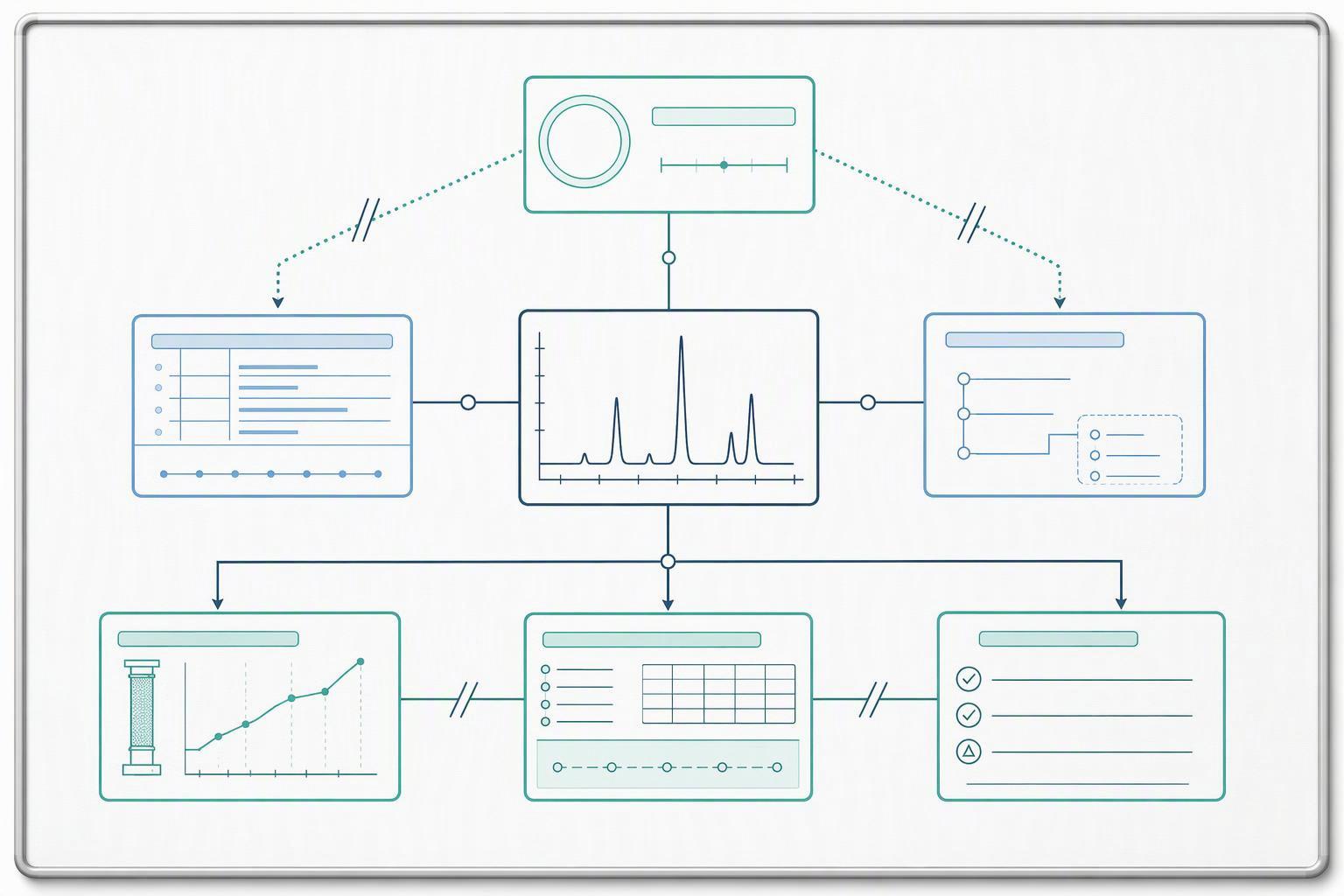
The record chain is part of the data package, and enforcement shows what breaks. 에이 2025 warning letter to a contract testing laboratory found that the Quality Unit failed to ensure establishment of restricted access and appropriate controls on computerized systems to prevent potential alteration or deletion of laboratory data, and failed to control a sample-preparation document (FDA 경고문 320-25-101, 20 팔월 2025, findings under FD&C법 501(에이)(2)(비)). 에이 2026 warning letter found discarded torn chromatographic records and impurity method-validation spreadsheets while the official record held only handwritten values, and staff recording observations in uncontrolled personal diaries (FDA Warning Letter MARCS-CMS 720463, 3 3월 2026, citing 21 CFR 211.22 그리고 211.192). These are named cases, not a rate; no official published rate of data-integrity findings in CRO inspections was verified.
The controls those findings map onto are specific. 부분 11 requires validation of systems to ensure accuracy, reliability, consistent intended performance and the ability to discern invalid or altered records, authority checks so that only authorized individuals can alter a record, and signature manifestations of printed name, 날짜와 시간, and meaning (21 CFR 부분 11, §11.10(에이), §11.10(g), §11.50(에이)). MHRA adds that reverting from computerized to paper-based systems or the reverse does not remove the need for data integrity controls, that audit trails identified by risk assessment should be switched on and users should not be able to amend or switch them off, and that where data was captured in a dynamic electronic state, paper copies cannot be considered raw data (MHRA GxP 데이터 무결성 지침 및 정의, Revision 1, 3월 2018). A PDF chromatogram is therefore a report, not raw data, when the underlying acquisition was electronic.
One link in the chain is not established by these sources. Instrument qualification evidence behind a chromatogram, the system qualification that supports the audit trail and the acquisition record, is named in the evaluation plan but the relevant pharmacopoeial chapter text was not read within this evidence base, so treat instrument qualification as a question to ask rather than a criterion to quote. Ask for the qualification status of the specific instrument that produced the data, alongside the audit trail extract.
자주 묻는 질문
Does a single-laboratory package establish reproducibility?
아니요. Reproducibility is a between-laboratory measurement, and the guideline states when inter-laboratory work is expected: when a procedure is standardised, adopted into a pharmacopoeia, or run at more than one site (나는 Q2(R2), §3.3.2.3). One lab can show repeatability, and it can show intermediate precision if it deliberately varies days, analysts and equipment (나는 Q2(R2), §3.3.2.2). It cannot show agreement between labs, so a package labelled “reproducibility” that never left one site is mislabelled.
How many replicate injections should I expect for a peptide HPLC purity method?
Determine replicate injections from the current applicable method and compendial requirements. System-suitability injections, independent sample preparations and method-validation determinations serve different purposes and must not be counted interchangeably.
Can I use a different analytical technique instead of HPLC?
Choose the technique against the attribute and intended uncertainty. The cited oxytocin interlaboratory study reports results for its material, laboratories and methods; it does not rank the expected precision of HPLC, qNMR and amino acid analysis for every peptide.
What should I do if the CRO reports an impurity level with no degradation control?
Treat the number as unassigned until a control separates sample from method. Column conditions alone can manufacture the peak: ~에 60 ℃, a near-ambient inline trap column cut N-terminal pyroGlu artifacts by 66% and oxidized Met artifacts by 63% relative to direct injection (Starovoit et al., Anal. 화학. 96(36), 2024). That is the in-column degradation peptide analysis question in practice. Without a comparable control, the impurity has not been shown to belong to the batch.
Is a paper copy of a chromatogram acceptable as raw data?
아니요, where the data was captured electronically. MHRA holds that information originally captured in a dynamic state should remain available in that state, and that a paper copy of electronically generated dynamic data cannot be considered raw data (MHRA GxP 데이터 무결성 지침 및 정의, Revision 1, 3월 2018). 부분 11 requires accurate and complete copies in both human readable and electronic form suitable for inspection (21 CFR 부분 11, §11.10(비)). Ask for the electronic record with its audit trail, not a scan.
What does it cost to add this level of evidence?
No verified cost figure exists in this evidence base, so the honest answer is that cost is a design decision rather than a line item. The drivers are countable: a published degradation design used 27 wells per condition across six timepoints with duplicate aliquots (Rozans, Moghaddam, Pashuck, J Biomed Mater Res A), and a fuller peptide analytical method validation adds a second column lot, an orthogonal confirmation subset, and the audit trail extract. Ask the supplier to price the replicate structure and the controls separately, so you can see what each one buys.
결론
The evaluation reduces to a decision rule you can apply in a partnering review. Require the replicate unit to be named before you read any precision figure, and count it against the ICH Q2(R2) minimums of 9 determinations across the reportable range or 6 ~에 100% 시험 농도의 (나는 Q2(R2), §3.3.2.1). Require the precision figure to arrive with a 100(1-에이)% confidence interval and the acceptance criterion it was judged against (나는 Q2(R2), §3.3.2.4). Require the system suitability criteria and the injection count to be stated in the method, so the five-versus-six rule in USP <621> can be checked (USP <621>). Require a degradation control that separates in-column and on-system artifact from sample degradation, and require the per-injection table with lot, 방법, column and gradient traceability rather than the summary. Require the audit trail and the electronic record, because a paper copy is not raw data where acquisition was electronic (MHRA GxP 데이터 무결성 지침 및 정의, Revision 1, 3월 2018). If a package fails any of these, the failure is a gap you can name in the review rather than a doubt you have to argue. The next step is to put the specification table from Step 3 into the request for proposal and ask for a data-package example that meets it.