Wat de 2026 ONS. Herclassificatie van peptiden feitelijk veranderd
De februari 2026 aankondiging dat 14 peptiden opnieuw zouden worden geclassificeerd was geen regel. Het was een verklaring van de HHS-secretaris die in februari op een podcast werd afgelegd 27, 2026, en vanaf maart 7, 2026 er was geen kennisgeving van het Federal Register uitgegeven en er was geen bijgewerkte lijst gepubliceerd (Peptide-dagboek, Maart 2026).
Twaalf van deze stoffen zijn uit Categorie verwijderd 2 op april 15, 2026, ongeveer een week later van kracht, maar verwijdering alleen gaf niets toestemming: het plaatste ze niet op de 503A-bulklijst of in de categorie 1, en het samenstellen op die basis bracht regelgevingsrisico's met zich mee (Orrik, april 2026).

In juli 2026, een adviescommissie van de FDA aanbevolen 6 van 7 genomineerde peptiden voor de 503A bulklijst, met stemaantallen variërend van 8-6-1 naar 6-7-1 (LumaLex, juli 2026). Deze aanbeveling heeft slechts een adviserend karakter: De FDA moet de kennisgevings- en commentaarregelgeving nog voltooien en mag dit accepteren, wijzigen of weigeren. FDA-personeel beweerde dat geen van de zeven goed gekarakteriseerd was.
Een onzeker rulebook verhoogt de waarde van authenticatie aan de leverancierszijde in plaats van deze te verlagen.
Waarom authenticatie van peptideleveranciers begint met identiteit, Niet zuiverheid
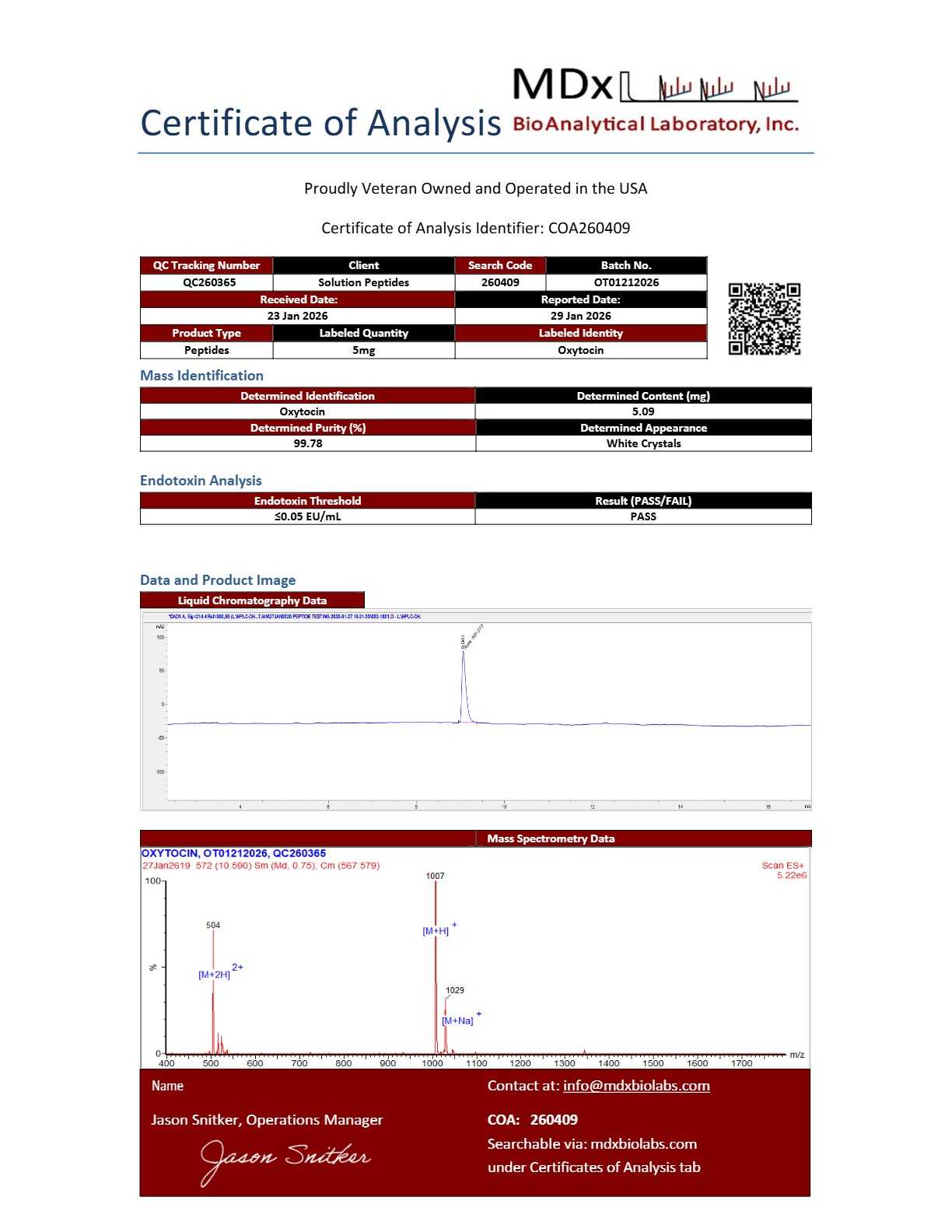
Dat onzekere regelboek is precies de reden waarom identiteit de eerste controle is, niet zuiverheid. Bevestiging van de peptide-identiteit gaat vóór elk zuiverheidscijfer, omdat de twee metingen verschillende vragen beantwoorden. HPLC-zuiverheid is de verhouding tussen het hoofdpiekoppervlak en het totale geïntegreerde piekoppervlak, en die berekening is blind voor water en zouten: een monster kan lezen 99% puur per gebied en toch de verkeerde verbinding zijn (Peptide vertrouwen, “Netto peptidegehalte versus zuiverheid”, 2026-07-31). Zuiverheid en inhoud beantwoorden twee verschillende vragen, en geen van beide is: “is dit het peptide dat ik heb besteld?”
Massamatching met de theoretische massa beantwoordt dit wel. Amerikaanse peptiden beschrijft LC-MS-identiteitsbevestiging door het vergelijken van de waargenomen massa met de theoretische massa berekend op basis van de beoogde aminozuursequentie, waarbij MS/MS de b-ion- en y-ion-ladder toevoegt die de sequentievolgorde ondersteunt in plaats van alleen de totale massa (2026-06-06). Dezelfde bron laat zien waarom de massabasis moet worden vermeld: een peptide met formule C65H101N17O18S heeft een mono-isotopische massa van 1455.71 Da tegen een gemiddelde massa van 1456.66 En, ongeveer 1 Ja uit elkaar, dus een ongekwalificeerde ‘match’ is dubbelzinnig.
Sleutel afhaalmaaltijd: Een zuiverheidspercentage vertelt u hoeveel van de piek één ding is. Alleen een massamatch met de door u aangegeven reeks vertelt u welk ding het is.
Onze bevinding: Het zuiverheidscijfer van 98% dat op een identiteitsbewijs lijkt, is de meest voorkomende fout bij de evaluatie van leveranciers. Een hoog oppervlaktepercentage en een aanzienlijk lager netto peptidegehalte kunnen beide eerlijk worden gerapporteerd voor dezelfde batch, Daarom kan op een partij met een laag gehalte een zuiverheidsgetal staan dat niets zegt over de hoeveelheid peptide die het flesje bevat.
De faalmodus is stil. Een peptide met de verkeerde volgorde of een afgeknot peptide kan een oppervlakte-% controle doorstaan en zelfs een retentietijd delen met de verwachte verbinding, omdat niet-verwante moleculen kunnen co-elueren. Massa-offsets benoemen in plaats daarvan het probleem: +16 Da wijst op oxidatie, -18 Da tot uitdroging, en een ontbrekend aminozuur voor afknotting (Amerikaanse peptiden, 2026-06-06). Vraag naar de waargenomen massa, de theoretische massa, en de basis die voor beide wordt gebruikt.
Zuiverheidsgegevens lezen zonder te worden misleid door het kopnummer
Zodra de identiteit is vastgesteld, het zuiverheidscijfer kan worden afgelezen voor wat het feitelijk meet. Gegevens over de zuiverheid van peptiden beantwoorden een engere vraag dan de meeste kopers aannemen. Een zuiverheidsgetal beschrijft het aandeel van het gedetecteerde signaal dat tot de doelsequentie behoort. Er wordt niet beschreven hoeveel peptide er in het flesje zit.
Typische specificaties van onderzoekskwaliteit bedragen ≥95% volgens HPLC, met hoge zuiverheidsgraden van ≥98% (ChemVerify's testgids voor peptidezuiverheid, Maart 2026). Waarden hierboven 99% verdienen nauwkeurig onderzoek voor sequenties langer dan 30 residuen tenzij chromatografische gegevens met hoge resolutie deze vergezellen. In dezelfde gids wordt opgemerkt dat zuiverheid gewoonlijk wordt gerapporteerd door UV-absorptie rond 214–220 nm, en dat de golflengte ertoe doet omdat onzuiverheden bij verschillende golflengten anders reageren.
Dan komt het deel dat de kop verbergt. Gevriesdroogde peptiden bevatten doorgaans een netto peptidegehalte van 60-85% (ChemVerify, Maart 2026). De rest zijn tegenionen, restwater en sporen van oplosmiddel. A 10 mg afwegen op 70% content yields roughly 7 mg peptide, which explains the shortfall many labs hit when they calculate an assay from the balance reading alone.
Peptide Counter-ion removal has limits. A 2020 review of counter-ion behavior in peptides found that TFA exchange reaches up to 98% efficacy after repeated cycles but does not completely remove TFA anions (PMC 7761850, December 2020). Those anions can bond directly to basic residues or sit adsorbed in the lyophilizate.
Onze bevinding: A 10 mg afwegen op 70% net peptide content delivers roughly 7 mg peptide. Budget assays against content, not against the vial label.
Documentatie: Wat moet er in een kavelspecifiek COA zitten
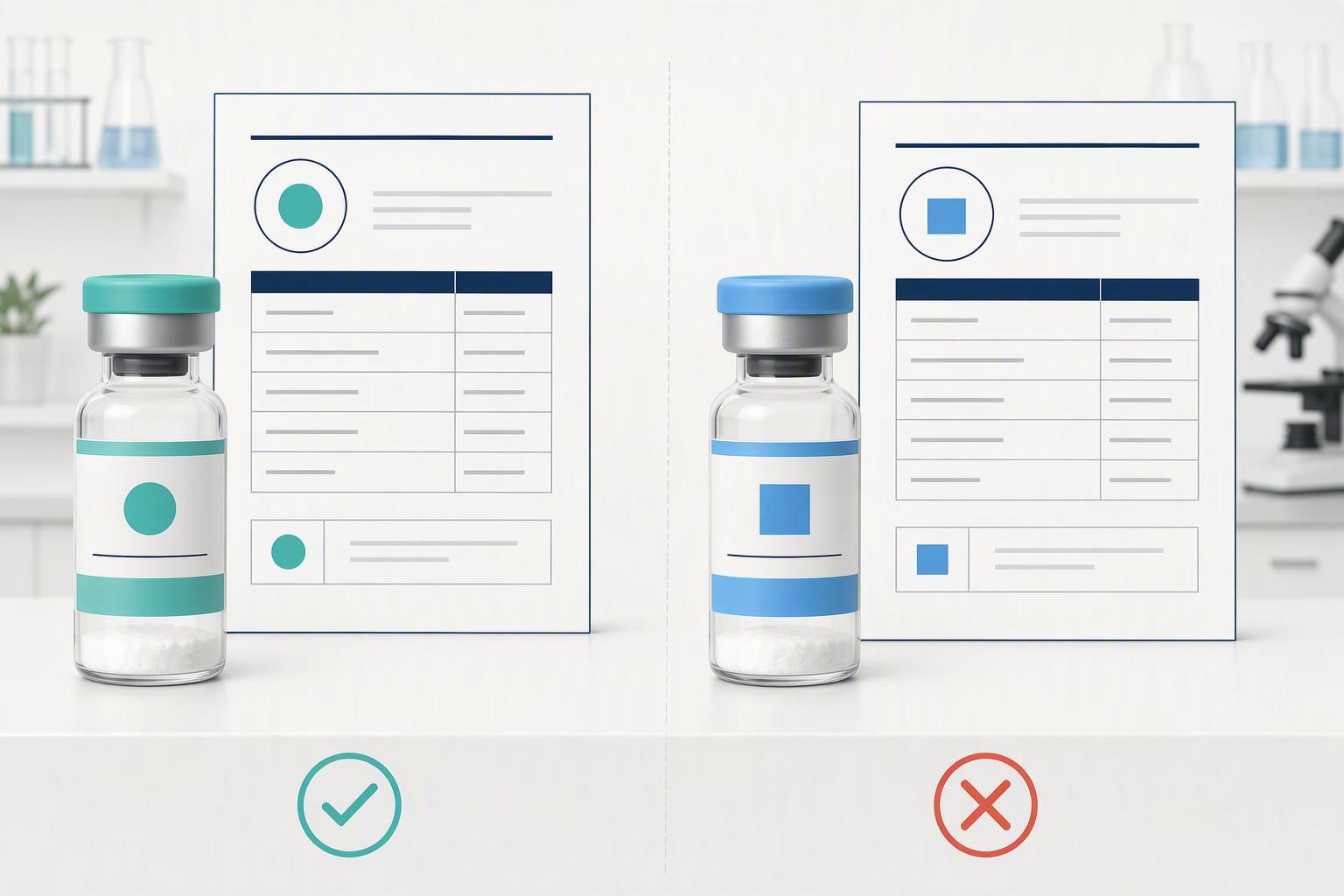
With identity and content understood, the next safeguard is the paperwork that ties both to your vial. A peptide certificate of analysis is only useful if it belongs to the vial in your hand. The batch or lot number printed on the COA must match the batch or lot number on the vial label, and the document must be issued for that specific lot rather than for the product line in general. Finnrick’s guide to reading a certificate of analysis states the batch ID rule plainly: no batch ID on a sample means no valid test. The same guide sets the minimum panel a peptide COA should carry, which is identity confirmation, zuiverheid, and potency or quantity.
⚠️Waarschuwing: These failure modes show up as ordinary conditions, not dramatic ones. A generic COA arrives instead of a lot-specific one. The lot number on the COA does not match the vial label. Batch documents are reused across shipments. The testing laboratory is never named. Raw data is not available on request.
A COA is a supplier-issued document, and a supplier-issued document is not independent verification. Where a supplier claims independent testing, the claim is checkable only if it names the third-party laboratory, de testdatum, de analytische methode, and whether the underlying raw data can be accessed. Without those four details, the document confirms that testing happened somewhere, not that it happened to your lot.
Keten van toezicht: De ontvangst-tot-gebruik-recordset
Spps Synthesis Documentation covers what the supplier did before shipping; custody covers everything after. Peptide chain of custody is the record set your laboratory creates between the moment a vial arrives and the moment its contents are consumed, and it is the only part of supplier authentication you control entirely. A supplier can hand you a clean certificate and still leave you unable to show how the material was handled afterward.
The record set has five linked entries. The receiving log captures receipt date, vervoerder, lotnummer, staat bij aankomst, and the name of the person who opened the package. The storage record names the location (freezer, shelf, box position) and the target temperature. The access log records who withdrew the vial and when. The reconstitution entry holds the diluent, volume, datum, and the resulting concentration. The aliquoting and distribution record tracks each daughter vial to its user or downstream experiment.
Temperature and freeze-thaw records belong alongside the batch file, not in a separate notebook, because they are what turn a set of entries into an auditable history. Lot-number traceability is the thread: if the lot number on the receiving log does not match the lot number on the certificate and the vial label, the record set breaks at its first link and nothing downstream can be reconstructed.
Sleutel afhaalmaaltijd: Custody records are what let a laboratory demonstrate that a research material was handled as a research material, from receipt through use, without relying on the supplier’s account of what happened before it shipped.
Onderzoeksmaterialen scheiden van therapeutische claims

The custody record is yours to keep; the last check is about the supplier’s own words. The fastest supplier-language test is this: a page that promises an outcome has told you about its claim discipline, not about its chemistry. Legitimate research suppliers keep their language on compound identity, purity documentation and laboratory procurement. Therapeutic, diagnostic, clinical and personal-use claims sit outside that vocabulary, and their presence is a signal about how the supplier handles the boundary, not proof of what is in the vial.
Apply the test to the product page, the certificate of analysis and the order confirmation. If any of the three describes a physiological effect, a dosing protocol or a benefit to a person, the supplier Peptide Melanotan Ii has moved from supplying laboratories to addressing consumers. That shift usually shows up before the documentation gaps do, which makes it a useful early filter when you are comparing vendors.
Voor Tip: The language test is a claim-discipline check, not a chemistry check. A supplier page that promises an outcome has told you something about its claim discipline, not about its chemistry.
The materials discussed in this article are for laboratory research use only and are not for human or veterinary use. Nothing here is a therapeutic, diagnostic or clinical claim, and nothing here should be read as guidance for personal use.
Veelvoorkomende fouten die u moet vermijden
Most peptide supplier authentication failures trace back to reading one number instead of the whole record. Each mistake below is common because it feels like diligence, and each has a specific fix.
Treating a purity percentage as proof of identity. A purity figure says how much of the sample is the target peak, not that the peak is the right molecule. Repareren: require a mass spectrometry result that matches the theoretical mass of the stated sequence before you accept any purity value.
Accepting a generic or reused COA. Vendors sometimes supply a template certificate covering a product line rather than the lot in hand. Repareren: check that the lot number on the certificate matches the lot number on the vial label, and reject the shipment if it does not.
Ignoring net peptide content when calculating a weigh-out. Zuiverheid en inhoud zijn afzonderlijke metingen, so a high-purity, Biotage Peptide Synthesizer low-content lot delivers less peptide than the mass suggests. Repareren: calculate from the content or assay value, not the purity percentage.
Keeping no custody record. Without a receipt-to-use trail, you cannot show what arrived, wanneer, or how it was stored. Repareren: log receipt date, kavel, staat bij aankomst, and storage location at the point of intake.
Letting therapeutic-adjacent marketing language pass unchallenged. Claims that imply human use shift a research material into a regulatory category it does not belong in. Repareren: treat that language as a documentation defect and ask the supplier to correct it in writing.
⚠️Waarschuwing: The most consequential mistake is a high purity number on a low-content lot. Both figures can be accurate and the pairing still misleads anyone who reads only the purity line, because the weigh-out they calculate will be short. Peptide Ll 37
Resultaten: Hoe een geverifieerde leveranciersrelatie eruit ziet
A verified supplier relationship is not a feeling about a vendor. It is a batch file you can hand to a colleague and have them reach the same conclusion. Peptide supplier authentication ends in a folder, geen oordeel. Cem Peptide
That folder carries six things. A lot-specific COA whose lot number matches the vial label. An identity result matched against theoretical mass, not just a pass mark. A purity figure sitting beside a net peptide content figure, so the two numbers can be read together. A named testing laboratory with a test date and the method used. A custody record running from receipt to use. And supplier language that stays on research use, in the marketing copy as well as the certificate.
The stretch goal is worth asking for. Where a supplier offers raw analytical data or independent third-party verification, request it. A supplier that can produce it is telling you something a clean PDF cannot.
MOL-wijzigingen is a peptide synthesis and modification organization that operates Class 100 ultrasteriele cleanroomproductie, with QC including HPLC, MS- en steriliteitstesten, and supports mg-to-kg scale-up.
If you are comparing suppliers against this checklist, talk to an expert or compare capabilities directly. MOL Changes heeft een commercieel belang bij de kwaliteitsnormen voor peptiden, and this article is written so the same checks apply to any supplier, including this one.
Veelgestelde vragen
Kan een peptideanalysecertificaat onafhankelijke tests vervangen??
Nee. A COA is the supplier’s own record, and it cannot verify itself. The batch ID rule applies here: the document is only meaningful when its lot number matches the vial label and it reports the full panel for that specific lot, not a representative or historical result. Independent testing by a laboratory you selected is the only check that sits outside the supplier’s control. Treat the COA as the claim and third-party analysis as the confirmation.
Wat moet ik doen als het lotnummer niet overeenkomt met het etiket??
Stop and do not use the material. A mismatch means you cannot tie the analytical results to the vial in your hand, which breaks the entire documentation chain regardless of how good the reported numbers look. Contact the supplier in writing, request the correct lot-specific COA, and keep the correspondence. If the supplier cannot produce a matching record, that is your answer about their documentation practice.
Hoe vergelijk ik een cijfer van ≥95% met een cijfer van ≥98% voor een bepaalde assay?
Compare the grade against the method and the assay, not against the number alone. A ≥98% figure measured by one HPLC method is not automatically superior to a ≥95% figure measured by a stricter one, because purity percentage is method-dependent. Ask which method produced the value, request the chromatogram rather than the summary line, and match the grade to what your assay actually requires.
Can I check a supplier’s stated testing laboratory?
Ja, and you should. Ask for the laboratory’s name and confirm it is a real, independent facility with the capability to run the panel reported. A named laboratory you can contact is a verifiable claim; an unnamed “third-party lab” is not. If the supplier will not identify the laboratory, treat the testing claim as unverified.
Conclusie
The five safeguards form one repeatable workflow: confirm identity against the theoretical sequence, read purity alongside content and assay, require a lot-specific certificate of analysis, keep a receipt-to-use record set, and hold research materials separate from therapeutic claims. Run them in that order on any supplier, and the result is a supplier-agnostic verdict rather than a trust exercise.
That standard does not depend on where U.S. rules land. Reclassification would change the paperwork a supplier is expected to produce, not the underlying questions a buyer needs answered. Identiteit, inhoud, documentatie, voogdij, and claim discipline stay the same checks whether the material sits in a research or a regulated category.
The next action is concrete. Build the batch file for the next lot you receive: reeks, lotnummer, COA, analytical report, ontvangst, and storage record. Then run the five checks against it before the material enters use. Peptide supplier authentication becomes routine once the file exists and each lot is measured against it.