Hur man jämför anpassade peptidsyntespartners: De fem testerna som betyder något
Att jämföra anpassade peptidsyntesfunktioner börjar med en förändring i vad du utvärderar. Marknaden trigger i september 2026 var Mediscas lansering av en global peptiddivision, en release som beskriver divisionens angivna omfattning som en kombination av API-försörjning med formuleringsexpertis, blandningstekniker, analytiska tjänster, utbildning och teknisk support, och tillämpa tillverkarkvalifikationer, produkttestning, dokumentation och övervakning av leveranskedjan för peptid-API:er (Medisca pressmeddelande, 2026-09-17). Det namnger ingen anläggning för tillverkning av peptider, kapacitet, antal anställda eller investeringsbelopp. Utgåvan som syndikerad tillägger att Medisca valde tillverkningspartners på läkemedelserfarenhet, kvalitetssystem, tillverkningsexpertis och efterlevnadspraxis (trade-wire täckning, 2026-09-17), och att täckningen spåras till samma tillkännagivande snarare än en oberoende bedömning.
Det är mönstret som är värt att internalisera: en divisionslansering är en åtagandesignal, inte en kapacitetsupplysning. Betyg partners på fem dimensioner, och bedöm var och en efter den dokumentation du kan kräva snarare än efter ett ja-eller-nej-krav.

|
Dimensionera |
Vad ska man kräva |
Vad ett svagt svar ser ut |
Vad ett starkt svar ser ut |
|---|---|---|---|
|
Sekvenskomplexitet |
En genomförbarhetsbedömning mot din faktiska sekvens, med den svåra sträckan identifierad |
"Vi syntetiserar alla sekvenser" |
Namngivna problempositioner och en föreslagen väg |
|
Modifieringsförmåga |
Vilka kemier är rutin, som är enstaka, och vem som driver de enstaka |
En modifikationsräkning utan frekvensdetaljer |
A short routine list plus a named route for the rest |
|
Analytisk transparens |
Lot-specific raw data, not a specification sheet |
CoA only, or a representative chromatogram |
CoA, chromatogram and MS per lot |
|
Skalbarhet |
Sigma Peptide Synthesis Whether the route transfers or changes between mg and kg |
“We scale linearly” |
A described process difference and its validation |
|
Discovery-to-development support |
The named handoff point and who owns it |
“One team handles everything” |
A stated transition stage and its documentation |
Sekvenskomplexitet: Kan partnern verkligen göra din sekvens?
The first test of custom peptide synthesis capabilities is not whether a partner says it can handle difficult sequences, but whether it can name the Peptoid Synthesis specific failure modes and describe how each one shows up in the data. General competence claims are unverifiable. Named failure modes are not.
Deleterings- och trunkerade sekvenser visas som separata, vanligtvis tidigare eluerande orenhetstoppar, med ett massunderskott som är lika med den eller de saknade resterna. Racemisering är svårare att fånga: det är isobariskt med föräldern, så intakt-mass MS kan inte se det, och detektion beror på diastereomerseparation. Aggregation producerar ofta ingen ren ny föroreningstopp alls, visar sig istället som toppbreddning eller dålig monomeråtervinning (Peptidnedbrytningsvägar; Royal Society gränssnittsfokus).

Peptid Fråga om långa kedjor, hydrofoba sträckor, aggregationsbenägna segment, svåra kopplingar, icke-kanoniska rester, D-aminosyror och makrocyklisering som separata frågor. Ett svagt svar behandlar dem som en kategori. Ett starkt svar skiljer dem och, i skala, beskriver när fragmentsyntes, enzymatisk ligering eller alternativa klyvningsstrategier blir nödvändiga, uppbackad av visad erfarenhet av både SPPS och LPPS (Neuland Labs, 2025). Mikrovågspeptidsynthesizer
Modifieringsförmåga: Vilka kemier är rutinmässiga och vilka är tillfälliga?
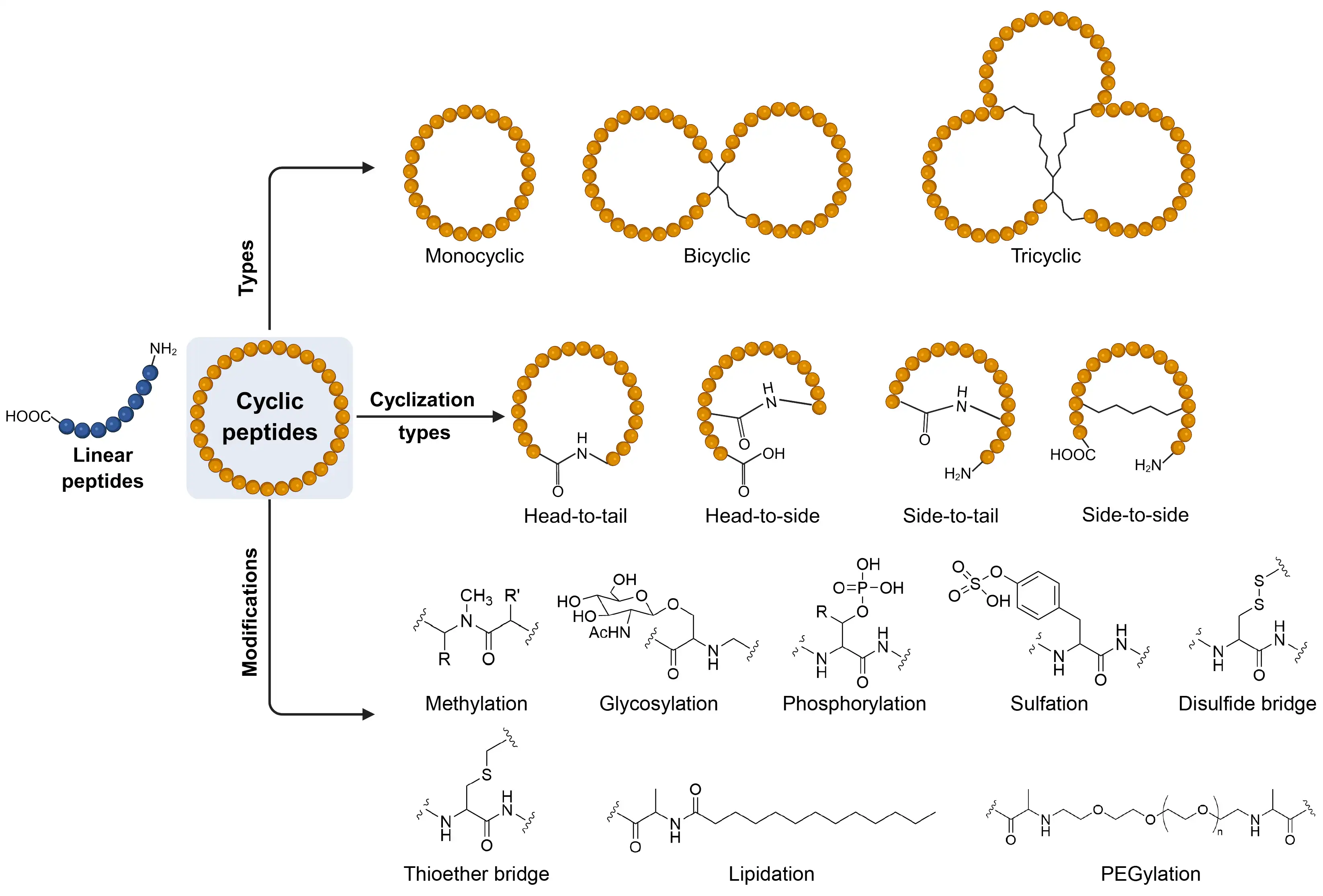
Komplexa peptidmodifieringar är inte en möjlighet. Funktionalisering i sen skede, kolvätehäftning, disulfid, laktam- och tioetercykliseringar, PEGylering, fosforylering, sulfatering, glykosylering, och C- och N-terminala modifieringar har var och en sin egen reagenshantering, skyddsgruppsstrategi och reningsbeteende. En partner stark i häftning kan vara svag i glykosylering, eftersom de två nästan inte delar några processsteg.
Så "vi erbjuder modifieringar" är inget svar. Fråga vilka klasser som är rutin, vilket betyder validerat och kört upprepade gånger under det senaste året, och som är enstaka, betyder försökt en eller två gånger. Begär den specifika kemins batchhistorik, not a portfolio page: lot counts, vågar, and yields for the class you need.
For calibration, one platform’s stated capability set covers over 300 functional-group modifications, inklusive lipidering, häftning, multi-disulfide loops and FRET pairs (MOL Ändringar, 2026). That is a vendor claim, useful as a question to put to every partner: what is your equivalent number, per chemistry class, with batch records behind it?
För tips: For any modification outside the routine list, ask whether a protocol exists in-house or whether development time is billed separately.
Analytisk transparens: Vad som följer med varje parti?
Peptide analytical transparency starts with one rule: the documentation follows the lot, not the catalog. A credible certificate of analysis is batch-specific, daterad, references the lot number, and carries data from at least two independent methods, typically HPLC and mass spectrometry (ChemVerify, april 2026). The minimum standard is reversed-phase HPLC purity plus electrospray ionization MS confirming molecular weight; amino acid analysis and endotoxin testing are higher-quality additions (ChemVerify, april 2026).
Read the numbers carefully. UV-based HPLC area percent measures chromatographic signal, not net peptide mass, because water, salts and counterions are invisible to UV detection (Janera Science). Net peptide content is typically quoted at 60 till 80 percent of gross powder weight (ChemVerify, april 2026). A vendor reporting 98 percent HPLC purity without MS data may be overstating effective purity.
A per-lot package worth asking for looks like this: CoA, kromatogram, MS-spektrum, method parameters and impurity profile. MOL Changes supplies that set per lot, with release testing spanning HPLC, mass spectrometry and amino acid analysis.
Red flags on a certificate of analysis
Generic CoA with no batch or lot number
No mass spectrometry Peptid 1 data
HPLC data without column, gradient and flow rate
Round-number purity values that suggest estimation
Purity quoted without stating the method behind it
Standards to name when you request documents: I Q2(R2) for analytical validation, USP <71> sterilitet och USP <85> bacterial endotoxins where relevant, and MHRA ALCOA principles for data integrity.
Skalbarhet: Är mg-till-kg en större batch eller en annan process?
Peptide scale-up from mg to kg is a re-engineering exercise, not a larger batch. Neuland Labs describes it as work that “involves re-engineering processes to maintain purity, avkastning, and cost-efficiency while meeting stringent GMP requirements,” and notes that multi-kilogram capacity “must be supported by validated large-scale purification systems and lyophilization equipment.”
That distinction changes what you ask for. A maximum-capacity figure tells you nothing about whether a partner can hold a method steady as it moves across the scale tiers a program passes through: discovery screening at 1–50 mg, lead optimization at 100 mg–10 g, pre-clinical at 50–500 g, and clinical or pilot batches at 1 kg and above, as MOL Changes sets out in its own service model.
Ask instead for intermediate engineering-batch records, method-transfer documentation, and the reactor scale those batches ran on. At large scale, Neuland Labs adds, stability studies, föroreningsprofilering, and full method validation become mandatory before batch release, and HPLC, LC-MS, and residual solvent methods must themselves be validated for large-scale application. Peptid 2
Stöd från upptäckt genom utveckling: Var avbryts handoff?

End-to-end support is a service list until you test it at the seams. The failure mode is rarely a partner that cannot synthesize, rena, or scale; it is a program where nobody owns the sequence between those stages, and the buyer discovers it when a batch needs reworking or a submission deadline moves.
Ask who holds the sequence record from design through synthesis, rening, and large-scale production, and who signs off when a route changes mid-program. Ask the same for regulatory support: if a partner lists IND and NDA support, name the person who assembles the chemistry section, and confirm they see the analytical data at the time it is generated rather than at submission.
The regulatory frame matters here. FDA’s interim 503A bulk drug substances policy sorts substances into three categories: Kategori 1, where FDA does not intend to act against compounders meeting the guidance conditions; Kategori 2, where FDA has identified significant safety risks pending further evaluation and would consider taking action; and Category 3, where supporting information is insufficient and the substance is not eligible for the Category 1 policy. That is a frame for asking questions, not a statement about any specific peptide’s status.
För tips: Put the handoff questions in writing before you award a program: who owns the sequence at each stage, who approves a route change, who assembles the regulatory section, and what documentation transfers with the project if you move suppliers.
Vem ska välja vilken partnerprofil
Weight the five tests against where your program sits on the scale tiers a program moves through, from discovery-stage milligram work to clinical and pilot kilogram batches. The profile that fits you is the one whose weakest dimension you can tolerate.
Discovery-stage teams optimizing a difficult sequence. Weight sequence complexity and modification capability first. A partner whose 300-plus functional-group modification range and non-standard residue experience are routine will save you resynthesis cycles; analytical depth matters less while the sequence is still moving.
Teams transferring a validated sequence into larger batches. Weight scalability and support continuity. Ask directly whether the milligram-to-kilogram path is the same process scaled or a different route, and who owns the technical handoff when your project moves from one team to another.
Teams needing a documented per-lot package for downstream work. Weight analytical transparency above all. Confirm the release package before you order: CoA, kromatogram, and mass spectrometry data supplied per lot, not on request.
Edge case: split the work. If no single partner clears all five tests, run the difficult sequence with a specialist and the scale-up with a manufacturer, and hold the analytical package to one standard across both.
Vanliga frågor
Är ett högre HPLC-renhetstal alltid bättre?
Inga. An HPLC result reported as area percent measures the proportion of the chromatogram’s peak area, not the mass of peptide in the vial. Salts, motjoner, residual water and solvent can all sit outside the peak, så a 98% area-percent lot and a 95% area-percent lot are not automatically ranked by that number alone. Ask for the chromatogram, metoden, and the net peptide content alongside it, and read why area percent is not peptide content before you use purity as a screening filter.
Kan en partner som gjort min forskningssats också göra den kliniska batchen?
Often yes, but not by repeating the same recipe at a larger size. Moving from discovery quantities to clinical supply is a re-engineering exercise, and it carries mandatory method validation, which is why what scale-up actually requires is a different question from whether the partner can run a bigger reactor. Ask what changes between the two campaigns and who validates the analytical methods at the new scale.
Vad ska jag be om innan jag tilldelar ett syntesprogram?
The same artifacts the five tests above describe: a sequence review against your actual sequence, the modification chemistries the partner runs routinely, a sample lot documentation package, a stated scale-up path, and a named technical contact for the program. Request them as documents rather than as capability statements.
Hur jämför jag partners när ingen publicerar kapacitetssiffror?
Treat the absence as normal. Medisca’s announcement of its peptide division describes the division’s stated scope without disclosing facility, kapacitet, headcount or investment figures, and most suppliers publish at the same level. Substitute documentation evidence: per-lot analytical packages, method descriptions, and engineering-batch records tell you more about what a partner can do than a capacity number would.
Slutsats
Treat the five tests as a standing scorecard rather than a one-off exercise. Score every candidate on sequence complexity, modification capability, analytisk transparens, scalability, and support continuity, then keep the completed scorecards on file. When a program moves from discovery to development, or when a second supplier is needed, the comparison is already documented instead of rebuilt under deadline pressure.
The tests also share one underlying question: what arrives with the material? A capability list states what a partner says it can do. A lot-specific certificate of analysis, a chromatogram, ett masspektrum, and a described method for the chemistry in question show what was actually done. That distinction, not the length of a catalog, is what separates partners during evaluation.
If you are working through a specific sequence and want a technical read on feasibility, skala, or documentation before you commit, talk to a technical expert about your sequence and bring the sequence and the analytical requirements with you.
Avslöjande: MOL Changes has a commercial interest in peptide quality standards and provides custom peptide synthesis services.