Come confrontare i partner per la sintesi di peptidi personalizzati: I cinque test che contano
Il confronto delle capacità di sintesi peptidica personalizzata inizia con un cambiamento in ciò che stai valutando. Il trigger del mercato a settembre 2026 è stato il lancio da parte di Medisca di una divisione globale di peptidi, un comunicato che descrive l’ambito dichiarato della divisione come la combinazione della fornitura di API con l’esperienza nella formulazione, tecnologie di compounding, servizi analitici, formazione e supporto tecnico, e applicando la qualificazione del produttore, test del prodotto, documentazione e supervisione della catena di fornitura delle API dei peptidi (Comunicato stampa Medisca, 2026-09-17). Non menziona alcun impianto di produzione di peptidi, capacità, numero di dipendenti o investimenti. Il comunicato diffuso aggiunge che Medisca ha selezionato partner di produzione in base all'esperienza farmaceutica, sistemi di qualità, competenze di produzione e pratiche di conformità (copertura tramite bonifico bancario, 2026-09-17), e tale copertura fa riferimento allo stesso annuncio piuttosto che a una valutazione indipendente.
Questo è lo schema che vale la pena interiorizzare: il lancio di una divisione è un segnale di impegno, non una divulgazione di capacità. Punteggio dei partner su cinque dimensioni, e giudicare ciascuno in base alla documentazione che è possibile richiedere piuttosto che in base a una dichiarazione di capacità sì o no.

|
Dimensione |
Cosa richiedere |
Che aspetto ha una risposta debole |
Che aspetto ha una risposta forte |
|---|---|---|---|
|
Complessità della sequenza |
Una valutazione di fattibilità rispetto alla sequenza effettiva, con il tratto difficile individuato |
“Sintetizziamo tutte le sequenze” |
Posizioni problematiche nominate e un percorso proposto |
|
Capacità di modifica |
Quali chimiche sono di routine, che sono occasionali, e chi gestisce quelli occasionali |
Un conteggio delle modifiche senza dettagli sulla frequenza |
A short routine list plus a named route for the rest |
|
Trasparenza analitica |
Lot-specific raw data, not a specification sheet |
CoA only, or a representative chromatogram |
CoA, chromatogram and MS per lot |
|
Scalabilità |
Sigma Peptide Synthesis Whether the route transfers or changes between mg and kg |
“We scale linearly” |
A described process difference and its validation |
|
Discovery-to-development support |
The named handoff point and who owns it |
“One team handles everything” |
A stated transition stage and its documentation |
Complessità della sequenza: Il partner può effettivamente creare la tua sequenza?
The first test of custom peptide synthesis capabilities is not whether a partner says it can handle difficult sequences, but whether it can name the Peptoid Synthesis specific failure modes and describe how each one shows up in the data. General competence claims are unverifiable. Named failure modes are not.
Le eliminazioni e le sequenze troncate appaiono come separate, solitamente picchi di impurità che eluiscono prima, con un deficit di massa pari al residuo o ai residui mancanti. La racemizzazione è più difficile da catturare: è isobarico con il genitore, quindi la MS a massa intatta non può vederlo, e il rilevamento dipende dalla separazione dei diastereomeri. L'aggregazione spesso non produce alcun nuovo picco di impurità pulito, manifestandosi invece come ampliamento del picco o scarso recupero del monomero (Vie di degradazione dei peptidi; Focus sull'interfaccia della Royal Society).

Peptide Chiedi informazioni sulle catene lunghe, tratti idrofobici, segmenti soggetti ad aggregazione, accoppiamenti difficili, residui non canonici, D-amminoacidi e macrociclizzazione come domande separate. Una risposta debole li tratta come un’unica categoria. Una risposta forte li distingue e, su larga scala, descrive quando la sintesi dei frammenti, diventano necessarie la legatura enzimatica o strategie di scissione alternative, supportato da esperienza dimostrata sia in SPPS che in LPPS (Laboratori Neuland, 2025). Sintetizzatore di peptidi a microonde
Capacità di modifica: Quali chimiche sono di routine e quali sono occasionali?
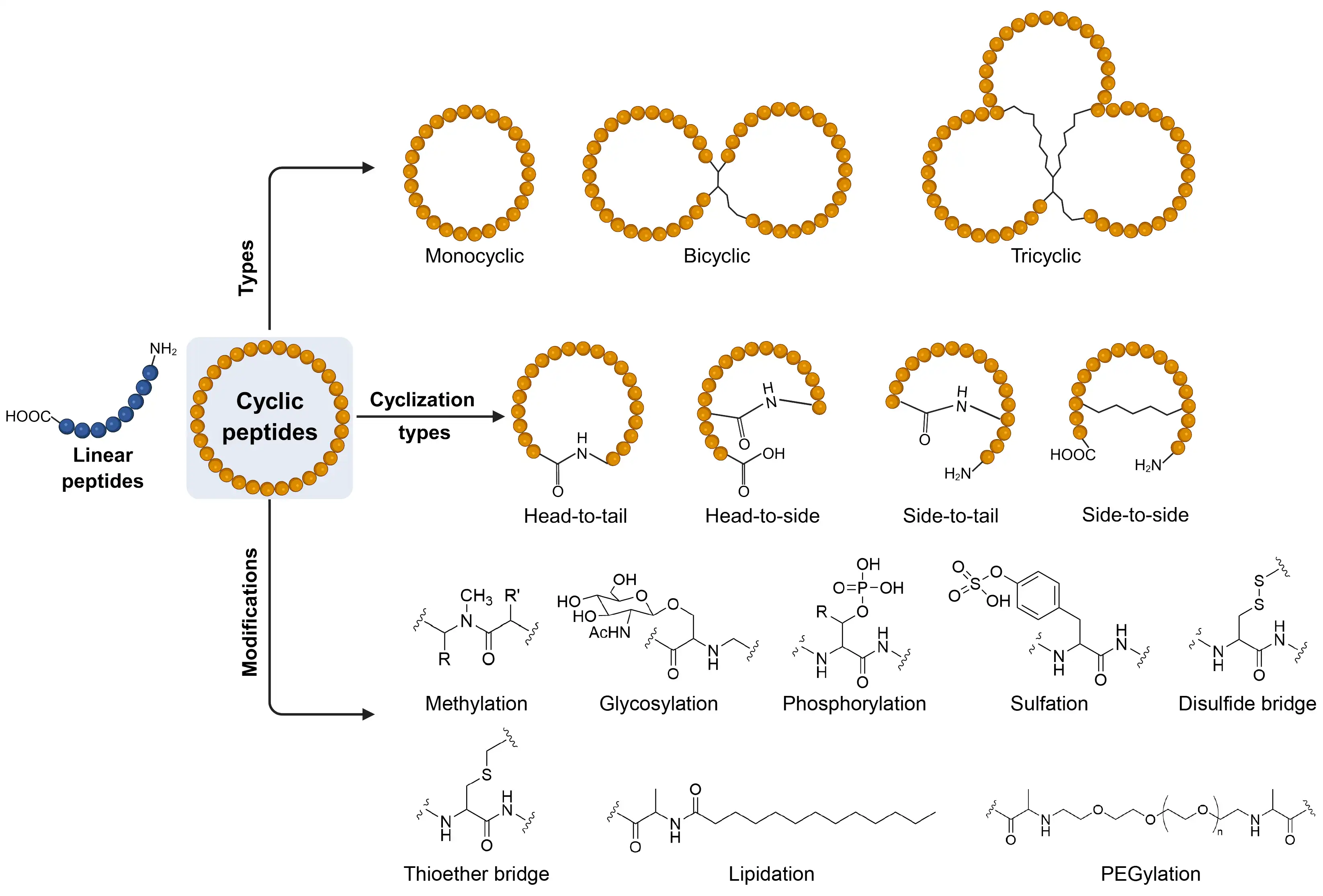
Le modifiche peptidiche complesse non sono una capacità. Funzionalizzazione in fase avanzata, aggraffatura di idrocarburi, disolfuro, Ciclizzazioni lattamiche e tioetere, PEGilazione, fosforilazione, solfatazione, glicosilazione, e C- e le modifiche N-terminali comportano ciascuna la propria gestione dei reagenti, strategia del gruppo protettivo e comportamento di purificazione. Un partner forte nella sutura può essere debole nella glicosilazione, perché i due non condividono quasi nessuna fase del processo.
Quindi “offriamo modifiche” non è una risposta. Chiedi quali lezioni sono di routine, ovvero convalidato ed eseguito ripetutamente nell'ultimo anno, e quali sono occasionali, significa tentato una o due volte. Request the specific chemistry’s batch history, not a portfolio page: lot counts, scale, and yields for the class you need.
For calibration, one platform’s stated capability set covers over 300 modifiche dei gruppi funzionali, compresa la lipidazione, pinzatura, multi-disulfide loops and FRET pairs (Modifiche MOL, 2026). That is a vendor claim, useful as a question to put to every partner: what is your equivalent number, per chemistry class, with batch records behind it?
Per Suggerimento: For any modification outside the routine list, ask whether a protocol exists in-house or whether development time is billed separately.
Trasparenza analitica: Cosa viene fornito con ogni lotto?
Peptide analytical transparency starts with one rule: the documentation follows the lot, not the catalog. A credible certificate of analysis is batch-specific, datato, references the lot number, and carries data from at least two independent methods, typically HPLC and mass spectrometry (ChemVerify, aprile 2026). The minimum standard is reversed-phase HPLC purity plus electrospray ionization MS confirming molecular weight; amino acid analysis and endotoxin testing are higher-quality additions (ChemVerify, aprile 2026).
Read the numbers carefully. UV-based HPLC area percent measures chromatographic signal, not net peptide mass, because water, salts and counterions are invisible to UV detection (Janera Science). Net peptide content is typically quoted at 60 A 80 percent of gross powder weight (ChemVerify, aprile 2026). A vendor reporting 98 percent HPLC purity without MS data may be overstating effective purity.
A per-lot package worth asking for looks like this: CoA, cromatogramma, Spettro MS, method parameters and impurity profile. MOL Changes supplies that set per lot, with release testing spanning HPLC, mass spectrometry and amino acid analysis.
Red flags on a certificate of analysis
Generic CoA with no batch or lot number
No mass spectrometry Peptide 1 dati
HPLC data without column, gradient and flow rate
Round-number purity values that suggest estimation
Purity quoted without stating the method behind it
Standards to name when you request documents: Io Q2(R2) for analytical validation, USP <71> sterilità e USP <85> bacterial endotoxins where relevant, and MHRA ALCOA principles for data integrity.
Scalabilità: mg-kg è un lotto più grande o un processo diverso?
Peptide scale-up from mg to kg is a re-engineering exercise, not a larger batch. Neuland Labs describes it as work that “involves re-engineering processes to maintain purity, prodotto, and cost-efficiency while meeting stringent GMP requirements,” and notes that multi-kilogram capacity “must be supported by validated large-scale purification systems and lyophilization equipment.”
That distinction changes what you ask for. A maximum-capacity figure tells you nothing about whether a partner can hold a method steady as it moves across the scale tiers a program passes through: discovery screening at 1–50 mg, lead optimization at 100 mg–10 g, pre-clinical at 50–500 g, and clinical or pilot batches at 1 kg and above, as MOL Changes sets out in its own service model.
Ask instead for intermediate engineering-batch records, method-transfer documentation, and the reactor scale those batches ran on. At large scale, Neuland Labs adds, studi di stabilità, profilazione delle impurità, and full method validation become mandatory before batch release, e HPLC, LC-MS, and residual solvent methods must themselves be validated for large-scale application. Peptide 2
Supporto dalla scoperta allo sviluppo: Dove si interrompe il passaggio di consegne?

End-to-end support is a service list until you test it at the seams. The failure mode is rarely a partner that cannot synthesize, purificare, or scale; it is a program where nobody owns the sequence between those stages, and the buyer discovers it when a batch needs reworking or a submission deadline moves.
Ask who holds the sequence record from design through synthesis, purificazione, and large-scale production, and who signs off when a route changes mid-program. Ask the same for regulatory support: if a partner lists IND and NDA support, name the person who assembles the chemistry section, and confirm they see the analytical data at the time it is generated rather than at submission.
The regulatory frame matters here. FDA’s interim 503A bulk drug substances policy sorts substances into three categories: Categoria 1, where FDA does not intend to act against compounders meeting the guidance conditions; Categoria 2, where FDA has identified significant safety risks pending further evaluation and would consider taking action; e Categoria 3, where supporting information is insufficient and the substance is not eligible for the Category 1 policy. That is a frame for asking questions, not a statement about any specific peptide’s status.
Per Suggerimento: Put the handoff questions in writing before you award a program: who owns the sequence at each stage, who approves a route change, who assembles the regulatory section, and what documentation transfers with the project if you move suppliers.
Chi dovrebbe scegliere quale profilo partner
Weight the five tests against where your program sits on the scale tiers a program moves through, from discovery-stage milligram work to clinical and pilot kilogram batches. The profile that fits you is the one whose weakest dimension you can tolerate.
Discovery-stage teams optimizing a difficult sequence. Weight sequence complexity and modification capability first. A partner whose 300-plus functional-group modification range and non-standard residue experience are routine will save you resynthesis cycles; analytical depth matters less while the sequence is still moving.
Teams transferring a validated sequence into larger batches. Weight scalability and support continuity. Ask directly whether the milligram-to-kilogram path is the same process scaled or a different route, and who owns the technical handoff when your project moves from one team to another.
Teams needing a documented per-lot package for downstream work. Weight analytical transparency above all. Confirm the release package before you order: CoA, cromatogramma, and mass spectrometry data supplied per lot, not on request.
Edge case: split the work. If no single partner clears all five tests, run the difficult sequence with a specialist and the scale-up with a manufacturer, and hold the analytical package to one standard across both.
Domande frequenti
Un numero di purezza HPLC più elevato è sempre migliore?
NO. An HPLC result reported as area percent measures the proportion of the chromatogram’s peak area, not the mass of peptide in the vial. Salts, contromisure, residual water and solvent can all sit outside the peak, so a 98% area-percent lot and a 95% area-percent lot are not automatically ranked by that number alone. Ask for the chromatogram, il metodo, and the net peptide content alongside it, and read why area percent is not peptide content before you use purity as a screening filter.
Un partner che ha realizzato il mio lotto di ricerca può realizzare anche il lotto clinico??
Spesso sì, but not by repeating the same recipe at a larger size. Moving from discovery quantities to clinical supply is a re-engineering exercise, and it carries mandatory method validation, which is why what scale-up actually requires is a different question from whether the partner can run a bigger reactor. Ask what changes between the two campaigns and who validates the analytical methods at the new scale.
Cosa devo chiedere prima di assegnare un programma di sintesi?
The same artifacts the five tests above describe: a sequence review against your actual sequence, the modification chemistries the partner runs routinely, a sample lot documentation package, a stated scale-up path, and a named technical contact for the program. Request them as documents rather than as capability statements.
Come faccio a confrontare i partner quando nessuno pubblica dati sulla capacità?
Treat the absence as normal. Medisca’s announcement of its peptide division describes the division’s stated scope without disclosing facility, capacità, headcount or investment figures, and most suppliers publish at the same level. Substitute documentation evidence: per-lot analytical packages, method descriptions, and engineering-batch records tell you more about what a partner can do than a capacity number would.
Conclusione
Treat the five tests as a standing scorecard rather than a one-off exercise. Score every candidate on sequence complexity, modification capability, trasparenza analitica, scalabilità, and support continuity, then keep the completed scorecards on file. When a program moves from discovery to development, or when a second supplier is needed, the comparison is already documented instead of rebuilt under deadline pressure.
The tests also share one underlying question: what arrives with the material? A capability list states what a partner says it can do. A lot-specific certificate of analysis, un cromatogramma, uno spettro di massa, and a described method for the chemistry in question show what was actually done. That distinction, not the length of a catalog, is what separates partners during evaluation.
If you are working through a specific sequence and want a technical read on feasibility, scala, or documentation before you commit, talk to a technical expert about your sequence and bring the sequence and the analytical requirements with you.
Divulgazione: MOL Changes has a commercial interest in peptide quality standards and provides custom peptide synthesis services.