Modifiche dei peptidi
Peptide FRET
Cos'è il peptide FRET?
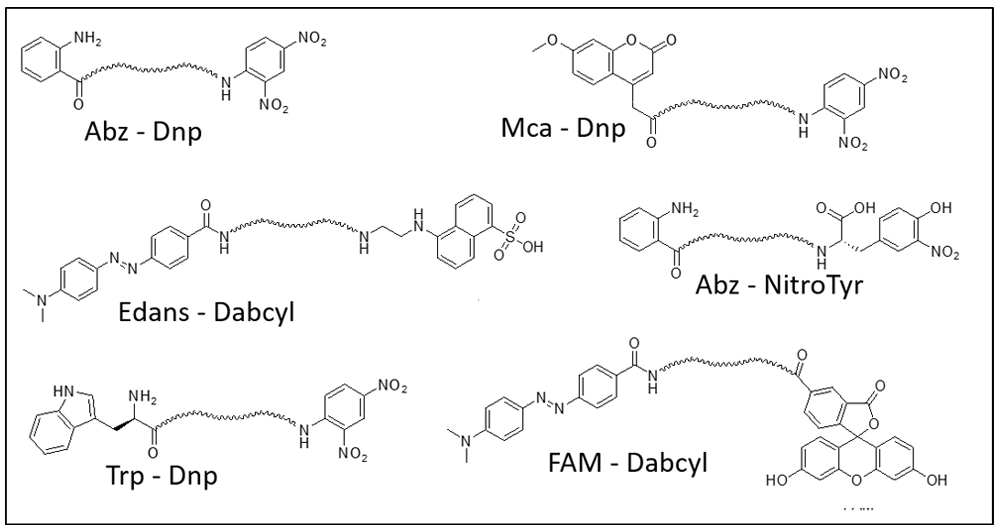
L'etichettatura del peptide FRET ha una molecola donatrice e un accettore (agente di scoppio) molecola. Nella maggior parte dei casi, le coppie donatore e accettore sono due coloranti diversi. Se l'accettore è un colorante non fluorescente (agente di scoppio), l'energia trasferita dal donatore fluorescente viene convertita in vibrazioni molecolari. Quando FRET viene terminato (separando il donatore e l’accettore), è possibile rilevare un aumento della fluorescenza del donatore. Quando sia i coloranti donatori che quelli accettori sono fluorescenti, l'energia trasferita viene emessa come luce a lunghezza d'onda maggiore, consentendo di misurare i cambiamenti nel rapporto di intensità della fluorescenza del donatore e dell'accettore. Per un'efficiente esplosione FRET, le molecole del fluoroforo e dell'agente di scoppio devono essere molto vicine l'una all'altra (~10-100Å) e lo spettro di assorbimento dell'agente di scoppio deve sovrapporsi allo spettro di emissione del fluoroforo. Quando si progettano sistemi FRET con agente di rottura donatore è necessario un attento confronto tra lo spettro di fluorescenza del donatore e lo spettro di assorbimento dell'agente di rottura.

Scienza dei peptidi FRET
Principali vantaggi dei peptidi FRET:
·Monitoraggio in tempo reale delle reazioni enzimatiche e dell'attività proteica.
·Sensibilità di rilevamento estremamente elevata grazie all'esclusivo trasferimento di energia basato sulla prossimità.
·Versatilità per applicazioni in vitro e in vivo, fornire informazioni su processi biologici complessi.
|
Fluoroforo
|
Quencher
|
Ex donatore
|
|---|---|---|
|
Abz |
DNP 2,4-dinitrofenile |
320 nm/420 nm |
|
Abz |
DNP 2,4-dinitrofenile |
320 nm/420 nm |
|
McA |
DNP 2,4-dinitrofenile |
325 nm/392 nm |
|
Trp |
DNP 2,4-dinitrofenile |
280 nm/360 nm |
|
FAM |
Dabcil4-([4'-dimetilammino)fenile]Potere)benzoile |
492 nm/517 nm |
|
Lucifero Giallo |
Dabsyl4(Dimetilammino)azobenzene-4'-solfonile |
430nm/520 nm |
Citazioni in primo piano
Nanosensori ultrasensibili che penetrano nel tumore dell'attività della proteasi
La capacità di identificare lesioni tumorali con biomarcatori endogeni è attualmente limitata ai tumori di circa 1 cm di diametro. Recentemente abbiamo segnalato un nanosensore che penetra il tumore somministrato per via esogena che perde, in risposta alle proteasi tumore-specifiche, frammenti peptidici che possono poi essere rilevati nelle urine. Qui, riportiamo l'ottimizzazione, informato da un modello matematico farmacocinetico, della presentazione superficiale dei substrati peptidici per migliorare la scissione della proteasi sul bersaglio e minimizzare la scissione fuori bersaglio, e della funzionalizzazione dei nanosensori con ligandi che penetrano il tumore che attivano percorsi di traffico attivo per aumentare l'attivazione nel microambiente tumorale. Il nanosensore risultante ha discriminato lesioni inferiori a 5 mm nei tumori epiteliali umani e ha rilevato noduli con diametro mediano inferiore a 2 mm in un modello ortotopico di cancro ovarico. Abbiamo anche dimostrato una maggiore specificità recettore-dipendente della generazione del segnale nelle urine in un modello immunocompetente di metastasi epatiche colorettali, e attivazione in situ dei nanosensori nei microarray tumorali umani quando riprogettati come sonde zimografiche fluorogeniche.
Servizi correlati di modifica dei peptidi
glicosilazione peptidica
glicosilazione peptidica
La glicosilazione peptidica è una modifica covalente che può potenzialmente migliorare le proprietà fisico-chimiche dei peptidi
Per saperne di piùFosforilazione dei peptidi
Fosforilazione dei peptidi
La fosforalazione può verificarsi sulla serina (S, Essere), Treonina (T, Thr) e tirosina (Y, Tyr) catene laterali mediante formazione di legami fosfoestere
Per saperne di piùPeptidi pinzati
Peptidi pinzati
Introduzione di due aminoacidi innaturali contenenti α-metile, Gruppi α-alchenilici durante la sintesi in fase solida delle catene peptidiche.
Per saperne di piùPeptide ciclico
Peptide ciclico
La ciclizzazione del peptide migliora la stabilità conformazionale dei peptidi (rispetto ai loro analoghi lineari) ed è una strategia comune nello sviluppo dei peptidi.
Per saperne di piùmodificazione peptidica
Vasta esperienza nella modificazione dei peptidi, fornendo molteplici strade praticabili per la ricerca sui peptidi.
