Vad är SLC-transportörer och varför är de hårda mål?
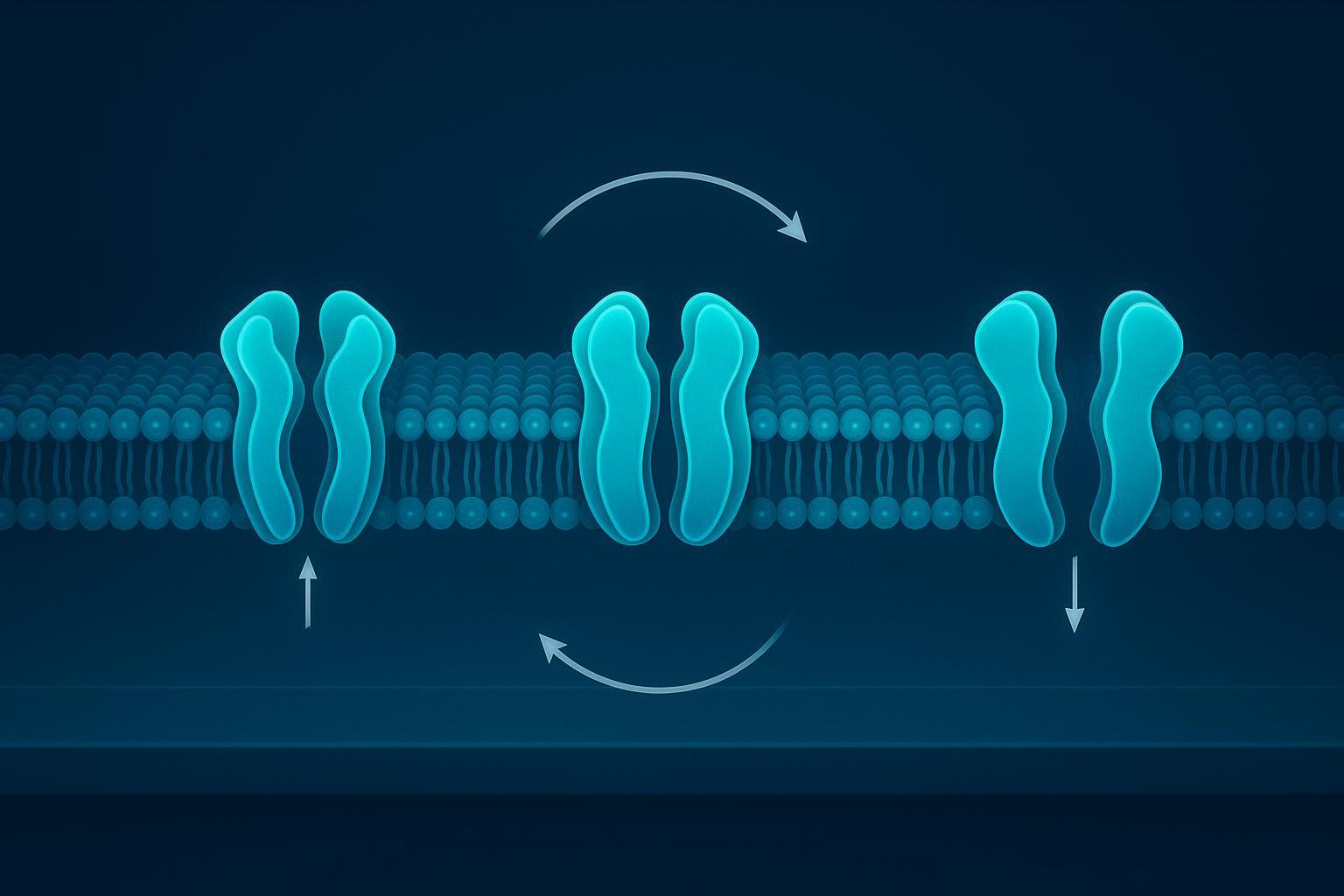
SLC-transportörer är de lösta bärarproteinerna som förflyttar joner, näringsämnen, signalsubstanser och läkemedel över cellmembranen, och människor har 464 kända medlemmar spridda över 70 familjer (News-Medical, 2026-09-10). De är också ovanligt envisa laboratorieämnen, och skälen är snarare strukturella än procedurella.

Svårigheten börjar med arkitektur. SLC-transportörer är integrerade membranproteiner byggda från många transmembranspiraler, vilket gör dem svåra att uttrycka, solubilisera, rena och kristallisera (PMC, 2025-09-02). Många fungerar genom en alternerande åtkomstcykel, växla mellan inåtvända, ockluderade och utåtriktade tillstånd, så ett enda experiment tenderar att fånga en konformation snarare än hela bilden. Native expressionsnivåer är ofta låga, vilket försvårar reningen, antikroppsgenerering och strukturellt arbete, och att flytta proteinet till tvättmedelslösning kan förvränga eller destabilisera strukturen du försökte studera.
Funktionella avläsningar är lika begränsade. Många SLC har inget känt substrat eller stark sekundär analys, och transportmätningar förvirras av substratspecificitet, elektroneutralitet, lokalisering, riktning och artefakter, med överlappande substratpromiskuitet som lägger till ytterligare ett lager av tolkning.
Konsekvensen är en familj som medicinen knappt har berört. Befintliga läkemedel adresserar endast en liten del av SLC-superfamiljen (News-Medical, 2026-09-10), och en 2026 opinionsartikel uppskattar att en superfamilj överskrider 400 medlemmar, ungefär en tredjedel har ingen känd ligand alls (Clinical Trial Vanguard, 2026-09-07). Den kombinationen, svårt att uttrycka, svårt att hålla i ett tillstånd, svårt att mäta, är just därför ett välkarakteriserat peptidreagens vinner sin plats i tidigt transportörarbete.
Varför anpassade peptider för SLC Transporter Research passar tidig upptäckt
Anpassade peptider för SLC-transportörforskning passar tidig upptäckt eftersom de är sekvensdefinierade, märkbara och modifierbara reagens som kan byggas mot mål där antikroppar, verktygsföreningar och strukturbiologi har avstannat. Gapet mellan verktyg och förening är det tydligaste beviset för den passningen. A 2024 undersökning av SLC-verktygsblandningar i Gränser i farmakologi skärmad 20,678 unika små molekyler över 199 SLCs och, efter att ha tillämpat verktygssammansatta kriterier, anlände till 6,876 inhibitorer som endast täcker 51 transportörer. Samma undersökning fann det 530 av 810 manuellt kurerade sammansättning/SLC-par saknades i de testade databaserna, och att det för många sjukdomsrelevanta SLC:er existerar en analys medan ingen verktygsförening alls har identifierats.
Key Takeaway: Fyra spakar avgör om ett peptidreagens fungerar i transportörarbete: sekvensen du väljer, etiketten du fäster, stabilitetsändringen du tillämpar, och de analytiska bevis du kan visa för partiet.
Valideringskaskaden: Målvalidering, Bindande, Avbildning, Analysutveckling
Kör de fyra applikationerna i ordning. Varje stegs reagens- och beviskrav begränsar nästa, så att hoppa framåt innebär vanligtvis att köpa samma peptid två gånger.
|
Etapp |
Reagensbehov |
Bevis krävs |
Beslutsgrind |
|---|---|---|---|
|
Målvalidering |
Omärkt eller minimalt modifierad sekvens |
Proteinet beter sig som förväntat i ditt system |
Är detta mål värt programmet? |
|
Tjänster Bindande |
Biotinylerad eller etikettfri peptid |
Din ligand engagerar målet |
Håller interaktionen? |
|
Avbildning |
Fluorescensmärkt peptid |
Var målet är och hur mycket |
Är signalen specifik? |
|
Analysutveckling |
Peptidsyntes Validerat reagens från stegen ovan |
En reproducerbar, mätbar förändring |
Kan du köra detta i skala? |
Kaskaden är inte teoretisk. De första SLC-inriktade kandidaterna använder aktivering, Tillvägagångssätt för stabilisering och genterapi är redan i klinisk utveckling för epilepsi, autismspektrumstörningar och kronisk smärta, med genterapiförsök som specifikt utvärderar SLC6A1-relaterade neuroutvecklingsstörningar, GLUT1-bristsyndrom och SLC13A5-relaterad sjukdom (Drug Target Review, 2026-09-11).
Analysutvecklingen sitter sist av en anledning: det funktionella analyslandskapet för dessa transportörer är smalt, så avläsningen du kan bygga beror på vad de tidigare stadierna bevisade.
Designa anpassade sekvenser för transportörmål

Sekvensdesign utgår från den region du behöver förhöra, inte från en katalog. Bestäm först om peptiden måste efterlikna en naturlig transportligand, tävla på ett känt bindningsställe, eller Handla höj helt enkelt en antikropp mot en loop. Det beslutet fastställer längden, den terminala kemin, och hur mycket av sekvensen som kan ändras utan att förlora den interaktion du vill mäta.
SLC-transportörer är ovanligt oförsonliga här. Deras transmembransträckningar är hydrofoba och deras cytoplasmatiska svansar är ofta basrika, och båda egenskaperna gör fastfasmontering och omvändfasrening svårare än en typisk löslig proteinepitop. Räkna med lägre råoljeavkastning, mer aggregation under klyvningen, och ett smalare reningsfönster. PHT1 (SLC15A4) rekrytering av TASL är en användbar referenspunkt: den visar SLC-ligandigenkänning upplöst på molekylär nivå, vilket är den detaljnivå som din sekvens måste respektera (Naturkommunikation, 2023).
Två praktiska regler följer. Beställ en omärkt referensanalog tillsammans med varje märkt version, så etikettens bidrag kan mätas snarare än antas. Och se sekvensval som taket för senare prestanda: ingen reningsgrad eller analysoptimering återvinner en interaktion som sekvensen aldrig kodade för.
Fluorescerande och biotinetiketter: Att välja rätt sond
Välj etiketten från analysformatet, inte från det som skickas snabbast. Fluorescent labels suit imaging and subcellular localisation; biotin labels suit binding, pull-down and surface-capture formats. Get that order backwards and the reagent can invalidate the readout.
The caveat is worth stating plainly: the fluorophore itself can alter transport behaviour, so a labelled peptide is not automatically a faithful surrogate for the unlabelled one (PMC, imaging therapeutic peptide transport across intestinal barriers, 2021-06-15). Treat any shift in apparent affinity or uptake rate as a property of the conjugate until you have shown otherwise.
Biotin’s advantage is that it stays out of the optical path. A published single-cell flow cytometry uptake method quantitates peptide fluorescence per cell and uses sodium azide to separate energy-dependent internalisation from surface binding, then trypan blue, trypsin or pronase stripping to separate internalised from surface-bound peptide (PMC, single-cell flow cytometry peptide uptake assay, 2016-12-05). Those controls are what turn a fluorescence number into a mechanistic claim, and they only work if you know which side of the membrane your signal sits on.
Budget the label into the timeline as well as the design. N-terminal biotin, biotin-Ahx, FAM and FITC-Ahx additions carry roughly a two-business-day penalty on top of standard synthesis (GenScript custom peptide services, live service page, hämtas 2026-02-12).
|
Label |
Best-fit assay |
Huvudbegränsning |
Turnaround penalty |
|---|---|---|---|
|
Fluorescerande (FAM, FITC-Ahx) |
Avbildning, lokalisering, flow-cytometry uptake |
Fluorophore can alter transport behaviour; needs azide and stripping controls to interpret |
+2 arbetsdagar |
|
Biotin / biotin-Ahx |
Bindande, pull-down, surface capture |
No direct optical readout; needs a detection step |
+2 arbetsdagar |
|
Unlabelled |
Competition binding, transport kinetics |
Requires a separate detection method |
Ingen |
Key Takeaway: Match the label to the assay format first, then confirm the conjugate behaves like the parent peptide before you build a conclusion on it.
Stabilitetsförbättrande ändringar och deras avvägningar
Stability-enhancing peptide modifications extend how long a construct survives an assay, but the same chemistry that buys that window can shift how tightly the peptide binds its transporter. Treat every modification as a variable that needs its own control, not as a free upgrade.
The routine terminal protections cost nothing extra. N-terminal acetylation and C-terminal amidation are standard options, and suppliers typically offer them at no additional charge alongside a catalog of more than 300 functional-group modifications (GenScript). Terminal blocking mainly defends against exopeptidase trimming, which is often the first thing to erode a peptide in serum or a long incubation.
Each benefit carries a cost. Higher purity grades recover less material: research grade at 85-95% purity returns 40-60% of the crude, and ultra-pure material at 98% or above returns only 20-40% (KeriSite International, hämtas 2026-07-09). Counterion chemistry is a related constraint: trifluoroacetate stays firmly bound to the free N-terminus and to basic residues such as Arg, Lys, and His, and removing it for a biocompatible salt form takes an extra ion-exchange step (Bachem, hämtas 2026-07-28).
Varning: A stabilized construct can silently change transporter affinity or narrow the very assay window you set out to measure. Run an unmodified comparator in the same experiment so any shift is attributable to the modification rather than to the peptide itself.
Analytisk testning och kvalitetskontroll: Vad ditt datapaket måste bevisa

A purity percentage on its own proves nothing. The number only becomes evidence when it arrives with the method that produced it, the identity check that confirms the sequence, and the acceptance criteria the supplier committed to before the run. Ask for all three, and ask for the raw data behind them.
The purity figure you need depends on what the peptide has to do. Bachem’s guide to peptide quality control sets the thresholds at greater than 95% for receptor-ligand interaction studies and blocking or competition assays, 90 till 95% for quantitative enzyme-substrate work, and above 80% for Western blotting. A supplier quoting a single grade for every application is telling you they have not thought about yours.
Identity is a separate test from purity. En peptid kan vara 98% pure and still be the wrong sequence. Wikipept’s QC reference accepts a measured mass within ±2 Da of the theoretical monoisotopic mass, widening to ±5 Da above 3 kDa, medan ILS Labs reports tighter windows from LC-MS: ±0.5 Da on a single quadrupole and ±0.01 Da on high-resolution instruments. Match the tolerance to the instrument, and check that the reported mass is the observed one, not the theoretical value restated.
Then there is the gap between purity and quantity. En flaska märkt 10 mg may hold only 6 till 8 mg of actual peptide once counterions and moisture are counted, as ILS Labs notes in the same QC overview. That is why net peptide content belongs on the certificate alongside purity, and why basic-rich sequences routinely show low net content from salt formation, a point Bachem makes explicitly. Weigh your working concentration against net content, not vial weight, or every downstream molarity is quietly wrong.
Endotoxin requirements scale with the study. Research-grade material is commonly specified below 10 EU/mg, preclinical below 1 EU/mg, and clinical below 0.25 EU/mg under FDA parenteral limits, with LAL testing per USP <85> as the method of record (wikipept; ILS Labs). For cell-based transporter assays, the research-grade tier is usually sufficient, but the specification should be stated rather than assumed.
A complete research-use package therefore carries RP-HPLC purity run at UV 214 eller 220 nm on a C18 column with an acetonitrile/0.1% TFA gradient, LC-MS identity, nettoinnehåll av peptider, LAL endotoxin per USP <85>, a rapid sterility screen, and heavy metals by ICP-MS per USP <233> and ICH Q3D (ILS Labs). Impurities above 0.5% should be characterised rather than merely counted, with LC-MS/MS used for sequence coverage and fraction identification (wikipept).
|
Testa |
Metod |
Typical acceptance criterion |
|---|---|---|
|
Renhet |
RP-HPLC, UV 214/220 nm, C18, acetonitrile/0.1% TFA gradient |
>95% receptor-ligand and blocking assays; 90-95% enzyme-substrate; >80% Western blot |
|
Identitet Om |
ESI-MS eller MALDI-TOF; LC-MS single quad or high-resolution |
±2 Da (±5 Da above 3 kDa); ±0.5 Da single quad, ±0.01 Da HRMS |
|
Netto peptidinnehåll |
Quantitative amino acid analysis or nitrogen determination |
Reported per lot; expect 60-80% of vial weight |
|
Counterion |
Ion chromatography or NMR |
TFA eller acetat, stated on the CoA |
|
Endotoxin |
LAL per USP <85> |
<10 EU/mg research grade; <1 EU/mg preclinical |
|
Föroreningsprofil |
LC-MS/MS for peaks >0.5% |
Individual impurities identified and quantified |
The practical test of a data package is simple: could a reviewer reconstruct your result from it without contacting the supplier? If the chromatogram has no integration window, the mass spectrum has no observed value, or the net content is missing, the answer is no.
Lot-till-lot-konsistens och läsning av ett analyscertifikat
A certificate of analysis is a supplier’s claim about one batch, not a guarantee that the next batch will match it. Treat it as a starting point for verification, and specify the tolerances you will accept before you place the order.
The gap between a stated purity figure and a measured one can be wide. A 2022 inter-laboratory study found that peptides labeled at 98% or higher by single-method HPLC ranged from 94.2% till 99.1% when three labs re-ran them on different columns and mobile phases (KeriSite International, hämtas 2026-07-09). Method choice alone moves the number.
Independent re-analysis cases point the same way. In one set of five products re-tested from a larger group of 30, four measured more than 10% below their CoA purity, and a product listed above 98% came back at 67%. A separate example showed a 99.2% CoA whose intended-peptide content was 76% because a co-eluting 16-mer variant inflated the purity reading (KeriSite International, hämtas 2026-07-09). Notera källan: KeriSite is a competing supplier, and these cases are vendor-authored, so read them as an illustration of the failure mode rather than a neutral survey.
What a CoA reports varies by vendor. A major supplier’s QC suite includes water content by Karl Fischer titration, nitrogen content by elemental analysis as a peptide-content measure, residual TFA by ion chromatography, and co-elution against a reference standard (Bachem, hämtas 2026-07-28). If your CoA lists purity and molecular weight only, you are missing the fields that explain a mid-study shift.
Put the acceptance targets in the order itself. These are the batch-to-batch tolerances worth specifying:
|
Parameter |
Acceptance target |
|---|---|
|
HPLC retention time |
±0.2 min |
|
Renhet |
±0.5% area |
|
Observed molecular weight |
±0.5 Da |
|
Peptidinnehåll |
±5% |
|
Vattenhalt |
± Syntetiska peptider 2% |
|
Motionsinnehåll |
±3% |
Suppliers working to tighter internal targets report purity CV below 0.5% and retention-time CV below 1.0%, with in-house specification pass rates above 95% (KeriSite International, hämtas 2026-07-09). Ask a prospective supplier for their multi-batch CV data, not just a single-batch CoA. Lot-to-lot consistency is a process claim, and the only evidence for it is a distribution across batches.
Vanliga missuppfattningar om peptidreagenser i transportörarbete
The most expensive misconception in transporter work is that a high purity number means a valid reagent. Purity is one property among several, and the assumptions that quietly invalidate a peptide usually sit outside the purity figure entirely.
A labeled peptide is interchangeable with its unlabeled analog. Det är det inte. Adding a fluorophore or biotin changes molecular weight, hydrofobicitet, and often transporter affinity, so a labeled probe needs its own binding characterization rather than inheriting the unlabeled peptide’s numbers. Peptidproduktion
A certificate-of-analysis purity figure transfers across analytical methods. Det gör den inte. A value obtained by one HPLC method is not comparable to a value from a different gradient, kolumn, or detection wavelength, so compare figures only when the method matches.
Net peptide content is ignored when calculating molarity. Net peptide content changes every molarity calculation. Weighing out material by gross mass and treating it as pure peptide overstates the amount of active reagent in the tube, sometimes by a wide margin.
TFA-salt material goes straight into counterion-sensitive cell assays. Cell-based assays are affected by counterion, and the grade listed for those assays is ≥98% peptide content supplied as a TFA or acetate salt (KeriSite International, 2026-07-09). Where the counterion itself perturbs the readout, confirm the salt form before the assay, inte efter.
Key Takeaway: The costliest error is not a low purity number. It is a reagent that passed every stated specification while resting on an unchecked assumption about labeling, metod, molarity, or salt form.
Ett fungerade exempel: En konstruktion genom kaskaden
A transporter team starting from a known substrate motif typically designs three peptides in parallel: an unlabeled reference analog, a fluorescently labeled probe, and a biotinylated capture reagent. The reference analog sets the baseline. Utan det, a shift in signal from the labeled probe cannot be attributed to the label rather than to the sequence itself.
Sequence design begins with the recognition determinants the target is known to use, since how peptide recognition by an SLC can be resolved structurally depends on preserving those contacts. The labeled and biotinylated versions then carry the same core sequence, with the modification placed at a terminus or a solvent-exposed position rather than inside the binding face.
At the assay handoff, the azide and stripping controls establish that signal reflects specific binding rather than nonspecific adsorption. QC gates the construct before it reaches that step: the purity-by-application matrix confirms the peptide performs in the intended buffer and detection mode, and net peptide content, inte bruttovikt, sets the molarity used in the binding calculation.
Begränsningar och när peptider är fel verktyg
Peptides are the wrong tool when a program needs a functional transport readout that does not yet exist. The transporter field has a narrow functional-assay landscape, so a peptide reagent can supply binding, localization or affinity data, but it cannot stand in for a measurement of transport itself. If the question is whether a substrate moves across a membrane, a peptide probe answers a different question.
Alternating-access mechanics impose a second boundary. Because these proteins cycle between inward- and outward-facing conformations, experiments often capture one state at a time, and a peptide optimized against one state may not report on the other. Label perturbation compounds this: attaching a fluorophore or biotin can invalidate a binding measurement outright, and stability-enhancing modifications can shift affinity enough that a stabilized construct no longer serves as a direct comparator against the parent sequence.
Treat any of these as a reason to reach for structural biology, a validated tool compound or an orthogonal assay instead. Over-claiming what a reagent class can prove costs a program quarter.
Komma igång: Första stegen för ett Transporter Peptide Project
Define the assay the reagent has to serve before you request anything. The acceptance criteria come first: purity grade, nettoinnehåll av peptider, saltform, batch-to-batch tolerances, and the analytical methods that will demonstrate each one. A quote requested before those specs exist usually comes back with assumptions you did not choose.
Three steps remove most of the friction:
-
Write the acceptance criteria, then request the quote. State the assay format, buffert, working concentration, and the tolerances you will accept between lots.
-
Order an unlabeled reference analog alongside the labeled construct. It gives you a control for the label itself and a way to confirm that any signal change comes from the modification, inte peptiden.
-
Request the full analytical package, not a purity figure. HPLC, masspektrometri, and a certificate of analysis let you verify identity as well as purity.
Plan the timeline around the chemistry. Standard custom synthesis runs about 2 till 3 veckor, modifierade sekvenser 4 till 6 veckor, och konjugation 3 till 5 veckor (Tsingke peptide synthesis services, hämtas 2026-08-21). If your assay date is fixed, start with the modified construct.
If you want a second opinion on whether your target and readout are compatible before committing to a sequence, talk to an expert or request a feasibility assessment. MOL Changes offers custom peptide services, so treat this as a commercial interest when weighing the advice above.
Vanliga frågor
Vilken renhetsgrad behöver jag för en transportörbindningsanalys?
Ovan 95% is the working threshold for receptor-ligand interaction and blocking or competition assays, per Bachem’s peptide purity guidance. Purity alone does not make a reagent fit for use: pair it with identity confirmation and a net peptide content figure before you calculate molarity.
Kan en fluorescerande märkning förändra hur min peptid interagerar med en transportör?
Ja. The fluorophore itself can alter transport behaviour, as reported in a 2021 study of fluorescent substrate analogues. Run an unlabeled comparator in the same assay so you can separate label effects from sequence effects.
How do I verify a peptide’s identity and not just its purity?
Verify by mass. Measured mass should fall within ±2 Da of the theoretical monoisotopic mass by ESI-MS or MALDI-TOF, tightening to ±0.5 Da by single-quad LC-MS and ±0.01 Da by high-resolution MS, according to ILS Laboratories’ analytical specifications. A purity trace without a mass spectrum tells you nothing about whether the correct sequence was made.
Vad betyder nettoinnehåll av peptider och varför spelar det någon roll?
Net peptide content is the mass of actual peptide in the vial once counterions and residual water are accounted for, and it can sit well below the purity figure. ILS Laboratories notes that 10 mg of lyophilized powder may contain only 6 till 8 mg peptid, which changes every molarity calculation downstream.
Ska jag begära en TFA- eller acetatsaltform?
It depends on the assay. Trifluoroacetate binds firmly to the free N-terminus and basic side chains and cannot be fully removed, so counterion-sensitive cell-based work calls for an ion-exchanged biocompatible salt, as Bachem and KeriSite both describe. Binding assays in buffer are usually tolerant of TFA; live-cell transport assays often are not.
Hur mycket lot-till-lot-variation ska jag förvänta mig mellan peptidbatcher?
More than most researchers assume. Peptides labeled at 98% or higher by single-method HPLC ranged from 94.2% till 99.1% across three laboratories in a 2022 inter-laboratory comparison published in Amino Acids. Specify batch-to-batch tolerances in the order: retention time within ±0.2 min, purity within ±0.5% area, peptide content within ±5%.
Vart är SLC-transportprogram på väg härnäst?
Toward assay formats that read transporter function in living systems rather than in isolated membrane preparations, which raises the bar for probe design. Fluorescently labeled peptides for transporter imaging and biotinylated peptides for transporter binding studies are increasingly specified together in the same project so that one sequence serves both readouts.
Slutsats
The reagent is only as good as the analytical evidence behind it, and the cascade order decides which evidence you need first. A custom peptide for SLC transporter research earns its place in a project when the sequence fits the target, the label does not distort the biology you are measuring, any stability modification is justified against its trade-offs, and the data package proves identity, renhet, and net content rather than asserting them. Get the order wrong and you pay for it later, which is exactly where the lot-to-lot variability seen in independent re-analysis becomes expensive.
The field is not standing still. The emerging SLC programmes now in clinical development are pushing toward activation and gene-therapy modalities, so the reagent requirements you write into a specification today will keep shifting. Build the habit now: define the assay first, then the probe, then the analytical acceptance criteria. The first steps in Getting Started are the ones to take back to your team this week.